





































































Summary
- AI-assisted development can speed up delivery while keeping security and human oversight in place.
- Standardized stacks keep teams aligned around proven technologies and shared contracts.
- Intentional architecture means starting simple and adding complexity only when it delivers value.
- Platform engineering brings automation, security, and observability into everyday development.
- A full-system approach connects performance, APIs, mobile, integrations, and legacy systems.
- MERN remains a practical choice for SaaS, web, and JavaScript-first products.
- A focused roadmap helps prioritize the trends that create the most business value.
Most 2026 trend lists tell you which frameworks are popular. For a technology leader, that is the wrong question. The real questions are harder: which of these shifts should you standardize on? Which should you hire for? And which can you safely ignore until they prove themselves? Get those calls wrong and it shows up fast, in your cloud bill and in your hiring plan.
This playbook sorts the year’s real full-stack development trends into five leadership themes. For each one, it says what is changing and the decision it forces you to make. The aim is not to make you fluent in every tool. It is to help you build a secure, AI-aware engineering setup that lets your product teams learn and ship faster.
Trend 1 – AI Moves Into The Workflow – But Judgement Stays Human
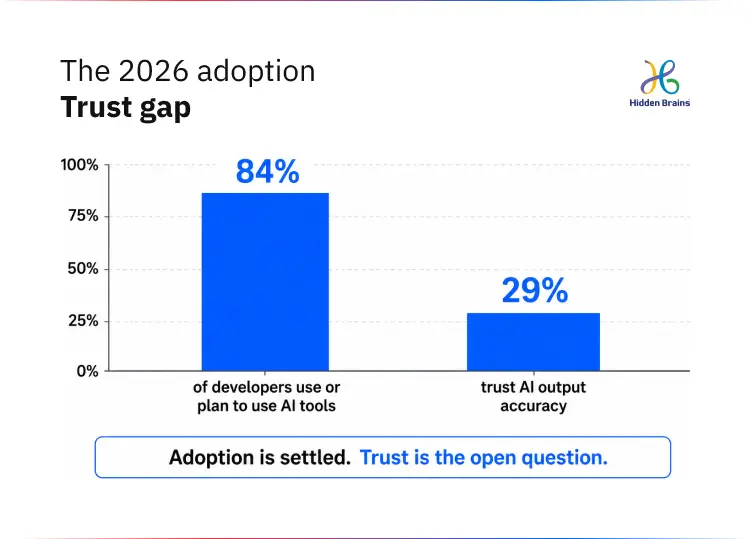
The big shift in 2026 is that AI is now used across the whole delivery process, yet trust in what it produces is falling. In the Stack Overflow 2025 Developer Survey, 84% of developers said they use or plan to use AI tools, up from 76% the year before. But only 29% trust the accuracy of what those tools produce, down from 40%. More developers actively distrust AI output (46%) than trust it (33%), and two-thirds say they spend more time fixing “almost-right” generated code.
This is not a reason to slow down. It is a reason to set rules. AI can help your team do more, drafting components, writing tests, explaining old code, speeding up modernization. What it cannot do is check its own work, protect customer data, or judge licensing and dependency risk. That part is still your team’s job.
AI is also moving inside the product, not just the tools — think semantic search, document extraction, copilots, and smart routing. That adds a new full-stack job: the frontend has to make the AI’s behaviour clear to users, while the backend needs retrieval, model orchestration, permissions, audit logs, testing, fallbacks, and cost controls.
What to do: Write down an AI engineering policy before you scale usage. Cover approved tools, rules for handling source code and customer data, required human review, test and security-scanning gates, and a way to measure real productivity, not just how many people turned the tool on. Treat any AI product feature like any other capability: define the user task it improves, an acceptable error rate, a human-escalation path, and a cost limit per completed workflow before you pick a model.
Trend 2 – The Stack Settles Around TypeScript and Shared Contracts
JavaScript-first teams are increasingly standardizing around TypeScript across the frontend and backend. React and Node.js remain widely used, while frameworks such as Next.js are bringing more frontend and backend capabilities together.
This keeps the basic idea behind the MERN stack relevant: React on the frontend, Node.js and Express on the backend, and JavaScript/TypeScript across the stack, but modern teams are no longer choosing a stack simply because it is called “MERN.” They are choosing the pieces that fit their product, team, data, and architecture.
The bigger pattern is consolidation: fewer, better-supported stacks instead of every team picking its own.
Common 2026 Stack Directions :
– Frontend — React, Next.js, Angular, Vue. Faster delivery of responsive, component-based UIs.
– Backend / API — Node.js, Express, NestJS; Java/Spring; .NET; Python/FastAPI. Choice should follow domain, scale, hiring pool, and existing systems.
– Shared contracts — TypeScript types, OpenAPI, GraphQL schemas. Fewer frontend/backend integration defects.
– Data access — ORM/query layers, managed databases. Faster iteration, though data-model design still decides scale.
FastAPI has gained real traction as Python grows across AI and data work, but it does not replace Node, Java, Go, or .NET everywhere. It shines when your product APIs sit close to Python-based data or AI services.
What to do: Support a small number of stacks and publish a “golden path”, one approved frontend framework, one API standard, one login method, one observability library, a CI/CD template, and default security checks. Let teams go off that path only with a clear, written reason.
Align Your Team With Your Roadmap
Hire Developers
Trend 3 – Architecture Becomes a Deliberate Choice, Not a Trend
In 2026, the smart move is to choose how complex your architecture is on purpose, and to walk it back when it isn’t paying off. Amazon’s Prime Video team is the clearest example. Its video-quality tool hit scaling limits and rising costs as a distributed, serverless design, so the team pulled that piece back into a single application and cut infrastructure costs by about 90%.
One thing to keep in mind: This was one component, not proof that microservices are bad. The rest of Prime Video still runs distributed where that makes sense.
Serverless functions and managed containers are still great for event-driven and spiky work, APIs with changing load, scheduled jobs, background processing, notifications, and integrations. Edge computing takes that further by running some logic closer to users for lower latency. But both come with trade-offs: cold starts, execution limits, vendor lock-in, harder debugging, and costs that can jump under heavy traffic.
What to do: Start new, uncertain products as a modular monolith (one application, cleanly divided inside). Break out a separate service only when there’s a clear reason: it needs to scale on its own, it has its own compliance rules, a separate team owns it, or it changes on its own schedule. Use serverless for spiky, event-driven work and edge for latency-sensitive public features. Don’t force long-running, stateful processes into serverless just because it’s trendy.
Trend 4 – The Platform and Security Become Your Operating Model
Platform engineering is the most strategic full-stack trend of 2026 because it turns repeated setup work into reusable “paved roads” your teams can just follow. Gartner expects that by 2026, 80% of large software engineering organizations will have platform teams providing shared services, components, and tools, up from 45% in 2022. The payoff is a better developer experience, more consistent delivery, fewer security gaps, faster onboarding, and less wasted cloud spend.
One honest caveat: Having a platform team doesn’t guarantee results. It only helps if the paved road is genuinely easier than going around it.
Security has moved the same way, out of a final testing step and into everyday work. Teams now run dependency scanning, code scanning, secret detection, infrastructure scanning, software bills of materials, and policy-as-code earlier in development. This matters more each year as apps lean on open-source packages, third-party APIs, and AI-generated code. AI tools add a new risk area too, so you need control over what a tool can see, what it can change, and how its output gets checked.
Observability ties it together. Modern products need visibility across the whole customer journey, browser speed, frontend errors, API latency, database health, background jobs, and third-party services, linked so you can trace an incident straight to its impact on users or revenue.
What to do: Start the platform small. Build a template for creating a new service that already includes branch-protection rules, a CI/CD pipeline, infrastructure-as-code, secrets management, login patterns, logging/metrics/tracing, and dependency and security scanning. Make secure defaults non-negotiable: MFA, least-privilege access, secret vaults instead of hard-coded passwords, and security checks sized to each app’s risk. Track your most important business journeys, not just your servers.
Trend 5 – The Product is Judged as One System
Users see the full stack as one product, so 2026 pushes leaders to manage it as one. Four connected shifts sit under this:
– API-first, composable apps. Companies increasingly build products by combining their own capabilities with outside services: payments, identity, maps, messaging, analytics, ERP, AI models. The job becomes keeping interfaces stable, managing versions, securing integrations, failing gracefully, and stopping any one outside service from becoming a hidden single point of failure.
– Performance as a product metric. Slow pages, oversized JavaScript, unoptimized databases, and heavy third-party scripts all hurt conversion and retention. Performance work now covers rendering, caching, CDN/edge delivery, API design, database queries, and real-user monitoring.
– Mobile-first and cross-platform delivery. Users expect a consistent experience across web, mobile web, and native apps. Progressive web apps and cross-platform frameworks cut duplication when you don’t need deep native features.
– Incremental legacy modernization. Most companies can’t replace everything at once, and not everything needs modernization or replacement. Instead, they take a step-by-step approach: adding APIs to existing systems, modernizing the UI ahead of the backend, migrating pieces gradually, and replacing or extracting individual services where it makes sense, rather than risking a full rewrite.
What to do: Set API rules early, clear ownership, versioning, rate limits, login standards, error conventions, documentation, monitoring, and a plan for retiring old versions. Build fallbacks for important third-party failures. Add performance budgets to your product requirements (page weight, load-speed targets, API latency, mobile startup time). Choose native, cross-platform, or responsive web based on what users need, not what’s easiest to build. And modernize by business risk: start with the systems that block revenue, create security holes, or slow down experiments, not just the oldest code.
Is MERN Stack an Ideal Fit for Full-Stack Development in 2026?
Yes, for JavaScript-first product teams, MERN (MongoDB, Express, React, Node.js) is still a strong choice in 2026, mainly because its two core parts sit right at the top of real usage data. Node.js and React are the most-used web frameworks in the Stack Overflow 2025 survey. That means a large pool of easy-to-hire MERN developers and a mature ecosystem, including newer patterns like React Server Components and TypeScript-first setups that answer MERN’s older performance and maintainability complaints.
MERN fits best when you want one language across the whole stack, quick iteration on interactive or real-time screens, and a team that can move easily between frontend and API work. It’s less obviously the right pick when your product is mostly heavy AI or data work (where a Python/FastAPI backend may suit better), or when your data is strongly relational and needs a different data layer.
MERN is a strong choice for SaaS products, web applications, dashboards, e-commerce platforms, and real-time applications where fast development and interactive experiences matter.
If this is the right direction and capacity is the challenge, hire dedicated developers or extend your existing team with experienced experts.
How to bring full-stack development trends into your 2026 roadmap
You don’t adopt all of these trends at once; you sequence them by which one unblocks your product fastest, then decide how to resource each. The trap is treating a trend list as a shopping list. The better approach is to score each theme against a problem you already have, standardize before you scale, and only then add capacity.
Start by sorting the five themes into “act now,” “pilot,” or “watch” for your specific product:
- AI in the workflow → Govern it before you scale it. Start by shipping an AI usage policy and measuring real productivity, not tool adoption.
- Stack consolidation → Standardize a golden path. Start by picking one frontend framework, one API standard, one auth method.
- Deliberate architecture → Default to a modular monolith. Start by writing down your criteria for when to split out a service.
- Platform + security → Build your first paved road. Start with one service template that has CI/CD and security checks built in.
- One-system product view → Instrument your top journey. Start by adding performance budgets and end-to-end monitoring to the flow that drives revenue.
Once you know what to adopt, decide how to resource it: build, buy, or bring in a team. Build in-house when the capability is permanent and central to your product. Bring in outside help when a skill is needed now but not forever, or when delivery is blocked by capacity rather than by unclear ownership — hiring won’t fix a process problem. Cost is usually the next question, and it varies widely by seniority, location, and engagement model; our guide to the cost of hiring a MEAN stack team breaks down the main drivers.
When the answer is to add accountable capability fast, a dedicated development team that plugs into your delivery setup, rather than a loose group of contractors, protects knowledge and keeps governance intact.
For JavaScript-first products, that usually means experienced hire full-stack developers comfortable across React and Node.js, or a focused team of MERN stack developers to run the build end to end. And when it makes more sense to hand off the whole thing, our custom software development services cover architecture, delivery, and support.
Frequently Asked Questions
Is investing in the MERN stack still a safe bet for our business in 2026?
Yes. React and Node.js remain the most-used web frameworks in the Stack Overflow 2025 Developer Survey, which means a deep, competitively priced talent pool and low hiring risk, you won’t be locked into a niche skill set. MERN is a strong, low-risk default for interactive, JavaScript-first products, though AI- or data-heavy products may get better value from a Python/FastAPI backend.
How do these full-stack trends affect our time-to-market and cost?
Directly. Standardizing your stack, using AI with proper review, and giving teams reusable “paved roads” all cut the time between an idea and a shipped feature, while reducing rework, security incidents, and wasted cloud spend. The trends that don’t fit your product, adopted for their own sake, do the opposite: they add complexity and cost with no business return.
Will AI coding tools reduce our development costs?
They can, but the savings depend on how they are used. AI coding tools can speed up development, automate repetitive work, and help teams work through complex code faster. The key is to set clear guidelines, require human review, and measure actual delivery outcomes. Without the right guardrails, AI can create rework and security risks instead of reducing costs.
Should we build an in-house team or bring in a dedicated one?
Build in-house for capabilities that are permanent and central to your product, so the knowledge stays with you. Bring in a dedicated team when a skill is needed now but not forever, or when delivery is blocked by capacity rather than unclear direction; that’s faster and lower-commitment than permanent headcount. If the constraint is process or ownership, fix that first; more people won’t solve it.
How do we avoid over-engineering and wasted cloud spend?
Choose architectural complexity on purpose. More microservices do not automatically mean a better or more scalable system. Start new products with a simple architecture, such as a modular monolith, and split out services only when there is a clear business or technical reason. Use serverless for genuinely bursty, event-driven workloads rather than applying it everywhere.
If we can’t do everything in 2026, what should we prioritize first?
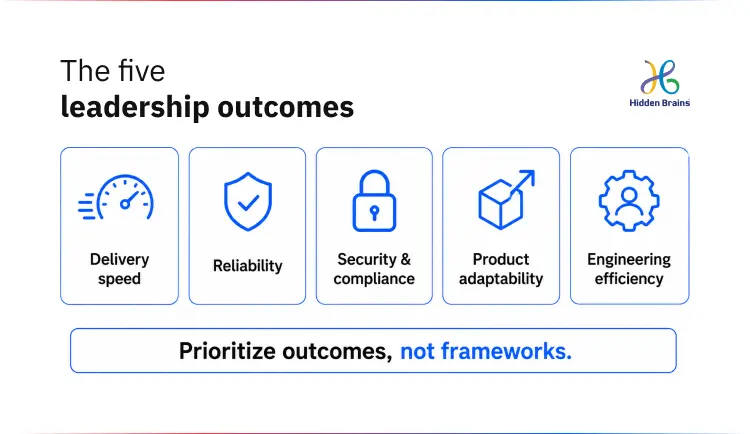
Prioritize by business outcome, not by trend popularity: delivery speed, reliability, security and compliance, product adaptability, and engineering efficiency. In practice, that usually means standardizing your stack, governing AI use, standing up a lightweight internal platform, and monitoring your highest-revenue product journey before chasing anything newer.
Conclusion
Full stack development in 2026 isn’t won by adopting the newest framework; it’s won by the business decisions behind each trend. Every shift in this playbook comes down to the same question for a leader: does this help us ship useful product faster, more safely, and at a cost we can defend? AI in the workflow only pays off with governance around it. A consolidated stack only pays off when teams actually follow the golden path. A platform only pays off when the paved road is easier than the workaround. The technology is the easy part; the operating discipline is the advantage.
Treat full-stack development as a business capability, not a tooling checklist. Pick the two or three trends that can make the biggest difference to your product this year, standardize before you scale, add guardrails before you accelerate, and resource each capability deliberately, building what is core and bringing in additional expertise where you need it.
The goal isn’t simply to keep up with 2026’s trends. It’s to turn the right ones into faster releases, lower risk, and a product that can adapt as the market moves. If you need help turning those priorities into an execution plan, a FREE consultation with the right development partner can be a useful place to start.
