






















































































































































Quick Summary
- The cheapest quote can end up being the most expensive once hidden costs like hiring, onboarding, governance, compliance, and rework are factored in.
- This guide breaks down what software development really costs in the UK in 2026 by comparing in-house teams and outsourcing across different project scenarios.
- It also explains how factors such as IR35, UK GDPR, IP ownership, and delivery models impact your overall investment—not just the upfront price.
- By the end, you’ll have a clearer understanding of which software development approach best aligns with your budget, timeline, project complexity, and long-term business goals.
| Details | Information |
|---|---|
| Guide Focus | Compare the real cost of in-house, outsourced, and hybrid software development in the UK, beyond salaries and day rates, to make better investment decisions in 2026. |
| Target Audience | Enterprise leaders, CIOs, CTOs, Finance & Procurement Teams, Product Leaders, and founders evaluating software delivery models. |
| TL;DR | Software costs aren’t defined by developer rates alone. Recruitment, governance, compliance, IR35, DUAA 2025, UK GDPR, IP ownership, and engineering maturity all influence your total investment. |
| Main Takeaways | Learn when in-house becomes cost-effective, where outsourcing delivers the highest ROI, how hybrid teams balance control and flexibility, and which hidden costs impact project budgets the most. |
| Recommended For | UK businesses deciding whether to hire developers, outsource software projects, or build hybrid engineering teams for strategic growth. |
If you’re budgeting a software project in the UK in 2026, the honest answer is: it depends less on the day rate you’re quoted, and more on which delivery model fits your project’s IP sensitivity, spec maturity, and regulatory exposure. This guide breaks down real cost ranges for in-house and outsourced development, plus the 2026-specific factors, IR35 threshold changes and the Data (Use and Access) Act 2025 that change the arithmetic.
How Much Does an In-House Developer Actually Cost in the UK?
An in-house UK developer costs significantly more than the advertised salary once you load in employer National Insurance contributions, pension contributions, benefits, recruitment fees, equipment, and office overhead. As a rule of thumb, the fully loaded cost of a permanent hire typically runs 30–50% above base salary. For a mid-to-senior developer, that loaded figure commonly lands well into six figures annually in London, somewhat lower outside the capital.
The in-house model gives you the tightest oversight and cultural alignment, and it’s the only model that builds long-term institutional knowledge inside your organisation. The trade-off is time and rigidity: recruiting a single senior UK engineer can take 8–12 weeks, and once hired, you carry that cost whether or not the workload is continuous.
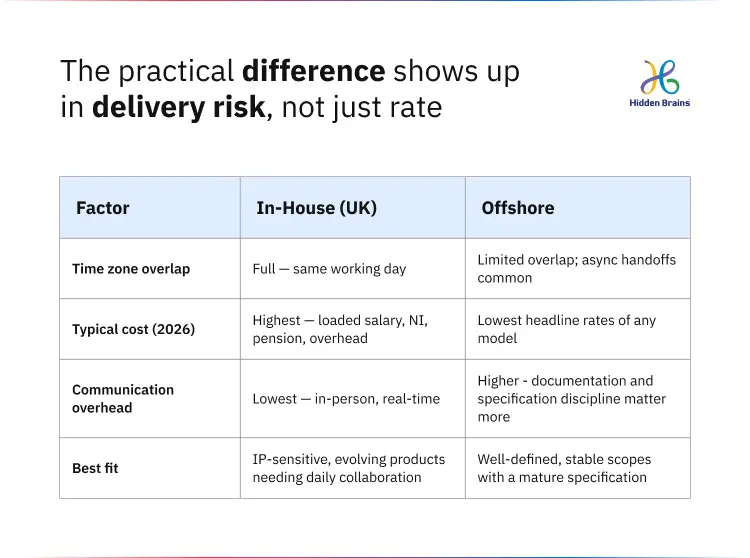
What’s the Real Difference Between In-House and Offshore Development?
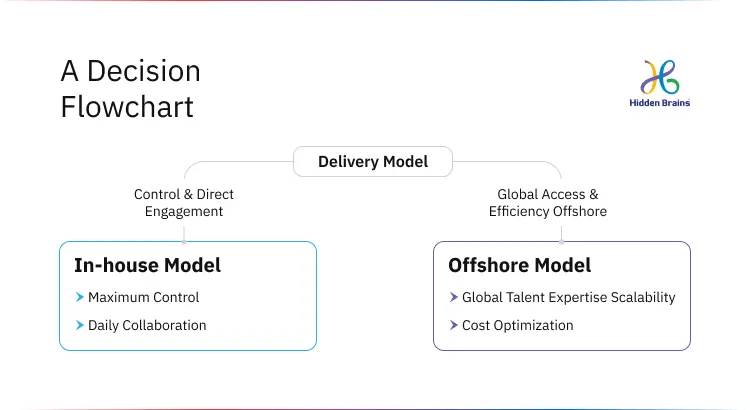
In-house means employing developers directly on your payroll, working alongside your product, design, and compliance teams day to day. Offshore means engaging a team in a distant time zone, most commonly in South or Southeast Asia, to extend your delivery capacity. The primary value of offshore isn’t just the lower rate; it’s access to larger talent pools, niche technical specialisms, and experienced teams in domains where local UK hiring is slow or expensive.
Effective offshore engagements depend on strong governance, clear communication frameworks, and a well-documented specification; without these, the coordination overhead can quietly erode the headline saving.
A Pattern Worth Internalising
Offshore delivery can be highly cost-effective, but the savings come from matching the right talent model to the complexity of the work, not simply choosing the lowest-cost location. Access to experienced engineers and flexible engagement models reduces coordination overhead and avoids unnecessary rework. This is why choosing a trusted software development company for UK businesses is often more important than choosing the cheapest offshore destination, especially for projects that demand long-term collaboration and consistent delivery.
What Does Outsourcing Actually Deliver Beyond Cost Savings?
Outsourcing means engaging an external team, an agency, a contractor, or an international delivery partner, rather than building headcount internally. While cost efficiency is the most visible advantage, the more durable value is access: to specialist skills that are scarce or slow to hire locally, to larger engineering benches that can flex up or down, and to teams that have already solved similar problems in your domain.
The trade-off is governance. Outsourcing shifts risk from “can I find and retain this skill” to “can I specify, oversee, and integrate this team effectively.” Strong communication frameworks, clear documentation standards, and a partner with a mature delivery process matter more to the outcome than the headline rate.
Looking For Secure, Compliant, And Scalable Development Support?
Let’s Talk
Is It Cheaper to Outsource Software Development in the UK?
Custom software development is not just about reducing costs; it’s about accessing the right expertise, accelerating delivery, and minimizing long-term project risk.
| Model | Relative Cost vs. UK In-house | Key Hidden Costs to Budget For |
|---|---|---|
| In-house UK | Baseline (100%) | Recruitment, NI, pension, benefits, office overhead, notice periods |
| UK contractor | Comparable to slightly below in-house, no NI/pension | IR35 status determination; no continuity beyond the contract |
| Outsourced (agency/international team) | Typically 40–70% below UK in-house cost, depending on model and location | Partner selection, communication processes, and knowledge transfer |
The consistent finding across current market analysis: an outsourced quote that looks 50–70% cheaper on paper frequently nets closer to 10–25% cheaper once management overhead, rework, and specification gaps are priced in. The gap between headline rate and effective project cost is the single most common budgeting mistake UK businesses make.
How Does IR35 (2026) Affect Your Outsourcing Decision?
If you’re engaging contractors through personal service companies rather than an agency or a directly-employed team, IR35 status determination affects who carries the compliance risk. From 6 April 2026, the “small company” thresholds under the Companies Act rose, turnover from £10.2m to £15m, and balance sheet total from £5.1m to £7.5m, with the 50-employee headcount test unchanged. A company now needs to meet only two of these three tests to qualify as small.
This matters because small companies are exempt from issuing a Status Determination Statement — that responsibility, and the associated tax risk, falls to the contractor instead. HMRC estimates around 14,000 previously medium-sized companies will reclassify as small under the new thresholds, though because company size is assessed against the prior financial year, most affected businesses won’t feel the practical change until the 2027/28 tax year at the earliest.
If you engage UK contractors directly, it’s worth confirming your company’s size classification and communicating it clearly to any contractors you work with.
What to Check on UK GDPR, and IP Ownership Before You Outsource
UK GDPR compliance and intellectual property ownership are two critical areas to clarify before engaging an outsourced development partner. Ensure your provider has appropriate data protection processes, access controls, security practices, and contractual safeguards in place to protect sensitive business information. At the same time, clearly define ownership of source code, documentation, designs, and all project deliverables to avoid disputes later in the engagement.
When outsourcing software development, evaluate how your partner manages personal data, including data access controls, processing responsibilities, and international data transfers where applicable. These considerations should be addressed during vendor selection, not treated as a final compliance check.
Beyond data protection, two contractual areas require careful attention:
- IP assignment clarity — Your contract should state explicitly, in the present tense, that IP created under the engagement transfers to you on payment, not on some future condition.
- Security certification — ISO 27001 or SOC 2 certification from your partner is a reasonable baseline to ask for, particularly where sensitive data is involved.
For a deeper walkthrough of UK compliance obligations specifically, see our GDPR compliance strategies guide.
What’s the Total Cost of Each Engagement Model — Beyond the Day Rate?
The most important cost drivers are often the ones that never appear on a proposal:
- Ramp-up time — From a few weeks for a small outsourced team to join your codebase to 3–6 months for a larger delivery centre to reach full productivity.
- Management overhead — Coordination, documentation, quality assurance, and governance all require time beyond the development itself.
- Engagement structure — Hourly or part-time specialists suit short-term needs; dedicated full-time teams deliver more continuity for long-term products.
- Transition costs — Knowledge transfer and vendor handover are rarely priced upfront but become real if the relationship ends.
- Engineering maturity — Strong delivery processes, code review discipline, and QA standards reduce defects and lower long-term rework costs; a cheaper partner without process discipline often costs more once rework is counted.
These factors are rarely visible on a rate card, but they directly impact the real cost and success of a project over time. The right custom software development services in the UK provide greater cost visibility, transparent processes, compliance-focused delivery, and flexible engagement models. This enables businesses to make informed decisions, maintain control over their investment, and achieve long-term value from their software development projects.
When Does In-House Make More Sense Than Outsourcing?
In-house delivery earns its higher cost when:
- You need two or more developers continuously for 18 months or longer on a single core product — at this point, the loaded cost of employment starts to compare favourably against sustained contractor or agency rates.
- The software is a long-lived strategic asset, not a defined project with an end date.
- You’re handling highly sensitive IP or require daily, in-person cross-functional collaboration with product, design, and compliance teams.
- Your regulatory exposure is significant (e.g., FCA, NHS), and control over who touches the code and data is a compliance requirement, not a preference.
Below that threshold, for a single developer, a defined project, or a product still finding its spec, outsourcing is very often the more capital-efficient choice.
Decision Framework: In-House or Outsourced?
| If Your Situation Is… | The Model That Typically Fits Best |
|---|---|
| Need specialist skills quickly without a long hiring cycle | Outsource — access to experienced engineers and domain expertise without building internal overhead. |
| One developer, a well-defined project, cost-sensitive | Outsource — efficient for focused delivery with predictable scope. |
| Complex, evolving product needing frequent iteration | Outsource with strong governance — faster access to senior specialists, provided communication frameworks are solid. |
| Need to scale engineering capacity quickly for a strategic initiative | Outsource — add dedicated teams and niche skills without permanent hiring commitments. |
| 2+ developers, 18+ months, core strategic product | In-house — stronger ownership makes sense once technology is a long-term business capability. |
| Need architecture control but flexible execution capacity | Hybrid — internal ownership of architecture, outsourced capacity for execution. |
If you’re weighing these trade-offs for a specific project, our team can walk through the arithmetic against your actual scope — see our custom software development services in the UK for how we structure hybrid and nearshore engagements.
Key Takeaways
- Build in-house when product ownership, domain expertise, and long-term innovation are strategic priorities.
- Outsource selectively to accelerate delivery, access niche capabilities, and optimize costs.
- Adopt a hybrid model to retain strategic control while scaling execution efficiently.

Still Evaluating Your Options? Get Expert Guidance.
Get a Free ConsultationHow We Can Help
Hidden Brains delivers UK software development under a CMMI Level 3-appraised process, with flexible engagement models spanning dedicated outsourced teams, staff augmentation, and hybrid delivery where our engineers work alongside your in-house architecture and product teams. Whether you need hourly, part-time, or full-time developers, we assemble teams with the right technical expertise, domain knowledge, and industry experience for your project. From governance and security to scalability, transparent communication, and long-term delivery support, we provide the flexibility to scale with your business while maintaining quality and control throughout the software development lifecycle.
Frequently Asked Questions
How much can UK businesses save by outsourcing software development?
Many companies save between 40–70% compared to maintaining an in-house development team. Actual savings vary based on the outsourcing model, project scope, and management requirements.
What is the total cost of outsourcing compared to hiring in-house?
Total cost extends well beyond salaries or hourly rates — it includes recruitment, onboarding, infrastructure, benefits, retention, and management overhead. Outsourcing converts many of these fixed costs into variable operating expenses, but the comparison only holds if you evaluate the total cost of ownership rather than day rates alone.
How can I get an industry-specific outsourced team or developer?
Start by defining the domain expertise your project needs — healthcare, fintech, logistics, retail — alongside the technical skills required, and look for a partner able to assemble a team against both.
What’s the best outsourcing model for a long-term product?
There’s rarely a single best model. Products that evolve continuously often benefit from a hybrid approach: internal teams retain product ownership and architectural direction, while an outsourced team provides scalable delivery capacity.
What engagement models are available for software development projects?
Common structures include dedicated development teams, fixed-price projects, time and materials, and staff augmentation. The right choice depends on requirement maturity, expected rate of change, and internal governance capacity.
How do I protect my intellectual property when outsourcing?
Build IP protection into the engagement from the outset — evaluate partners on security governance, access controls, code ownership terms, and compliance with standards such as ISO/IEC 27001 and UK GDPR, with a contract that states IP transfer in the present tense.
Does IR35 affect software development contractors?
Yes, if you engage individuals through personal service companies rather than an agency or outsourced team. From April 2026, revised small-company thresholds shift Status Determination Statement responsibility to the contractor for newly reclassified small companies, though most won’t see the practical change until the 2027/28 tax year.



Conclusion
There’s no universally “cheaper” model, only the model that matches your project’s duration, complexity, and risk profile. In-house wins on control and long-term ownership once you’re sustaining two or more developers on a core product; outsourcing wins on speed, specialist access, and cost efficiency for defined-scope work, provided you budget for the real total cost of ownership, not just the day rate. For most UK businesses in 2026, the practical answer is to start with the decision framework above, price out total cost rather than headline rate, and build in the IR35 and DUAA compliance checks from day one, not as an afterthought once a contract is signed.