





















































































Summary
Choosing the right AI model in 2026 is a business decision, not a tech experiment. This blog breaks down RAG vs LLMs in simple terms, when to use each, when to combine them, and why hybrid AI is winning at scale. Learn how leading enterprises reduce hallucinations, control costs, and stay accurate while growing fast. If you’re building AI for the long run, this guide shows you how to choose smart and scale with confidence.
Why the RAG vs LLMs Choice Matters in 2026?
Startups are pausing on LLM-first strategies. And for good reason. AI has moved past experiments. It’s now a business decision.
In 2025, the global enterprise LLM market is valued at $6.5 billion. By 2034, it’s expected to hit $49.8 billion. That’s rapid growth. But also rising pressure. Costs are harder to predict. Compliance is no longer optional. Customers expect accurate answers every time.
This is why the RAG vs LLM debate matters more in 2026. IDC predicts that by 2026, 90% of enterprise AI use cases will shift toward smaller language models. Why? Lower costs. Better performance. Easier deployment. Many of these systems rely on RAG to stay grounded in real data.
So, is AI still a competitive edge? Not really. In 2026, AI is table stakes. Choosing the right custom AI solution is what sets you apart.
Quick Reset: What Are LLMs and RAG?
Let’s strip this down.
An LLM is trained to predict the next best word. That’s it. It learns patterns from massive public and licensed data. When you ask a question, it doesn’t “look up” answers. It generates them based on probability.
That works well. Until accuracy really matters.
This is where RAG steps in. Retrieval-augmented Generation doesn’t replace the LLM. It guides it. Before the model responds, it pulls verified information from your own data sources: documents, databases, and knowledge bases. Then it generates an answer grounded in that data.
So what’s the real difference in the RAG vs LLM conversation? LLMs rely on what they already know. RAG systems rely on what’s actually true right now. Confusion usually starts at the leadership level when AI is treated as a single model choice. In reality, it’s a system design decision.
Ready to Build Scalable AI?
Talk to Our AI Experts
The First Question Executives Ask: What Problem Are We Solving?
This is where most AI decisions should start. Not with models. With outcomes.
Are We Answering, Generating, or Deciding?
If you’re answering questions, accuracy matters a lot. If you’re generating content, speed and creativity matter more. If you’re supporting decisions, trust becomes non-negotiable. Different problems need different AI setups. One model won’t fit all three.
What Kind of Data are We Working with?
Is your data mostly static? Or does it change every week, day, or hour? LLMs work best with general, stable knowledge. RAG shines when data is internal, proprietary, or constantly evolving.
What’s the Real Cost of Hallucinations?
For some teams, a wrong answer is annoying. For others, it’s a compliance issue. Or a lost deal. Or legal risk.
This is the core of the RAG vs LLM decision. Not capability. Risk tolerance.
RAG vs LLMs- Key Comparison with Stats
This is usually where the conversation gets real.
Less hype. More trade-offs.
If accuracy is critical, hallucinations aren’t a “model issue.” They’re a business risk.
RAG systems can reduce hallucinations by 42–68%, and in some real-world setups, reach up to 89% accuracy for fact-based answers. That’s because RAG doesn’t guess. It retrieves. Then responds.
Cost is the next pressure point. Fine-tuning LLMs on proprietary data is expensive and ongoing. RAG avoids retraining altogether. You scale by updating data, not models.
Now think about growth. More users. More data. More compliance checks. RAG is modular. You plug in new sources without breaking the system. Standalone LLMs struggle here.
That’s why many enterprises now lean toward RAG in the RAG vs LLM decision.
| Feature | Retrieval-Augmented Generation (RAG) | LLM Fine-Tuning |
|---|---|---|
| Main Goal | Delivers real-time, factual answers using your own data. | Teaches the model a new skill, style, or behavior. |
| Always current. Pulls from live and updated data sources. | Static. Knowledge is locked at the time of training. | Static. Knowledge is locked at the time of training. |
| Accuracy | High. Answers are grounded in your documents, reducing hallucinations. | Variable. Accurate for trained tasks, but still prone to making things up. |
| Hallucination Risk | Low. Retrieval keeps responses tied to verified sources. | Higher. Relies on learned patterns, not live facts. |
| Cost Efficiency | Cost-effective at scale. No retraining required. | Expensive. Requires repeated training and high computing costs. |
| Setup & Time to Value | Fast to deploy. Connects directly to existing data. | Slow. Needs large, clean datasets and long training cycles. |
| Scalability | High. Easily scales with new data and users. | Limited. Scaling often means retraining. |
| Flexibility | High. New knowledge sources can be added anytime. | Low. Changes require retraining the model. |
| Transparency & Auditability | High. You can trace answers back to source documents. | Low. Black-box behavior with limited explainability. |
| Security & Compliance | Strong fit for regulated industries and internal data use. | Riskier if not tightly controlled. |
| Best For | Customer support, internal Q&A, knowledge-heavy workflows. | Brand voice adaptation, structured outputs, specialized reasoning. |
| Ideal Business Stage | Scaling teams and enterprise-ready products. | Mature products with stable, narrow use cases. |
RAG vs LLM Fine-tuning: When to Choose What for Your Business?
This is the moment where theory stops helping. And decisions start costing real money. The RAG vs LLM choice isn’t about which model is “better.” It’s about which one fits how your business actually operates today and how it plans to scale. Let’s break it down.
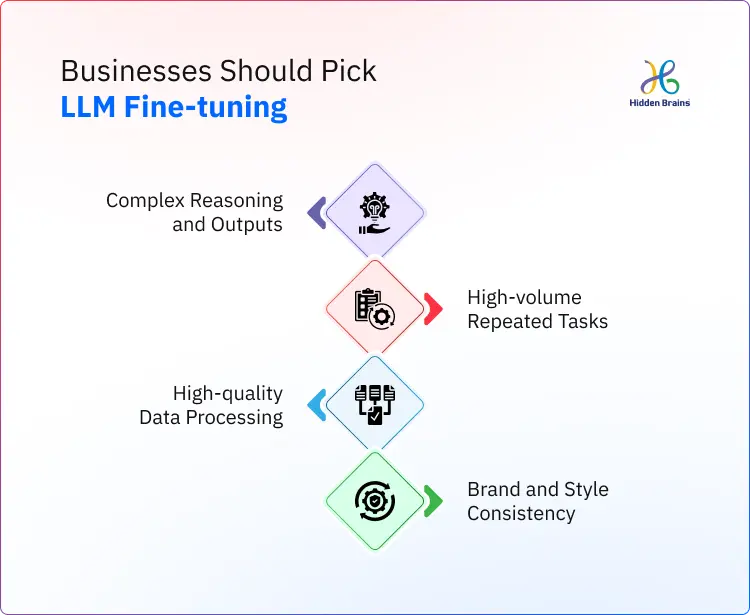
You Must Choose LLM Fine-tuning When…
LLM fine-tuning makes sense when behavior matters more than fresh knowledge.
Complex Reasoning and Structured Outputs
If your product needs multi-step logic, consistent reasoning paths, or strict output formats, fine-tuning helps. Think legal document drafting, or complex workflow automation. Here, how the model thinks is more important than what it knows.
Repeated, Narrow, High-volume Tasks
When the same task runs thousands of times with little variation, fine-tuning shines.
Examples include:
- Classification
- Sentiment scoring
- Data normalization
- Form extraction
Once trained, the model performs predictably and quickly.
Static and High-quality Data Processing
If your data rarely changes and is already clean, fine-tuning is efficient. No need for live retrieval. No need for frequent updates. It works well in mature products with stable rules and datasets.
Brand Voice and Style Consistency
When tone, phrasing, or personality must stay consistent across every output, fine-tuning is hard to beat. Marketing copy. Product descriptions. Customer-facing messaging. This is where LLMs excel.
Using RAG Is Ideal for Your Business When…
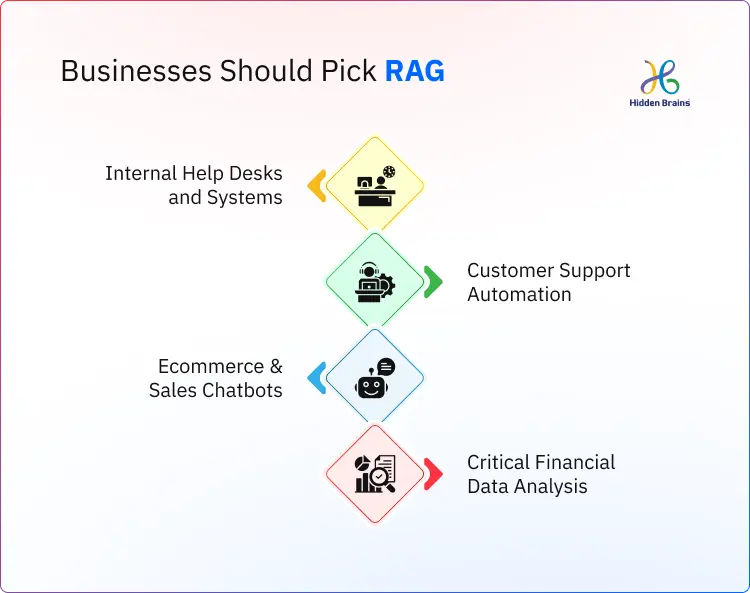
it is built for businesses that deal with change, scale, and risk. Let’s check out the occasions.
Customer Support Automation
Support teams live on dynamic data. Policies change. Products evolve. FAQs grow daily. RAG pulls answers from your latest docs, tickets, and knowledge bases. No guessing. No outdated responses. It alone drives many RAG vs LLM decisions.
Internal Help Desks and Knowledge Systems
Employees don’t need creativity. They need correct answers. Fast. RAG connects Slack, Notion, Confluence, wikis, and databases into one reliable AI layer. And it shows sources when required.
Ecommerce and Sales Chatbots
Pricing updates. Inventory changes. Policy nuances. RAG ensures the chatbot responds using real-time product and policy data. Not assumptions from last year’s training set.
Critical Financial and Operational Analytics
Here, hallucinations aren’t annoying. They’re dangerous. RAG grounds responses in verified reports, dashboards, and databases. That’s why finance, healthcare, and regulated industries lean heavily toward RAG.
Can You Combine RAG and LLMs?
Yes, and the smartest teams don’t just pick one. They combine RAG with LLMs to get both accuracy and intelligence. RAG brings up-to-date facts. LLMs bring deep reasoning and natural language. Together, they make AI useful at scale.
What does a hybrid approach look like?
In practice, hybrid means the system first retrieves relevant facts or documents from your own data. Then an LLM uses that data to generate the answer. This method grounds the model’s responses while keeping them fluent and contextual. It’s not just “AI creative writing”, it’s fact-backed AI that businesses can trust.
When does it make sense to start a hybrid?
Start hybrid when accuracy matters, and your data moves fast.
If you’re building tools for sales, support, compliance, finance, or consulting, and you care about correctness, hybrid gives you the best of both worlds: factual grounding + sophisticated language output.
How mature does your product need to be? You don’t need a finished product, but you should have:
- A data source worth retrieving (documents, CRM records, knowledge bases, tickets), and
- A clear business problem that pure LLMs struggle to solve accurately on their own.
Once you have those, hybridization is not just possible, it’s often the next logical step.
Real-world Hybrid Examples
Linkedin Customer Service
Linkedin built a customer support AI that combines RAG with a knowledge graph. Instead of using unstructured text alone, the system uses structured connections between past support tickets for retrieval. This hybrid setup improved how relevant information is found and cut average per-issue resolution time by about 28-29% in production.
Morgan Stanley Financial Tools
Morgan Stanley’s internal AI suite, including the AI @ Morgan Stanley Assistant, uses OpenAI’s models plus retrieval over the firm’s internal knowledge base to give financial advisors fast, accurate insights. Advisors use it every day to pull up detailed information from vast internal libraries, reducing research time and improving service quality.
datumsAI
Platforms like datums.ai explicitly combine retrieval workflows with advanced LLMs to turn raw business data into accurate, context-aware insights. Their RAG implementation fetches relevant data before generating the AI response, boosting accuracy and relevance in real-time business analytics.
What to Ask Before You Commit to Any AI Model?
Before you lock in a model, pause. This decision will live with your product for years. Especially if you’re moving toward a hybrid RAG + LLM setup.
What data will this touch in 6 months?
Your data won’t stay still. Policies change. Products evolve. New documents appear. Fine-tuning alone struggles here. RAG doesn’t. A hybrid model lets you fine-tune how the system thinks and speaks, while RAG controls what it knows right now. That’s how you stay current without retraining.
Who owns model behavior internally?
When something goes wrong, who fixes it? With fine-tuning, behavior is buried inside the model. With RAG, answers are tied to visible sources. A hybrid gives you shared ownership. Teams tune their behavior once. They update their knowledge continuously. That’s easier to manage across product, data, and compliance teams.
How easy is rollback if something breaks?
It matters more than most teams expect. Pure fine-tuning is hard to undo. Pure RAG can feel limited in tone or reasoning. Hybrid systems are modular. You can swap data sources. Adjust prompts. Roll back changes without taking the whole system down. That flexibility is why scalable teams choose RAG + LLMs. Not because it’s fancy. Because it’s safer.
Why Choose Hidden Brains?
With 22+ years of proven expertise, Hidden Brains helps enterprises move from AI ideas to real-world impact. We design and build future-ready AI solutions from RAG to hybrid LLM systems engineered for scale, security, and performance across industries. Get ready to create AI that actually delivers.
Make Smarter AI Decisions Without Guesswork.
Connect Now!
Frequently Asked Questions
Still weighing your options? These are the most common questions leaders ask when deciding between RAG vs LLMs in real-world AI implementations.
1. Is RAG better than LLM fine-tuning?
Not always. RAG is better for fresh, factual data. Fine-tuning is better for behavior and style. Most scalable systems use both.
2. Can I start with RAG and add fine-tuning later?
Yes. Many teams do. RAG gives fast results. Fine-tuning can follow once patterns are clear.
3. Does RAG eliminate hallucinations?
No. But it significantly reduces them by grounding responses in real data.
4. Is a hybrid RAG + LLM setup expensive?
It’s usually cheaper long-term. You avoid frequent retraining and control API costs better.
5. How do I know my product is ready for hybrid AI?
If accuracy matters and your data changes often, you’re ready.


Conclusion
Choosing between RAG and LLMs isn’t about trends. It’s about fit. In 2026, scalable teams think hybrid. They fine-tune how AI behaves. They control what it knows. Build AI that’s accurate, flexible, and ready to grow with your business.