













































































































































Overview
In today’s manufacturing world, smart factories are essential for efficiency and growth. This blog features insights from seven industry leaders who’ve transformed challenges into innovation. Discover how IoT sensors reduce downtime, AI ensures quality, and cybersecurity protects production lines. Learn practical ways to boost efficiency, cut costs, and enhance output. Whether you’re a manufacturer or tech leader, these expert perspectives show how data, technology, and human-first design power smarter, connected production.
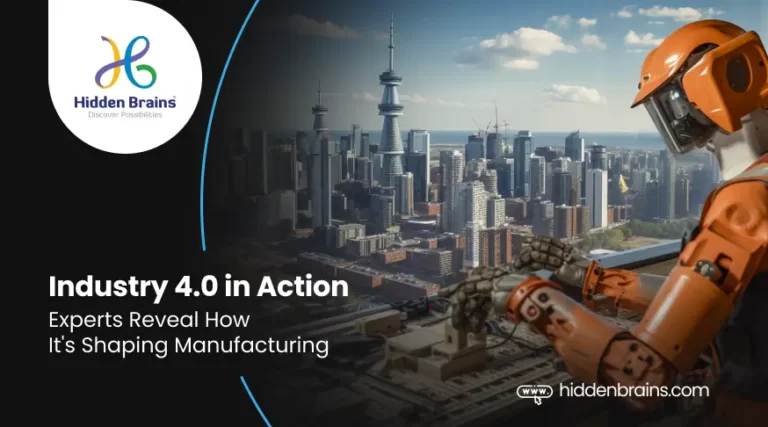
Industry 4.0 solutions are changing manufacturing in big ways. Smart factories are using IoT, AI, and advanced analytics to improve efficiency, reduce costs, and prevent unexpected problems. These changes sound exciting, but implementing them isn’t always simple. Which strategies actually work on the factory floor?
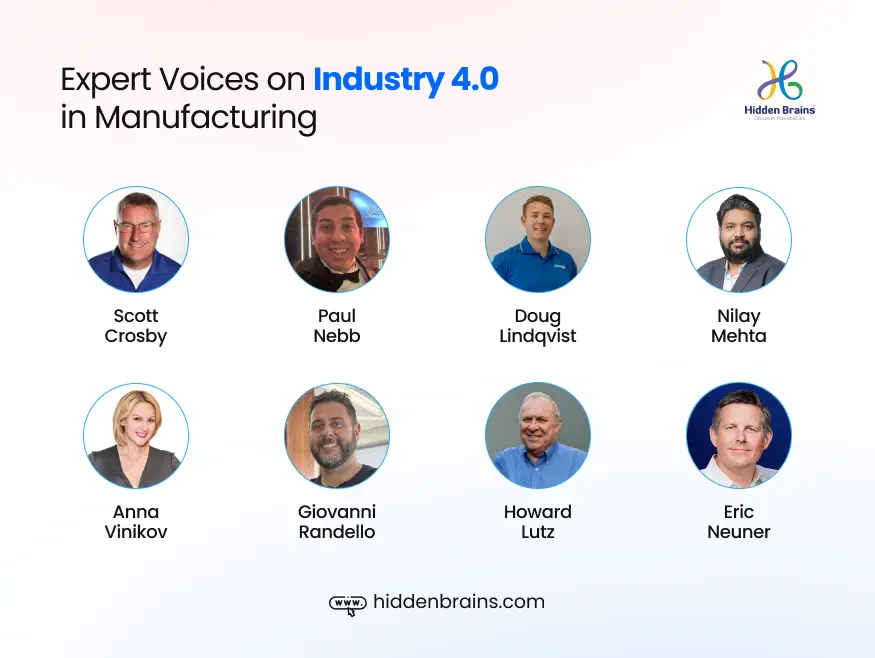
We reached out to 8 experts from various industries. Founders, leaders, and innovators shared their experiences and practical advice. In this blog, you’ll read their honest insights on how Industry 4.0 solutions are shaping the future of smart manufacturing.
Why Talking about Industry 4.0 is Important
Industry 4.0 solution is more than a trend. It’s a shift to connected, data-driven manufacturing. Smart factories can anticipate problems, optimize production, and make faster decisions. Companies that adopt these solutions can cut downtime, save costs, and respond quickly to changing demands.
It also helps with safety, sustainability, and innovation in enterprise software development. Understanding the benefits and knowing where to start is essential. It’s the difference between investing in technology and actually seeing results.
#1 Reducing Downtime with Predictive Maintenance
Scott Crosby, founder of EnCompass, has seen the impact of Industry 4.0 tools firsthand. He believes the combination of IoT sensors and AI analytics can be “transformative” for manufacturers.
Scott explained that by deploying connected sensors to monitor vibration, temperature, and power consumption, the AI system learned normal operating patterns and flagged anomalies weeks in advance. It shifted the company from reactive repairs to planned maintenance.
“Unplanned downtime dropped by 78% in just six months,” he said. Maintenance costs fell by 40%, while productivity soared.
He recommends starting with the most critical equipment first, gathering 30-60 days of baseline data before expanding. “Focus on the machines where unexpected failure hurts production most; that’s where you’ll see ROI fastest,” Scott emphasized.
#2 Treating Cybersecurity as a Production Asset
Paul Nebb, founder of Titan Technologies, emphasizes that in modern manufacturing, cybersecurity is not just protection; it’s a production asset. He recalls a client whose ransomware attack shut down the entire production line for 72 hours, costing $180,000.
Paul explained that the breakthrough came when IT and OT networks were monitored together, creating unified visibility across both environments. This approach caught malware spreading from office systems toward CNC machines before it could cause downtime.
He warns that “your production equipment is now part of your attack surface.” Hackers can exploit IoT sensors and smart machinery to steal IP or disrupt operations.
Paul recommends network segmentation and 24/7 monitoring to adopt Industry 4.0 technologies safely. “Securing the factory floor with the same rigor as financial data doesn’t just prevent attacks, it enables confident digital change,” he said.
#3 Turning Customer Insights into Smart Production
Doug Lindqvist, General Manager at Pinnacle Signage, has transformed manufacturing by starting from customer pain points and working backwards through production. He explained that their biggest bottleneck wasn’t machinery. It was the disconnect between urgent customer orders and production scheduling.
Doug shared that they implemented a real-time visibility system connecting distributors’ urgent requests directly to the printing floor. “When a distributor logs an emergency order for safety signage, our system automatically bumps it to same-day production and updates everyone in the chain,” he said. This cut emergency order fulfillment from 3–5 days to same-day delivery in 67% of cases.
He highlighted that treating distributor networks as sensors in the manufacturing process, not just end points, helped prevent stock outs and predict seasonal demand spikes. Doug advises manufacturers to “connect your external stakeholders’ real-time needs directly to your production decisions,” focusing first on the most time-sensitive product lines. The efficiency gains, he noted, “compound quickly across your entire operation.”
#4 Empowering People for the Age of Smart Manufacturing
Nilay Mehta, Chief Technology Officer at AppsDevPro, brings over 17 years of IT expertise to the forefront of digital transformation. For him, the future of Industry 4.0 isn’t just about machines getting smarter; it’s about people evolving alongside technology.
“Smart factories aren’t truly smart unless their people are,” Nilay said. “You can automate a process, but you still need skilled minds to interpret data, make ethical decisions, and drive innovation.”
Nilay has seen this firsthand while implementing digital solutions for global manufacturers. He emphasized that many companies invest heavily in IoT, AI, and robotics but overlook workforce readiness. “The biggest transformation happens when workers are empowered to work with machines, not against them,” he noted.
Nilay believes human–machine collaboration is the cornerstone of Industry 4.0’s success.
“Technology can amplify human potential,” he concluded. “But to truly build the factory of the future, we must invest as much in people as we do in platforms.”
#5 Using Continuous Data Feedback to Drive Smarter Decisions
Ana Vinikov, Practice Manager at Global Pain & Spine Clinic, has seen firsthand how real-time data integration can completely change efficiency and outcomes in healthcare.
“At our clinic, we connected our InBody weight-loss scanners directly to our patient management platform,” Ana explained. “Now, every 2–4 weeks, body composition changes like fat loss, muscle gain, and hydration are automatically tracked.”
Before this integration, her team spent hours entering scan results manually. “It was tedious,” she admitted. “Now the system instantly generates treatment adjustments, saving us 60% of administrative time. Even better, doctors can spot concerning trends right away.”
Ana’s key insight? “Treat data like a continuous feedback loop, not isolated snapshots.” When a patient’s muscle mass suddenly drops, the system flags it instantly, prompting immediate action.
She believes manufacturers can learn from this approach. “Real-time data integration can catch quality issues before they become expensive problems,” she said. Her advice is simple yet powerful: “Pick one critical metric, automate its collection, and build instant response triggers around it. That’s where transformation begins.”
Data and AI are inseparable. To get most of AI in manufacturing, you need to have data readiness.
#6 Engineering Flexibility: Turning Constraints into Strengths
For Giovanni Randello, founder of GC Jet Ski on the Gold Coast, innovation didn’t start in a boardroom; it began on a farm.
“Growing up fixing tractors and farm gear teaches you something simple,” Giovanni said. “If you wait for things to break before fixing them, you’ve already lost time. Preventive thinking keeps you ahead.”
That same mindset shaped his business. When Giovanni launched GC Jet Ski, he faced a big problem: theft, vandalism, and rigid storage locations that limited where his team could operate.
“We were constantly tied down by our infrastructure,” he recalled.
So he built his own solution, a custom floating pontoon storage system. “It gave us freedom,” Giovanni said. “We could move our entire operation depending on weather, demand, or maintenance needs.” The result? Downtime dropped by 40%, and equipment damage from storage issues disappeared completely.
But the real breakthrough was mental, not mechanical. “We stopped treating our storage as a fixed constraint,” he explained. “Once it became mobile, everything changed: operations, flexibility, even customer experience.”
Now, GC Jet Ski is the only operator on the Gold Coast that can shift locations daily, guaranteeing optimal launch spots no matter the conditions.
Giovanni’s takeaway for manufacturers and entrepreneurs is crystal clear:
“Identify your biggest bottleneck and flip it. Engineer a solution that turns that weakness into your competitive advantage.”
#7 Predictive Maintenance: Turning Data into Trust
For Howard Lutz, founder of Universal Inspections and a former Toyota Service Innovator, decades under the hood taught him one thing — waiting for failures costs more than fixing them early.
“After inspecting over 25,000 vehicles, I saw patterns everywhere,” Howard shared. “Certain transmission issues always appeared around 85,000 miles. Once you know that, you don’t wait, you act.”
At Toyota, Howard implemented a predictive maintenance system that used repair history and mileage data to forecast failures before they happened. “We weren’t guessing,” he said. “We used facts, and that built trust.”
The results were powerful: emergency breakdowns dropped by 40%, customer loyalty grew, and parts inventory finally matched real demand. “When you can show a customer that 73% of vehicles like theirs need a repair soon, they believe you,” he explained.
Howard’s takeaway is simple:
“You don’t always need new tech, just better use of the data you already have.”

#8 Predictive Quality at Scale: How AI Transformed Footwear Returns
For Eric Neuner, founder of NuShoe Inc., innovation began with a simple question, “What if we could spot quality problems before they even reached the factory floor?”
Since 1994, Eric’s company has handled over 1.5 million footwear returns annually for major brands. But the real breakthrough came when they introduced AI-driven quality prediction at the point of cargo arrival.
“We started analyzing shipping data, weather patterns, and decades of defect history,” Eric explained. “Now we can predict which containers will have mold, delamination, or other issues before we open them.”
The results were game-changing: turnaround time dropped from 7 days to 3.5, and one global athletic brand cut returns processing by 60%.
Eric’s approach proves that transformation doesn’t always need expensive new tools:
“Sometimes, your most powerful innovation comes from the data you already own.”
Hidden Brains: Powering the Next Wave of Smart Manufacturing
At Hidden Brains, we’ve spent over 22 years helping manufacturers evolve. Our focus is simple: offer manufacturing software development services that make factories smarter, faster, and more connected.
We offer solutions across the manufacturing spectrum. From predictive maintenance and IoT-driven analytics to AI-based production monitoring and AR-enabled workforce training, we bring real-time visibility to every stage of production.
Our goal is to turn data into decisions. We help businesses reduce downtime, improve quality, and maximize output all without increasing costs.
What sets us apart is our human-first approach to Industry 4.0. solution. We don’t just automate processes. We empower people with tools that make work safer, easier, and more efficient.


Conclusion
The rise of Industry 4.0 solutions is redefining what’s possible in manufacturing: from predictive intelligence to human–machine collaboration. But at its heart, it’s not just about automation; it’s about adaptation. The future belongs to manufacturers who embrace data, agility, and continuous learning.