







































































































Overview
AI adoption is no longer optional; it’s a business necessity. By 2025, over 80% of enterprises will be leveraging AI, and those investing in custom AI solutions are gaining unmatched advantages. Unlike generic off-the-shelf tools, custom AI is built around your business goals, processes, and data: driving efficiency, reducing costs, enhancing customer experiences, and enabling smarter decisions. This guide explores why tailored AI is essential today, what problems it solves, the feasibility of implementation, and the tangible ROI it delivers. From industry use cases to development lifecycles, ethics, costs, and vendor selection, this is your roadmap to future-proofing your business with AI.
In 2024, 42% of large companies (those with 1,000+ employees) already used custom-built AI. By 2025, that number has nearly doubled; 82% of global businesses are using AI or actively exploring making it part of their organization.
So, why the sudden rush?
Businesses realize that generic, off-the-shelf AI tools don’t always cut it; they’re often too broad, too rigid, or not built for the specific challenges a company faces daily.
This is where custom AI solutions make all the difference.
Instead of trying to fit your business into someone else’s mold, custom AI is designed around you, your processes, goals, and data. Whether you’re trying to speed up operations, improve customer service, reduce costs, or make better decisions faster, a tailored solution can do it with far more precision and impact.
Strategic Value: Solving Real Business Problems with Custom AI
What is a Custom AI Solution?
Start by looking at the fundamental aspects. A custom AI solution is made for your business, matches your goals and needs, and helps you solve daily problems.
Think of it like a tailor-made suit. Off-the-rack options fit okay, but custom fits just right and performs better. The flexibility of custom AI solutions enables tech enterprises to earn 3 times the return on investment than generic AI users. Startups can leverage leading AI analytical platforms like datums.ai to make informed decisions and tap into this high-ROI market.
From intelligent chatbots to fraud detection engines to predictive models for supply chain planning, custom AI works best when designed with you in mind.
You can also strengthen brand identity during product launches and campaigns by using an ai logo maker to create consistent visuals that align with your AI-powered services and business goals.
Also read: Smart AI-powered BI solutions that turn complex data into actionable insights.
What Business Problems Can AI Solve?
AI may not be magic, but it can make a practical and measurable difference in nearly all business areas.
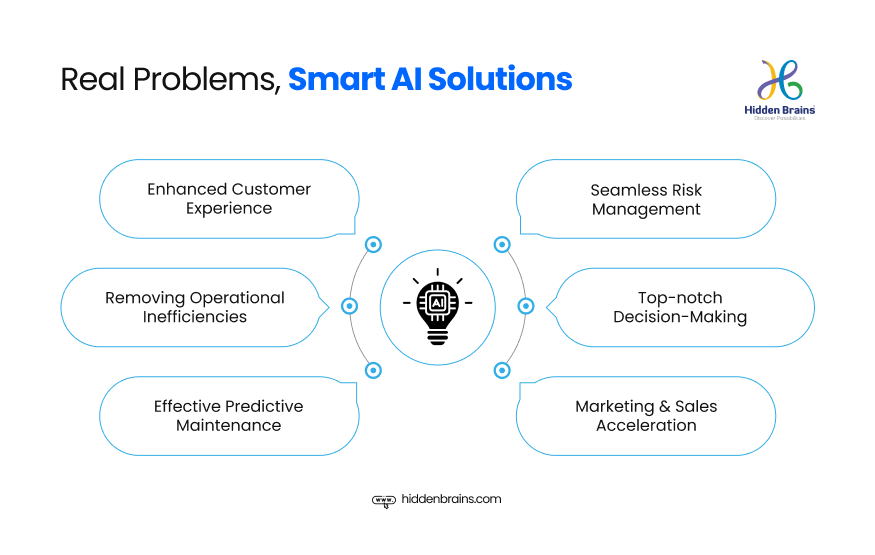
AI is powerful because it can analyze vast amounts of data, find patterns, share insights, and perform tasks quickly than any team of people could. AI solutions designed for a particular enterprise can handle many everyday business challenges. Let’s get into more detail.
Customer Understanding & Experience
Helping businesses grasp what their customers want is one of the main benefits Custom AI offers. Custom AI can look at many customer actions, such as what they browse and buy, to detect trends that people often overlook.
It lets brands accurately target recommendations, content, and offers to each individual. Chatbots and support assistants that help people are often built with AI, which allows them to respond immediately and improve as they go. The result? Making customer interactions smoother raises engagement, satisfaction, and loyal customers.
Operational Inefficiencies
If frequent tasks keep your team stuck on data entry, organizing spreadsheets, or managing email, Custom AI tools can do all these jobs automatically. Working all day doesn’t depress it; it just stays on task. AI might find areas where your work takes a long time and provide time-saving tips. It results in more efficient work, less time wasted, and happier employees.
Predictive Maintenance & Asset Monitoring
Businesses ‘ daily use of equipment or machines can result in significant expenses when breakdowns happen. Custom AI solution lets you check on how your devices are doing and alerts you in advance if an issue is coming up. In this manner, you can solve problems early and avoid losing money from downtime. You can keep your tools in good shape and keep everything working smoothly this way.
Risk Management & Fraud Detection
AI is excellent at spotting unusual behavior, like a strange transaction or a security issue that could be a sign of fraud or risk. It watches your data closely and raises red flags when something looks off. It helps protect your business and keeps everything more secure.
Smarter Decision-making
We all want to make better decisions, primarily when they affect the future of a business. AI helps by looking at past and present data to give valuable insights. Want to know which product will sell best next month? Or where to open your next store? AI can help you make those calls with more confidence. It can also help you test different ideas and see what might happen before you leap.
Marketing & Sales Acceleration
AI makes marketing and sales teams more powerful. It can tell you which leads are most likely to turn into customers, personalize your emails and ads for different people, and even suggest the best time to reach out. AI can also predict when a customer might lose interest, so you can act early and win them back.
Is Your AI Idea Technically and Operationally Feasible?
That is a good question and one that often gets missed by enterprises.
Before you jump in, it’s worth asking:
- Do you have enough quality data?
- Are there clear business goals that this AI will support?
- Will your team be able to use and maintain it?
This is where technical feasibility meets operational reality. Having a great idea is only the first step. Ensuring it works within your business and keeps working makes the investment worthwhile.
How AI Improves Operational Efficiency and Decision-Making?
Having custom AI helps improve your operations, such as adding a superpower. Picture how much time you could save by reducing processing by 70% of your confidence in making decisions using data on the spot.
AI has the following abilities:
- Set up automation for repetitive tasks so teams can work on more meaningful things.
- Look through large data sets in no time at all.
- Recommend strategies you could miss because they’re not easily seen by hand.
- Flag cases outside standard patterns more quickly than most people can.
The result? Improved speed, intelligence, and efficiency can lower costs and increase customer happiness.
Role of AI Consultants in Identifying High-Impact Opportunities
AI consultants are your early-stage allies. They help you figure out where AI can move the needle for your business and where it might be overkill.
They’ll:
- Map your existing processes
- Identify areas with high data volume or repetitive patterns
- Suggest quick wins and longer-term opportunities
- Help evaluate ROI before you commit to development
In short, they help you avoid costly mistakes and maximize your AI investment from day one.
Custom AI vs. Off-the-Shelf AI: Which Is Right for Your Business?
For businesses that need simple chatbots or AI in CRMs, an AI solution from the shelf is a good option. They’re easy to set up but limited in how much you can customize them.
Custom AI, on the other hand, is built around your needs. It’s ideal when:
- You want competitive differentiation
- You need to train AI on your proprietary data
- You have complex workflows that generic tools can’t handle
- You’re aiming for deeper automation or prediction
If you’re after something that grows with your business and solves real, unique challenges, custom AI is likely the smarter route.
Common Business Use Cases for Custom AI Solutions
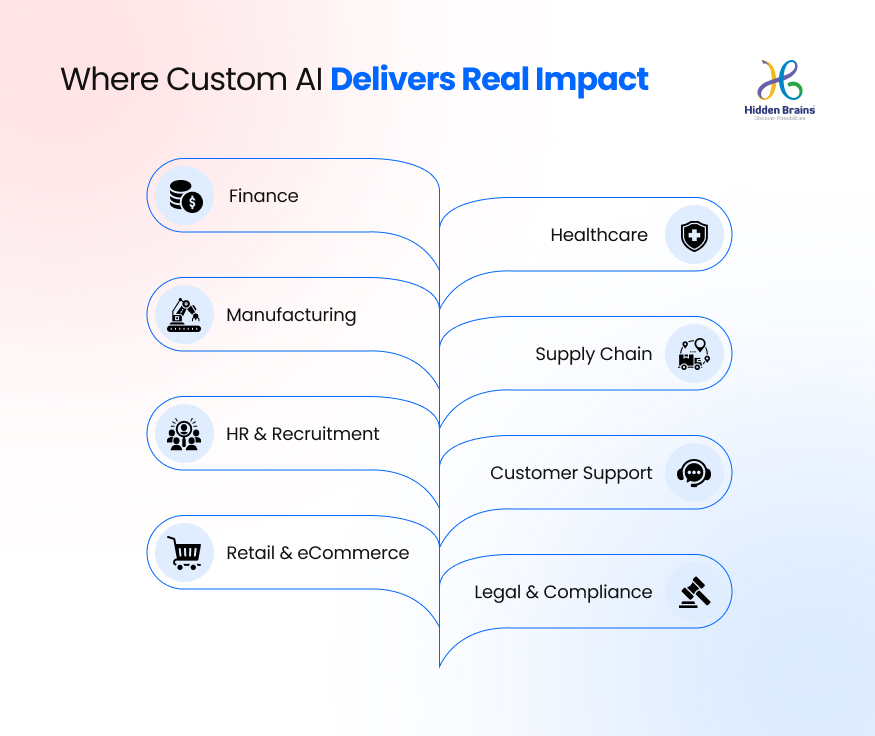
Here are only a few examples of where custom AI is having a significant impact:
- Finance: Protecting against fraud, modeling risk, and using new underwriting ideas. This sector relies heavily on custom AI solutions for risk, compliance, and customer trust.
- Retail & eCommerce use chatbots to provide personal recommendations and assist in estimating stock amounts. In addition, AI solutions help this sector in understanding buyers while forecasting demands.
- In healthcare, diagnostics help, patient data analysis is done, and future treatment plans are predicted. Custom AI solutions play a critical role in this sector in analyzing complex patient data and regulations.
- Manufacturing Plants: Use AI-powered predictive maintenance, see defects, and apply process improvements to keep machines running.
- HR & Recruitment are in charge of screening resumes, hiring the right employees, and planning the workforce.
- Customer Support: Tickets are routed automatically, mood is detected, and help is available via AI chatbots.
- Logistics & Supply Chain benefit from real-time routing and demand planning
- Legal & Compliance industries use AI to speed up contract review and data discovery.
If information and decisions are significant in your company, you can rely on Custom AI solutions.
Also read: Check out how our AI-powered & Crop Monitoring systems help in real-time health tracking and optimized farming.
Feasibility & Planning
You believe that AI could solve essential issues your business is facing. Having completed all that, what’s the next step? Before you start with development, you should clarify the role of AI in your business, prepare for it, and collect the necessary resources. We can go through each step one at a time.
What is Custom AI Development and How Does It Work?
Custom AI development is about building an AI solution designed specifically for your business, not a generic system built for everyone. It’s tailored to your data, your workflows, and your goals. Unlike plug-and-play AI tools, a custom solution grows with your needs and delivers insights that genuinely make a difference.
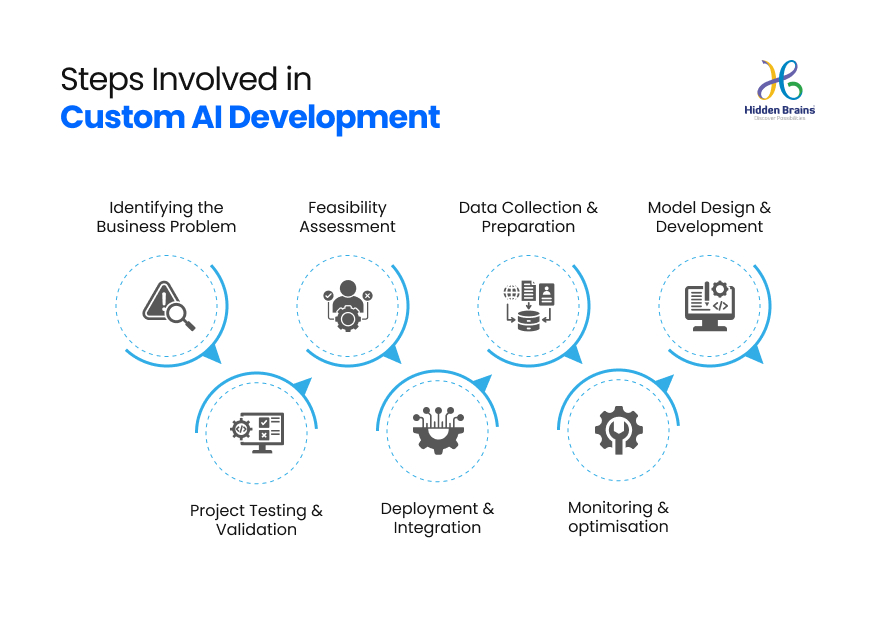
Let’s walk through how the process usually unfolds, step by step:
Identifying the Business Problem & AI Use Cases
Every successful AI project starts by asking the right questions. What exactly are you trying to solve? Is it a delay in the supply chain, customer churn, or inefficient processes? This step defines the problem you want AI to help with and ensures it’s worth solving.
Feasibility Assessment & Planning
It is where your enterprise must identify the existing user pain points where you can implement tailored AI solutions to make a difference. You must also analyze the feasibility of your AI innovation, including its computation power and integration capabilities. AI consultants or developers often guide you through this phase to ensure alignment.
Data Collection & Preparation
AI is only as good as the data it learns from. All relevant data, from spreadsheets to CRM entries to sensor logs, is collected, cleaned, and organized in this step. Data quality matters greatly here, as messy or incomplete data can impact accuracy. This phase may also involve anonymizing sensitive data and ensuring privacy compliance. Data plays a critical role in training the custom AI models. Therefore, your choice of structured and unstructured data will provide efficiency for your Custom AI model.
Model Design & Development
Here, the actual “brain” of the AI gets built. Developers choose the correct algorithm or architecture based on your use case. It could be a recommendation engine, a chatbot, a forecasting model, or something else entirely. The model is trained using your data to learn patterns, detect trends, and make predictions or decisions.
Testing & Validation
Before going live, the model is tested against real-life scenarios or historical data. It is done to measure how accurate and reliable it is. If needed, developers tweak the model to improve performance. Testing ensures the AI works as intended and produces results you can trust.
Deployment & Integration
When the model gives good results, you can use it within your business. You can set up APIs between your accounting software and your CRM, ERP, website, or other internal systems. You want the solution implemented smoothly so it fits without disrupting things.
Monitoring & Optimisation
AI isn’t a “build it and forget it” solution. After launch, it must be monitored regularly to ensure it stays accurate and continues learning. As your business evolves, the model can be retrained with new data or adjusted to meet changing goals. Many vendors offer long-term support to keep your AI sharp and relevant.
Types of AI Services Offered by Vendors
Before choosing custom AI, remember that every vendor might not provide the same service. Some companies offer all the services, whereas some concentrate on particular technology or development phases. To choose the right vendor, look at your goals, knowledge within your group, and your steps with AI. Take a look at the main kinds of AI services you could meet:
End-to-End AI Development
This service is for businesses that want the whole thing taken care of, from figuring out what kind of AI they need to build it, testing it, launching it, and keeping it running smoothly. They act as your technical assistance. They set up your product and then continue adjusting it to ensure it runs on your current setup. If you seek guidance, a pair relationship will suit you best.
Predictive Analytics Services
This is where AI shines for decision-makers. Predictive analytics services help you turn your past data into future insights. Whether forecasting sales, predicting customer churn, or identifying risks before they become problems, this AI solution gives you a serious edge. It’s about making smarter choices with confidence, backed by data, not guesswork.
AIOps Solutions
Handling IT operations in today’s world is a big challenge. AIOps is designed to use AI to monitor, find, and solve issues without missing a beat. With AIOps services, you can prevent downtime and predict system issues, like having a watchful technological brain protecting your tech stack 24/7.
LLM (Large Language Model) Development
LLMs like GPT, Grook, or Claude have changed how businesses think about language and communication. Vendors offering LLM development can help you build powerful tools like intelligent search engines, document summarisation tools, or custom assistants trained on your internal knowledge base. It’s ideal for enterprises that deal with tons of text and want to make that information work harder.
Facial Recognition Software
Facial recognition software could be a game-changer if your business involves security, identity verification, or any visual recognition. Vendors in this space help you develop systems that can identify faces in real-time video, match images to existing profiles, or even monitor customer engagement in retail settings while adhering to strict data privacy standards. Another benefit of FRS is that businesses can also verify their clients profiles using an online face finder and prevent fraud.
AI App Development
AI app development is about directly embedding intelligence into your mobile or web applications. Whether it’s a personal finance advisor, a health tracker with predictive features, or a productivity app that adapts to user behavior, vendors in this space build AI-powered experiences tailored to your users and goals.
Generative AI Development
Making your own AI content comes from generative AI, not only analysis. Experts in this area let you construct systems that can create text, pictures, audio, or video according to prompts. It is beneficial for marketing, media, education, and eCommerce because quickly making a lot of content helps you compete.
AI Chatbot Development
Chatbots have come a long way. Today’s AI-powered bots can do more than answer FAQs; they can handle bookings, offer personalized recommendations, manage complaints, and even close sales. Vendors in this space create conversational experiences that feel human, work 24/7, and integrate with your existing systems to make customer service smoother and brighter.
AI Workflow Automation
AI workflow automation vendors build systems that take over the boring stuff like data entry, invoice matching, or internal approvals. These solutions save time; they reduce errors and free up your team to focus on higher-value work. It’s a quiet revolution that pays off quickly.
Computer Vision
From quality checks in factories to intelligent surveillance in cities, computer vision uses AI to help machines “see” and understand the world visually. Vendors in this space can build tools that detect anomalies, read text in images, count inventory, or even track movement. It’s a go-to solution for manufacturing, logistics, healthcare, and retail industries.
Also read: AI-powered boardroom for strategic growth shows how data insights transform leadership and decisions.
Real-life Examples of Successful Implementation of Custom AI
Sometimes, the best way to understand the value of custom AI is to see it in action. Here are three real-world stories of how businesses and researchers used tailored AI solutions to solve complex problems and unlock measurable impact:
Smarter Hiring for a Recruitment Firm
A fast-growing recruitment agency struggled to keep up with many applicants. With candidates coming from diverse backgrounds and job categories, shortlisting the right match became time-consuming and inconsistent. They needed a system that could interpret job roles more contextually and recommend suitable candidates — all without losing that human touch. With the help of a custom-built AI platform, they transformed their hiring process. The result? A 40% cut in hiring time, a 60% boost in candidate quality, and an overall 60% increase in hiring efficiency. AI didn’t replace recruiters; it made them faster and sharper.
Revolutionising Crop Health with AI
An associate professor of entomology and biology set out to build a more innovative way to monitor crop diseases, especially for remote farming communities with limited access to expert help. Off-the-shelf tools just didn’t cut it. So, he turned to a custom AI solution that combined a mobile app with a device camera. Farmers could snap pictures of diseased plants, and the app would instantly provide a highly accurate diagnosis and advice. The system even supported a Q&A forum where farmers could exchange knowledge and receive guidance on flood control, soil conservation, and climate-resilient crops. Over time, crop yields improved by 50%, the cassava leaf image database nearly tripled, and global crop losses from preventable diseases dropped by 33%.
Streamlining Legal Document Review
A prominent legal firm was overwhelmed by the volume of documents needing review. Everything was buried in unstructured text, from contracts and case notes to regulations. Instead of expanding the team, they built a custom AI system to read, tag, and sort legal documents at scale. The solution could process over 200,000 files, recognize over 1,000 document types, and extract insights across 500,000+ legal keywords. As a result, the firm boosted its client capacity, now serving over 800 clients, and saved hundreds of hours that used to go into manual document review.
How Long Does It Take to Build and Deploy a Custom AI Solution?
The timeline can vary, but most custom AI projects take 3 to 6 months from discovery to full deployment. The first month usually involves problem scoping, planning, and data preparation. Model development and training may take another 1–2 months, followed by rigorous testing and integration with your systems. Some complex projects may take longer, especially those involving sensitive data or heavy compliance needs. The good news? Many vendors now work in agile sprints, so you can see value early, even before the complete solution is launched.
Do You Need a Tech-Savvy Team to Adopt AI?
Yes, you must. You certainly don’t need a room full of data scientists, but having a basic internal setup can make adoption smoother. Ideally, you’ll have:
- A project manager who understands the business challenge
- IT support to integrate systems and manage data access
- A few subject matter experts to help train the AI with context
Think of AI as a collaborative partner; the better your internal team communicates and supports the process, the brighter and more accurate your solution becomes.
Should You Use a Pre-Trained API or Build From Scratch?
It depends on what you need. Pre-trained APIs (like Google Vision or OpenAI’s GPT) are great for quick wins. They’re affordable, fast to implement, and well-tested. But they’re also generic. Custom-built AI is the better choice if your business needs deeper personalization, works with niche data, or has strict compliance requirements. It gives you control, flexibility, and performance in your use case. Many vendors blend both, starting with APIs and then training custom layers.
Why Train AI on Your Own Data?
Because your data tells the real story of your business, public AI models are trained on general information — they don’t know your customers, your language, or how you work.
When you train AI on your own data, it learns what matters to you. Whether it’s sales history, legal files, sensor readings, or chat logs — your data gives the AI real context. That means better results, smarter insights, and tools that actually fit your business.
Also read: Check out Re-imagining Learning Management Systems Using Generative AI, exploring how AI is personalizing and enhancing the learning experience.
AI Development Lifecycle
The process of developing, deploying, and running AI systems is planned with the help of the AI development lifecycle. Let’s understand it with a deeper outlook.
How Does the Custom AI Development Lifecycle Actually Work?
Defining the goal for your business is usually the first step. In the next step, AI consultants and developers develop a design, collect the necessary facts, and build a test version. Every project is unique and needs strong collaboration and many drafts. You repeat the testing, fine-tuning, and training process until the model meets your requirements. After you validate the AI, start working with it and monitor it to ensure it functions properly. Sometimes, the entire lifecycle lasts 3 months, while it could also take longer if your use case needs more detailed handling.
Why is Good Data the Backbone of Any AI Solution?
Because insufficient data leads to bad decisions, ensuring your data is prepared, cleaned, and well-organized is crucial for a sound AI solution. Raw data is managed, named, and put in order during the development phase to prepare it for machines. This step often takes longer than most clients expect, but skipping it risks making the AI model unreliable or biased. Clean, well-labeled data helps your AI learn better and perform more accurately.
What are the Most Common Custom AI Models Being Built Today?
While every use case is unique, most enterprises lean toward solutions like:
- AI chatbots for customer support and internal automation
- Predictive models for demand forecasting, risk analysis, and behavior tracking
- Generative AI tools for content creation, product design, and knowledge extraction
- Agentic AI tools for video and image creation.
These models are tailored to match specific goals, whether that’s reducing manual work, improving decision-making, or scaling personalized experiences.
What are the Latest Trends in Custom AI Development?
Custom AI is evolving fast, and businesses that stay ahead of the curve gain a real edge. Here are a few key trends shaping how tailored AI solutions are being built and deployed today:
- AutoML (Automated Machine Learning): This trend is making AI more accessible. AutoML tools help automate time-consuming tasks like model selection, training, and tuning, meaning even businesses with limited in-house AI talent can build powerful solutions faster.
- Edge AI: Instead of sending data to the cloud, Edge AI processes it locally, right on devices like cameras, smartphones, or sensors. It’s ideal for real-time responses (think security, manufacturing, or healthcare), and it keeps sensitive data closer to home, which helps with privacy and speed.
- Multimodal AI: These models can process and combine multiple types of input like text, images, and video all at once. Great for complex use cases like medical diagnostics, autonomous systems, or next-gen customer service platforms.
- Responsible & Ethical AI: With AI being used to make more impactful decisions, there’s a growing focus on transparency, fairness, and bias mitigation. Today’s best AI solutions are not just smart. They’re built responsibly, with clear checks in place.
- Domain-Specific LLMs: Instead of relying solely on general-purpose models, companies are now investing in large language models trained on their own data and industry-specific language, making outputs more relevant, accurate, and secure.
In short, modern custom AI is becoming faster to build, easier to scale, and more business-aware than ever before.
Technology Stack & Tools
What Are the Core Tools and Technologies Used in Custom AI Development?
Using this table, you can learn how the main tools in AI are used and how they differ from others on the market.
| Category | Tool/Framework | Description |
|---|---|---|
| AI Development Frameworks | TensorFlow | Deep learning at scale; ideal for production environments |
| PyTorch | Research-friendly; preferred for experimentation and dynamic computation | |
| Keras | High-level API for quick prototyping (runs on TensorFlow backend) | |
| Scikit-learn | Traditional machine learning — classification, regression, clustering | |
| Hugging Face Transformers | Pre-trained NLP and generative AI models | |
| OpenCV | Real-time computer vision tasks | |
| Data Storage & Processing | Apache Hadoop | Distributed storage and batch processing of large datasets |
| Apache Spark | Fast data processing engine for real-time analytics | |
| AWS S3 | Cloud-based storage for massive volumes of AI training data | |
| Google BigQuery | Serverless data warehouse for AI-ready analytics | |
| MongoDB | NoSQL database for handling unstructured data | |
| PostgreSQL | Structured data storage with AI plugin support | |
| MLOps Platforms | MLflow | Managing the ML lifecycle — from training to deployment |
| Kubeflow | Scaling and deploying ML workflows on Kubernetes | |
| DVC (Data Version Control) | Version control for datasets and machine learning models | |
| Weights & Biases | Real-time experiment tracking and collaboration | |
| Amazon SageMaker | End-to-end managed service for building, training, and deploying ML models | |
| Google Vertex AI | Unified platform for developing and managing the entire AI lifecycle |
How Do Vendors Stay Updated With Evolving AI Trends?
AI is progressing rapidly, which can be quicker than what analysts had predicted. Rather than just using theories, the best AI vendors dedicate their efforts to ongoing learning and hands-on integration in the real world. They keep informed about the latest breakthroughs by reading research materials, joining events like NeurIPS and CVPR, and taking up certifications. In addition, they check out the newest tools, such as AutoML platforms and modified large language models, to discover what is useful. A lot of professional developers remain in touch with what’s happening in AI, joining open-source projects and commonly visiting developer forums.
Such connections with tech providers offer them early opportunities to use updated APIs, frameworks, and upgrades. They also use new technologies on actual client projects, which helps them mix creativity with relevance. Curiosity, working with others, and actual knowledge are what help the most advanced vendors stand out in developing custom AI.
Integration with Existing Systems
Can Custom AI Work with Current Systems and Software?
This is true, and it is one of the main reasons custom AI applications are valuable. The main goal of a custom AI system is to integrate with existing technology, not to replace it. It is possible to integrate AI with ERP software, CRMs, or industry tools, no matter if they are old, cloud-based, or special for certain industries. Your solution needs developers who are familiar with your architecture and can create smooth connections so AI is seamlessly integrated into your workflow.
What Are the Methods for Seamless Integration with Tools and Workflows?
Integration methods vary depending on your systems, but some common approaches include:
- API Integrations to connect AI models with CRMs, ERPs, chat tools, or dashboards.
- Webhooks and Event Triggers to automate real-time responses based on AI decisions.
- Embedded AI Modules directly inside the software you already use such as email systems or analytics tools, making it easier to manage and optimize email deliverability.
- Cloud-Based AI Services that run externally but sync smoothly with your internal operations.
The goal is to make the AI invisible, running in the background, enhancing your existing systems without slowing them down or requiring a total overhaul.
Examples of AI integration with Business Intelligence and Analytics Platforms
- Microsoft Power BI integrates Azure Machine Learning for predictive analytics, natural language processing (NLP), and automated insights.
- Tableau integrates Tableau LangChain for secure AI agents and Einstein Discovery for predictive and prescriptive analytics.
- IBM Cognos Analytics embeds Watson AI for NLP, predictive modelling, and automated data preparation.
- Domo’s Mr. Roboto, introduced in 2024, integrates AI, ML, and predictive analytics with over 400 native connectors to third-party apps (e.g., Shopify, Salesforce).
Data Privacy, Ethics & Compliance
How is Data Protected in Custom AI Projects?
The protection of data is not open to discussion. The best AI solutions are built with secure encryption and strict user rights, and they are stored in secure cloud areas. Whenever data is stored, it is either made anonymous or pseudonymous, and backups are encrypted. No matter if the data is financial or healthcare, security measures are in place to avoid any leaks or abuses.
How Do You Ensure Compliance With Global Regulations Like GDPR or HIPAA?
It becomes easier to maintain compliance since it is part of the early stages. Vendors design their way of handling data to stay compliant with laws like GDPR, HIPAA, and CCPA. New features like managing consent, tracking data, and generating audit trails are required to follow the law. The main focus should be on protecting people and upholding your image, not just following guidelines.
Who Owns the Model and Data — And is the AI Fair and Transparent?
When you build a custom AI solution, you should own the model, the outputs, and the data used for training unless you’ve agreed otherwise. A good AI partner will make this clear. On top of that, today’s enterprises expect their AI to be explainable and unbiased. Developers use techniques to make outputs understandable and run regular bias checks to ensure the system is ethical and fair. Ongoing audits and monitoring help maintain trust long after deployment.
Also read: Smart Assistance Solution for Remote Support which highlights how intelligent tools are streamline remote issue resolution and boost productivity.
Cost & ROI
Setting up a custom AI solution isn’t easy, especially since every business carefully checks cost and likely yield. However, developing your AI is more similar to building everything from the start rather than using existing software. What is the average amount you should plan for? What are the factors that set the price? How can you be sure that it is effective? Let’s look more closely at what this means.
How Much Does It Cost to Develop an AI-Powered App or Software?
It can change based on your aims, the project’s toughness, and the time needed. You will spend less on a chatbot made for one task than on a complete analytics system with live integration. It is essential to realize that what you pay for includes all the processes from collecting data, setting up the model, evaluating it, deploying it, and providing support after that. If implemented well, it becomes a smart way to increase automation and efficiency and make better decisions in the future.
What Factors Influence the Cost of AI Development?
Several factors are involved. The amount of data you have, its quality, the number of purposes you have in mind, and the difficulty of the algorithms are all important. If you need to adjust the platform, add it to your current software, or get help after deployment, these will increase your costs. When planning from the beginning, you will likely need to spend a large budget on planning and preparing your data. On the other hand, development is smoother if you have organized data and well-defined purposes.
How to Define and Track ROI and Business Success Metrics?
Although AI results are not always quick, they can always be measured. Whatever your AI is designed for, you should see time spent on tasks decrease, costs drop, accuracy increase, or decisions be made more quickly. Metrics can show changes in business KPIs such as more sales, less churn, and less time needed to do the same task manually. How should you calculate the return on investment? Make sure your goals are practical, and watch them at each step in the AI lifecycle.
Performance, Scalability & Maintenance
Can a Custom AI Solution Keep Up As My Business Grows?
Absolutely, and that’s one of its biggest strengths. A well-architected custom AI solution is built with scalability in mind. Whether your data volume doubles or your user base expands across regions, the system can be adjusted to handle the growth. Vendors typically design the solution to scale both horizontally (adding more resources) and vertically (handling more tasks) so it grows with your business without a performance drop.
What Happens After Deployment? Is Ongoing Support and Maintenance Included?
Deployment isn’t the end; it’s just the beginning of your AI journey. Good vendors offer ongoing support, regular model retraining, and performance monitoring to keep your solution sharp as your data and business needs evolve. They also track key metrics, manage uptime guarantees, and offer Service Level Agreements (SLAs) to ensure reliability. In other words, you’re not left alone after launch; you get a long-term partner.
Choosing the Right AI Partner
Getting the right AI partner will greatly influence your project’s chances of success. With the help of a suitable vendor, you can make sure that AI solutions are in line with what your company needs and provide real results.
How to Evaluate and Select an AI Development Vendor?
When evaluating AI vendors, consider the following factors:
- Technical Expertise: Assess the vendor’s proficiency in AI technologies relevant to your project, such as machine learning, natural language processing, or computer vision.
- Industry Experience: Look for vendors with experience in your industry, as they will better understand your specific challenges and requirements.
- Data Security and Compliance: Ensure the vendor adheres to data protection regulations like GDPR or HIPAA and has robust security protocols in place.
- Scalability: The vendor should be capable of developing solutions that can scale with your business growth.
- Support and Maintenance: Post-deployment support is essential. Confirm that the vendor offers ongoing maintenance, updates, and support services.
- Transparency and Ethics: The vendor should be transparent about their AI models and committed to ethical AI practices, including bias mitigation and explainability.
What Questions Should You Ask During the Evaluation Process?
To make an informed decision, ask potential AI vendors the following questions:
- Can you provide case studies or examples of similar projects you’ve completed?
- How do you ensure data privacy and compliance with relevant regulations?
- What is your approach to model training, retraining, and maintenance?
- How do you handle integration with existing systems and workflows?
- What measures do you take to prevent bias in AI models and ensure ethical AI practices?
- What kind of support and training do you offer post-deployment?
- Can you provide a clear breakdown of costs and expected ROI for your solutions?


Final Words
Custom AI isn’t just a tech upgrade; it’s a business advantage. When built around your goals and powered by your data, it helps you work smarter, move faster, and serve better. Whether you’re just exploring or ready to build, the right AI partner can make all the difference. Now’s the time to take that step.
Hidden Brains builds AI solutions that fit your business — not the other way around. Their team knows how to turn complex problems into simple, smart tools. From AI chatbots and predictive models to computer vision and NLP, they offer everything under one roof. They also make sure your data stays safe and follow all privacy laws like GDPR and HIPAA.
What makes them stand out is their long-term support and commitment to doing AI right. Their solutions grow with your business. They keep your system updated, secure, and easy to manage. Most importantly, they build AI that’s fair, reliable, and clear. If you want a partner who understands both tech and business — Hidden Brains is the team to trust.