






































































































































Overview
This blog dives deep into 21 AI-powered mobile app ideas poised to dominate 2026, from virtual health assistants to fraud detection tools. With AI reshaping industries, startups and enterprises must seize the opportunity to innovate faster, smarter, and at scale with Custom AI Development Services. Explore cost estimates, market trends, and real-life use cases to spark your next breakthrough product. Whether you’re a founder, investor, or product leader, this guide helps you validate ideas, estimate budgets, and build solutions that users and the market want. Let AI be the game-changer in your next big move.
What are the top AI app ideas in 2026 that you should invest in now to stay ahead of the market curve?
With the steady expansion of the AI market size, enterprises are all set to embrace emerging technologies in their business operations.
Over 80% of multinational enterprises expect to spend more on AI in 2026. This demand would be fueled by automation, analytics and agentic AI solutions.
But the question is, why has artificial intelligence technology become a big thing to adopt now in business solutions?
How are they impacting the business’s success? Let’s take a look at it!

What is AI Mobile App Development?
AI mobile app development refers to integrating artificial intelligence technologies such as machine learning, computer vision, natural language processing, and neural networks into modern mobile applications to enhance functionality, decision-making, and user experience.
AI-based app ideas are the foundation for building modern-day mobile apps. As a result, companies worldwide are increasingly looking to hire generative AI engineers. It could be a fitness application that responds to your heart rate, a tool to plan your budget knowing your monthly expenditure, or a mental health coach who speaks your language.
Why Do Entrepreneurs Need to Invest in AI App Development?
AI is transforming the functioning of mobile apps. It is assisting apps to be quicker, wiser, and more practical. For businesses, it’s an opportunity to create unique solutions that can develop over time.
Do you wish to have an app that will address the issues, keep your users satisfied, and stay in the market lead? AI will help you achieve it.
Here’s why it’s a smart move:
- Find Problems Quickly: AI helps you quickly understand what users are doing and where they face issues.
- Create Better User Experiences: Apps with AI can show the right content, give innovative suggestions, and learn what users like.
- Save Time and Money: AI can handle tasks like sorting data or sending updates, so you don’t need to do them manually.
- Make Smarter Decisions: AI apps can spot trends, guess what users might do next, and help you make better choices.
- Grow Easily: As more people use your app, AI will help improve it without significant changes.
- Stay Ahead of Others: Most apps still follow fixed rules. AI apps keep learning, which enables you to stay ahead of the curve.
- Try New Ideas: AI lets you build apps in areas that are hard to explore, like mental health, innovative finance, or learning tools. Enterprises can partner with AI integration services to build innovative apps.
- Attract Investors: AI-driven startups are more exciting to investors who are looking for future-ready businesses.
21 AI App Ideas for Startups, Scale-ups & Entrepreneurs to Invest In
You’re here because you don’t just want to build an app, you want to develop the app that matters in 2026. One that solves real problems, scales fast, and earns trust from users and investors alike.
Let’s get straight to it. Below are 21 AI mobile app ideas that are not just “cool”, they’re built to serve where demand is rising, and expectations are high.
- AI-guided eCommerce Platform
Launching or scaling an online store? An AI-powered eCommerce platform can be your silent co-founder. As per McKinsey, AI-driven personalization can increase revenue by 40%. It tracks browsing behavior, predicts demand, personalizes product recommendations, automates customer support, and even optimizes pricing in real-time.
Why it’s a game changer: It’s like having a full-stack growth team working 24/7, boosting conversions, retention, and customer delight.
Real-world example: Think AI-driven product tagging, dynamic storefront personalization, and voice-based shopping guidance, all from one integrated dashboard. - AI-powered Chatbot
Still think chatbots are limited? Not anymore. Today’s AI chatbots act like smart customer success reps: answering questions, resolving issues, and guiding users across web, apps, or social platforms.
Why it’s startup gold: It’s 24/7 support without the headcount. And it gets better every day with more data.
Hot stat: The global AI chatbot market is projected to exceed $18 billion by 2026. Retail, banking, even healthcare, everyone’s in. An effective chatbot development solution can help you tap into this growing demand across retail, banking, healthcare, and more. - AI-driven Meeting Summary Tool
You know how messy follow-ups get after meetings, especially when nobody took notes. This tool transcribes, summarizes, and even flags action items from your Zoom or Meet calls.
Why you should care: It’s like hiring an assistant who never misses a word and sends perfect summaries before you even hang up.
Market traction: Tools like Fireflies and Avoma are helping remote teams move faster. And the space is growing, projected to hit $7.65B by 2029. - AI-driven Calendar Scheduler
You’ve got 10 calls, 3 time zones, and one open slot left. This app manages your calendar before it becomes chaos, scheduling, rescheduling, and suggesting smart time blocks.
What makes it special: It learns how you work, when you’re most productive, when to block deep work, and when to follow up.
Real-world edge: Founders using tools like Clockwise or Reclaim.ai have seen up to a 40% increase in focus time. - AI-powered Legal Research Assistant
If you’re building anything in fintech, health, or compliance-heavy industries, you already know legal research is a nightmare. Imagine an AI assistant that reads through contracts, flags risks, and pulls up relevant cases in minutes.
Why it’s a game changer: It saves you (and your clients) hours and dollars.
Inspiration: Tools like InstaLegalAI are redefining how legal teams access, search, and interpret case laws with precision and speed. - AI-based Inventory Tracking App
Inventory mess-ups kill margins. This app tracks stock in real time, predicts demand, and automates restocking so you never overstock or run out.
If you’re building for retail, logistics, or D2C, this is one of the most in-demand use cases.
Real proof: Tools like Netstock and Zebra show that AI-based inventory can reduce stockouts by up to 30%. - AI Virtual Health Assistant
You’ve seen chat-based therapy or symptom checkers, but what about a true digital health concierge? One that schedules your appointments, reminds you about meds, and accurately answers basic health queries.
Why it matters: Healthcare staff are stretched. It bridges the gap.
Big picture: AI in healthcare is expected to surpass $100B annually by 2026, and with remote care rising, it’s only getting bigger. - AI-based Personalized Nutrition App
If you’re in wellness, here’s a golden idea: an app that learns users’ goals, allergies, preferences, and delivers hyper-personalized meal and grocery plans.
Want to go deeper? Integrate with DNA data or fitness apps.
Why founders love this: High engagement. Daily usage. And loyal users who pay for results.
Market forecast: Expected to hit $12.71 by 2031. - AI-powered Fitness Tracker
You’ve seen wearables tracking steps. But what if your app could analyze form, give real-time coaching, and suggest personalized routines based on progress?
That’s your edge: Build the AI brain behind fitness, not just the data collector.
Massive market: Expected to grow to $323.47 by 2034. The space is vast, and there’s room for specialized solutions. - AI-driven Mental Health App
Mental health support doesn’t scale well. But AI can help. Imagine an app that checks in daily, detects mood shifts, and delivers personalized coping tools, or even connects to a therapist if needed.
Why it works: Low-friction, accessible support that users return to.
Popular models: Wysa and Woebot are paving the way. You could niche into teens, burnout recovery, or workplace mental health. - AI-powered Virtual Event Organizing App
Running webinars or summits? AI can help you plan, invite, personalize content, and even recommend networking matches among attendees.
Why startups use it: Events are expensive. It makes them more effective and data-driven.
Bonus: You can build white-label versions for agencies, communities, or SaaS brands. - AI-based Fraud Detection Tool
When you are associated with money transactions in your app, be it payments, insurance, or lending, you will require absolute time protection against fraud.
It is possible to detect patterns, warn of risky behavior, and identify fraud even before it can occur with AI. AI is steadily fueling concepts like zero-trust security to build a robust enterprise security posture.
Why it’s critical: Digital fraud is rising. It isn’t optional anymore.
Real traction: Fintechs like Stripe and PayPal use it to protect millions of users daily. - AI-enabled Money Management App
Imagine giving users a tool that doesn’t just track spending, but helps them build smarter habits. AI breaks down expenses, predicts bills, and suggests where to save or invest.
Why it wins: Millennials and Gen Z want financial control without the overwhelm.
Upsell idea: Add credit score insights, tax tips, or small investment nudges. - AI-powered Talent Recruitment Platform
Recruitment does not work, at least not how fast-growing startups want it to. This platform will filter the resumes, rank applicants, and even conduct interviews depending on the positions’ fit.
What’s impacting: It removes bias, saves hours, and improves hiring quality.
Real-world example: ROCKEYE’s AI-powered HRMS solution automates end-to-end human resource operations, empowering precise, data-driven decision-making. - AI-powered Expense Tracker
For executives, solopreneurs, and startups, managing receipts is a nightmare. This app connects to bank feeds, auto-categorizes expenses, and generates wise monthly reports.
Why it sells: It’s automation that saves real time. And it’s super sticky.
Extra edge: Add GST/tax-ready exports or AI alerts for overspending. - AI-driven Personalized Travel Planner
We all know how time-consuming it is to plan a trip. This artificial intelligence assistant constructs personal itineraries, recommends flights and hotels, and updates the schedule over time in real time.
Why users love it: It fits in moods, weather, and budget.
Current trend: More travelers demand flexibility and personalization. - AI-powered Tutoring Platform
If you’re looking at EdTech, this is a big one.
An AI tutor can adjust content difficulty, offer instant feedback, and adapt to each student’s learning style.
Why it scales: Teachers can’t be everywhere, but your app can.
Bonus: Build a niche like math for kids, coding for teens, or soft skills for job seekers. - AI-enabled School Management App
You can build a back-office brain for schools.
Track attendance, handle grades, automate communication, and even flag struggling students early.
Why schools need it: Less admin work = more time to teach.
Expandability: Can be bundled with LMS or fee/payment modules. - AI-powered Precision Farming App
Farmers want better yields with fewer resources.
This app reads weather, soil, and crop health, and guides farmers on when and how to act.
Why it matters: Food demand is growing, and AI helps reduce waste.
Real-world Example: Solutions like Plant Village utilise AI, combined with satellite and sensor data, to monitor crops and provide real-time field insights. - AI-based Personalized News Aggregator
The newsfeed is broken. People are overwhelmed and misinformed.
This AI app idea can help you curate credible news based on interests, behavior, and bias checks.
Why it works: It builds trust and is used daily.
Bright idea: Offer a reader mode, summarizer, and fact-check layer. - AI-enhanced Career Planning App
Not everyone knows what to do next. This app maps user skills, passions, and job market trends to recommend career paths.
Why it connects: People want personal guidance, not generic.
Next step: Link to upskilling platforms or mentor networks.
What is the Estimated Cost to Build an AI-powered App?
Once you take your AI mobile app idea and put it into the world as a functioning product, cost will be one of the first significant decisions you must make. Not to mention code, data, model training, infrastructure, and the capacity to scale. These technical factors will determine the overall cost of hiring AI developers for your enterprise.
It can be very expensive or cheap in situations that depend on complexity, whether AI models are applied, third-party API integration, and how customized the product is.
To give you a rough idea, here is a breakdown to help you plot the reality of your budget:
| App Type | Estimated Cost Range | Examples/Features |
|---|---|---|
| Simple AI App | $10,000 – $50,000 | Custom ML models, user behavior tracking |
| Complex AI System | $150,000 – $500,000+ | NLP, computer vision, and real-time data processing |
| Enterprise-Grade Solution | $500,000 – $1,000,000+ | Scalable AI, automation, and high-availability systems |
How to Get Started with the Right AI App Ideas in 2026?
Here’s an innovative, founder-friendly roadmap to transform your AI-based app ideas into a reality.
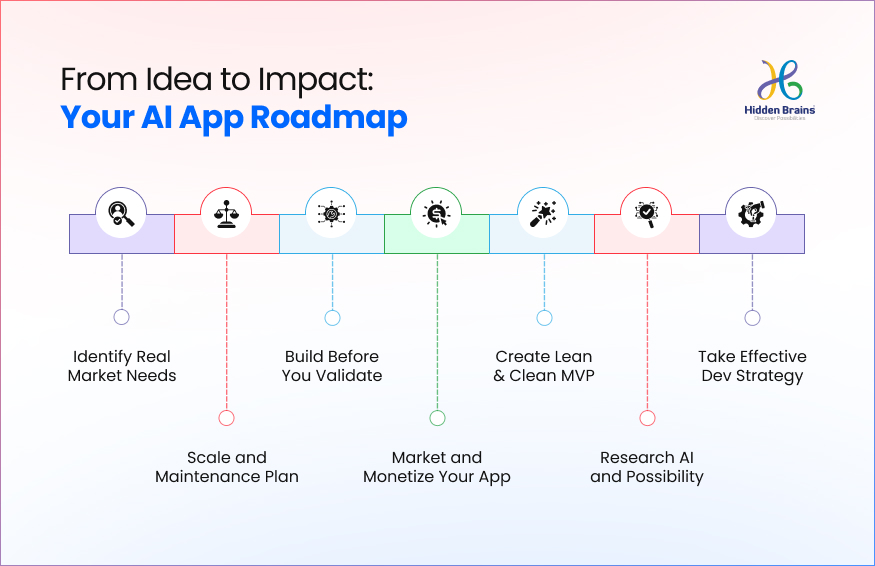
Let’s check out the steps you should take to launch your AI-powered mobile app.
- Identify Real Market Needs
Examine the pain points in healthcare, e-commerce, and finance.
Example: Zocdoc is an AI-powered scheduling facility, making finding doctors and scheduling visits with them easier. Currently, 10M+ patients book through Zocdoc every year in the United States. - Research AI and Possibility
Cut expenses by 30-50 percent using GPT-4, Hugging Face or Google Cloud AI tools.
Example: GlossaryTech created an app that NLP powers on a budget and could multiply. - Build Before You Validate
Build a model and talk to real users through surveys or test groups. Startups can grow substantially by adopting this model. - Create Lean MVP
Iterate on 1-2 AI capabilities at a budget of 30K-150K with Agile methodology. - Implement Innovative Dev Strategies to lower Costs
Use AI APIs, choose outsourcing options wisely, and automate testing. - Craft a Robust App Maintenance Plan
Yearly, 15-50 percent of dev cost is needed to cover AI model updates, hosting, and tuning. - Develop Long-term Promotional & Monetization Plan
Invest 10-20 percent of the budget on digital campaigns. Find a freemium, SaaS, or in-app purchase model. Perspective: 90% of companies plan to boost AI in 2026

How Does Hidden Brains Help You Build an AI-based Application in 2026?
Hidden Brains is a leading AI app development company offering the best AI development services, from AI chatbots to intelligent automation. Backed by an expert team, we help startups and enterprises build scalable, future-ready AI applications tailored to real business needs. Let’s turn your AI vision into reality in 2026.
Frequently Asked Questions
If you’re exploring AI app ideas, having questions is natural. Below are some of the most common queries we get from founders, entrepreneurs, and tech teams ready to dive into AI in 2025.
What are the top AI app ideas for 2026?
Some of the most promising ideas include AI-based meeting summary tools, virtual health assistants, personalized fitness/nutrition apps, AI-powered travel planners, and fraud detection systems. Real market needs and strong user demand across industries drive these ideas.
How much does it cost to develop an AI-based mobile app?
Costs typically range from $30,000 to $500,000+, depending on complexity, features, and AI model integration. Lean MVPs can be built under $150,000 using pre-trained models and cloud infrastructure.
How long does it take to build an AI app?
A basic AI app may take 3 – 4 months, while complex systems can take 6–12+ months.
Do I need a large team to build an AI app?
Not necessarily. With the right AI development partner, even a small team can deliver robust solutions using pre-built APIs, open-source models, and agile workflows.
Can AI apps be customized for specific industries?
Absolutely. AI apps can be tailored to meet the unique needs of sectors like healthcare, retail, finance, logistics, and education, enhancing efficiency and delivering targeted value.



Conclusion
AI is still transforming industries, and developing an appropriate AI app idea today may provide your enterprise with long-term success. Whether you are a new or an established company, it boils down to finding problems in the real world and creating solutions that are both intelligent and scalable. The future is AI-driven, begin to build it today.
