
























































































































Summary
- Explore how hidden costs and inefficiencies quietly drive supply chain disruption, and what they mean for long-term performance.
- See how Agentic AI, cobots, and XaaS are reshaping everything from procurement to logistics and decision-making.
- Learn from companies like Zara, Unilever, Siemens, and Walmart that are already putting these technologies into action.
- Understand what it takes to build a supply chain that’s more agile, resilient, and ready for constant change.
Supply chains are no longer just about moving goods from point A to point B. They’re becoming the backbone of a global economy under constant pressure. From geopolitical turmoil to climate unpredictability, business leaders now recognize that supply chain challenges are no longer temporary, they are ongoing. In fact, global supply chain disruptions are costing businesses more than $1.6 trillion annually.
By 2027, the supply chain landscape will look dramatically different. Some trends are reshaping overall business strategies, while others are enhancing the role of technology and data to improve decision-making, streamline processes, and tackle external forces head-on. From AI-driven procurement to autonomous logistics, these supply chain trends are set to redefine what a resilient, value-driven supply chain looks like.
| At a Glance | Overview |
|---|---|
| Content Focus | An in-depth analysis of the latest supply chain trends shaping the future of global operations, including AI, automation, digital twins, IoT, and intelligent systems. |
| Target Audience | Supply chain leaders, logistics managers, operations executives, CTOs, CIOs, and businesses investing in digital transformation. |
| 60-Second Takeaway | Modern supply chains are moving beyond traditional logistics toward AI-powered, autonomous, and resilient networks that improve visibility, efficiency, and decision-making. |
| Key Insights | Covers emerging trends such as Agentic AI, Generative AI, digital twins, autonomous supply chains, robotics, predictive analytics, IoT, cybersecurity, and sustainable operations. |
| Recommended For | Organizations looking to modernize supply chain operations, improve resilience, and adopt emerging technologies. |
In this post, we’ll explore 13 key trends shaping the future of supply chain management. More importantly, you’ll discover what businesses should do today to stay ahead of the curve and drive sustainable growth.

Optimize Routes. Decide Faster. Scale Smarter With Our Experts.
Get Started1. Agentic AI: Autonomous Decision-making in Procurement and Operations
Agentic AI will automate core supply chain functions like procurement, vendor management, and risk mitigation. Gartner predicts that by 2027, half of supply chain management will operate with Agentic AI capabilities, significantly reducing human error and cutting operational costs.
Retail leaders like Zara are already using AI-driven demand planning systems to improve replenishment speed and respond faster to shifting customer demand, turning operational agility into a competitive advantage.
Executive Action
Start piloting AI-driven procurement and supplier management systems in controlled operational environments. Focus on areas where autonomous decision-making can reduce delays, improve forecasting accuracy, and minimize manual intervention.
2. Generative AI: Enabling Smarter Scenario Planning and Risk Mitigation
Generative AI enhances scenario planning and risk mitigation by analyzing a wide range of data to pinpoint emerging risks and vulnerabilities. It helps businesses to model various potential future scenarios, assess their impact, and prioritize responses. By rapidly processing information, AI enables companies to act proactively, adapt faster to market changes, and make smarter decisions to reduce disruptions.
Strategic Priority
Invest in generative AI Development services that strengthen scenario planning and predictive forecasting. Organizations that can simulate disruption before it occurs will gain a significant operational advantage in volatile markets.
3. Digital Twins: Real-time Simulations for Smarter Decisions
Digital twins create virtual replicas of your entire supply chain, allowing businesses to test scenarios, simulate disruptions, and make decisions in real time.
Companies like Siemens are already using digital twins to model production environments, improving manufacturing responsiveness, reducing operational friction, and identifying bottlenecks before they impact performance.
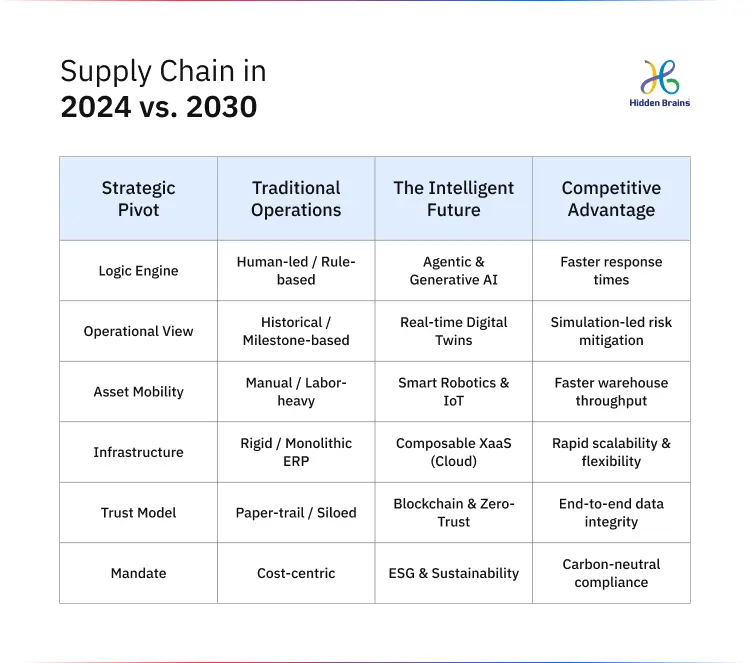
The bigger shift is this: supply chains are no longer reacting to disruption after it happens. With digital twins, leaders can pressure-test operations before risk turns into costly delays.
Operational Imperative
Transform manufacturing with digital twin technology, logistics, and warehouse workflows to proactively identify bottlenecks, simulate disruptions, and improve operational responsiveness.
4. Autonomous Supply Chain Action Centers: Automation Beyond Visibility
Predictive supply chain control towers will evolve into autonomous action centers that not only provide visibility but also trigger automated corrective actions. Autonomous action centers will streamline decision-making, improving responsiveness and reducing delays by 40%.
Transformation Opportunity
Move beyond visibility-focused control towers and begin building autonomous response systems capable of initiating corrective actions across procurement, fulfillment, and logistics workflows.
Executive Takeaway
AI-driven supply chains are no longer optimizing isolated workflows. They are becoming autonomous operational systems capable of responding dynamically to disruption, volatility, and changing customer expectations.
5. Smart Warehouse Robotics: Tackling Labor Shortages and Improving Efficiency
Smart warehouse robotics, fueled by Industry 4.0 tech like AI and IoT, are stepping in to solve labor shortages by automating the grind.
But here’s where it gets interesting: Industry 5.0 isn’t just about robots taking over; it’s about humans and robots working side by side, each bringing their A-game.
Together, they make the warehouse not just efficient but incredibly adaptive, scalable, and ready for anything that comes next.
Companies like Amazon are already using robotics and cobots to accelerate fulfillment, improve picking accuracy, and keep operations moving during peak demand periods. The payoff is more than efficiency. It’s resilience at scale.
Leadership Focus
Address long-term labor constraints by investing in collaborative warehouse automation to improve throughput, operational scalability, and workforce efficiency.
6. AI-driven Risk Modeling: Proactive Risk Management
AI-powered risk models will continuously monitor potential threats across your supply chain, providing real-time insights to mitigate risks related to climate events, geopolitical shifts, or cybersecurity breaches.
Investment Consideration
Prioritize AI-powered risk intelligence platforms that continuously monitor geopolitical, environmental, supplier, and cybersecurity risks across the supply chain ecosystem.
7. Sustainable Green Technologies: Aligning with Global Sustainability Goals
Sustainable technologies are the new, urgent supply chain trend. Electric vehicles (EVs) for deliveries and green shipping fuels are set to go mainstream as businesses strive to meet climate goals, cut carbon emissions, and embrace eco-friendly supply chain practices.
What You Should Do
Begin transitioning to sustainable technologies like EV fleets and renewable energy sources to reduce your environmental impact and meet compliance standards.
8. Computer Vision: Bringing Real-time Intelligence to Supply Chains
Supply chains have always struggled with one simple problem: not seeing enough, fast enough.
Computer vision changes that. It turns everyday cameras in warehouses, factories, and logistics hubs into real-time observers, automatically scanning inventory, spotting defects, tracking parcels, and flagging issues as they happen.
The impact is immediate. Businesses are reducing manual inventory audits by up to 70%, improving accuracy, and catching quality issues before products move downstream. What once relied on periodic checks now has continuous visibility.
The impact is immediate. Businesses are reducing manual inventory audits by up to 70%, improving accuracy, and catching quality issues before products move downstream. What once relied on periodic checks now has continuous visibility.
As computer vision moves from experimentation into core supply chain infrastructure, organizations are also building deeper expertise by hiring computer vision talent to scale and operationalize these systems effectively.
It’s a quiet shift, but a powerful one: from delayed reports to live operational awareness, where every movement in the supply chain becomes visible and actionable in real time.
9. Hyper Connected IoT
Supply chains are becoming more connected than ever, but the real shift isn’t just connection. It’s awareness.
IoT is quietly turning everyday touchpoints, containers in transit, pallets in warehouses, even temperature sensors in cold storage, into live streams of information. Instead of waiting for updates, businesses can now see what’s happening as it happens.
And as IoT starts working more closely with AI and machine learning, that visibility becomes more useful. Systems can begin to flag delays, spot inefficiencies, and help teams respond while operations are still in motion, not after the fact.
Key Takeaway
IoT works when it connects the full chain of action, tracking shows movement, sensors capture conditions, automation handles warehouse execution, predictive tools anticipate failures, and blockchain protects trust in the data.
That’s what turns visibility into a real operational response.
10. Cloud-based Collaborative Platforms: Seamless Partnerships
Cloud-based platforms will enable real-time collaboration across teams, suppliers, and partners, ensuring that data is always up to date and accessible.
Transformation Opportunity
Replace disconnected workflows with cloud-based applications that enable suppliers, logistics partners, and internal teams to operate from unified real-time data environments.
Real-world Impact We Built
Deliver Any Nigeria’s cloud-powered logistics platform improved delivery times by 20%, enhancing efficiency and customer satisfaction.
11. Cybersecurity Systems: Safeguarding Supply Chain Data
Cybersecurity in supply chains is no longer just about protecting internal systems; it now extends across an entire ecosystem of manufacturers, suppliers, logistics partners, and connected platforms.
As attacks grow in scale and complexity, the real challenge is no longer just defense; it’s trust. How do you know what’s safe, what’s verified, and what’s moving through the network at any given moment?
Modern supply chain security is built in layers. Zero-trust means nothing is assumed safe by default.
Access is continuously verified, and permissions are tightly controlled. At the same time, organizations are keeping a closer watch on third-party partners and connected systems to catch unusual activity early, before it spreads.
Actionable Plan
Start by shifting toward a zero-trust security across supply chain systems, tightening access for users and partners, and setting up continuous monitoring for vendors and connected devices so unusual activity can be identified and acted on quickly.
12. Advanced Data Analytics for Demand Forecasting
Supply chains aren’t just about moving goods; they’re the core of operations. Advanced analytics helps you stay ahead by predicting market trends, weather, and social signals in real-time, keeping your business on track. With intelligent business intelligence platforms like datumsAI, these signals become easier to interpret and act on, helping teams move from reacting to anticipating.
Strategic Priority
Build real-time analytics capabilities that enable faster operational decisions, dynamic forecasting, and predictive supply chain optimization.
13. The Rise of XaaS in Supply Chain
XaaS is flipping the supply chain script. With composable architecture, businesses can mix and match the best tools without being stuck with a single vendor. Continuous innovation means no more big upgrade headaches. And with ERP independence, you can modernize without a full system overhaul. It’s not just a supply chain trend; it’s the key to a flexible, scalable, and smarter supply chain.
What You Should Do
Move away from “all-or-nothing” systems. Start by integrating modular XaaS platforms with your current ERP and logistics setups, turning composability into a real operational advantage.
Transform Your Supply Chain With Better Management.
Get 2 Hours Free Consultation
Steps to Build a Resilient, Intelligent Supply Chain
Strategy only matters when it leads to action. To build a resilient, intelligent supply chain, focus on these four steps.
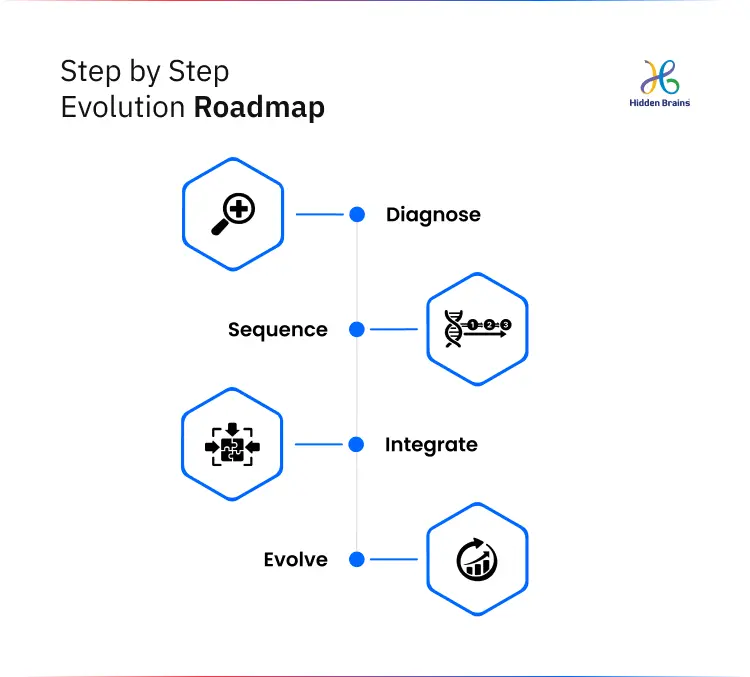
Step 1 — Diagnose Honestly
Assess resilience, technology maturity, data quality, and fragmentation without bias.
Step 2 — Sequence for Dual Value
Deliver near-term gains while building long-term platform and data foundations.
Step 3 — Invest in the Platform and Data
Without integration and governance, AI and automation quickly lose impact and fail to scale beyond isolated pilots.
Step 4 — Execute, measure, evolve
Deploy iteratively, track outcomes, and build feedback loops that accelerate learning.
With the right mix of strategy, technology, and execution, the supply chain will redefine from fragmented operations to an intelligent, resilient supply chain ecosystem.
How Hidden Brains Helps You Get There
Building an intelligent, resilient supply chain requires more than strategic intent. It requires the right technology partner.
Transportation & Logistics Software Development
Hidden Brains builds end-to-end logistics and transportation software solutions, from real-time fleet tracking and route optimization to warehouse management and last-mile delivery platforms. Whether you are looking for legacy modernization strategies or building new intelligent systems from the ground up, we bring the technical depth and domain expertise to deliver.
AI Development & AI Integration
Most supply chain teams don’t struggle with data; they struggle with connection. We develop AI systems for forecasting, automation, and decision support, and then help integrate them across ERP, logistics, procurement, and analytics tools. The goal isn’t just intelligence in one place, but intelligence where decisions actually happen.
AI Support & Maintenance
Because AI isn’t a one-time setup. It evolves. We provide ongoing AI support and maintenance services to keep models accurate, systems stable, and performance aligned with changing supply chain conditions. So your AI keeps learning, adapting, and delivering value over time.
From AI consultation to implementation, we help supply chain organizations move from fragmentation to intelligent, scalable ecosystems.
Talk to our supply chain technology experts.
Frequently Asked Questions
What are the biggest supply chain trends shaping 2026 and beyond?
The most consequential supply chain trends include the rise of agentic AI and autonomous decision-making, the convergence of cost and resilience strategies, platformization of supply chain technology, procurement’s elevation to a strategic function, and sustainability becoming a core design constraint rather than a reporting obligation.
What is the difference between supply chain visibility and predictive orchestration?
Visibility tells you what is currently happening across your supply network. Predictive orchestration uses AI and digital twin capabilities to anticipate what is about to happen, and automatically initiates response actions before disruption reaches your operations.
How are supply chain software trends changing procurement?
Modern supply chain software trends are enabling procurement to move beyond transactional management into strategic value creation, through AI-driven supplier risk scoring, real-time spend analytics, ESG-aligned sourcing tools, and supplier collaboration platforms that operationalize risk diversification at scale.
Why is cybersecurity now a supply chain management technology trend?
As supply chains become more digital and interconnected, cyber vulnerabilities extend across the entire supplier ecosystem. A breach in a third-party logistics provider or supplier system can cascade into operational shutdowns and significant financial impact across the full value chain, making security architecture a supply chain design requirement, not just an IT concern.
What does “agentic AI” mean in supply chain management?
Agentic AI refers to AI systems that can autonomously execute multi-step tasks, not just provide recommendations, but act on them. In supply chain contexts, this means AI that can autonomously re-route shipments, adjust inventory positions, or trigger procurement actions in response to real-time signals without requiring human approval at every step.
How can Hidden Brains support supply chain transformation?
Hidden Brains partners with enterprises on both the technology and integration layers of supply chain transformation, from custom logistics software development to connecting fragmented ERP, procurement, and logistics systems into a unified, intelligent platform.

Conclusion
The future of supply chain management is here, and it’s smarter, faster, and more adaptive than ever. By embracing AI, automation, and predictive technologies, supply chains are shifting from reactive to proactive, becoming intelligent ecosystems that anticipate disruptions and optimize decisions in real-time.
For senior leaders, the opportunity is clear: now is the time to build a resilient, agile supply chain that can handle whatever comes next. Leaders who invest in the right technologies and capabilities today will define the benchmarks of tomorrow.
Don’t wait for disruption to force change. Start building your smarter supply chain now.