





























































































































Quick Overview:
- Discover how offshore software development is evolving beyond cost savings in 2026.
- Learn how AI-powered engineering improves delivery speed and developer productivity.
- Explore why Managed GCCs are becoming the preferred offshore engagement model.
- Understand Zero-Trust security and compliance best practices for distributed teams.
- Follow proven strategies to build, onboard, and scale high-performing offshore teams.
- Compare offshore models to choose the right approach for your business goals.
Offshore software development has entered a new phase.
For years, companies viewed offshore development primarily as a way to reduce engineering costs and access affordable technical talent. That approach is outdated.
In 2026, successful businesses are using offshore engineering teams as strategic technology extensions, helping them accelerate product development, access specialized skills, integrate AI into workflows, and build long-term engineering capabilities.
With growing demand for AI engineers, cloud specialists, cybersecurity experts, and full-stack developers, many organizations are finding it challenging to build complete technology teams locally. Offshore development provides access to experienced talent pools while maintaining control over architecture, security, and product direction.
For CTOs, engineering leaders, and product teams, offshore development is no longer just about reducing expenses. It is about increasing engineering velocity and creating a flexible technology foundation for future growth.
| Details | Information |
|---|---|
| Guide Focus | Explore how offshore software development is evolving with AI-powered engineering, Managed GCCs, security practices, and modern delivery models. |
| Target Audience | CTOs, CIOs, Engineering Leaders, Product Teams, Founders, and enterprises evaluating offshore development strategies. |
| TL;DR | Offshore development is no longer about cost savings alone. AI integration, security, talent access, and strategic partnerships define success. |
| Main Takeaways | Learn how AI improves engineering efficiency, why Managed GCCs are gaining momentum, and how to build secure, high-performing offshore teams. |
| Recommended For | Businesses planning to scale engineering teams, accelerate software delivery, or establish long-term global technology capabilities. |
Why Traditional Offshore Software Development Models Are Changing Rapidly
The traditional outsourcing model was built around a simple equation:
Lower development cost = more engineering capacity.
However, modern businesses need more than additional developers.
The modern offshore development model combines:
- AI-assisted engineering practices
- Agile collaboration frameworks
- Enterprise-grade security
- Dedicated offshore teams
- Managed Global Capability Centers (GCCs)
They need teams that can:
- Understand complex business requirements
- Work within existing engineering environments
- Follow enterprise security standards
- Deliver faster product iterations
- Adopt emerging technologies like AI and cloud platforms
Many organizations have moved away from short-term project outsourcing because it often creates challenges such as:
- Limited product understanding
- Knowledge loss when developers leave
- Communication gaps
- Dependency on external vendors
- Difficulty maintaining engineering standards
The future belongs to integrated offshore development teams that operate as an extension of internal engineering departments.
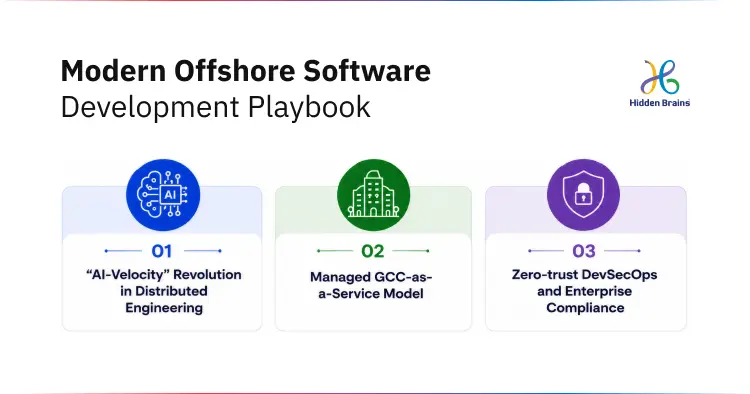
1. The “AI-Velocity” Revolution in Distributed Engineering
The single most disruptive factor in modern offshore software trends is the rise of the AI-augmented developer. The conversation has completely moved past generic automation to focus on real-world delivery metrics.
When analyzing AI-augmented software outsourcing costs, the value proposition is no longer calculated by raw hours billed, but by functional output per sprint. Elite offshore development teams are seamlessly embedding AI coding environments such as Cursor, Windsurf, and Bolt directly into their daily workflows.
The Impact on the Tech Stack
Whether your infrastructure is built on a modern MERN/MEAN stack, high-performance Python microservices, or enterprise .NET Core architectures, AI orchestration tools allow engineering teams to write boilerplate components, spin up test suites, and refactor legacy code at unprecedented speed.
Key Velocity Metric: Data from leading engineering teams indicates that integrating AI-augmented workflows reduces time-to-market for major product feature releases by 16% to 30%.
This efficiency completely shifts the economic equation. Instead of paying local developers $150 or more per hour to handle mundane architectural maintenance, organizations can hire AI-proficient remote developers at an optimized $35–$55 per hour range, freeing up local architects to focus entirely on core business logic and system design.
From Hourly Billing to Engineering Outcomes
Modern businesses are increasingly evaluating offshore software development solutions based on measurable outcomes:
- Sprint completion rates
- Release frequency
- Code quality
- Application stability
- Time-to-market
Seamless capabilities for smart AI integration services allow offshore teams to deliver more value within the same development timeframe.
For companies, this creates a better balance between cost efficiency and engineering excellence. Instead of simply adding more developers, organizations can build highly efficient engineering teams equipped with AI-powered workflows.
2. Moving Beyond Outsourcing: The Managed GCC-as-a-Service Model
One of the most defining offshore software development trends is the massive structural migration away from transient, project-based contracts toward permanent, integrated technical centers. Enterprises and fast-growing mid-market companies no longer want an external vendor; they want an extension of their own engineering department.
This demand has driven the rise of GCC-as-a-Service (Global Capability Centers).
Historically, figuring out how to set up a global capability center was an operational nightmare reserved exclusively for Fortune 500 giants. It required setting up foreign legal entities, navigating complex international tax regulations, managing physical real estate, and handling local compliance frameworks.
Building an internal offshore center required:
- Creating a legal entity
- Recruiting local talent
- Managing payroll and compliance
- Setting up infrastructure
- Handling administrative operations
For many companies, this process was expensive, time-consuming, and operationally complex. Managed GCC models are changing this approach.
Struggling to Scale Your Engineering Team Faster?
Reach Out to Us
3. Zero-trust DevSecOps and Enterprise Compliance
As engineering ecosystems grow more geographically distributed, code security has become a primary bottleneck. Security cannot be a secondary thought tacked onto the end of a sprint; it must be built directly into the delivery pipeline.
When evaluating external partners, offshore software development compliance (SOC 2, ISO 27001, HIPAA) is the baseline standard for entry. Modern distributed development requires a shift toward a comprehensive Zero-trust architecture.
The Modern Security Stack for Offshore Teams
- Automated Static Analysis (SAST) : Modern offshore teams integrate automated security testing into every development cycle, reducing vulnerabilities before applications reach production
- Identity & Access Management (IAM) : Eliminate shared credentials. Implement strict, role-based access control (RBAC) utilizing modern enterprise identity providers like Okta or Keycloak, backed by mandatory multi-factor authentication (MFA).
- Isolated Cloud Sandboxes : Offshore developers should operate within secure, containerized cloud environments (AWS, Azure, or GCP) that prevent local data extraction or source code downloads, keeping your proprietary code completely insulated inside corporate parameters.
Essential Security Practices for Offshore Development Teams
Successfully integrating a distributed engineering team requires a structured, deliberate execution framework. Missteps during the initial 30 days are the leading cause of friction and missed milestones later in the product lifecycle.
1. Role-Based Access Control (RBAC)
Every team member should have access only to the systems and information required for their role.
This reduces security risks by preventing unnecessary access to:
- Production environments
- Customer data
- Sensitive business information
- Critical infrastructure
Companies should implement centralized identity management with:
- Multi-factor authentication (MFA)
- Secure authentication protocols
- Regular access reviews
2. Secure Cloud Development Environments
Modern offshore teams should work within controlled cloud environments instead of relying on local systems.
Secure development environments help businesses:
- Protect source code
- Monitor developer activity
- Prevent unauthorized downloads
- Maintain compliance standards
Cloud platforms such as AWS, Microsoft Azure, and Google Cloud provide enterprise-grade security capabilities for distributed engineering teams.
3. Automated Security Testing
Security checks should become part of the development pipeline. Modern DevSecOps practices integrate security throughout the software development lifecycle through:
- Static Application Security Testing (SAST)
- Dependency scanning
- Code quality analysis
- Vulnerability monitoring
This enables teams to identify security issues early rather than discovering them after deployment.
4. Compliance-Driven Development Practices
For enterprises operating in regulated industries, compliance is a critical requirement.
A capable offshore software development partner should understand frameworks such as:
- ISO 27001
- SOC 2
- HIPAA
- GDPR requirements
Compliance ensures that development processes meet industry expectations for security, privacy, and operational reliability.
Choosing Your Development Model
Scaling a software engineering footprint requires balancing speed, operational control, and financial efficiency. The right framework depends entirely on the current scale of your product roadmap and your long-term business objectives.
| Operational Model | Primary Benefit | Ideal Scenario |
|---|---|---|
| Pre-Vetted Remote Teams | Immediate talent injection and quick time-to-market. | Rapidly scaling an existing team for a specific product push. |
| Managed GCC Solutions | Complete institutional IP retention and long-term stability. | Establishing a dedicated, permanent offshore engineering hub. |
| Custom AI Development Service | Drastic reduction in initial feature delivery timelines. | Launching new, highly intelligent features or data products quickly. |
The transition away from transactional outsourcing toward deeply integrated, AI-empowered engineering centers is the definitive competitive edge for modern software organizations.
By focusing on rigorous DevSecOps compliance, clean architectural guardrails, and clear performance metrics, you can confidently turn a distributed engineering footprint into a massive engine for growth.
How to Successfully Build and Manage an Offshore Software Development Team
Selecting an offshore development partner is only the beginning.The success of distributed engineering depends on how effectively teams are integrated into existing workflows.
Many offshore initiatives struggle not because of technical limitations, but because companies fail to establish clear processes around communication, ownership, and collaboration. A structured onboarding approach helps eliminate these challenges.
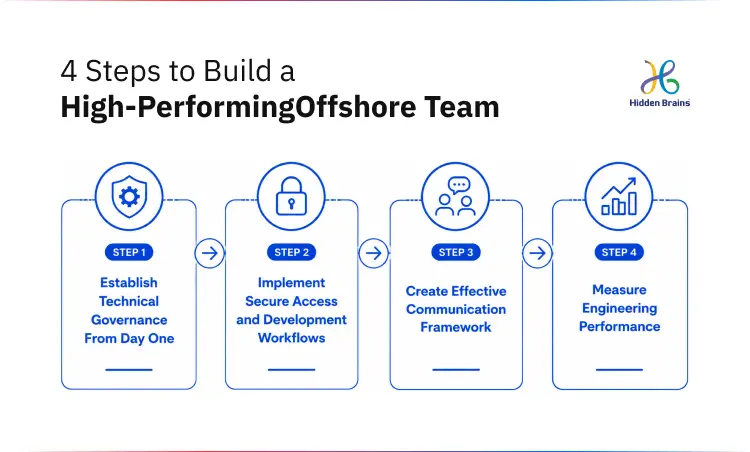
Step 1: Establish Technical Governance From Day One
Before developers start working on a project, organizations should define clear engineering guidelines.
It includes:
- Coding standards
- Architecture principles
- Branching strategies
- Documentation practices
- Testing expectations
- Definition of Done (DoD)
Clear technical governance prevents inconsistencies and ensures offshore developers follow the same engineering standards as internal teams.
A well-defined technical foundation allows teams to move faster without creating long-term maintenance challenges.
Step 2: Implement Secure Access and Development Workflows
Access management should be established before development begins.
Companies should define:
- Development environment permissions
- Repository access levels
- Deployment responsibilities
- Data handling procedures
A mature offshore development setup separates:
- Development environments
- Testing environments
- Production systems
This creates better security controls while allowing developers to work efficiently.
Step 3: Create Effective Communication and Collaboration Frameworks
Successful offshore teams are built on transparency and consistent communication. The goal is not to eliminate time-zone differences but to create workflows that make distributed collaboration effective.
Best practices include:
Structured Agile Ceremonies
Regular:
- Sprint planning meetings
- Daily standups
- Sprint reviews
- Retrospectives
Help teams stay aligned.
Asynchronous Communication
Documentation-first communication helps teams avoid unnecessary delays.
Tools such as:
- Jira
- Microsoft Teams
- Slack
- Confluence
help teams track progress and maintain visibility.
Overlapping Working Hours
A dedicated collaboration window between local and offshore teams enables:
- Faster decision-making
- Real-time discussions
- Efficient code reviews
Step 4: Measure Engineering Performance Through Clear Metrics
Managing offshore teams based only on task completion is not enough. Successful organizations measure engineering effectiveness through meaningful performance indicators.
Important metrics include:
Deployment Frequency
How often teams successfully release new features or improvements.
Lead Time for Changes
The time required to move from code changes to production deployment.
Defect Rate
The quality of delivered software and effectiveness of testing practices.
Mean Time to Recovery (MTTR)
How quickly teams can restore systems after failures.
Sprint Velocity
The amount of planned work completed during development cycles. These metrics provide visibility into team performance and help organizations continuously improve delivery processes.

Need an AI-ready Offshore Development Partner?
Talk to Our ExpertsFrequently Asked Questions
How do modern offshore teams protect our core intellectual property (IP)?
Our Modern offshore engineering centers protect your source code with Zero-Trust security. Developers work in secure, cloud-based environments where code stays protected and cannot be downloaded or copied locally. Access is controlled through NDAs, multi-factor authentication (MFA), role-based access controls (RBAC), and centralized identity management platforms such as Okta and Keycloak.
What is the difference between traditional software outsourcing and GCC-as-a-Service?
Traditional outsourcing is project-based and highly transactional, meaning the vendor retains complete operational control over the team, which often leads to high engineer churn and structural misalignment. GCC-as-a-Service (Global Capability Center) provides you with a dedicated, permanent offshore engineering extension. While Hidden Brains handles operational overhead like regional HR, recruitment, legal compliance, and workspace infrastructure, the team operates entirely under your technical leadership, adopting your internal git workflows, sprint ceremonies, and engineering culture.
How does integrating AI tools impact modern offshore software development costs?
The integration of next-gen AI environments like Cursor, Windsurf, or Bolt. New shifts the outsourcing paradigm from hours billed to total feature velocity. By automating boilerplate code, generating unit test coverage, and accelerating debugging pipelines, specialized offshore teams can optimize product delivery timelines by up to 45%. This allows companies to deploy highly efficient, AI-proficient engineering squads at a targeted $ 20–$50/hr range, dramatically reducing overall capital expenditures compared to standard local staffing models.
Which tech stacks are most scalable for distributed engineering teams?
Distributed engineering teams scale exceptionally well on modern, modular architectures that support clear API boundaries and microservices. The MERN (MongoDB, Express.js, React, Node.js) and MEAN stacks remain enterprise favorites for robust web and mobile applications due to their rich open-source ecosystems. For enterprise infrastructure requiring heavy computational efficiency, data processing, or legacy integration, .NET Core and high-performance Python frameworks provide the necessary runtime scalability and strict typing environments.
How do we bridge time-zone gaps to maintain sprint velocity?
Maximizing cross-border team velocity relies heavily on structured asynchronous communication and a clearly documented architecture strategy. Setting up clean definitions of done (DoD) and automated continuous integration (CI/CD) pipelines ensures development continues without waiting for real-time feedback loop approvals. Engineering units typically plan a fixed 2- to 3-hour overlap window daily to handle collaborative Agile ceremonies such as sprint planning, alignment check-ins, and code reviews, ensuring seamless handoffs between local and offshore teams.



Final Words
The transition away from transactional outsourcing toward deeply integrated, AI-empowered engineering centers is the definitive competitive edge for modern enterprises. By focusing on rigorous DevSecOps compliance, structural models like Managed GCCs, and clear performance indicators, you can confidently turn a distributed engineering footprint into a massive engine for product growth.
At Hidden Brains, we help businesses eliminate the friction of scaling global engineering teams. Whether you need to embed pre-vetted AI-proficient developers into your current sprints or want to build a fully compliant, permanent offshore operation from the ground up, our engineering frameworks ensure zero knowledge drain and maximum sprint velocity.