










































































































Quick Summary
- Understand software development costs in Europe, from hourly rates to project budgets and hidden expenses.
- Compare engagement models to choose between managed services, dedicated teams, and flexible delivery options.
- Learn the software development journey from discovery and architecture to deployment and optimisation.
- Navigate GDPR, EU AI Act, security, IP, and compliance requirements when hiring European partners.
- Discover how to evaluate partners based on expertise, processes, certifications, and delivery experience.
- Identify the right approach to build secure, scalable, and business-ready software solutions.
When you hire a software development company in Europe, expect €35–€95 per hour depending on seniority and where the delivery team sits, and €90,000–€180,000 for a mid-complexity build delivered over five to eight months. According to Deloitte’s Global Outsourcing Survey, organisations continue to use technology outsourcing to access specialised skills, improve scalability, and accelerate digital initiatives, making partner selection a strategic decision, not just a cost decision.
That’s the commercial answer. The rest of this page is the operational one: which engagement model to choose, what our six-step process actually looks like week by week, what goes into your contract, and two European builds you can go and read in full.
| Details | Information |
|---|---|
| Guide Focus | A practical guide to hiring a software development company in Europe, covering pricing, engagement models, development processes, contracts, compliance requirements, and selecting the right technology partner. |
| Business Challenge | Businesses need to balance software quality, development costs, delivery timelines, security, regulatory compliance, scalability, and long-term value when choosing a software development partner. |
| Target Audience | CTOs, CIOs, founders, product leaders, engineering managers, procurement teams, and organisations planning custom software development, modernisation, or digital transformation initiatives. |
| TL;DR | Choosing the right software development company requires more than comparing rates. European businesses should evaluate technical expertise, delivery processes, security standards, compliance readiness, engagement models, and proven project outcomes. |
| Key Evaluation Criteria | Development expertise, architecture capabilities, cloud strategy, cybersecurity practices, GDPR compliance, EU AI Act readiness, pricing transparency, delivery methodology, team experience, communication model, and client success stories. |
| Expected Outcome | A clear framework to understand software development costs, select the right engagement model, reduce delivery risks, and partner with a company that can build secure, scalable, and business-focused software solutions. |
What it Costs to Hire a Software Development Company in Europe
Price is driven by three things: seniority mix, engagement model, and where the engineering happens.
Hourly rate bands across Europe
| Delivery Region | Mid-level | Senior | What You’re Paying For |
|---|---|---|---|
| UK, Nordics, Switzerland | €70–€95 | €95–€150+ | Same-postcode presence, highest labour cost base. |
| DACH, Benelux, France | €60–€80 | €80–€110 | In-region contracting, strong enterprise depth. |
| Southern Europe | €45–€60 | €60–€80 | Emerging nearshore option for Northern European buyers. |
| Central & Eastern Europe | €35–€50 | €50–€70 | Best in-EU quality-to-cost ratio. |
| Hidden Brains — European-hours delivery | €30–€55 | €55–€70 | Named account lead in your timezone, CMMI Level 3 process, no in-region cost base. |
Regional bands are indicative 2026 ranges for budgeting. See our pricing for the current Hidden Brains rate card.
What a project actually costs
| What You’re Building | Indicative Range | Duration |
|---|---|---|
| Discovery & technical assessment | €8,000–€25,000 | 2–5 weeks |
| MVP or product prototype | €40,000–€90,000 | 3–5 months |
| Mid-complexity custom software solution (web platform plus integrations) | €90,000–€180,000 | 5–8 months |
| Enterprise platform build, multi-module | €200,000–€600,000+ | 9–18 months |
| Legacy modernisation or re-platforming | €120,000–€500,000+ | 6–15 months |
| Dedicated squad — 5 engineers, QA, PM | €22,000–€55,000/month | Rolling, 6-month minimum |
The two costs that surprise people
Management margin. Every provider adds delivery management, QA, HR, and overhead on top of an engineer’s base cost, typically 30–60%. It buys you something real, but it means a quoted “engineer rate” and a quoted “team rate” are not comparable units. Ask which one you’re being shown.
Your own internal cost. Procurement, security review, onboarding, and product-owner time add roughly 30–50% to the headline figure. Budget for it in month one, not month four.
Solve Your Biggest Software Challenges With Expert Guidance.
Get a 2-Hour Free Consultation
Managed Services or Hire: Pick the Model Before You Compare Quotes
Two engagement models are worth shortlisting, and they answer different questions. Getting this wrong is the most expensive mistake in the process.
Managed Services — you buy an outcome
We own scope, staffing, delivery management, QA, and timeline. You own business requirements and acceptance.
Right for you if: you have a defined problem but no internal engineering leadership to direct a team, you need a budget you can defend to a board, and the work has a clear end state.
Ask us about: change-request pricing. You should know exactly how a mid-project scope change is priced and how fast it’s approved, before you sign.
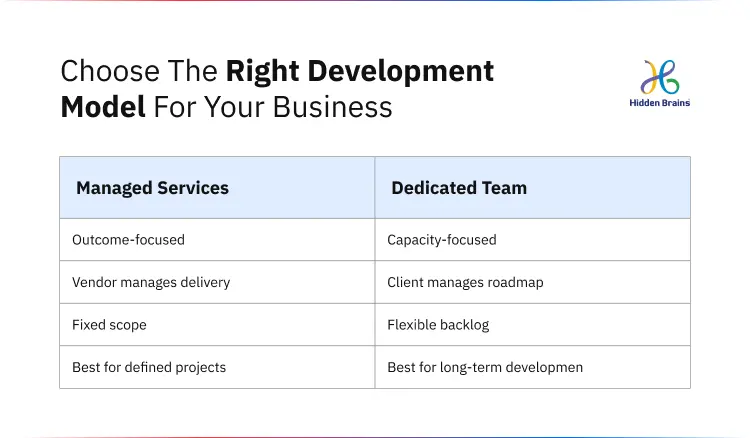
Hire — you buy capacity
Engineers work as an extension of your team, under your product ownership and your sprint cadence.
Right for you if: you have a CTO or engineering manager who can direct work, your roadmap is still moving, and you want the team to stay after v1 ships.
Ask us about: Ramp-up. Nobody is productive on a complex existing codebase on day one; realistic ramp is three to six weeks. Know who’s paying for it.
Many European engagements start as Managed Services through the first release and convert to a hired squad for the ongoing roadmap. Negotiate the conversion terms up front rather than at the handover meeting.
Quick Check → Compare both on our business delivery models page, or see how a dedicated development team is structured.
Our Process: What Happens After You Get in Touch
This is the part most vendor pages skip. Here is the sequence, with the checkpoint you should hold us to at each stage.
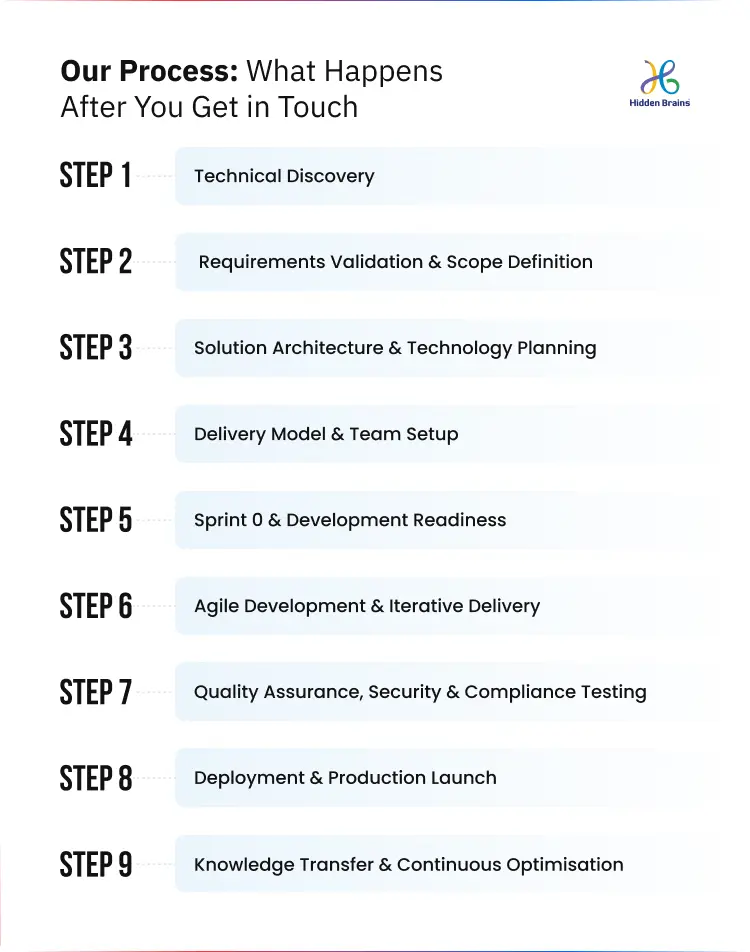
Step 1 — Technical Discovery (Weeks 1–3)
Understand business goals, requirements, existing systems, architecture, integrations, and technical constraints through workshops and assessments.
Checkpoint: You receive a complete discovery package — architecture review, prioritised backlog, risks, and estimates with assumptions clearly documented.
Step 2 — Requirements Validation & Scope Definition (Weeks 2–4)
Refine business requirements, define user journeys, identify functional and non-functional requirements, and establish project success criteria.
Checkpoint: Clear scope boundaries, priorities, and acceptance criteria are agreed before development begins.
Step 3 — Solution Architecture & Technology Planning (Weeks 3–5)
Create the technical blueprint, evaluate technology options, define architecture decisions, and plan scalability, security, and integrations.
Checkpoint: Architecture decisions are documented with clear reasoning, trade-offs, and future growth considerations.
Step 4 — Delivery Model & Team Setup (Weeks 4–6)
Select the right engagement model, finalise commercial agreements, and assemble the development team with defined roles and responsibilities.
Checkpoint: You know exactly who is working on your project, including architects, engineers, and delivery leads.
Step 5 — Sprint 0 & Development Readiness (Weeks 5–7)
Set up repositories, CI/CD pipelines, development environments, access controls, security baselines, and communication workflows.
Checkpoint: Cloud accounts, source code repositories, and project assets remain accessible and controlled by you.
Step 6 — Agile Development & Iterative Delivery (Week 7 onward)
Build the solution through structured sprints with continuous collaboration, regular demos, code reviews, and ongoing quality checks.
Checkpoint: You have visibility into progress, sprint outcomes, budgets, risks, and delivery performance.
Step 7 — Quality Assurance, Security & Compliance Testing
Validate functionality, performance, security, accessibility, and compliance requirements through structured testing.
Checkpoint: Testing evidence, security reports, compliance documentation, and quality approvals are available before launch.
Step 8 — Deployment & Production Launch
Release the software into production with deployment planning, monitoring setup, migration support, and launch management.
Checkpoint: A controlled release process, rollback plan, and production monitoring are in place.
Step 9 — Knowledge Transfer & Continuous Optimisation
Provide post-launch support, documentation handover, team training, performance monitoring, and ongoing improvements.
Checkpoint: Complete ownership transfer with runbooks, architecture documents, deployment guides, and support processes.
What Goes in Your Contract
Hiring a software development company in Europe means the paperwork carries obligations that don’t exist in other markets. These are settled at the SOW stage, not discovered later.
GDPR and the DPA. Any provider touching personal data is a processor and needs a Data Processing Agreement covering purpose limitation, sub-processor disclosure, breach notification timelines and deletion on termination. GDPR compliance also requires privacy-by-design, data minimisation, encryption, access controls, auditability, and clear data governance throughout the AI agent lifecycle. Where delivery sits outside the EEA, that means Standard Contractual Clauses plus a documented transfer impact assessment.
Data residency. Distinct from GDPR and often stricter, German public-sector, French health data and several financial-services regimes require data to stay in-country. The cloud region goes in the SOW, not a follow-up email.
IP assignment. All deliverables transfer to you on payment, including AI-assisted code. You receive a software bill of materials listing every third-party dependency and its licence.
NIS2. If you operate in an essential sector, your supply chain is in scope, and your development vendor is part of it. ISO 27001 certification is the usual evidence.
EU AI Act. If your build includes AI features, classification matters. High-risk obligations under Annex III were originally set for August 2026; a provisional agreement in May 2026 would defer them to December 2027, subject to formal adoption. We track this and scope accordingly.
Accessibility. Where the European Accessibility Act applies, WCAG 2.1 AA belongs in acceptance criteria from sprint one. Retrofitting costs multiples.

Your software budget deserves a second opinion.
Book a CallIndustries We Serve
We’ve been building software since 2003, across fintech, oil and gas, logistics, healthcare, retail, real estate, manufacturing and EdTech. That range matters when you’re hiring: the integration problem in your sector has usually turned up in someone else’s first.
| Sector | Our work |
|---|---|
| Fintech / BFSI | Credit scoring and risk platform · Digital banking |
| Oil & Gas | Real-time operational visibility across upstream and midstream |
| Manufacturing & Industrial | Industrial security & hardware integration · Iron & steel trading platform |
| EdTech | Generative AI learning platform · Moodle-based LMS |
| Logistics | AI and automation across delivery operations |
| Retail & eCommerce | Magento 1EE to 2EE migration, 50K active users · Product configurator · Automotive car retailer |
| Agritech | AI-powered crop & plant monitoring |
| Real Estate | Rental marketplace platform |
Why Choose Hidden Brains as Your Enterprise Software Development Company in Europe
We’ve delivered business software solutions to European clients for over two decades. Buyers shortlist us for a consistent reason: in-region accountability without the in-region rate card.
- European-hours delivery with a named account lead in your timezone — not a ticket queue.
- Process maturity you can audit. CMMI Level 3 appraised, ISO 27001 and ISO 9001 certified. The artefacts exist because the audits demand them.
- Process maturity you can audit. CMMI Level 3 appraised, ISO 27001 and ISO 9001 certified. The artefacts exist because the audits demand them.
- Full lifecycle under one owner. Discovery, architecture, build, QA, DevOps, and maintenance and support.
- Both engagement models, with a defined conversion path between them.
- Decade-long client retention, evidenced above and in our client testimonials.
Frequently Asked Questions
How do you handle data protection if your delivery team is outside the EEA?
We put Standard Contractual Clauses and a transfer impact assessment in place, both attached to the Data Processing Agreement, before any personal data moves. If you require EU-only processing, we scope the cloud region to match and name it in the SOW. You get documentation your DPO can file, not a verbal assurance.
What happens to our project if a key engineer leaves mid-build?
We treat continuity as our responsibility, not a risk you absorb. Knowledge lives in shared architecture decision records and runbooks throughout the build, not in one person’s head, so a replacement onboards against that documentation with a handover overlap. You hear from us before it touches your timeline. Our bench depth and handover practice go in the contract in writing.
Can we start with a paid pilot before committing to a full build?
Yes. We usually begin with a discovery-and-assessment phase, 2 to 5 weeks, €8,000–€25,000, that produces an architecture, a costed backlog and a risk register you own outright. If you decide not to proceed, you keep every deliverable and owe nothing further. It’s the lowest-risk way to see how we work before a six-figure commitment.
How do you price against a fixed budget when scope isn’t fully defined yet?
We fix the discovery price because it’s definable, then scope the build against the backlog discovery produces, with a change-control mechanism we agree with you before sprint one. You get a ceiling and a documented process for anything beyond it, not an open meter, and not a number we pulled before understanding the work.
Who signs the contract, and under which jurisdiction?
We execute the MSA with the contracting entity and governing-law clause your legal team requires; we negotiate that at SOW stage rather than assuming it. Bring jurisdiction, liability caps, and IP assignment to our first commercial call; we’ll talk through all three before anyone drafts.
How does your quote compare against a cheaper one that looks similar?
We’ll walk you through the three things a headline rate hides: what’s inside our team rate (QA, PM and DevOps are included, not billed as extras), how we price change requests, and the fact that you hold the cloud accounts and repositories from day one. When a competing quote comes in dramatically lower, it’s usually lower on one of those three, and we’re happy to help you find out which before you decide.



Conclusion
Hiring a software development company in Europe comes down to three decisions, not one: the rate you can justify, the engagement model that fits how you work, and whether the vendor’s process holds up when the project gets hard in month seven. Price is the easy filter. The process is what determines whether you get what you paid for.
What should separate your shortlist is evidence, a named delivery lead you’ve spoken to, cloud accounts and repositories in your name from day one, a change-control mechanism agreed before sprint one, and case studies with numbers and clients you can check. We’ve delivered on those terms for European clients for over two decades, across fintech, manufacturing, EdTech and more, with the certifications and the client retention to back it.
The fastest way to find out whether we’re the right fit for your build is through a two-hour free consultation with an architect who has done it before.