




































































![Sales & Distribution [Oil & Gas]](https://www.hiddenbrains.com/blog/wp-content/themes/blankslate/assets/images/sales_and_distribution-icon.74d08193.svg "Sales & Distribution [Oil & Gas]")

![Fluid Terminal Management [Oil & Gas]](https://www.hiddenbrains.com/blog/wp-content/themes/blankslate/assets/images/fluid_terminal_management-icon.4b3a27a4.svg "Fluid Terminal Management [Oil & Gas]")


![Sales & Distribution [Oil & Gas]](https://www.hiddenbrains.com/blog/wp-content/themes/blankslate/assets/images/sales_and_distribution-icon.74d08193.svg?1.0.0 "Sales & Distribution [Oil & Gas]")
![Fluid Terminal Management [Oil & Gas]](https://www.hiddenbrains.com/blog/wp-content/themes/blankslate/assets/images/fluid_terminal_management-icon.4b3a27a4.svg?1.0.0 "Fluid Terminal Management [Oil & Gas]")




























































































Quick Summary
- Predictive analytics replaces hindsight with foresight — acting on what’s about to happen, not what already did.
- AI models score loan applicants in milliseconds, factoring hundreds of variables no human analyst could process in time.
- Fraud gets caught the moment it deviates from normal behavior — not after the damage is done.
- Small banks and fintechs now access enterprise-grade AI without needing a massive data science team.
- The competitive gap between big banks and lean fintechs is closing fast, and predictive analytics is the reason.
- When AI handles the speed and scale, humans can focus on the judgment calls that actually matter.
Predictive Analytics in Fintech
Your risk model is running on last quarter’s data.
Think about that for a second.
The loan that just defaulted? The fraud that just cleared? The customer who quietly moved their money to a competitor last Tuesday? Your system found out after the fact. A report was generated. A meeting was scheduled. And somewhere in that gap between “what happened” and “what we’re doing about it”, money walked out the door.
That’s not a technology problem; that’s a timing problem. That’s exactly where a AI software development company comes in, not to add more reports, but to build systems that act in real time.
That’s not a technology problem. That’s a timing problem.
Predictive analytics solves the delay. It doesn’t wait for the quarter to close or frauds to clear. It reads the signals, inside your transaction data, your customer behaviour, your portfolio exposure, and tells you what’s coming, before it arrives.
Here’s the scale of what’s happening: the global predictive analytics market was valued at USD 18.89 billion in 2024. By 2030, it’s projected to hit USD 82.35 billion by 2030.
The institutions moving now are building a data advantage that compounds every single quarter.
How can you move?
Let’s get into it.
From Spreadsheets to Signals: Why FinTech Needed a New Model
You collected historical data, developed a model from it, and applied it to future scenarios in a clear, logical, and manageable way.
The problem? Digital finance doesn’t move in neat quarterly cycles. It moves in milliseconds.
Today, millions of transactions happen every second. Fraud patterns evolve faster than rule books get updated. A customer’s financial situation can shift significantly between the day your model was trained and the moment a credit decision is made. The idea that a static, historical model can protect you in real time is, and we’ll direct here, a dangerous assumption.
Big data and machine learning broke that assumption open. Instead of snapshots, you get continuous signals. Instead of rules someone wrote eight months ago, you get models that learn from live outcomes. That’s what predictive analytics in fintech actually means in practice.
Three areas where it matters most:
- Risk management — assessing exposure in real time, not retrospectively
- Fraud prevention — catching anomalies before the transaction clears
- Customer retention — spotting churn signals weeks before a customer leaves
Predictive Analytics on the Rise: The global market is expected to expand at a 28.3% CAGR by 2030, fueled by growing demand for AI-powered insights. — Grand View Research
Four Problems Predictive Analytics Solves in FinTech
Problem 1: Your Risk Model Tells You What Already Happened
Traditional credit risk assessment isn’t wrong. It’s slow. A borrower’s financial picture can shift dramatically between the time a model was trained and the moment a decision lands on someone’s desk.
What predictive analytics does instead: Continuous scoring. Loan default probability, portfolio exposure, and market volatility are assessed as data comes in, not quarterly. Your CRO sees a live risk picture, not a retrospective one.
Problem 2: Your Fraud Detection System Reacts. Fraud Doesn’t Wait.
Fraud detection that reacts to fraud is, by definition, too late. The transaction has gone through. The damage is done. Your team is now managing a claims process instead of preventing a loss.
What predictive analytics does instead: Real-time anomaly detection. Unusual transaction patterns, logins from unfamiliar locations, behavioural shifts that don’t match a customer’s baseline, flagged before the payment clears.
Here’s a real example. HSBC partnered with Google to build a Dynamic Risk Assessment system using AI predictive analytics in fintech. The result? It identifies 2-4 times more financial crime than previous methods, while cutting false positives.
Problem 3: You Find Out a Customer is Lost. After They’ve Left.
Here’s what churn actually looks like in the data, weeks before it happens:
- Login frequency drops
- Transaction volume decreases
- They check a competitor’s rates (if you can see that signal)
- They stop using a secondary product
- Support interactions become transactional, not engaged
These signals appear 3–6 weeks before an account closes. Predictive customer analytics in fintech pick them up and surface them in time for someone to actually do something about it.
A targeted retention offer at week two is infinitely more effective than a win-back campaign after the account is closed.
Problem 4: Your Revenue Forecasts Are Really Educated Guesses
Inaccurate cash flow forecasting creates ripple effects, misallocated capital, understaffed teams, and missed growth windows. Predictive models don’t eliminate uncertainty. They quantify it.
What that means in practice: Cash flow projections, investment strategy, and operational resource planning all get sharper when your model is learning from live data, not running on historical averages stitched together in a spreadsheet.
Who Benefits Most?
Not every financial institution sits in the same spot when it comes to predictive analytics. The use cases differ. The urgency differs. The starting point differs. So let’s stop treating this as one-size-fits-all and get specific.
Small Banks and Community Lenders
This is where the biggest misconception lives. Small banks assume predictive analytics is enterprise-only territory. It isn’t.
Think about what a community lender is actually dealing with: limited credit bureau data, thin customer files, and underserved borrower segments that traditional scoring models either reject or misprice. That’s not a data shortage problem. That’s a data type problem.
A predictive model trained on alternative signals, utility payment history, rental behaviour, and transaction patterns can dramatically improve loan decisions for exactly those borrowers. It doesn’t just improve risk management. It opens up new customer segments that the big players haven’t figured out how to serve profitably yet.
Small banks that get this right aren’t playing catch-up. They’re carving out territory that the giants can’t easily follow them into.
Large Financial Institutions and Tier-1 Banks
Millions of customer interactions daily. Complex multi-product portfolios. Cross-border regulatory requirements. Fraud patterns that evolve week to week. Credit scoring, AML, customer segmentation, and investment risk- these systems need to talk to each other, not operate as siloed models.
The institutions doing this well have moved beyond individual predictive models. They’ve built enterprise-wide predictive intelligence layers, a continuous signal across every product, every customer, every risk exposure. That’s the frontier right now for Tier-1 banks.
NBFCs and Digital Lending Platforms
Non-banking financial companies are, honestly, the most natural home for predictive analytics in the fintech business. The entire model is risk-priced lending. The sharper your risk model, the better your book.
Loan default prediction. Dynamic creditworthiness scoring using non-traditional data. Collections prioritisation based on repayment likelihood. These aren’t nice-to-haves when you’re operating without a full banking licence and the infrastructure that comes with it. They’re the competitive edge.
Insurance Companies
Insurance is a prediction business. It always has been. The question is just: how good are your predictions?
Claims forecasting, fraud detection on submissions, personalised risk-based pricing, these aren’t future use cases. They’re table stakes for any insurer that wants to stay profitable as the market gets smarter and customer expectations keep rising. The actuarial model alone isn’t enough anymore.
Investment Firms
Market modelling. Asset allocation. Sentiment analysis on earnings calls and financial news. Algorithmic trading informed by predictive price signals.
Investment firms with embedded AI predictive analytics in fintech workflows are making faster, better-calibrated decisions than those still relying purely on analyst intuition. That gap widens every year as the models get richer data to learn from.

The Power Combinations
Predictive analytics doesn’t operate in isolation. The real breakthroughs happen when it’s paired with other technologies.
Here are the four combinations that matter most in financial services right now.
Predictive Analytics + Machine Learning (ML)
ML is the engine room. It’s what makes predictive analytics adaptive.
The models don’t just forecast, they learn. Every transaction, resolved fraud case, and loan repayment, each one feeds back into the model, making it sharper.
In practice:
- Gradient boosting models (XGBoost, LightGBM) power credit scoring
- Random Forest algorithms detect fraud by spotting transaction patterns that deviate from a customer’s baseline
- Neural networks drive algorithmic trading signals
The result? A predictive system that improves with every data point it processes, without anyone manually updating the rules.
Predictive Analytics + Natural Language Processing (NLP)
Numbers tell part of the story. Language tells the rest.
NLP models analyse earnings call transcripts, financial news sentiment, regulatory filing language, and customer support interactions, extracting signals that numerical data misses entirely.
NLP picks this up. In banking and investment management, NLP-powered sentiment analysis is already being used to anticipate market movements and flag regulatory risk faster than any human analyst team could.
Predictive Analytics + Real-time Streaming (Kafka / Flink)
A predictive model is only as good as the data feeding it.
Batch processing, where data is collected and analysed in scheduled cycles, creates lag. And in fraud detection, lag is money lost.
Real-time data streaming eliminates that lag. Apache Kafka handles ingestion. Apache Flink handles processing. Every transaction triggers an immediate model inference. The fraud signal fires before the payment clears. The churn alert surfaces the moment a behaviour pattern shifts.
This combination transforms predictive analytics from a planning tool to a live operational system.
Predictive Analytics + AI Chatbots
Most people think of chatbots as customer service tools. That’s underselling them significantly.
When a predictive model identifies a customer at churn risk, an AI chatbot can initiate the right conversation at the right moment, proactively, personally, and at scale.
When a fraud alert fires, the chatbot verifies the transaction with the customer in seconds. When a credit decision is made, the chatbot explains it clearly, in easy language, without the jargon.
Predictive analytics provides the intelligence. The chatbot is the delivery mechanism. Together, they close the gap between insight and action.

Want to turn predictive insights into real-time conversations?
Hire Chatbot DevelopersReal Builds. Real Results.
Theory is fine. Here’s what it looks like when you actually ship it.
CreditPulse — Smarter Credit Scoring for Financial Inclusion
Client: Credit Pulse, a leading national credit bureau in Saudi Arabia, operating under Saudi Central Bank supervision.
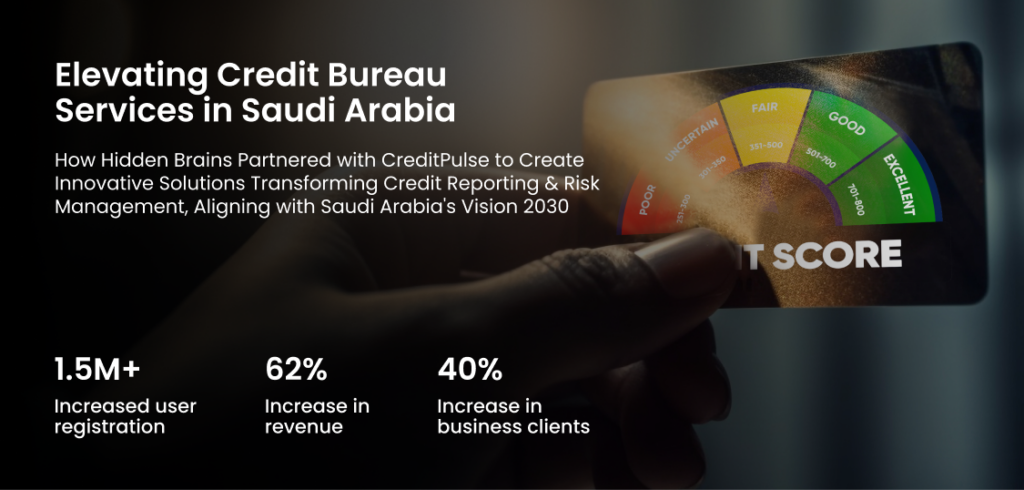
The problem: Traditional credit scoring was limiting financial access for underserved segments. Static models failed to capture the full picture of creditworthiness, particularly for individuals with thin credit files.
What we built: A dynamic, ML-powered credit scoring platform that learns from each customer’s full financial history, past and present transactions, repayment behaviour, and multi-sector signals. The model operates without bias, producing consistent creditworthiness benchmarks used across banks, insurance companies, telecoms, real estate firms, and government bodies.
The result: A scalable, regulatory-compliant predictive credit intelligence system now powering risk decisions across Saudi Arabia’s financial ecosystem.
GT Bank — Digitalising Banking Across Africa
Client: Guaranty Trust Bank, a multinational financial institution operating across Africa and the UK.
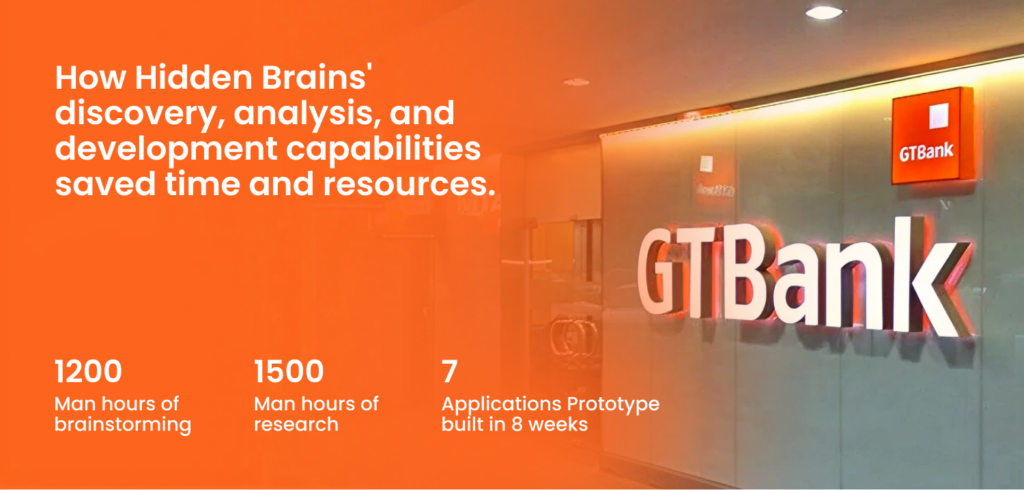
The problem: GT Bank needed to bring its full range of banking services to customers digitally, including populations in markets where branch infrastructure is limited. It needed to work online and offline, integrate with core banking, and handle the scale of one of Africa’s largest banks.
What we built: A custom mobile banking platform enabling digital payments, online/offline fund transfers through core banking infrastructure, and the complete GTBank service suite, accessible to every account holder regardless of connectivity.
The result: A robust, scalable mobile banking system serving millions of GTBank customers across Africa.
How to Integrate Predictive Analytics: The “Why Now” Argument
Early adopters are compounding a data advantage. Their models are trained on richer datasets. Their systems are more refined. The gap between them and late movers widens every single quarter.
That’s not an alarm. That’s maths.
Here’s your 5-step integration roadmap:
Step 1 — Data Collection and Cleaning: Start here. Unify your data sources, transactions, customer behaviour, market signals, and clean before you model. Garbage in, garbage out. That hasn’t changed.
Step 2 — Tool Selection: AWS SageMaker, Azure ML, and Google Vertex AI are the enterprise standards. Match the platform to your existing cloud infrastructure. Don’t rebuild from scratch if you don’t have to.
Step 3 — Model Development: Build for one specific use case first. Fraud detection and credit risk show the fastest ROI. Targeted models outperform general-purpose ones every time.
Step 4 — Implementation with Live Feedback Loops: Static models go stale. Set up real-time data pipelines so your system learns from live outcomes continuously. A model that doesn’t update is a model that degrades.
Step 5 — Compliance and Explainability: Build this in from day one. Not bolted on at the end.
Ready to build? Explore our Fintech Software Development capabilities.
Talk to Us
Compliance Not an Afterthought
This is the section most teams skip. It’s the one they regret skipping.
Here’s the reality of deploying predictive models in financial services: regulators don’t just want to know what your model decided. They want to know why.
And that’s a fair ask.
Think about it from a customer’s perspective. Your model just declined their loan application. Or flagged their transaction as suspicious. Or priced their insurance higher than their neighbour’s. They have every right to know the reason. Not “the algorithm said so.” An actual reason.
That’s not just good ethics. In most markets, it’s the law.
Questions to introspect.
- Why did the model make this decision?
- What data influenced it most?
- Is it treating different customer groups fairly?
If you can answer all three clearly, you’re compliant. If you can’t, you have a problem that will surface at the worst possible time.
The Things Teams Get Wrong – You Should Avoid Them
We’ve got 5 for you here. Learn from others’ expensive mistakes.
1. Dirty Data Kills Good Models: Clean beats large. Every time. Sort your data house before you build on it.
2. Don’t Confuse Historical Performance with Live Performance: A model that aces your test data but fails on live transactions isn’t a win. It’s a liability.
3. For Fraud, Batch Processing is Already Too Late: The signal needs to fire before the transaction clears. If your system runs on scheduled cycles, you’re always one step behind.
4. The Model Flags it. A Human Decides: Predictive analytics sharpens decisions; it doesn’t replace them. Build your workflows accordingly.
5. A Model You Don’t Monitor is a Model that Degrades: Set up feedback loops. Retrain when performance drifts. The worst time to discover your model has gone stale is during a fraud spike.
The Moral of the Story
The financial institutions that will lead the next decade aren’t the ones with the most capital. They’re the ones with the best foresight.
Predictive analytics in fintech isn’t a technology project. It’s a business decision. Do you want to operate in real time, or keep catching up after the fact?
Fraud that’s already cleared. Customers who’ve already churned. Loans that have already defaulted.
The market is growing at 28.3% CAGR. BFSI is leading adoption. AI-powered fraud prevention has demonstrated a significant reduction in losses.
Frequently Asked Questions
Is predictive analytics actually worth it for a small fintech startup, or is it just enterprise hype?
Predictive analytics scales down just as well as it scales up. Start with one use case, fraud detection or credit scoring, and the ROI justifies itself fast. The “enterprise-only” assumption is the most expensive misconception in fintech right now.
How is predictive analytics different from just running reports on historical data?
Reports tell you what happened. Predictive analytics tells you what’s about to happen. One is a rearview mirror. The other is a windshield. The underlying data might be the same; what’s different is the model learning from it in real time.
How do you stop a predictive model from being biased against certain customer groups?
You don’t accidentally stumble into fairness; you build for it. That means diverse training data, regular bias audits, and fairness tools baked into the model architecture from day one. Not reviewed annually. Continuously.
What’s the biggest mistake companies make when implementing predictive analytics in fintech?
Skipping the data quality step and jumping straight to model building. A sophisticated model trained on messy data doesn’t give you better predictions. It gives you confidently wrong ones.
How do I integrate predictive analytics into my legacy system without rebuilding everything from scratch?
You don’t have to rip and replace. The smarter approach is to layer predictive capabilities on top of your existing infrastructure using APIs and middleware. Your legacy system keeps doing what it does, the predictive layer sits alongside it, pulling data, running models, and feeding signals back in real time.
The Bottom Line
At Hidden Brains, we bring 22+ years of fintech development experience, 700+ in-house experts, and a track record across every corner of financial services. With over global clients and collaboration with multinational banking institutions, we know how to drive value, impact, and meet solutions that actually work.
We don’t do generic things. We work with lending platforms, NBFCs, insurance companies, digital banks, and payment processors, and we build predictive systems that are production-ready, regulatory-compliant, and built to scale.