











































![Sales & Distribution [Oil & Gas]](https://www.hiddenbrains.com/blog/wp-content/themes/blankslate/assets/images/sales_and_distribution-icon.74d08193.svg "Sales & Distribution [Oil & Gas]")

![Fluid Terminal Management [Oil & Gas]](https://www.hiddenbrains.com/blog/wp-content/themes/blankslate/assets/images/fluid_terminal_management-icon.4b3a27a4.svg "Fluid Terminal Management [Oil & Gas]")


![Sales & Distribution [Oil & Gas]](https://www.hiddenbrains.com/blog/wp-content/themes/blankslate/assets/images/sales_and_distribution-icon.74d08193.svg?1.0.0 "Sales & Distribution [Oil & Gas]")
![Fluid Terminal Management [Oil & Gas]](https://www.hiddenbrains.com/blog/wp-content/themes/blankslate/assets/images/fluid_terminal_management-icon.4b3a27a4.svg?1.0.0 "Fluid Terminal Management [Oil & Gas]")





































































Summary
The shift from AI experimentation to execution is here.
- AI in education is shifting from experimentation to real-world execution.
- Modern chatbots now offer 24/7 personalized tutoring, streamlined admissions, and instant feedback.
- Integrating AI with institutional data improves retention and graduation outcomes.
- Challenges include data privacy and legacy system integration.
- Leading institutions are adopting proactive, agentic AI systems to support students in real time.
Here’s a scene that played out millions of times last year.
At 11:52 PM, a student is staring at a thermodynamics problem. He’s not emailing his professor. He opens an AI assistant, types his question, and in 40 seconds gets a step-by-step breakdown; first in textbook language, then in plain English. He solves it. He sleeps. He passes.
That interaction costs your institution nothing extra. It happened without a single staff member being present. And it may be the reason that the student re-enrolls next semester.
This is the conversation your leadership team should be having, not “should we explore AI?”
But “where is AI already creating measurable value, and how fast can we scale it?”
What Are AI Chatbots in Education, Really?
Let’s skip the dictionary definition and get straight to what actually matters.
An AI-powered chatbot in education is a software system that uses natural language processing (NLP) and machine learning to hold meaningful, context-aware conversations with students, faculty, or staff. Most executives still picture AI chatbots as glorified FAQ pages. That mental model is costing institutions real money.
Today’s chatbots adapt to a student’s learning level mid-conversation. They integrate with your LMS, SIS, and CRM. They escalate to a human when needed (a feature that gets overlooked constantly, and shouldn’t). They remember context, track patterns, and, in the best deployment, proactively reach out before a student even knows they’re struggling.
Turn Questions into Learning. AI Chatbots. Built for Education.
Talk to Our Team
Key Use Cases of AI Chatbots in Education
Here’s the ideas meet execution: the specific applications that are already delivering measurable results at institutions worldwide.
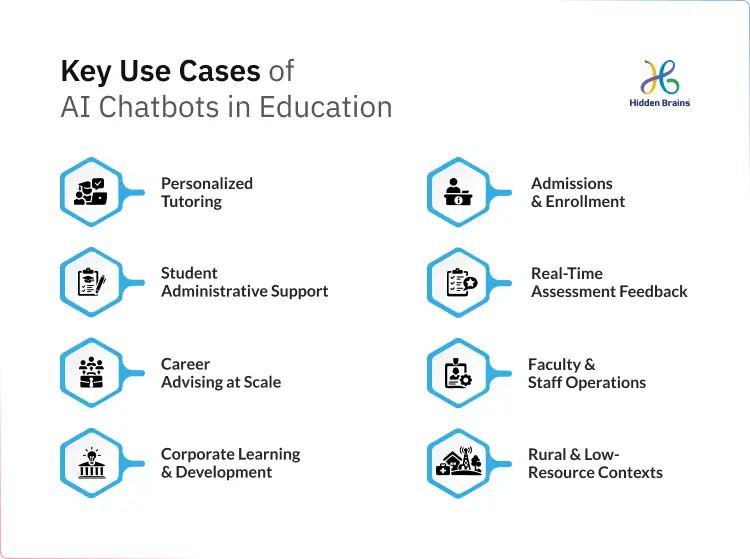
1. Personalized Tutoring: The Midnight Problem Solver
Imagine: A first-generation college student, first in her family to go to university. She can’t afford a private tutor. Office hours closed three hours ago. She types her question into the university’s AI chatbot, and it meets her exactly where she is. It explains the concept at a foundational level, checks her understanding, then walks her through the harder version. She gets it. She comes back tomorrow.
This is personalized tutoring at scale, and it’s not hypothetical. A study examining Rori, an AI math tutor deployed across 11 schools in Ghana, found a statistically significant improvement in math scores with an effect size of 0.37, a result that most in-person interventions would be proud of. Students used it for two 30-minute sessions per week alongside their normal class. That’s it.
The chatbot didn’t replace teachers. It extended them because a good AI chatbot doesn’t compete with educators. It handles the repetitive at-scale stuff so teachers can focus on the irreplaceable human parts.
2. Admissions & Enrollment: The Question That Kills Conversions
Imagine: A prospective student from a small town. First time applying to college. He has ten questions before he can even start the form. He sends an email. Waits two days. Gets a partial answer. Loses momentum. He doesn’t enroll. That’s a student lost, and an empty seat that didn’t need to be.
Admissions chatbots eliminate this problem because they give instant, accurate answers at the exact moment a prospective student needs them. Questions about fees, scholarships, eligibility, deadlines, and documents are handled in seconds, 24/7, without a staff member touching a keyboard.
This isn’t just a convenience upgrade. It’s a revenue conversation. Every unanswered question is a potential dropout from the funnel.
3. Student Administrative Support: The Hidden Time Drain
Here’s something nobody talks about enough: the sheer administrative weight students carry alongside their actual studies. Checking exam schedules. Submitting documents. Navigating financial aid. Figuring out how to change an elective before the deadline.
Picture this: Georgia State University. A student texts “Pounce” at 11 PM, the institution’s AI chatbot. “When’s the last day to drop a course?” Answered in seconds. Without a human. Without a wait. Pounce handled thousands of these interactions — and GSU’s 6-year graduation rate climbed 23 percentage points over 15 years as part of this broader AI-supported initiative. That’s not a coincidence.
The impact on AI chatbots in higher education is especially clear here. Large universities deal with thousands of administrative queries every week. Automating even 60–70% of these, the routine, policy-based ones, frees up advisors for the complex, human-intensive conversations that actually move the needle.
4. Real-Time Assessment Feedback: The Week-Long Wait, Eliminated
Imagine: A Year 12 student submits a draft essay on Friday evening. The AI chatbot reviews it overnight. By Saturday morning, she had specific feedback: two weak arguments flagged, a missing source identified, and a structural suggestion made. A Queensland secondary school ran exactly this experiment and saw an 81% improvement in grades between assessments. The wait time dropped from a week to seconds. Students revised more. They improved faster.
The benefits of AI chatbots in education show up fastest in feedback loops. When students wait a week for feedback, the learning moment has passed. Immediate feedback, specific, actionable, and non-judgmental, keeps students on the problem while the context is still fresh.
5. Career Advising at Scale (Higher Ed’s Biggest Gap)
Career advising is one of the most under-resourced functions in higher education. Ratio of students to career advisors at most universities? Somewhere between painful and absurd.
Imagine: A junior who has skills, interests, and zero clarity. He spends 20 minutes with the institution’s AI career chatbot. It maps his strengths against in-demand roles, surfaces three internships closing this week, and suggests two alumni to connect with. He walks out with a shortlist and a plan. His advisor now has a higher-value conversation to have, instead of starting from scratch.
This is where AI for chatbots in education punches well above its weight. Career guidance chatbots don’t replace advisors; they prepare students to use advisors better.
6. Faculty & Staff Operations: The Quiet Efficiency Win
Not everything is student-facing. Chatbots are quietly transforming back-office operations too, handling leave policy questions, IT support tickets, HR queries, and academic calendar lookups. These interactions are low-value individually but enormous in aggregate.
AI-powered chatbots handling 70% of common HR and operational queries is already an industry benchmark, freeing up people for work that requires judgment, empathy, and institutional knowledge.

7. Corporate Learning & Development: The Upskilling Crisis No One Talks About Loudly
Employees sit through a training module, click through the slides, pass the quiz, and retain almost none of it two weeks later. That’s not a people problem. That’s a delivery problem.
Imagine: A new sales hire. Day 12. She’s on a live call and blanks on a product objection she definitely covered in onboarding. She can’t pause the call to search for a PDF. But she can, in the right setup, have an internal AI chatbot she queries in real time, pulling the exact talking point she needs in under ten seconds.
AI chatbots in corporate education don’t replace training programs. They make them retrievable. Just-in-time knowledge, delivered in the moment of need, not front-loaded into an onboarding week that gets forgotten by month two.
The ROI math is simple: faster ramp time, fewer errors, lower re-training costs. AI chatbots in education extend well beyond campuses, and the enterprise L&D market is catching on fast.
8. Rural & Low-Resource Contexts: The Equity Case for AI
Here’s the uncomfortable reality of EdTech conversations: most of them assume broadband, smartphones, and institutional infrastructure. Most of the world doesn’t have all three.
This is where AI chatbots make their most important argument, not their flashiest one.
Imagine: A student in a rural district. Nearest tutoring center: two hours away. The family can’t afford supplemental coaching. What she does have: a basic Android phone and a WhatsApp account.
That’s exactly what Rori was built for. Deployed via WhatsApp across rural schools in Ghana, it delivered a 0.37 effect size improvement in math scores without a high-speed connection, without an LMS, without institutional IT. Just a chatbot meeting students where they actually are.
The benefits of AI chatbots in education aren’t equally distributed by default. But designed intentionally lightweight, low-bandwidth, accessible on basic devices, they become one of the most powerful equity tools available to policymakers and EdTech builders alike.
The Real Benefits of AI Chatbots in Education
Let’s be direct about this, because a lot of “benefits” lists in EdTech read like marketing copy and say almost nothing.
The numbers that matter: AI-driven learning paths are helping institutions achieve faster course completion rates and improved knowledge retention. By leveraging AI, educational organizations can offer more personalized learning experiences, which contribute to greater student success and operational efficiency.
The global AI tutor market in K–12 is projected to exceed $136.79 billion by 2035.
Here’s what those numbers actually mean in practice:
- Personalized at scale — Not “personalized” in the brochure sense. Chatbots adapt difficulty, pacing, and explanation style based on how individual students actually respond.
- 24/7 without overtime — The operational math is straightforward. One deployed chatbot handles thousands of simultaneous interactions that would otherwise require headcount.
- Measurable retention impact — Georgia State’s data isn’t an outlier. Proactive, AI-driven student outreach consistently moves graduation and retention metrics.
- Cost efficiency that scales — Majority of L&D professionals see AI as a way to scale personalized learning without increasing budget linearly. That’s the core value proposition.
- Staff reallocation, not staff replacement — The institutions getting this right are using chatbots to free up their best people for the work only humans can do.
In short, the AI chatbots in education benefits aren’t soft. They’re operational, financial, and measurably tied to student outcomes.
Real-World Use Cases You Shouldn’t Ignore
Because evidence matters more than enthusiasm, here are the deployments that actually deliver:
Georgia State University — Pounce
Pounce does two things well. It answers student questions via SMS, 24/7, and it flags at-risk students before they fall through the cracks. When the system detects a concerning pattern, a human advisor steps in. Targeted, timely, effective.
The result? Graduation rates climbed significantly, with the biggest gains among first-generation and low-income students.
Georgia Tech — Jill Watson
Built on IBM Watson, Jill was deployed in a large online course to answer student questions. Students didn’t realize for months that they were talking to an AI. The quality bar for what “good” looks like, that’s what this example sets. When a chatbot is accurate, fast, and context-aware enough that students don’t notice the difference, you have something worth scaling.
Khan Academy — Khanmigo
Built on GPT-4, Khanmigo doesn’t give answers; it asks questions back. “What happens if you try a different formula?” It adapts lesson plans for multiple proficiency levels simultaneously. Teachers report saving planning time while students get more differentiated support. That’s not a demo, that’s a deployed product with real educator feedback.
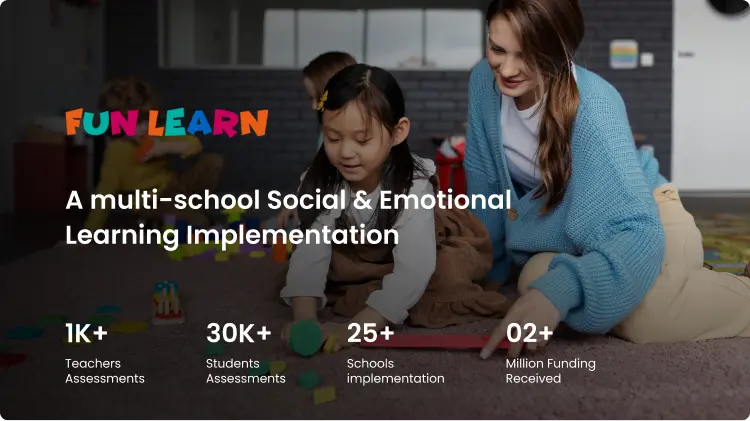
FunLearn— Custom LMS
Not every EdTech problem fits a ready-made solution. FunLearn is a K–8 LMS built in collaboration with a university R&D department, combining digital curricula, personality assessments, goal-setting tools, and a custom teacher assessment algorithm. Piloted across 25 schools.
Result: Improved student grades, stronger SEL awareness, and full buy-in from school leadership.
Integrations included custom DRM, PPT content authoring, browser-to-classroom screen projection, and HubSpot CRM, none of it off-the-shelf, all of it built to spec.
That’s what purpose-built EdTech looks like. And it’s exactly what we bring to AI chatbot development.
Challenges of AI Chatbots in Education (The Honest Version)
Here’s where most blog posts get diplomatic and vague. We’re going to be more useful than that.
Here’s what a failed deployment actually looks like: A university rolls out a chatbot in six weeks. No integration with the student information system. No data governance policy. No escalation path. No staff training. Within a month, students are getting the wrong fee information. A faculty query accidentally surfaces another faculty member’s record. The chatbot gets shut down. The initiative is labeled a failure. But technology wasn’t the problem. The implementation was.
The challenges of AI chatbots in education aren’t technical mysteries; they’re planning failures. Here’s what to actually watch out for:
- Data privacy and compliance — FERPA, GDPR, and local regulations are non-negotiable. Student data is sensitive. Any chatbot deployment needs a privacy framework before a single line of code runs.
- Accuracy and hallucination risk — AI models can generate confident, plausible, wrong answers. Build in human escalation paths, feedback loops, and regular accuracy audits. Non-negotiable.
- Legacy system integration — Most institutions run on SIS, LMS, and CRM systems that weren’t built with APIs in mind. Integration complexity is where timelines blow up. Plan for it.
- The equity gap — A chatbot that only works well on high-bandwidth devices isn’t actually equitable. Rori’s WhatsApp-based delivery in Ghana is instructive here — the best AI design meets students where they actually are.
- Change management — Faculty who feel threatened by AI won’t advocate for it. Institutions that invest in educator buy-in early see dramatically smoother rollouts.
As UNESCO’s guidance on AI in education makes clear, responsible deployment requires governance frameworks, not just capable technology. The institutions winning with AI are the ones that treat governance as infrastructure, not an afterthought.
How AI Chatbots in Education Get Built (And Why “Off-the-Shelf” Usually Isn’t Enough)
There’s a gap between buying a chatbot SaaS subscription and deploying something that actually moves your institutional metrics. The gap is called context.
Your institution’s data, workflows, student profiles, and compliance requirements are unique. A generic chatbot doesn’t know your enrollment flow, your leave policy, or what your at-risk student flags look like. Training and configuring a chatbot to your specific environment is where the real work and the real impact happen.
A solid implementation lifecycle looks like this:
- Discovery — mapping use cases, integration touchpoints, compliance requirements, and stakeholder expectations before anything gets built.
- Conversational design — flow architecture, escalation logic, tone, persona. This is where chatbots feel human or robotic. Don’t skip it.
- Technical integration — LMS, SIS, CRM connections. NLP training on your institution’s specific vocabulary and policies.
- Testing — simulated student journeys, edge case handling, and accuracy benchmarking against your actual student questions.
- Phased rollout — start with one use case, collect feedback, expand. Avoid the big-bang launch.
For institutions that need a purpose-built solution, rather than a generic chatbot dressed in your brand colors, partnering with a specialist makes this significantly less painful. Our AI chatbot development services are built around this exact lifecycle, with education-specific deployment experience that accelerates the process and reduces the implementation risk that sinks most first attempts.
Where AI-powered Chatbots in Education Are Heading
HolonIQ’s 2026 outlook is focused on what comes next: “agentic use cases and proven instructional benefit over broad personalization promises.” That’s the signal to pay attention to.
Imagine 2028: A student logs into her university portal. The AI already flagged she’s struggling with her stats module, three sessions, declining scores. It’s queued three micro-lessons, surfaced a study group that matches her schedule, and drafted a check-in message to her advisor. She didn’t ask for any of it. The system just knew, because it’s been learning alongside her all semester.
This is the trajectory: from reactive (answer questions when asked) to proactive (identify needs before they become crises). From text-based to multimodal, voice, video, and emotionally aware. From siloed tools to embedded infrastructure that works across the entire student lifecycle.
Getting there requires more than a chatbot vendor. It requires an AI architecture that scales, infrastructure that grows with your institution, without requiring a full rebuild every two years. That’s where custom AI development solutions becomes the conversation, not just chatbot deployment. Institutions planning now are building the data foundations and integration layers that will make 2028’s capabilities actually possible.
Frequently Asked Questions
Why should our enterprise invest in AI for learning and development now?
Enterprises should invest in AI for learning and development now because it enables personalized, scalable, and data-driven training that keeps employees’ skills aligned with rapidly changing business needs.
AI can quickly identify skill gaps, recommend targeted learning paths, and provide real-time insights into training effectiveness. This helps organizations accelerate upskilling, improve workforce productivity, and build a future-ready workforce while optimizing training costs.
How does AI in education align with our overall digital transformation strategy?
AI in education aligns with digital transformation by strengthening how organizations build and manage skills. Key ways it supports this include:
Personalized learning: AI tailors training based on employee roles, skills, and learning behavior.
Data-driven insights: Provides real-time analytics on skill gaps and learning performance.
Automation of learning processes: Streamlines course recommendations, assessments, and progress tracking.
Better integration with digital tools: Works with existing LMS and enterprise platforms.
Faster workforce upskilling: Helps organizations adapt quickly to new technologies and business needs.
What business outcomes can we realistically expect?
The goal is to build institutional resilience. This means faster employee onboarding, fewer skill gaps in critical roles, and higher employee engagement. Instead of traditional training, the focus is on providing real-time performance support that helps employees work better and improves overall business results.
What are the most impactful AI use cases in corporate learning?
Some of the most impactful AI use cases in corporate learning include personalized learning paths, automated skill gap analysis, AI-powered content recommendations, intelligent coaching or chatbots, and real-time learning analytics. These use cases help organizations deliver more relevant training and accelerate upskilling.
How can AI help us close skills gaps?
AI allows for a move from “Guessing” to “Mapping.” By analyzing work outputs and project requirements, the software creates a living Skills Ontology. It identifies exactly which team members have the potential to step into new roles and provides the precise bridge of knowledge required to get them there.
Can AI create training content, and is it accurate?
AI acts as a “Force Multiplier” for Subject Matter Experts. It handles the heavy lifting of instructional design, curating, tagging, and structuring, while veterans provide the “Final Mile” of validation. This keeps content libraries fresh without exhausting the organization’s top talent.
How does AI enhance compliance and upskilling?
Instead of mandatory, hours-long videos for everyone, the AI validates mastery through micro-interactions. If an employee demonstrates mastery, they move on. This respects the learner’s time and focuses resources where they are actually needed.
How to integrate AI chatbots into existing systems?
Modern transformation software is platform-agnostic. It functions as an intelligent orchestration layer that sits on top of current LMS or HRIS systems. We don’t “rip and replace”; we enhance and connect, ensuring data flows seamlessly from the system of record to the system of engagement.
Do we need to replace our current learning platform?
Rarely. We recommend an “Extensible Architecture.” The current LMS remains the “System of Record” for compliance and storage, while the AI transformation layer provides the modern, adaptive, and intuitive experience that today’s workforce expects.

The Bottom Line
The student buzzing an AI chatbot at midnight to crack thermodynamics? He’s not an outlier. He’s your student right now, this semester, across every device, in every time zone your institution operates in.
AI chatbots in education are no longer experimental. They’re table stakes, and the gap between institutions that have deployed them thoughtfully and those that haven’t is widening every semester.
Start with one use case where the pain is clearest, such as admissions drop-off, after-hours support, admin query overload, and build from there. Tiny wins compound.
We’ve spent 22+ years building in EdTech, not observing it. Our portfolio means we’ve already navigated the integration headaches, compliance tangles, and legacy system dead-ends you’re about to face. You don’t pay for our learning curve.
Explore our AI chatbot development services, or reach out directly. No pitch decks, just a real conversation.