




















































![Sales & Distribution [Oil & Gas]](https://www.hiddenbrains.com/blog/wp-content/themes/blankslate/assets/images/sales_and_distribution-icon.74d08193.svg "Sales & Distribution [Oil & Gas]")

![Fluid Terminal Management [Oil & Gas]](https://www.hiddenbrains.com/blog/wp-content/themes/blankslate/assets/images/fluid_terminal_management-icon.4b3a27a4.svg "Fluid Terminal Management [Oil & Gas]")


![Sales & Distribution [Oil & Gas]](https://www.hiddenbrains.com/blog/wp-content/themes/blankslate/assets/images/sales_and_distribution-icon.74d08193.svg?1.0.0 "Sales & Distribution [Oil & Gas]")
![Fluid Terminal Management [Oil & Gas]](https://www.hiddenbrains.com/blog/wp-content/themes/blankslate/assets/images/fluid_terminal_management-icon.4b3a27a4.svg?1.0.0 "Fluid Terminal Management [Oil & Gas]")




































































Quick Summary
- This blog breaks down how a structured application modernization strategy can transform enterprise financials.
- Backed by sourced data from McKinsey, Gartner, and Deloitte, it delivers insights grounded in real-world research.
- It explores five core modernization approaches that every C-suite leader should understand.
- It highlights five key profit levers unlocked by modernization: revenue, cost, risk, talent, and customer experience.
- It provides a practical framework to help build a strong, board-level business case.
There’s a scene that’s happening in boardrooms across the globe. A CFO stares at an operations report showing that the majority of the IT budget is being consumed just to keep the lights on, maintaining aging infrastructure, patching outdated code, and manually reconciling data that modern systems would handle automatically. Across the table, the CTO is nodding slowly, recognizing the problem but dreading the disruption.
Sound familiar?
Here’s the truth: a thoughtful application modernization strategy is not a technology project. It’s a profitability project. For C-suite executives, the pressure to grow revenue, reduce costs, and stay competitive, it may be the most consequential business decision on the table right now.
90% of legacy systems hold back businesses, triggering data breaches, operational drag, and inefficiencies that block innovation and agility.
While organizations are expanding overall technology budgets, much of that spend still goes to maintaining existing systems rather than strategic transformation.

Paying More to Maintain Than to Modernize? It’s Time for Change!
Modernize With Us!The Hidden Tax of Legacy Systems: What’s Really on the Balance Sheet
Every enterprise running without a legacy application modernization strategy is paying a hidden tax. It shows up as:
- Escalating maintenance costs for systems that no longer have vendor support. Hardware refresh cycles alone increase significantly annually after warranty expiration
- Security vulnerabilities that expose the company to regulatory fines and reputational damage, legacy systems carry 3x more vulnerabilities than modern equivalents
- Inability to integrate with modern SaaS platforms, partner APIs, or customer-facing tools
- Missed revenue opportunities when digital product launches are delayed by technical debt
Technical debt isn’t just a tech problem. It’s a profit problem wearing a tech costume.
Legacy systems consume a significant portion of IT budgets, with most of the spending focused on maintenance and operations rather than innovation or growth. At the same time, a large percentage of the average enterprise’s IT budget is dedicated to fostering innovation. However, this investment is often limited in effectiveness due to the overhead imposed by rigid, outdated legacy systems.
The good news? When enterprises implement a structured application modernization strategy, the financial return is measurable, significant, and often faster than expected.
The Core Application Modernization Strategies: A C-Suite Playbook
Not every modernization path looks the same. The right legacy application modernization strategy depends on your architecture complexity, business speed, risk tolerance, and long-term technology roadmap. Here are the primary approaches enterprise leaders should evaluate:
Rehost (Lift and Shift)
Move existing applications to a cloud environment without changing the codebase. Think of it as picking up your house and setting it on a better foundation. It’s the fastest, lowest-risk entry point. You reduce infrastructure costs and gain cloud elasticity almost immediately. It’s not a permanent solution, but as a first step, it’s incredibly powerful.
Replatform (Lift, Tinker, and Shift)
Make targeted optimizations during migration, adopting managed database services, and containerizing workloads, without a full code rewrite. This is the sweet spot for many mid-size enterprise platforms: tangible performance gains without the risk of full rearchitecture.
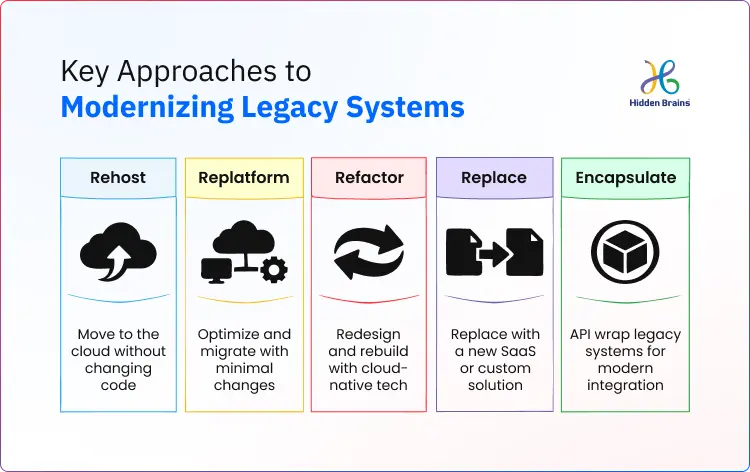
Refactor / Re-architect
The most transformative approach. Rewriting core application logic to take full advantage of cloud-native architectures, microservices, serverless, and event-driven design. It’s more expensive upfront, but the downstream profitability gains are the strongest. For enterprises whose core applications are central to their revenue model, this is often the right answer.
Replace
Sometimes, the most strategic move is to retire an aging application entirely and adopt a modern SaaS or custom-built solution. This sounds disruptive, but when the legacy system is a persistent drain on IT resources, talent, and agility, replacement can deliver the fastest path to ROI.
Encapsulate and Extend
Wrap legacy systems with APIs, enabling modern applications to interact with older architectures without replacing them immediately. This is a particularly elegant approach for large enterprises with complex, deeply embedded systems that can’t be retired overnight.
The worst modernization strategy? Trying to do everything at once. Start with the system causing the most business pain. Win there. Then build momentum.
Real-world Impact: What Application Modernization Actually Delivers
Theory is fine. But executives make decisions based on results.
Studies into advanced software improvement strategies reveal that businesses leading in digital modernization achieved substantially higher revenue growth compared to those trailing behind.
This isn’t just a small edge; it’s a fundamental divide between companies that embraced modernization and those that didn’t. Cloud-native organizations, for instance, experience significantly lower IT costs and much faster feature deployment compared to traditional infrastructure setups.
Furthermore, many organizations are planning to significantly boost their investment in application modernization, making it one of the top technology priorities across the globe.
A great example comes from Hidden Brains legacy modernization, where enterprises shifted from monolithic systems to cloud-native microservices, cutting infrastructure costs, reducing downtime, and accelerating feature deployment.
These outcomes weren’t accidental. They were the direct result of a phased, strategically sequenced modernization roadmap that tied every technology decision to a measurable business outcome from day one.
Why Application Modernization Directly Drives Enterprise Profitability
Let’s get specific about the profit levers that modernization unlocks.
Revenue Acceleration
Modern architectures enable faster feature deployment. Cloud-native companies deploy features 2.5x faster than legacy-constrained competitors. In markets where the first-mover advantage is real, that’s a direct, compounding revenue impact, not a theoretical one.
Cost Reduction
Every dollar spent keeping a legacy system alive is a dollar not building a competitive advantage. Application modernization changes that equation by eliminating the three core cost drivers of technical debt, outdated infrastructure, expensive end-of-life support, and inefficient manual processes.
Cloud environments replace rigid, high-cost architecture with flexible, scalable alternatives. The financial impact is both immediate and lasting: lower operational costs, leaner IT spend, and a budget structure oriented around growth rather than survival.
Risk Mitigation
Legacy systems carry 3x more security vulnerabilities than modern equivalents. The average cost of a data breach has crossed $4.88 million, per IBM Security, and breaches involving legacy systems run 13% higher than that average. For regulated industries, financial services, healthcare, and insurance, PwC data shows financial institutions spend 45% of their IT budget maintaining existing systems, while simultaneously being 40% more likely to experience compliance failures. Modernization addresses both sides of that equation.
Talent Retention and Attraction
The average COBOL programmer is now 55 years old, with a small ratio of that workforce retiring annually. The talent pool to maintain legacy systems is structurally shrinking, and the salary premium to retain those specialists is rising. Modern platforms attract better talent, reduce turnover, and simplify the process by hiring a dedicated developer.
Customer Experience
Ultimately, every modernization initiative should trace back to the customer. Faster application performance, better mobile experiences, and more personalized digital touch points are the outputs of modern architecture and the drivers of customer retention and lifetime value. Modernized systems make these outcomes achievable in a way legacy architecture simply cannot.
Modernization isn’t a cost center. It’s a profit center that takes two to three years to reveal itself fully.
Building the Business Case: What C-suite Leaders Need to Move Ahead
One of the most common friction points in enterprise modernization isn’t the technology; it’s the internal business case. Here’s the framework that works:
Current State Audit
Document what inaction is costing you. Include annual maintenance spend on legacy systems, hours lost to manual workarounds, incident-related revenue loss, and competitive features you couldn’t build because of technical constraints.
ROI Framework
Tie every modernization milestone to a business metric. Not “we migrated to Kubernetes”, but “we reduced deployment lead time from 3 weeks to 2 days, enabling us to launch 6 additional features this quarter.” Business language, not tech language.
Phase the Investment
A phased legacy application modernization strategy, starting with the highest-pain, highest-ROI systems, allows you to demonstrate early wins, build organizational confidence, and course-correct before committing full capital. Note that technical debt compounds annually if left unaddressed; every year of delay makes the eventual program more expensive.
Partner With Proven Expertise
The difference between a modernization project that delivers and one that drains resources often comes down to the legacy modernization partner. Organizations like Hidden Brains, with demonstrated methodology across industries, provide the architectural judgment and execution discipline that enterprise transformations require.

Transformation starts with breaking free from legacy constraints.
Upgrade TodayOur Leadership in Application Modernization: Why Authoritativeness Matters
Application modernization isn’t commodity technology delivery; it’s strategic business transformation executed through technology. The stakes are too high for experimentation with unproven partners.
What distinguished expertise looks like in practice:
- Deep cross-industry methodology refined across hundreds of enterprise engagements.
- An architecture-first approach that aligns technology decisions to business outcomes before a single line of code is written.
- Proven frameworks for risk mitigation, change management, and stakeholder alignment.
- Post-modernization supports models that ensure enterprises capture long-term value, not just short-term technical wins.
This is what leadership in application modernization actually means: not the vendor who promises the fastest migration, but the partner who ensures you emerge from modernization with a stronger business model, not just a more modern code base.
The right modernization partner doesn’t just upgrade your technology. They upgrade your organization’s capacity to compete.
Frequently Asked Questions
Got questions about legacy system modernization? We’ve answered the ones you’re probably already thinking about.
What is an application modernization strategy, and why does it matter for enterprises?
An application modernization strategy is a deliberate, phased plan to update or replace legacy software systems with modern architectures, cloud-native, microservices, and API-first that deliver better performance, security, and business agility.
For enterprises, it matters because legacy systems are not neutral. With the majority of IT budgets consumed by maintenance, they actively consume capital, slow innovation, increase security risk, and limit competitive response.
What is the difference between an application modernization strategy and a legacy application modernization strategy?
The terms are often used interchangeably, but the emphasis differs slightly. “Application modernization strategy” is the broader discipline; it applies to any application improvement effort, including greenfield enhancements. “Legacy application modernization strategy” specifically addresses aging, outdated systems that have become technical and financial liabilities.
In enterprise contexts, most modernization work is legacy modernization, given the prevalence of systems built 10–30 years ago that were never designed for today’s digital economy.
How long does an enterprise application modernization program typically take?
Timelines for enterprise application modernization can vary widely based on scope and complexity. A focused rehosting of a single critical application might take a few weeks to a couple of months, depending on specific requirements.
On the other hand, a comprehensive re-architecture, such as transitioning from monolithic on-premise systems to cloud-native microservices, generally spans a longer period, often executed in phases over the course of a year or more. The key principle is to prioritize high-impact systems and build organizational momentum through measurable successes at each stage.
What is the expected ROI of an enterprise application modernization strategy?
Enterprise application modernization delivers strong ROI, with companies that lead in modernization seeing significantly higher revenue growth. Cloud-native organizations reduce IT costs and deploy features faster.
When factoring in revenue growth, risk reduction, and infrastructure savings, the total ROI over five years is substantial.
The key is to consider the full benefits, including cost avoidance, productivity gains, and revenue potential.
What are the biggest risks in enterprise application modernization, and how are they mitigated?
The three most common failure modes are scope creep (attempting to modernize everything simultaneously), misalignment between IT and business stakeholders (treating modernization as a tech project rather than a business transformation), and underestimating organizational change management.
It is estimated that many modernization projects fail due to a lack of domain expertise and planning. Mitigation requires executive sponsorship, a phased roadmap with measurable business milestones, and an experienced implementation partner with cross-industry methodology.
Why is partnering with an expert firm essential for enterprise application modernization?
Partnering with an expert firm is crucial for successful enterprise application modernization, as the risk of failure in poorly executed projects is high. Failed initiatives not only lead to budget overruns but also drain capital, damage executive confidence, and delay competitive progress.
Expert partners like Hidden Brains provide proven frameworks, cross-industry experience, and architectural expertise that shorten learning curves and mitigate execution risks. They ensure that every technology decision is aligned with business outcomes from the start, guaranteeing that modernization drives measurable profitability improvements, rather than just updating the codebase.
The Bottom Line
Application modernization is, at its heart, a business decision. It’s about freeing capital trapped in maintenance overhead, accelerating revenue through faster innovation, reducing risk exposure that threatens enterprise value, and building the organizational capability to outcompete in an increasingly digital economy.
The enterprises winning in their markets, growing faster, attracting better talent, and delighting customers with better digital experiences are not running on legacy systems. They made the decision to modernize, built a structured strategy, and are now harvesting the returns.
