




























































































































Want faster AI, fewer headaches, and real results?
This blog lists the top 11 MLOps tools every startup needs to thrive in 2025. MLOps isn’t just for big tech; these tools help lean teams move faster, scale smarter, and avoid costly AI pitfalls. From model deployment to real-time monitoring, we unpack how startups like yours can benefit without overspending. Whether building your first MVP or managing multiple pipelines, the right MLOps stack can change your AI game. Dive in to learn how to turn your machine learning ideas into a production-ready reality with less tech debt and more business wins.
MLOps Tools: Machine Learning and data engineering go hand in hand with DevOps. These tools do not qualify as some seamy add-ons, but rather the fundamental force to construct novel, scalable AI solutions that can work in reality.
Here’s a stat that might surprise you:
The U.S. MLOps market is expected to cross $11 billion by 2034 Big companies lead the way. But guess what? Startups stand to gain even more. If you’re building AI into your product, MLOps platforms can save you time, cut costs, and help you scale faster.
They’re not just for tech giants, they’re for innovative, fast-moving businesses like yours. Let’s explore the 11 best MLOps tools that can give your startup an edge in 2025.

What Are MLOps Tools?
MLOps stands for Machine Learning Operations.
It’s the practice of managing the entire lifecycle of a machine learning model, from training and testing to deployment and monitoring. If you partner with a reputed AI development company, it manages the entire operation.
MLOps tools are the systems and platforms that make this process smooth, fast, and reliable. Think of MLOps as DevOps for AI. Just like DevOps transformed how we build and deploy apps, MLOps is changing machine learning in the same way.
It combines the best of DevOps, data engineering, and ML to help teams put models into production very quickly and with far less pain. MLOps tools also deliver automation, repeatability, and management of your AI workflow, without endless manual interventions.
11 MLOps Tools to Supercharge AI in 2025
The best MLOps tools will save your startup enormous time and money, as well as headaches. In any case, here is our highly selective list of the 11 MLOps tools that will make your AI projects lean, fast and ready to go into production by 2025.
1. MLflow Overview
A free, cloud-based, open-source project dedicated to the lifecycle management of ML, such as tracking of experiments, packaging of code, and deployment frameworks.
Key Features
- Experiment tracking
- Model registry
- Reproducible runs
- Integration with many ML libraries
Best For: Small early-stage startups are looking for lightweight, flexible MLOps platforms that do not ” lock in with the supplier”.
Why It Matters: MLflow keeps your projects organized and reproducible from the start, no more guessing which version worked best.
Real-life Example: San Francisco-based Chime tracked its experiments using MLflow, with the help of which it launched its AI-based banking application 30 percent faster, and it currently has 14 million users.
2. Kubeflow Overview
A powerful MLOps platform built to run on Kubernetes. It helps manage end-to-end ML pipelines at scale.
Key Features
- Pipeline automation
- JupyterHub integration
- Kubernetes-native
- Model training and deployment workflows
Best For: Tech-heavy startups with Kubernetes expertise and a need to scale fast.
Why It Matters: Kubeflow turns your ML projects into genuine cloud-native and scalable ones, which fit well with the teams that expect intense scaling.
Real-life Example: ExxonMobil (Texas) leverages oil and gas analytics with Kubeflow, Petabyte-scale seismic data, saving $50m annually.
3. Weights & Biases (W&B) Overview
A popular tool for tracking experiments, visualizing models, and collaborating with your ML team.
Key Features:
- Real-time experiment dashboards
- Model versioning
- Collaborative reports
- Integrates with most ML frameworks
Best For: AI-driven startups focused on deep learning and frequent experimentation.
Why It Matters: W&B helps you see your model’s performance in action, making collaboration and iteration easier than ever.
Real-life Example: Lyft (San Francisco) runs W&B to find the best pricing models to increase ride efficiency for 40 million users.
4. AWS SageMaker Overview
A fully managed ML service from Amazon that covers everything from data prep to model deployment.
Key Features
- Built-in AutoML
- SageMaker Studio IDE
- Training and tuning jobs
- Real-time model serving
Best For: Startups already on AWS are looking for a one-stop shop for ML.
Why It Matters: It offers enterprise-grade tooling, even for small teams. You get speed, security, and scalability out of the box.
Real-life Example: SageMaker is used by Plaid (San Francisco) to power Fintech APIs supporting the USD 13.4 billion valuation.
5. Metaflow Overview
Initially developed by Netflix, Metaflow is a human-centric Python library that manages real-world ML projects.
Key Features
- Version control for code, data, and experiments
- Built-in support for AWS
- Easy debugging
- Local and cloud execution
Best For: Data scientists who prefer writing simple code over managing infrastructure.
Why It Matters: It lets you focus on your models, not on the plumbing. Great for startups with lean ML teams.
Real-life Examples: Netflix applies Metaflow to boost recommendation relevance by 20% for 250 million users, one personalized experience at a time.
6. Google Vertex AI Overview
Google’s unified platform that brings AutoML and custom model development together.
Key Features
- Pre-built ML APIs
- Model monitoring and drift detection
- AutoML + custom training
- Pipelines and deployment support
Best For: Startups using Google Cloud are looking for a flexible and powerful ML stack.
Why It Matters: Vertex AI makes it easy to train, tune, and deploy new AI in minutes, whether with code or no-code AutoML.
Real-life Example: Waymo (Mountain View, CA) deploys Vertex AI for an autonomous driving Model, processing 1 PB of Sensor Data Daily.
7. Azure Machine Learning Overview
Microsoft’s end-to-end MLOps platform has comprehensive connections with the Azure ecosystem.
Key Features
- Automated ML
- ML pipelines
- Data labeling tools
- Responsible AI dashboards
Best For: Startups already using Microsoft tools and looking for tight ecosystem integration.
Why It Matters: You can obtain the best MLOps platforms without starting from scratch, where you must build everything.
Real-life Example: Microsoft (Redmond, WA) uses Azure ML for the search algorithms of Bing, which has 8.5 billion searches every day.
8. Feast Overview
An open-source feature store that helps you manage, serve, and reuse ML features across models.
Key Features
- Real-time and batch feature serving
- Feature versioning
- Decouples data engineering from model training
- Works with BigQuery, Redis, Snowflake, etc.
Best For: Startups scaling multiple ML models that rely on shared data.
Why It Matters: Feast helps ensure feature consistency, saving time and reducing model errors down the line.
Real-life Example: The payment processing models at Stripe (San Francisco) operate with the help of Feast, handling USD 817 billion in transactions.
9. Pachyderm Overview
A data versioning and lineage tool that helps you track exactly how data changes over time.
Key Features:
- Git-like version control for data
- Pipeline automation
- Data lineage tracking
- Scales with Kubernetes
Best For: Startups in regulated industries or those handling sensitive, fast-changing datasets.
Why It Matters: It gives you complete transparency and traceability, which are critical for compliance and trust.
Real-life Example: Shell, like 30% of US energy firms, runs Pachyderm on data-intensive seismic processing, cutting downtimes to 35%.
10. ZenML Overview
An extensible MLOps framework focused on reproducibility and pipeline standardization.
Key Features
- Reusable pipeline components
- Integration with central cloud and on-prem tools
- CLI and UI for pipeline control
- Vendor-agnostic
Best For: Startups that want machine learning monitoring tools without getting locked into one provider.
Why It Matters: ZenML helps you build repeatable, production-ready pipelines without the vendor baggage.
Real-life Example: Airbnb (San Francisco) uses ZenML for recommendation models, serving 150 million users.
11. Fiddler AI Overview
A model monitoring and explainability platform to help you understand how your models behave in the real world.
Key Features
- Bias detection and fairness checks
- Drift monitoring
- Explainability dashboards
- Alerts and diagnostics
Best For: Startups in high-stakes fields like finance, healthcare, or legal tech.
Why It Matters: Trust in AI is everything. Fiddler gives you the tools to explain, monitor, and defend your models.
Real-life Example: JPMorgan Chase (New York) uses Fiddler AI for loan models, ensuring fairness for USD 2.5 trillion in assets.
Role of MLOps in the AI Lifecycle
- From experimentation to production: MLOps tools help teams move ideas from notebooks to production systems, without messy handoffs.
- Automating the “last mile”: Rarely does this involve manually training and testing models, updating, and so on.
- Reproducibility and scale: Monitor all data, code, and measures to be able to scale without fear and address compliance requirements
Why MLOps is a Smart Investment for Startups
- Encourages fast, agile experimentation: Test more ideas with less friction.
- Reduces failure and tech debt: Stop worrying about broken pipelines or untracked models.
- Drives real business results: Get models into production faster, measure impact clearly, and iterate based on results.
Briefly said, MLOps tools do not only transform AI into a startup resource, but are also designed to expand.
Benefits of MLOps Tools for Your Startup
One thing is clear: startups cannot afford to spend time or money. You must develop quickly, test even faster, and keep everything running smoothly.
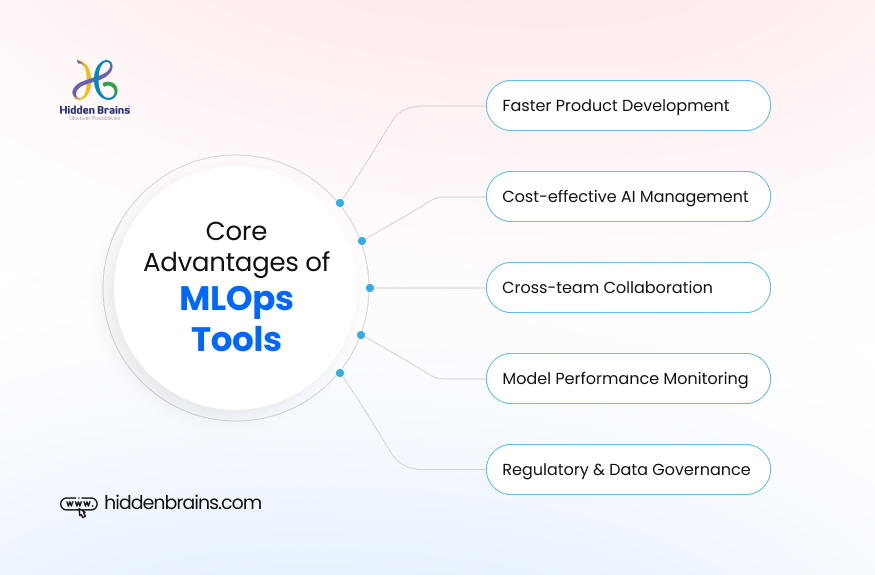
That’s where MLOps tools come in. They’re not just for big tech. They’re built to help small teams punch above their weight. Here’s how
Faster Product Iteration Cycles
No more waiting weeks to ship an update. MLOps tools let you build, test, and deploy models in a few days. You move fast. Your AI should too.
Cost-efficient Scaling of AI Workloads
These tools are cloud-ready. You only use (and pay for) the computing power you need. That means more power, less spending.
Cross-team Collaboration & Workflow Transparency
All of them remain on the same level: data scientists, engineers, and product teams. You see the same results, track the same models, and fix issues faster, no more silos.
Model Performance Monitoring = Business Uptime
Bad models can break products. MLOps tools watch performance in real time. If things drift, you get alerts before users notice.
Regulatory & Data Governance Readiness
Need to show where your data came from or how your model made a decision? MLOps tools keep everything tracked and versioned. Perfect if you’re in finance, healthcare, or anything with rules.
Core Components of MLOps Tools
The tools of MLOps are also not all about automation; they are instead about establishing a quality base that could ensure scaling and trustworthy AI. These are the main ingredients of how it all works:
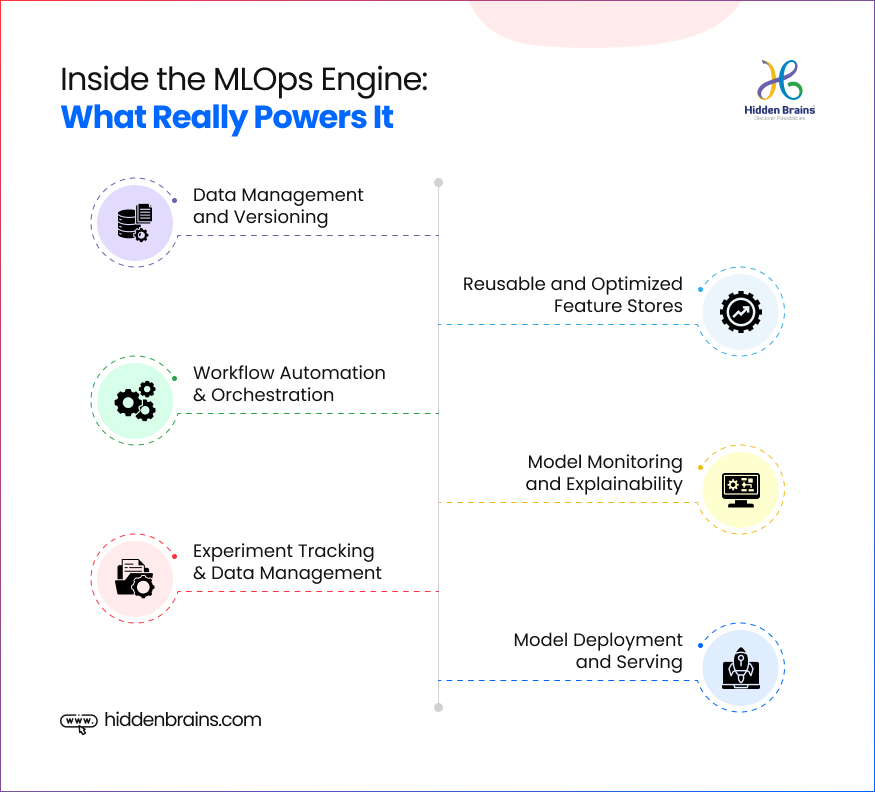
- Data Management and Versioning: Keep track of datasets, changes, and lineage so you always know what trained your model.
- Experiment Tracking and Metadata Management: Log every run, parameter, and result. Never lose track of what worked and why.
- Workflow Orchestration: Automate the steps from data to deployment. Build repeatable, reliable pipelines.
- Model Deployment and Serving: Push models live with confidence, whether it’s real-time or batch.
- Model Monitoring and Explainability: Know when a model drifts and understand how it makes decisions.
- Feature Stores: Reuse and manage features across projects for consistency and speed.
How to Choose the Right MLOps Stack for Your Startup
The thing is that there is nothing like a universal fit in MLOps. The stage of your startup, team, objectives, and budget will determine the appropriate stack.
Stage of Growth
If you’re creating an MVP, use free tools initially and save time and budget. Invest in automation and monitoring to ensure your AI systems scale smoothly and reliably. Running mature AI operations? Go for enterprise-ready platforms.
Team Composition
A data science-heavy team might prefer user-friendly tools like Metaflow or W&B. Do you have ML engineers and DevOps? Tools like Kubeflow or SageMaker will shine.
Cloud Strategy
Match your stack to your cloud: AWS, Azure, GCP, or hybrid.
Budget Considerations
Open-source tools save costs early on. Managed services cost more but reduce setup and maintenance overhead.
Integration Needs
Use tools that integrate with our existing technological ecosystem to simplify workflow.

Unlock MLOps Innovation with Hidden Brains
Ready to scale your AI the smart way?
We at Hidden Brains assist startups with incorporating the appropriate MLOps solutions and creating stable, production-ready AI systems. We have you covered, whether it is MVP or enterprise-level solutions. Aim together to make your AI experience.
Frequently Asked Questions
You are not alone in exploring the best MLOps tools for your startup. Different founders have the same concerns when it comes to the adoption of AI and making it scalable. Some of the frequently asked questions are answered hereunder.
Do I need MLOps if I’m building an MVP?
Sometimes you need them. Even basic experiment tracking and version control can save time and reduce errors. Start small and scale as your needs grow.
What’s the difference between MLOps and DevOps?
DevOps focuses on software delivery. MLOps adds layers like model training, data handling, and post-deployment monitoring of AI performance.
Can I use MLOps tools without a dedicated ML engineer?
Even though tools like Metaflow, MLflow, or SageMaker are designed to be beginner-friendly, you need a dedicated ML engineer to customize their features and modify them if required to meet your specific business needs.
Are open-source MLOps tools good enough for startups?
Absolutely. They’re cost-effective, flexible, and great for early-stage teams, especially with cloud services.
How do I measure the ROI of MLOps tools?
Look at faster deployment cycles, reduced model failures, better team collaboration, and lower operational costs. These are your real wins.



Conclusion
MLOps tools are not optional anymore; they have become a must-have toolbox when scaling reliable AI products in startups. You would be a step ahead with the right tools and be able to move quickly, be less expensive, and spend less time. To be world AI leaders in 2025 and beyond, start small and do your calculations smartly with MLOps.