

































































Summary:
Planning to build a software product for your startup but not sure where to begin? This blog is your go-to guide. From understanding what startup software development really means to building MVPs, estimating costs, choosing the right tech stack, and hiring developers, you’ll find practical insights every founder needs. Whether you’re bootstrapped or investor-backed, this roadmap will help you launch smarter, avoid costly mistakes, and scale with confidence. Learn from real-world examples, explore hiring tips, and discover why choosing the right development partner is critical to your success. Ready to bring your startup idea to life? Dive in!
The rise of startups in the digital age is inspiring—but did you know that 90% of them fail, often because they don’t embrace the right technology? In today’s world, a startup without a solid web and mobile app is like a car without fuel. But where do you even begin with software development? If you’re a founder with a head full of questions, this blog is for you.
We’ve gathered the most important answers you need to make informed decisions before you choose the finest startup software development company. Ready to turn your idea into a powerful product? Keep reading, our startup’s roadmap starts here!
What is Software Development for Startups?
Got a bold startup idea? Great. But turning that idea into a real, working product? That’s where startup software development comes in.
Selecting the right development tools is crucial for building a scalable product. Comparison platforms like G2, Capterra, and Techimply help teams explore and evaluate the best options.
Startup software development is not about solid and permanent software like the one that existed back in the day; it is all about being swift, responsive and rapid. It enables you to establish a good digital presence, streamline operations, and lead the market curve.
Need to test fast? Pivot faster? Rapid prototyping, MVPs are meant to do that. It is your tech backbone, designed to improve, grow and ensure your idea cannot be courted.
Because in a startup world, speed + strategy = survival.

What is an MVP and Why is It Critical for Startups?
An MVP, or Minimum Viable Product, is the basic version of a tech product that allows you to test the market response with real users and use that feedback to improve your app further. How can it make or break your startup? Let’s discuss.
What exactly is an MVP?
An MVP, or Minimum Viable Product, is your product’s most basic functioning form – the bare bones with merely enough functions to address the fundamental issue and put it into the hands of the actual consumers.
It’s not about launching big. It’s about launching smart, fast, and focused.
Why should startups start with an MVP?
Because you don’t want to burn time and money building something people don’t like.
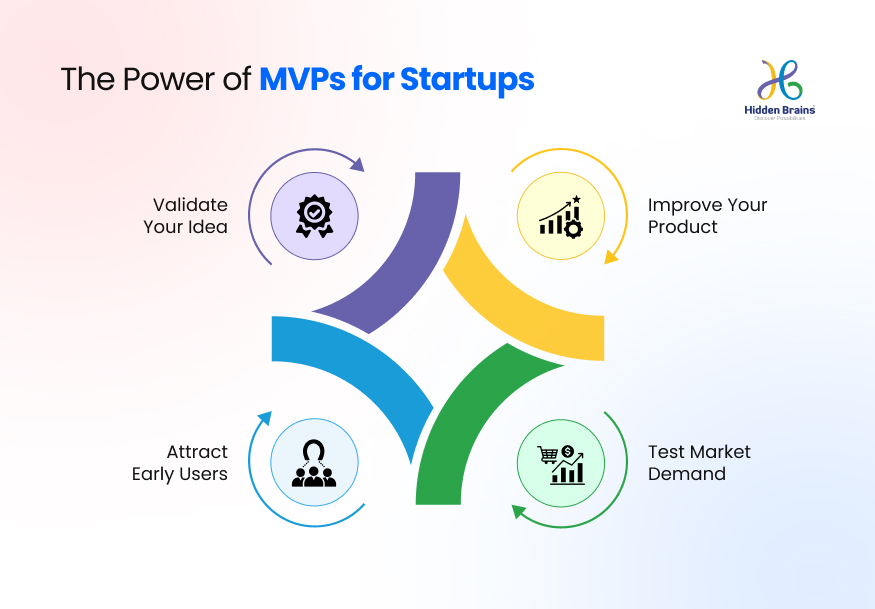
Here’s what an MVP helps you do:
- Validate your idea in the real world
- Attract early adopters and investors
- Test market demand before scaling
- Learn quickly and pivot when needed
How MVPs Powered Startup Growth: Real-world Examples
All the most successful startups are guided by audacious ideas, not the perfect product. The difference between winning startups and others is that the first team created a fast, lean product on which they can test their vision.
A good MVP allows proving presumptions, finding early adopters, and adapting rapidly, neither software but your launch strategy, proof of concept, and the first step of growth.
- Amazon: Started as a basic online bookstore to test if people would buy books online, now the world’s largest eCommerce empire.
- Dropbox: Launched a simple explainer video to prove cloud sync made sense. Demand exploded before a line of code was written.
- Spotify: Created a desktop app with just one feature, music streaming, to test three big things: user demand, artist approval, and instant playback tech.
How Much Does It Cost to Build a Software for a Startup?
The cost of developing a startup software system may be significantly higher or lower depending on the scale, service complexity, and location. The minimum price of creating a basic MVP can be about $15,000 to $50,000, whereas a fully-fledged product with more sophisticated features may exceed $200.000.
Let’s understand the cost of startup software development with the help of a cost breakdown for different development stages:
- Requirement Analysis: $1000 – $5000
- UI/UX Design: $2,000 – $10,000
- Planning & Architecture: $1,000 – $2,000
- Development / Coding: $10,000 – $200K+
- QA & Testing: 15 – 25 % of overall developmental cost
- Project Management: 10 – 20 % more of the total development cost
- Maintenance and Updates: 15 – 20 % additional cost in a year on the development cost
Also read: How a Seasoned Entrepreneur from Manhattan Built an AI-Powered Boardroom to Create a Positive Business Impact
What’s the Average Hourly Rate to Hire Developers for Startup Software Development?
When you are on a limited budget, where you obtain your developers will make a colossal difference. Location influences the hourly rates, the total development cost, and the project schedule. The proper selection of the region will assist you in maximizing your quality and ensure your budget is within the right line- for every early-stage founder, this should be perfect.
Here’s a quick look at average hourly rates by region:
- USA/Canada: $100 – $200/hr
- Western Europe: $20 – $120/hr
- Eastern Europe: $30 – $60/hr
- India and Southeast Asia: $30 – $50/hr
- Latin America: $30 – $50/hr
Is It Cheaper to Outsource Software Development for Startups?
Yes, outsourcing startup software development is cost-effective. Outsourcing lets you tap into skilled global talent at a fraction of local costs. Plus, you skip the hiring hassle and hit the ground running. It’s great to build faster, test quicker, and bring your product to market without draining your startup budget.
Where to Find Reliable Software Development Teams for Startups?
Identifying the right people is half of the battle won. Freelance and agency platforms are another way that startups may consider, as these platforms, such as Upwork, Toptal, Clutch, and GoodFirms, have already been vetted. These sites offer reviews, portfolios, and guaranteed ratings to help you with hiring.
What are the Best Platforms to Hire Developers for Startups?
You don’t have to look far, top platforms include:
- Upwork: Wide talent pool with flexible pricing
- Toptal: Pre-vetted top 3% of freelancers
- Clutch & GoodFirms: Agency-focused listings
- Dice.com: Great for tech-specific job postings
- GitHub Jobs: Ideal for finding passionate coders
Also read: Top Offshore Software Development Trends And Tips For 2025
What are the Top Interview Questions for Startup Software Developers?
Hiring for startup software development? You will require developers who can think on their feet, be flexible and even wear several hats. Thoughtful questions to ask are as follows:
- Tell us about a project that you built from scratch.
- How do you manage last-minute deadlines and priorities?
- What would happen if one of the features went wrong just before release?
- Are you comfortable working without detailed specs?
- Have you ever worked on MVP or a startup product?
- What are your priorities, writing perfect code or shipping fast?
Look for problem-solvers, not just coders.
How to Assess a Developer’s Technical Abilities and Portfolio for a Startup?
It’s crucial to evaluate the skills and abilities of a developer before hiring him for your start-up. Begin with their portfolio–that is their tale. Search projects that are similar to what you require. View clean and well-documented code at GitHub. Request live demos so that you can observe them at work. Go further into the technical tests or test work on tasks related to your project.
You should also observe problem-solving abilities. Inquire about setbacks that they have experienced and how they conquered them. Even better, if they already have startup or MVP experience, they will understand what it means to trade speed with quality. Follow your instincts, a suitable developer will shine through, especially when you pair that talent with support from a nearshore webflow agency that can help you scale efficiently.
What Tech Stack is Best for Startup Software Development?
The selection of the tech stack is never a matter of being trendy but picking the ones that will best satisfy the startup aims, its cost, and time to market. The way it can be broken down is as follows:
For Web App MVPs
- MERN (MongoDB, Express.js, React, Node.js)
- MEAN (MongoDB, Express.js, Angular, Node.js)
- Great for dynamic, scalable applications
- Strong community support
- Reusable components for faster development
You must hire dedicated MEAN stack developers to build an application with intuitive and highly responsive interfaces. This stack allows you to deploy your product to the market at a rapid speed.
For Mobile App MVPs
- React Native
- Flutter
- Single codebase for both iOS & Android
- Faster to build and launch
- Ideal for MVPs with moderate complexity
You should hire dedicated Flutter developers if you want to expand your reach by developing top-notch cross-platform applications.
For AI-driven or Data-Intensive Apps
- Python + Django/FastAPI + TensorFlow
- Powerful for machine learning and automation
- Efficient with large-scale data processing
- Clean syntax and strong library support
Hiring Python developers can be ideal if you want to build a complex application for your startup while making it user-friendly.
Looking for a Tech Partner to Scale Your Startup? Trust Hidden Brains
At Hidden Brains, we do not only build software. We collaborate with start-ups to make big dreams come true and create scalable and future-ready products. Whether it is a lean MVP to test a vision or the whole-scale application to conquer your market, our team will provide a full scope of services, including strategy and design, development, and growth scaling after launch.
Having outstanding knowledge in startup-concentrated tech stacks, agile delivery, and impressive experience in assisting startups worldwide, we are here to accompany you through all the success stages of your growth.
Frequently Asked Questions
Do you have further questions? These are some of the additional questions that are usually posed by startup founders when considering the option of developing software:
What is the duration of developing a startup software?
MVPs typically take 2 to 6 months; full-scale products can take longer on more complex items.
Can I make changes to my MVP once it is launched?
Yes! MVPs are made to change. Periodic improvements assist in keeping in line with user comments.
Do I need to bother with scalability during the phase of MVP?
Be lean, but make the architecture scalable so they do not have to start over.
Custom software vs no-code tools: which is better?
No code is applicable during initial tests. Custom software provides long-term flexibility.
Where can I get funding for software development?
Start with a transparent MVP plan – it will be easy to pitch once you validate your idea.



Conclusion
Startup software development is a fantastic idea and necessary to move forward in this digital age. The correct tech stack, lean MVP, and credible development partner will help you go faster and smarter and can scale your business much more rapidly. You can make your software your most significant strength and complete the journey from a startup to a next-gen unicorn.
