



































































































































Quick summary
- Palm oil data breaks at six handoffs: weighbridge, mill, tank, dispatch, logistics, and finance.
- Each break hides oil losses, causes supplier disputes, and delays month-end margins.
- EUDR applies from December 30, 2026, so every consignment needs origin evidence that links back to these records.
- Traceability comes out of connected operations; it doesn’t work as a separate software layer.
- There are three ways to fix it: integrate existing systems, consolidate onto one ERP, or phase the two.
- Start with a one-mill, one-month reconciliation audit.
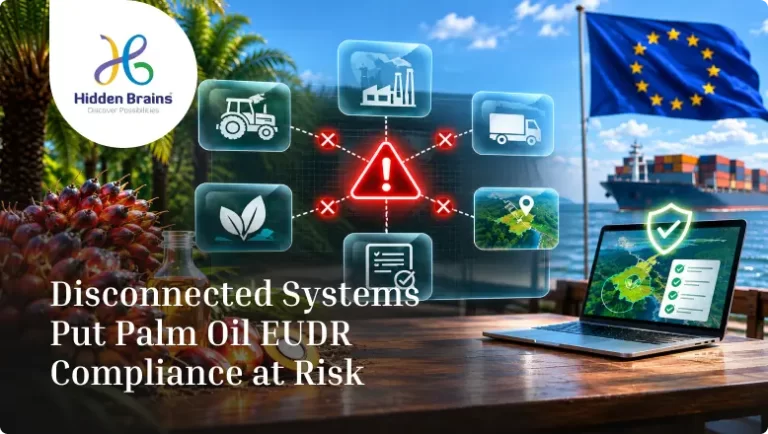
Disconnected systems in palm oil industry operations mean the weighbridge, procurement, mill, tank farm, transport, and finance teams each record the same crop in a different place, and those records rarely agree. Each function runs its own tool, whether that is procurement software, a transport management solution, or financial accounting software, and none of them shares a record with the next. A truck of fresh fruit bunches (FFB) is weighed in one system, graded on a paper slip, paid from a spreadsheet, and turned into crude palm oil (CPO) that lives in a mill logbook. By month-end, nobody can say with confidence how many tonnes came in, how much oil came out, and where it went.
That gap used to be an efficiency problem. It is now a market-access problem. The EU Deforestation Regulation (EUDR) applies to large and medium operators from December 30, 2026, and every consignment placed on the EU market needs evidence that links product to origin. That evidence is assembled from the same operational transactions that disconnected systems fail to connect.
This guide maps the six handoff points where palm oil data breaks, what each break costs, and how to decide between software integration services that connect the systems you already have and moving to a single platform.
What Do Disconnected Systems Look Like in a Palm Oil Business?
They look like a set of tools that each work on their own but cannot see each other. Most palm oil supply chain challenges inside a company trace back to this: every function has a record, but no record follows the crop from one function to the next.
| Function | Typical tool | What it cannot see |
|---|---|---|
| Weighbridge | Standalone weighbridge software or indicator printout | Supplier contract, grading result, payment status |
| FFB grading | Paper slip or a separate spreadsheet | The weighbridge ticket it belongs to, the final payment deduction |
| Procurement and supplier payment | Accounting package or spreadsheet | Net tonnage after grading, what the mill actually processed |
| Mill production | Logbook, control-room screens, daily Excel report | Which suppliers’ fruit was processed, live tank levels |
| Storage | Manual tank dip sheets | Production entries, dispatch tickets |
| Dispatch and transport | Transporter’s own system, delivery orders, messaging apps | Tank stock, the weight the refinery or port received |
| Finance and compliance | General ledger, certification portals | Everything upstream until someone re-keys it |
Manual reporting in palm oil mills fills the gaps between these tools. Clerks re-type weights, production figures, and dispatch quantities into the next system, often the morning after. The daily report then explains what happened yesterday instead of supporting a decision today.
Scale makes it worse. Indonesia alone has more than 1,200 palm oil mills, and a single mill can buy from thousands of smallholders. Every supplier adds weighbridge tickets, grading records, and payments that have to line up.
Still Reconciling Mill Data Manually?
Start Automating Now
Where Does Palm Oil Data Break? The Six Handoff Points
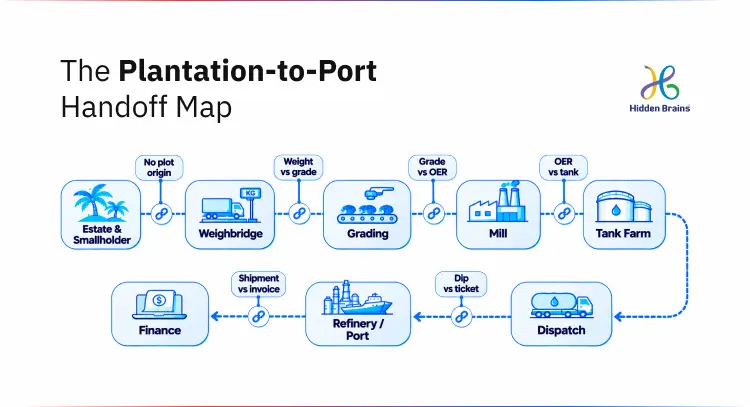
Palm oil data breaks wherever one team’s output becomes another team’s input, and the record is re-entered instead of passed on. Six handoffs account for most of the damage.
1. Weighbridge to Procurement: FFB Intake, Grading and Supplier Payment
The first break happens before any oil is produced. The weighbridge captures gross and tare weight, graders record deductions for unripe bunches, empty bunches, or long stalks, and procurement pays the supplier on the net figure. When weight and grading do not share one transaction record, three things follow: payment disputes, deductions applied inconsistently, and no reliable link between a delivery and the plot it came from.
This handoff never rests. Commercial estates harvest the same blocks as often as every seven days, so intake volume is continuous rather than seasonal. Our procurement software solution starts here for that reason.
2. Procurement to Production: What Arrived Versus What Was Processed
The second break sits between the intake yard and the mill floor. FFB is usually processed within about a day of harvest because free fatty acid (FFA) levels rise while bunches wait. The mill reports oil extraction rate (OER) against the FFB it processed, while procurement holds the FFB it received. If those two numbers live in separate systems, OER is calculated on the wrong base and oil losses stay hidden.
Palm oil mill production tracking only works when the mill’s FFB-processed figure comes from the same intake records procurement paid against.
3. Production to Storage: CPO and Kernels Into Tanks and Silos
The third break is between the production report and the tank. The mill reports a CPO figure for the shift. The tank farm records dip readings that need temperature and density correction, plus quality results such as FFA and moisture. Crude palm oil inventory tracking fails when these are compared once a week on paper instead of per movement.
4. Storage to Dispatch: Tank Dips Versus Loading Tickets
The fourth break is inventory reconciliation in palm oil storage. Book stock says one figure, physical dips say another, and loading tickets and outbound weighbridge records say a third. Oil can sit in storage for weeks or months, so small daily mismatches build into a write-off that nobody can explain.
5. Dispatch to Logistics: Trucks, Tankers, Refinery and Port
The fifth break is between the dispatch order and the vehicle. Tankers are booked by phone, transporters keep their own records, and the refinery or port reports a receipt weight days later. Palm oil refinery logistics bottlenecks show up as trucks queuing at intake, arrival weights that differ from dispatch weights, and freight invoices nobody can verify. Palm oil logistics and fleet management needs dispatch, vehicle and receipt data in one view.
6. Operations to Finance and Compliance
The last break is where everything above gets re-keyed one more time. Finance rebuilds tonnage, cost and margin from upstream spreadsheets. Sustainability teams compile certification declarations the same way. Cost per tonne of CPO and margin per sales contract remain unknown until month-end, and every audit becomes a document hunt.
What Do These Gaps Actually Cost?
Disconnected systems rarely cost a palm oil business one large, visible sum. The cost spreads across disputes, unexplained losses, delays and compliance effort, which is why it is easy to underestimate.
| Gap | Operational symptom | Business consequence |
|---|---|---|
| Weight and grade not linked | Supplier disputes, manual adjustments | Overpayment risk, weaker supplier trust |
| Intake and production separate | OER calculated on the wrong base | Oil losses hidden, poor yield decisions |
| Production and tanks not reconciled | Book stock differs from dips | Write-offs nobody can explain |
| Dispatch and receipt not matched | Weight differences at refinery or port | Freight and quantity claims, delayed invoicing |
| Finance re-keys operations data | Late month-end close | Margin known after the decision window |
| Compliance compiled by hand | Declarations rebuilt for every audit | Market access depends on a few people |
Why Does Traceability Compliance Expose Disconnected Systems?
Traceability rules ask a company to prove, per consignment, what its own operations recorded. When those records do not connect, the proof cannot be assembled without manual reconstruction. That is the core of most palm oil traceability compliance challenges.
The deadlines are close. The European Commission confirmed that EUDR applies to large and medium operators from December 30, 2026, with micro and small operators following on June 30, 2027 (European Parliament). Operators must submit due diligence statements under Regulation (EU) 2023/1115.
Producer countries are moving in the same direction. Malaysia’s MSPO 2.0 standard took effect on January 1, 2025 and added mandatory certification for dealers. MPOB says Malaysia is linking GeoSAWIT, e-MSPO and SIMS to connect geospatial, certification and commercial transaction data. In Indonesia, regulations for traceability downstream of the mill are being developed alongside ISPO.
This leads to the central point of this article. End-to-end palm oil traceability is an output of connected operations, not a separate software layer. A traceability tool placed on top of disconnected weighbridge, mill, and dispatch systems becomes one more silo to reconcile. The plot reference has to travel with the FFB delivery, through the mill batch and the tank, to the dispatch ticket and the invoice.

Ready for EUDR Due Diligence?
Book an Operations ReviewHow Can Palm Oil Companies Connect Procurement, Production, Inventory, and Logistics?
There are three practical approaches: integrate the systems you have, consolidate onto one platform, or connect first and consolidate in phases. The right choice depends on how sound your current systems are, not on which option sounds more modern.
The most reliable way to improve palm oil supply chain efficiency is to fix the handoffs before adding features. Automating a broken handoff only makes the mismatch happen faster.
Option 1: Integrate Existing Systems
Palm oil ERP integration through APIs or middleware connects the weighbridge, mill, tank and accounting systems you already run. It suits companies whose core systems are stable and well-used. Our software integration services and this guide to enterprise application integration explain the patterns involved.
Option 2: Consolidate Onto One Palm Oil ERP
Consolidation replaces several tools with one platform covering procurement, production, inventory, transport and finance. It suits companies where spreadsheets already do most of the work, or where legacy tools cannot expose their data at all.
Option 3: Connect First, Consolidate in Phases
A phased approach connects the highest-risk handoffs first, usually weighbridge to payment and tank to dispatch, then replaces systems one function at a time. It suits multi-mill groups that cannot stop operations for a single cutover.
| Approach | Best fit when | Trade-offs | Main risk |
|---|---|---|---|
| Integrate existing systems | Core systems are stable and widely used | Faster start, but you maintain more interfaces | Integrations break when a vendor updates |
| Consolidate onto one ERP | Spreadsheets dominate or legacy tools are closed | One data model, but a larger change for staff | Cutover during peak crop disrupts intake |
| Connect first, then consolidate | Multi-mill groups with mixed system maturity | Early wins, but a longer overall program | Phase two stalls once urgent gaps are closed |
For a closer look at what a full rollout involves, see our guide to ERP implementation.
What Should Palm Oil ERP and Traceability Software Actually Do?
The real test of palm oil ERP software is not its module list. It is whether one FFB delivery can be followed to a sales invoice without anyone re-typing a number. Use these criteria when you evaluate palm oil mill management software, palm oil traceability software, palm oil supply chain management software or palm oil transport management software.
- Weighbridge integration: weights captured directly from the indicator, with no manual entry.
- Grading linked to the ticket: deductions recorded against the same transaction and supplier contract.
- Lot and batch genealogy: FFB intake linked to mill batch, tank and dispatch.
- Supply model handling: support for identity preserved, segregated and mass balance flows, with the model recorded on each movement.
- Tank management: dips, temperature correction and quality results (FFA, moisture) per tank.
- Transport records: dispatch orders, vehicles, transporters and receipt-weight reconciliation.
- Supplier master data: plot or geolocation references and certification status per supplier.
- Field capture: mobile entry that works offline at estates and collection points.
- Multi-mill consolidation: group-level views across mills, companies and currencies.
- Audit trail and APIs: a full change history, plus data export to compliance systems and national platforms.
Where Should a Palm Oil Business Start?
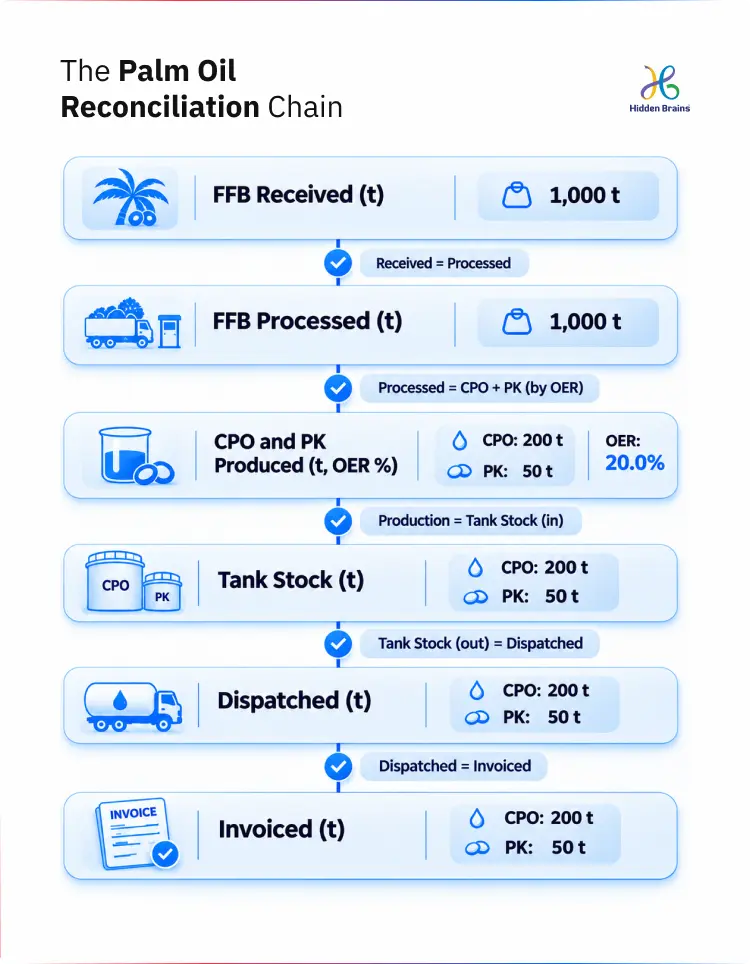
Start with a reconciliation audit of one mill for one recent month. It costs little, needs no new software, and shows exactly which handoffs leak.
- Pick one mill and one closed month.
- Compare weighbridge net weight, graded weight and paid weight for FFB.
- Compare FFB processed, CPO and kernel produced, and the resulting OER.
- Compare tank movements with loading tickets and receiver weights.
- List every point where a number was re-keyed, and who re-keyed it.
- Rank each gap by financial exposure and by compliance exposure.
The ranked list becomes your integration roadmap. It also tells you whether Option 1, 2 or 3 above fits your situation.
At Hidden Brains, our work as a palm oil software development company usually starts with this kind of process map, before any technology selection. Supplier, payment, and geolocation data are commercially sensitive. Our ISO/IEC 27001:2022 and ISO 9001:2015 certifications and CMMI Level 3 delivery processes cover how that data is secured and how changes are controlled.
Frequently Asked Questions
Why don’t palm oil mill production figures match inventory?
Usually because production, tank and dispatch figures are recorded in separate systems and compared only periodically. Dip readings also need temperature and density correction before they match a production report. Reconciling per movement, not per week, closes most of the gap.
Can a palm oil ERP connect to existing weighbridge systems?
In most cases, yes. Many weighbridge indicators and weighbridge software packages can send weights to another system through a serial, network or API connection. Check the exact model and software version before you decide between integration and replacement.
Should a palm oil company integrate its existing systems or replace them with one ERP?
Integrate when your core systems are stable and widely used. Replace when spreadsheets do most of the work or legacy tools cannot share data. Multi-mill groups often connect the riskiest handoffs first and consolidate in phases.
What data does a palm oil mill need for EUDR due diligence?
At minimum, the mill needs supplier and plot origin data linked to each FFB delivery, then to the mill batch, storage and dispatch records for the consignment. EU operators use this to file due diligence statements from December 30, 2026. Mills that cannot link intake to dispatch struggle to supply it.
How does MSPO 2.0 change traceability for mills and dealers?
MSPO 2.0, in force since January 1, 2025, strengthened traceability requirements and made certification mandatory for dealers. Mills now receive more supplier-side data and are expected to keep it connected to their own records.
How can palm oil mills reduce manual reporting?
Capture data once at the source: weights at the weighbridge, grades at intake, and dips at the tank. Then pass those records automatically to production, inventory and finance. Reports built from connected records are ready the same day, not the next morning.

Conclusion
The EUDR deadline will pass, but the problem behind it will not. Disconnected systems in palm oil industry operations were costing money long before regulators asked for proof of origin. Compliance has simply made the cost visible.
That is why the fix should not be treated as a compliance project. A palm oil business that links each FFB delivery to its batch, tank, dispatch and invoice gets traceability as a by-product. It also sees oil losses sooner, settles supplier disputes faster, and knows its real margin before month-end instead of after it. Start with one mill, one month and one reconciliation. The gaps you find will tell you which system to connect first.