
















































































































































Quick Summary
- Margin often leaks through everyday operational inefficiencies rather than one major failure.
- Routing, freight audit, warehousing, fleet management, visibility, and billing are key areas to examine.
- Connected systems make hidden costs easier to identify and control.
- No need to optimize every process; start small.
- Integration can often deliver faster value than replacing systems that already work.
- Build custom software when existing tools cannot support a critical or differentiating workflow.
The margin isn’t lost in one big number. It leaks out of eight everyday processes; here’s where to look first, what a logistics software development company actually fixes at each one, and how to know which to start with.
If your logistics costs are climbing faster than your revenue, the market usually isn’t the problem; your processes are. Logistics is one of the thinnest-margin industries there is: operating margins across transport and logistics sit around 7%, with net margins near 5% (CSIMarket, Q1 2026). At that level, a few points of hidden inefficiency are the difference between a profitable lane and a loss-making one.
This guide breaks down the eight processes where margin quietly leaks, what each one costs you, the specific software capability that closes the gap, and how to pick where to start.
| # | Details |
|---|---|
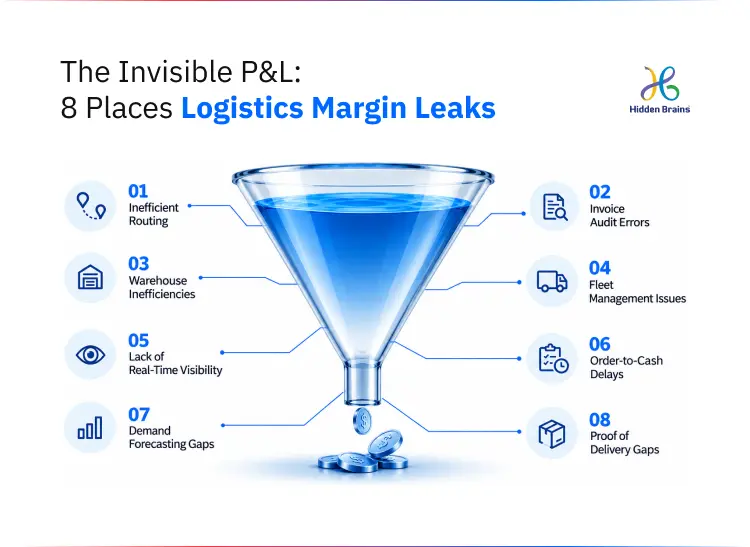
| What does this guide cover? | Eight logistics processes where margin commonly leaks, including routing, freight audit, inventory, fleet maintenance, shipment visibility, order-to-cash, capacity forecasting, and proof of delivery. |
| TL;DR | Logistics margin often disappears through small operational inefficiencies. Better visibility, integration, and automation can expose these leaks and help recover costs without a full platform overhaul. |
| Who should read this guide? | Logistics leaders, COOs, CIOs, CTOs, fleet and warehouse managers, operations teams, and businesses evaluating logistics software development or modernization. |
| What will you learn? | Where margin leakage happens, which software capabilities address each process, what KPIs to track, and whether you should integrate existing systems or build new software. |
| Expected outcome | Identify the logistics process creating the greatest measurable loss and determine the most practical technology intervention to address it first. |
| Key takeaway | Do not optimize everything at once. Start where measurable margin leakage, available data, and a feasible technology fix overlap, prove the return, then expand. |
Here’s the uncomfortable part: Most of this leakage is invisible on the P&L. It doesn’t show up as a line item called “waste.” It shows up as slightly-too-high fuel spend, invoices nobody checked, safety stock nobody trusts, and detention charges everybody absorbed. Industry analysis suggests a $1 billion business can recover $5–15 million a year, 50 to 150 basis points of margin, purely by fixing logistics inefficiencies, not by winning new customers (PraxiChain, 2026).
Why Logistics Margin Leaks Where You Can’t See It
Margin leakage happens when the economics of moving freight stop converting cleanly into expected profit. It rarely appears as one clear failure; it builds across repeated, reasonable-looking decisions: a waived detention charge here, an unrecovered fuel movement there, a manual dispatch that added an hour. Each looks manageable in isolation; together they compound across every lane, shipment, and location.
The root cause is almost always the same: Disconnected systems and manual steps. When routing lives in a spreadsheet, invoices are checked by eye, and shipment status arrives by phone call, there’s no single place where the true cost of serving a customer becomes visible. You can’t fix what you can’t see, which is why the fix is rarely “work harder” and usually “connect the process.” That’s the lens for the eight processes below.
The 8 Processes to Optimize First
We’ve ordered these by how much margin they typically recover relative to implementation effort.
1. Route planning and dispatch
The leak: Routes built on experience, whiteboards, or spreadsheets produce empty miles, backtracking, missed delivery windows, and avoidable overtime.
The cost: fuel and driver hours are your two highest variable costs; guesswork inflates both on every run.
The software fix: AI-assisted route optimization and automated dispatch that plan around real constraints (traffic, delivery windows, vehicle capacity, driver hours) and re-route dynamically when conditions change.
The impact: fewer miles per drop, lower fuel cost per mile, more completed stops per shift. Explore how we build this into our transport management solution.
2. Freight and Carrier Invoice Audit
The leak: Carrier invoices get paid without line-by-line checking — incorrect rates, wrong fuel surcharges, duplicate charges, and accessorials that don’t match the agreed service level slip straight through.
The cost: Studies attribute 1–5% of EBITDA to inefficiencies and billing errors.
The software fix: Automated freight audit that reconciles every invoice against contracted rates and flags discrepancies before payment.
The impact: Measurable drop in billing error rate and recovered overcharges, often the fastest payback of the eight.
3. Warehouse and inventory management
The leak: Without real-time stock visibility, teams hold excess safety stock “just in case,” mis-pick orders, and pay for storage they don’t need.
The cost: carrying cost, write-offs, and slower fulfilment.
The software fix: A warehouse management system with real-time inventory, barcode/scan accuracy, and smart slotting.
The impact: Higher inventory accuracy, lower carrying cost, faster order movement. See our deeper insights and guide on warehouse inventory management solutions.
4. Fleet Management and Maintenance
The leak: Reactive, break-then-fix maintenance means unplanned downtime; poor utilization means assets sitting idle; no telemetry means fuel and mileage go unmonitored.
The cost: Downtime, repair premiums, and under-used vehicles.
The software fix: Telematics with GPS tracking and predictive maintenance that schedules service before failure.
The impact: Higher vehicle uptime, better asset utilization, and lower fuel cost per mile through stronger fleet and vehicle tracking solution and maintenance visibility.
5. Real-time Shipment Visibility
The leak: No milestone tracking means exceptions are discovered late, detention and demurrage charges pile up, and staff spend the day answering “where’s my shipment?” calls.
The cost: Detention/demurrage is one of the largest unmanaged spends in logistics, and it usually sits outside the freight budget.
The software fix: Milestone-level visibility and a control-tower view with proactive alerts.
The impact: Lower detention costs, better on-time performance, and fewer status calls through predictive supply chain visibility.
6. Order processing and order-to-cash
The leak: Manual order entry and delayed invoicing introduce errors and stretch the time between delivering a service and getting paid.
The cost: working capital tied up in a long DSO, plus rework on order errors.
The software fix: order automation with integrated OMS-to-invoicing and EDI/API connections to customers.
The impact: shorter days sales outstanding, higher order accuracy, faster cash conversion.
7. Demand and capacity forecasting
The leak: Without forecasting, you run over-capacity (idle assets) or under-capacity (expensive expedited freight and empty backhauls).
The cost: expedite premiums and idle-asset cost, both avoidable.
The software fix: demand forecasting and capacity planning analytics that match assets to expected volume.
The impact: lower expedite spend, higher asset utilization.
8. Proof of Delivery and Last-mile Documentation
The leak: Paper PODs create disputes, redeliveries, and claims, and they delay billing because invoicing waits on paperwork.
The cost: claims, redelivery costs, and slower cash.
The software fix: a mobile ePOD app with photo, signature, and timestamp capture synced in real time.
The impact: Fewer disputes, faster billing, and a cleaner audit trail with better-connected logistics application development.
The 8 Processes at a Glance
| Process | Where margin leaks | Software fix | KPI it moves |
|---|---|---|---|
| Route planning & dispatch | Empty miles, overtime, missed windows | AI route optimization + auto-dispatch | Fuel cost/mile, stops/shift |
| Freight invoice audit | Billing errors, unbilled accessorials | Automated freight audit | Billing error rate |
| Warehouse & inventory | Excess safety stock, mis-picks | WMS + real-time inventory | Inventory accuracy, carrying cost |
| Fleet & maintenance | Downtime, low utilization | Telematics + predictive maintenance | Vehicle uptime, fuel/mile |
| Shipment visibility | Detention/demurrage, exceptions | Milestone visibility + control tower | Detention spend, on-time % |
| Order-to-cash | Manual entry, slow invoicing | Order automation + integrated OMS | DSO, order accuracy |
| Demand & capacity forecasting | Idle assets, expedite premiums | Forecasting + capacity analytics | Utilization, expedite spend |
| Proof of delivery | Disputes, redelivery, slow billing | Mobile ePOD | Dispute rate, time-to-invoice |
Still Losing Margin? Find the biggest logistics cost leaks first.
Get Free Consultation
Before vs. After: What the Tech Stack Actually Changes
The pattern behind all eight is a shift from disconnected manual work to connected, real-time operations. Here’s what that looks like in practice:
| Process area | Before (typical stack) | After (connected stack) |
|---|---|---|
| Invoice audit | Manual Excel spot-checks | Automated audit vs. contracted rates |
| Routing | Excel/whiteboard routing | AI route optimization |
| Detention | No milestone tracking | Real-time milestone visibility |
| Order-to-cash | Manual entry + delayed invoicing | Integrated OMS → auto-invoicing |
A Real Before/after — PropDispatch.
When Hidden Brains built the PropDispatch last-mile logistics platform, the operation ran on spreadsheets, text messages, emails, and phone calls, with no central system, no real-time access, and field users often working in remote areas with limited connectivity. The rebuilt platform stored everything in the cloud with local sync for low-connectivity sites, and integrated multiple data feeds that eliminated manual inputs and gave the team real-time inventory visibility and automated dispatch. That’s the before/after in one project: manual and blind, to connected and visible.
You Probably Don’t Need to Optimize All Eight at Once
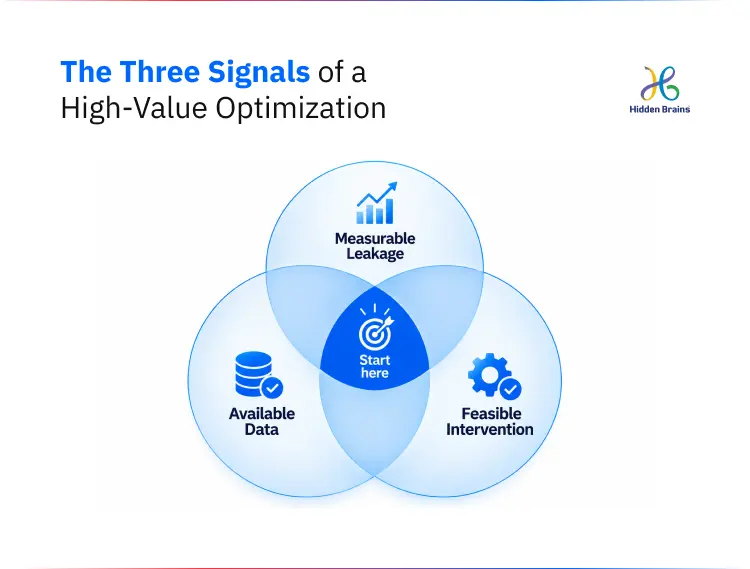
Trying to fix all eight processes simultaneously is how transformation projects stall. You don’t need a big-bang platform swap; you need the one process where fixing it pays back fast and visibly. Run each candidate through six questions:
| Ask | What it tells you |
|---|---|
| Where is the highest recurring cost? | Financial priority |
| Which process requires the most manual intervention? | Automation opportunity |
| Where do errors repeatedly occur? | Process/control weakness |
| Which delay affects the next three processes? | Bottleneck importance |
| Is the required data already available? | Implementation readiness |
| Can improvement be measured within 3–6 months? | ROI visibility |
The best starting point isn’t necessarily your biggest system. It’s the process where measurable leakage, available data, and a feasible intervention overlap. A smaller fix you can prove in a quarter beats an ambitious one you can’t measure for two years, because the recovered margin funds the next step, and the early win earns internal buy-in for the rest.
Do You Need New Logistics Software or Better Connections Between What You Already Have?
Before you scope a new platform, check whether your real problem is missing software or disconnected software. In many logistics operations, the TMS, WMS, ERP, and telematics all work fine on their own; they just don’t talk to each other. The margin leaks in the gaps between them: data re-keyed from one system to the next, a shipment status that never reaches invoicing, an ERP that records the transaction but can’t tell you the true cost to serve.
When integration is the answer: if your systems each hold part of the truth but no one has the whole picture, connecting them, through APIs, middleware, or a shared data layer, usually recovers margin faster and at lower cost than replacing anything. This is often the highest-ROI move on the entire list, and it’s invisible to vendors selling you a new platform.
When you genuinely need new software: when a core process can’t be modeled by anything off-the-shelf, when multi-location or multi-company complexity has outgrown your current tools, or when a specific workflow is a competitive advantage worth owning. That’s where custom logistics software development services come into play.
The honest rule: Buy where the process is standard, connect where systems already exist, and build only where the margin genuinely lives in a workflow you own.

Not Sure Whether to Build, Integrate, or Optimize?
Get FREE ConsultationHow to Choose a Logistics Software Development Company
When you evaluate a logistics software development company, look past the technology list. The vendors that rank for this term all cite the same capabilities: AI, IoT, real-time tracking. What actually separates them is whether they start with your process and P&L or with their tech stack. Ask three questions: Can they show a logistics build with a clear before/after operational outcome? Do they understand order-to-cash, detention, and utilization, not just “an app”? And will they integrate with your existing ERP/WMS rather than replace everything? A partner who begins with “where are you losing margin?” and who’ll tell you when you don’t need to build is the one worth shortlisting.
Where You Can Start Logistics
Margin recovery in logistics isn’t a technology decision first; it’s a visibility decision. You can’t optimize a process you can’t measure, and you can’t prioritize leaks you can’t see. Whether the answer is a new platform, a single automated process, or just connecting the systems you already own, the sequence is the same: find the biggest measurable leak, fix it where the data already supports you, prove the return, and reinvest it into the next. Do that four or five times and you’ve rebuilt your margin without a single big-bang project.
Frequently Asked Questions
How do we quantify what margin leakage is actually costing us before investing in software?
Start with the four highest-frequency leaks: freight invoice errors, empty-mile and routing inefficiency, detention/demurrage, and order-to-cash delay. Pull 90 days of data on each and compare actual cost to what it should have been. Most operators find their largest recoverable number in invoice audit or routing, and that figure becomes the budget and the business case for fixing it.
Which logistics process gives the fastest return on investment?
Freight invoice audit and route optimization usually pay back quickest. Invoice audit recovers real overcharges from money already spent, and route optimization cuts fuel and labor on every run, both show measurable results within a quarter, before you commit to anything larger. The right first move is wherever measurable leakage, available data, and a feasible fix overlap.
Should we invest in logistics software when margins are already tight?
Tight margins are the argument for it, not against. When operating margins sit near 7%, recovered inefficiency drops almost entirely to the bottom lin, you don’t need new revenue to see the benefit. The disciplined approach is to start with one self-funding process fix rather than a large capital project, so the first recovery pays for the next step.
How do we build the business case for logistics software to leadership or the board?
Frame it in margin and payback, not features. Show the quantified leak on one process, the expected recovery, and a 3–6 month window to measure it, then commit to reinvesting proven savings into the next process. Leadership approves a self-funding, measurable sequence far more readily than a multi-year platform bet.
Do we need new logistics software, or better integration between the systems we already have?
Often the latter. If your TMS, WMS, ERP, and tracking tools each work but don’t share data, the margin leaks in the gaps between them, and connecting them via APIs or a shared data layer usually recovers it faster and cheaper than replacing anything. Build new software only when a core workflow can’t be handled off-the-shelf or is a genuine competitive advantage.
How do we avoid a logistics transformation project that stalls or fails?
Don’t try to fix everything at once; that’s the most common failure mode. Sequence the work: one measurable process, proven in a quarter, funding the next. This keeps risk contained, gives leadership visible wins early, and builds the internal momentum that big-bang platform replacements almost always lose.
How do we tell whether it’s a process problem or a software problem?
If the same error keeps recurring despite capable people, it’s usually a process or control gap that software can enforce. If people are manually moving data between systems that should talk to each other, it’s an integration problem. If a core workflow simply can’t be modeled by your current tools, that’s when new software is justified. Diagnosing this correctly first is what separates recovered margin from wasted spend.
How long before we see measurable results?
A single well-chosen process fix should show measurable movement in billing error rate, fuel cost per mile, detention spend, or days sales outstanding within 3–6 months. If a proposed initiative can’t be measured in that window, it’s usually too broad a starting point; narrow it until the return is visible.
How do we choose the right logistics software development company?
Look past the technology list; every vendor cites AI, IoT, and real-time tracking. Judge them on whether they start with your process and P&L instead of their platform, whether they can show a logistics build with a clear before/after outcome, and whether they’ll integrate with your existing systems rather than replace everything. A partner who tells you when not to build is usually the one worth trusting.



Conclusion
The real value of logistics technology is not in adding more systems. It is in exposing where margin is being lost and giving teams the ability to act before that loss compounds.
That could mean improving route decisions, automating freight audit, connecting fleet data, or removing manual handoffs from billing and settlement. The right starting point depends on where the operational friction is strongest today.
A focused first move usually delivers more value than a large platform overhaul. Our logistics software development company can help you with end-to-end integration, modernization, automation or custom development. But there is no linear or specific path; it starts with a free consultation and moving ahead in that direction.