














Quick Summary
- Enterprise software becomes harder to change as dependencies grow.
- Tight coupling, shared databases, integrations, and knowledge silos slow progress.
- Technical debt can equal 20–40% of technology estate value (McKinsey).
- Modernize bottlenecks instead of rebuilding entire systems.
- Track change speed, dependencies, and maintenance costs.
A price change that once took a developer an afternoon now needs sign-off from four teams, edits in six systems, and a release slot next quarter. Nothing is broken. The business simply grew faster than its software was designed to bend, and enterprise application modernization exists to close that gap.
The stakes are bigger than one delayed release. McKinsey’s research found that technology drives up to 71 percent of the impact of business transformations, depending on the sector (McKinsey, Breaking technical debt’s vicious cycle). When the software resists change, it quietly caps what any new strategy can deliver.
Modernization is the work of restructuring the applications a business runs on (their code, data, integrations, and hosting) so they can keep changing at the speed the business needs. It is not the same as moving old software onto new infrastructure. The test of a modernized system is simple: does a routine business change still cost a routine amount of effort?
This guide is for CIOs and CTOs at growing enterprises. It explains why the cost of change rises as a company scales, how to read the warning signs in your own estate, and how to decide where modernization will actually pay off.
Why Does Enterprise Software Become Harder to Change as a Business Grows?
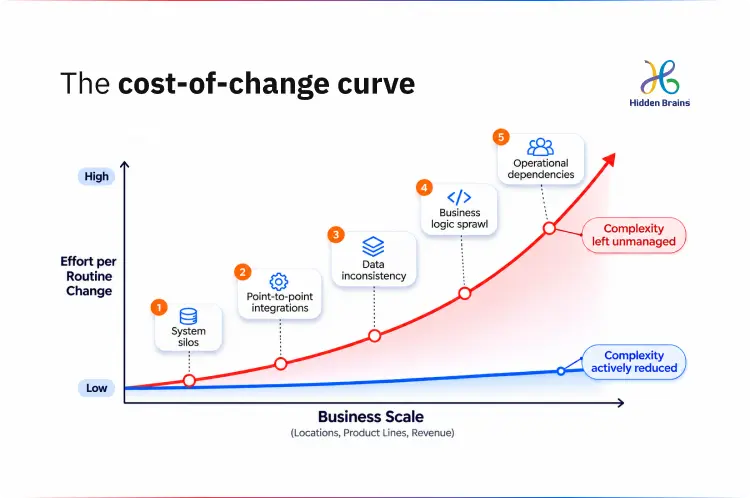
Enterprise software becomes harder to change because growth adds dependencies faster than anyone removes them. New products, locations, regulations, and teams each add code paths, data fields, and integrations, and each addition raises the number of places a future change can break.
This is not a new observation. Meir Lehman’s law of increasing complexity, drawn from decades of studying large systems, holds that a program in continuous use grows more complex unless work is done to reduce it (Lehman, Laws of Software Evolution Revisited).
In modernization assessments, the rising cost of change usually traces back to five mechanisms. Each has a different signal and a different fix. That is why treating “legacy” as one problem tends to produce expensive, unfocused programs.
1. Coupling Grows Faster Than Features
New features are usually built on top of existing modules rather than beside them. Over time, unrelated functions share code, configuration, and assumptions, so a change to tax calculation also touches invoicing, reporting, and the customer portal. This is what engineers mean by legacy code rigidity: the code still works, but its parts can no longer move independently.
Signal to watch: Small changes trigger large regression test cycles.
2. The Shared Database Becomes the Real Integration Layer
Many enterprise applications integrate by reading and writing the same database tables. It is quick to build and works while one team owns the schema. As the business grows, reports, batch jobs, and other applications start depending on those tables too. The schema turns into a contract nobody signed, and renaming one column becomes a cross-department project.
Signal to watch: Schema changes require a list of downstream consumers that nobody fully trusts.
3. Point-to-point Integrations Multiply
Every new SaaS tool, partner, or acquisition tends to arrive with a direct connection to the core system. Five systems connected to each other can need up to 10 links; twenty systems can need up to 190. Each link carries its own data mapping and failure mode. Decoupling legacy enterprise systems usually starts here, by placing an API or event layer between the core and everything that consumes it.
Signal to watch: Incidents increasingly start at integration points rather than inside application code.
4. Knowledge Concentrates in a Few People
As systems age, the reasons behind business rules leave with the people who wrote them. Documentation lags and automated tests stay thin. The result is a key-person risk that rarely appears on a risk register: changes queue up for the two engineers who understand the billing engine. Enterprise legacy system risk management should treat this as a risk in its own right, alongside security patching and vendor support.
Signal to watch: Lead time depends on who is available, not on how big the change is.
Modernize Business Apps. Keep Operations Live.
Talk to Us
5. Team Structure and System Structure Drift Apart
In 1968, Melvin Conway observed that organizations design systems that mirror their own communication structures (Conway, How Do Committees Invent?). A system built by one team for one country carries that shape. When the business reorganizes into product lines or regions, the software does not reorganize with it, so nearly every change crosses team boundaries. Restoring enterprise architecture agility means bringing the two back into alignment.
Signal to watch: most changes need coordination across three or more teams.
What Does Rigid Enterprise Software Cost the Business?
Rigid software costs the business in three places: engineering time spent on upkeep instead of new capability, budget diverted from new initiatives, and modernization programs that stall. The clearest evidence comes from surveys of technology leaders, summarized below.
| Finding | Source |
|---|---|
| CIOs estimate technical debt at 20 to 40 percent of the value of their entire technology estate, before depreciation | McKinsey, Tech debt: Reclaiming tech equity |
| 60 percent of CIOs surveyed felt their tech debt had risen noticeably over the previous three years | Same McKinsey survey |
| CIOs reported that 10 to 20 percent of the technology budget meant for new products is diverted to tech-debt issues | Same McKinsey survey |
| Companies in the bottom fifth for tech debt are 40 percent more likely to have incomplete or canceled IT modernizations than those in the top fifth | McKinsey, Demystifying digital dark matter |
| Developers reported spending 13.5 hours of a 41.1-hour week on technical debt | Stripe, The Developer Coefficient (2018) |
| US federal agencies typically spend about 80 percent of IT budgets on operating and maintaining existing systems | US GAO, GAO-23-106821 |
Two caveats matter. The McKinsey figures come from a 2020 survey of 50 CIOs at financial-services and technology companies with more than $1 billion in revenue, and the Stripe data dates from 2018. Treat them as direction, not as a benchmark for your own estate.
The pattern behind the numbers is consistent. When most of the budget keeps existing systems running, the business can still operate, but it loses the ability to respond. At enterprise scale, technical debt’s impact is less about outages and more about decisions that never get made because the change looked too expensive.
What Are the Signs Your Enterprise Architecture Needs Modernization?
Your architecture needs modernization when the effort to make routine changes keeps rising while the size of those changes does not. The table maps common warning signs to their likely cause and a metric you can start tracking this quarter.
| Warning sign | Likely mechanism | Metric to track |
|---|---|---|
| A routine change takes weeks to reach production | Coupling | Change lead time, request to production |
| Small releases need a full regression cycle | Coupling, thin test coverage | Share of releases needing full regression |
| Schema changes stall or get abandoned | Shared database | Number of known consumers per core table |
| Incidents start at integration points | Point-to-point integrations | Share of incidents originating in integrations |
| Work waits for specific engineers | Knowledge concentration | Share of changes touching code that two or fewer people understand |
| Most changes need several teams to coordinate | Team and system drift | Average number of teams involved per change |
| Run costs crowd out new initiatives | All five | Run versus change split of the IT budget |
One or two signs in isolation are normal for any long-lived system. Three or more, trending in the wrong direction for several quarters, usually mean the cost-of-change curve has turned steep.

Spot the Signs? Find What’s Slowing Growth.
Get Free ConsultationModernize, Replace, or Leave It Alone: How Should CIOs Decide?
Decide component by component, based on which mechanism is causing the rigidity, rather than making one decision for the whole application. A sound application modernization strategy for CIOs treats the estate as a portfolio: some parts are worth restructuring, some are better replaced with packaged software, and some should be left alone because they rarely change.
| Mechanism | Modernization move | Consider replacing when | Leave it alone when |
|---|---|---|---|
| Coupling | Refactor into clear modules; extract high-change areas incrementally | A packaged product covers the function, and it does not differentiate you | The area changes once or twice a year |
| Shared database | Put data-access APIs in front of shared tables; give each module ownership of its own schema | The data model belongs to a commodity function such as payroll | Few consumers exist and the schema is stable |
| Point-to-point integrations | Introduce an API or event layer between the core and its consumers | The integrated tools themselves are being retired | Only a handful of stable links exist |
| Knowledge concentration | Add characterization tests and documentation before any rewrite | Never as a first step: replacing a system nobody understands moves the risk instead of removing it | Not applicable; this risk grows if ignored |
| Team and system drift | Redraw module boundaries around business domains that match team ownership | A reorganization is planned and a platform choice is already part of it | Teams and boundaries already align |
For a deeper look at the keep-or-replace call, see our guide on when to modernize, replace or keep legacy systems.
Is a Monolith-to-Microservices Transformation Always the Answer?
No. Moving from a monolith to microservices fixes coupling and team drift, but it adds operational costs: service-to-service networking, distributed tracing, independent deployment pipelines and harder data consistency. For many mid-market teams, a modular monolith (one deployable application with strictly separated internal modules) captures most of the agility benefit at a fraction of the operating overhead. Microservices earn their cost when several teams need to release independently at high frequency.
Whichever target you choose, replace incrementally. Martin Fowler’s strangler fig approach builds new capability beside the legacy system and moves behavior across in small releases, which reduces risk compared with a single cutover (Fowler, Strangler Fig).
What Does an Enterprise Application Modernization Roadmap Look Like?
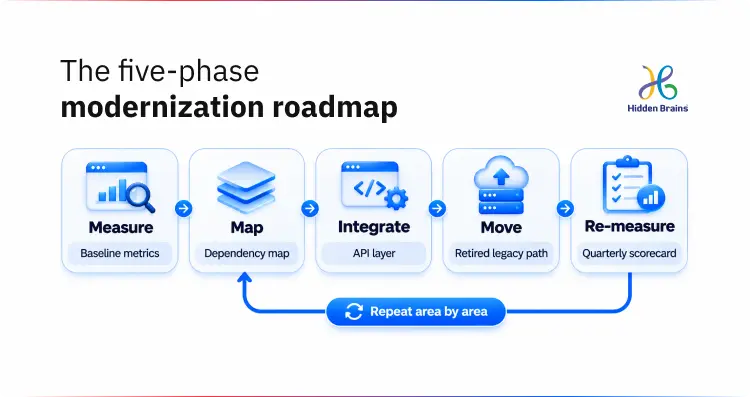
An enterprise application modernization roadmap is a sequence of small, measurable moves that lowers the cost of change one area at a time. It starts with measurement, not with a target architecture. A practical roadmap has five phases:
- Measure the cost of change. Baseline the metrics from the warning-signs table: lead time, regression effort, teams per change, and the run versus change budget split. Without a baseline, nobody can prove the program worked.
- Map dependencies and pick the first seam. Inventory integrations, database consumers, and the people who understand each area. Choose a first target that changes often but carries moderate risk, so the team learns before it tackles the core.
- Build the integration layer before moving logic. Put APIs or events between the core system and its consumers. This makes later extractions safer and usually delivers value on its own. Our software integration services often begin here.
- Move behavior incrementally. Add characterization tests around the area, build the replacement beside it, route traffic gradually, and retire the old path only when the new one has run in production.
- Re-measure and reprioritize. Compare the metrics each quarter. Keep investing where the curve is flattening and stop where the return has leveled off.
For the execution detail behind each phase, see our step-by-step guide to enterprise modernization.
How Should CIOs Weigh Modernization Cost Against ROI?
Modernization cost depends mainly on the size of the codebase, how tightly it is coupled, data complexity, existing test coverage, and the target architecture. The return should be measured in change capacity, not only in lower hosting or license costs.
The main cost drivers to scope early are:
- Coupling and test coverage: tightly coupled code with few tests needs safety work before anything moves.
- Data migration and reconciliation: shared databases with many consumers take the most planning.
- Integrations: each external connection needs mapping, testing, and a cutover plan.
- Parallel running: old and new paths often run side by side for a period, so both carry cost.
- Knowledge recovery: time spent reconstructing undocumented business rules.
The return usually shows up in three forms: engineering hours moved from upkeep to new work, shorter lead time for business changes, and lower operational risk from unsupported components and key-person dependency. Tie each budget tranche to one of these metrics. McKinsey found that almost half of firms that completed modernization programs did not reduce their technology debt (McKinsey), which is a reminder that finishing a program and fixing the problem are not the same thing.
How does Hidden Brains Approach Enterprise Application Modernization?
We start by measuring where the cost of change comes from, before recommending any platform or architecture. In most assessments, one or two of the five mechanisms account for most of the friction, and the roadmap is built around those rather than around a full rewrite.
Hidden Brains has delivered enterprise software for 23+ years under CMMI Level 3 processes, with ISO/IEC 27001:2022 information security and ISO 9001:2015 quality certifications. Those certifications matter most during data migration and parallel running, when production data moves between old and new systems. Our legacy application modernization services cover assessment, refactoring, integration, and cloud migration, and our enterprise software development services cover new capability built beside the legacy core.
A modernization project for iMak, a backyard and pool-services company, shows the approach in practice. Its operations system was more than 10 years old and handled about 1,000 clients and pools, 600 active scheduled services and 7,500 work orders a month, but staff found it complex, and managers got little usable insight from it. Hidden Brains began with a three-day on-site discovery, including visits to six pool sites, then replaced the system with a web portal and a field-staff Android app integrated with the client’s Zoho accounting and CRM. Since going live in June 2020, the platform has handled around 250 work orders and 30 Zoho invoices a day, as noted in the case study.
The Real Question for CIOs
Growth will always add complexity to enterprise software. The question is whether anyone in the organization is accountable for taking it out again. Businesses that measure the cost of change and pay it down area by area keep their software moving with the strategy. Those that wait for a single, large replacement usually discover that the business has changed again by the time it ships.
Frequently Asked Questions
How do we know if our software is holding back business growth?
Look at what the business is waiting for, not at the age of the technology. Common signs are new products or markets delayed by IT changes, management reports that arrive after the decision window, teams relying on spreadsheets and manual workarounds, and IT run costs rising while the budget for new initiatives shrinks. If several of these show up together, the software has likely become a constraint on growth.
What business results should we expect from enterprise application modernization?
Expect faster response to business change, lower operational risk, and more of the IT budget available for growth initiatives. In practice, that means shorter time from a business request to a live change, fewer people the business depends on to keep systems running, and a better split between run and change spending. Agree on these measures before the program starts so results can be shown to the board.
How much does modernization cost, and how do we justify it to the board?
There is no reliable single figure: cost depends on system size, complexity, data, and integrations. Justify it by comparing it with the cost of standing still: delayed launches, rising maintenance spend, and operational risk. Fund the work in stages, each tied to a business metric, so the board sees returns before committing to the next phase. Our legacy software modernization team scopes cost through a short assessment before proposing a roadmap.
Will modernization disrupt day-to-day operations?
It should not, if the work is done in stages. Building new capability beside the existing system, running both in parallel and switching over gradually, lets the business keep trading while each area moves. Disruption risk rises sharply with large, single-weekend cutovers.
Should we replace our legacy system with off-the-shelf software instead?
Replace it where the function is standard for your industry, such as payroll or general accounting, and a packaged product already does the job well. Keep and modernize the parts that reflect how your business competes, such as pricing rules, customer workflows, or operational processes unique to you. Most enterprises end up with a mix of both.
Is moving to the cloud the same as modernizing?
No. Moving an application to the cloud changes where it runs and can reduce infrastructure costs, but it does not make the application easier to change. If the business problem is slow delivery or rising maintenance effort, the application itself needs restructuring, with or without a cloud move.
What should we look for in a modernization partner?
Look for a partner that assesses before it proposes, delivers in stages with measurable results, and transfers knowledge to your team rather than creating a new dependency. Check security and quality credentials such as ISO/IEC 27001 and ISO 9001, since modernization involves moving live business data, and ask for references from projects of similar scale.
Conclusion
Growth will always add complexity to enterprise software. For CIOs and CTOs, what matters is whether someone is accountable for removing it. Businesses that pay it down area by area keep their software in step with strategy; those waiting for one big replacement often find the business has moved on by launch.
You can start this quarter: pick the system where routine changes feel slowest, measure its change lead time and the teams each change touches, and name the mechanism behind the friction. That one measurement makes or rules out the case for enterprise application modernization faster than any platform evaluation.
Want an outside view? Book a free two-hour technology consultation with Hidden Brains engineers and leave with practical next steps for your modernization roadmap.