







































































![Sales & Distribution [Oil & Gas]](https://www.hiddenbrains.com/blog/wp-content/themes/blankslate/assets/images/sales_and_distribution-icon.74d08193.svg "Sales & Distribution [Oil & Gas]")

![Fluid Terminal Management [Oil & Gas]](https://www.hiddenbrains.com/blog/wp-content/themes/blankslate/assets/images/fluid_terminal_management-icon.4b3a27a4.svg "Fluid Terminal Management [Oil & Gas]")


![Sales & Distribution [Oil & Gas]](https://www.hiddenbrains.com/blog/wp-content/themes/blankslate/assets/images/sales_and_distribution-icon.74d08193.svg?1.0.0 "Sales & Distribution [Oil & Gas]")
![Fluid Terminal Management [Oil & Gas]](https://www.hiddenbrains.com/blog/wp-content/themes/blankslate/assets/images/fluid_terminal_management-icon.4b3a27a4.svg?1.0.0 "Fluid Terminal Management [Oil & Gas]")































































































Summary
The Ecommerce trends in 2026 are redefining digital and B2B commerce through AI-driven automation, hyper-personalization, omnichannel ecosystems, and composable architecture. Businesses must modernize legacy systems, adopt responsible AI governance, and strengthen first-party data strategies to stay competitive.
From headless commerce to voice-enabled shopping and ERP-integrated B2B platforms, the future of ecommerce demands scalable, secure, and experience-led infrastructure. Leaders who treat 2026 as a transformation year will unlock sustainable growth, operational efficiency, and long-term customer loyalty.
The ecommerce industry is entering a decisive phase. Ecommerce trends in 2026 are no longer centered on incremental UX upgrades or faster checkout pages. They are driven by intelligent automation, unified ecommerce ecosystems, and architecture built for scale.
For founders, CTOs, and digital commerce leaders, 2026 represents a structural shift. AI is becoming autonomous. Personalization is becoming predictive. B2B buyers demand consumer-grade experiences, and omnichannel execution is no longer optional.
Understanding 2026 ecommerce and online shopping trends is key to building competitive, future-ready platforms, not just boosting short-term sales. This is your 2026 ecommerce playbook.
Ecommerce Trends in 2026: What Will Define the Next Commerce Era
The shift toward intelligent, scalable, and experience-driven commerce is accelerating rapidly. Ecommerce industry trends in 2026 show a clear transition from platform-centric growth to ecosystem-driven innovation, where AI, unified data, B2B digitization, and composable architecture define competitive advantage. Businesses that align technology, customer experience, and operational efficiency will capture the next wave of digital commerce expansion.

Unlock AI Strategies to Boost E-commerce Sales
Download Free eBookTrend #1: The Rise of Agentic Commerce
Artificial intelligence is moving beyond recommendations into autonomous decision-making. Agentic commerce refers to AI systems that can independently research products, compare options, and even execute purchases on behalf of users. Instead of simply responding to queries, these AI agents proactively guide the buying journey. As AI assistants become embedded in shopping platforms and devices, they will reshape how consumers discover products and how businesses compete for digital visibility.
What It Is
AI & agentic commerce refers to intelligent systems that independently optimize pricing, inventory, promotions, and customer interactions in real time.
Why It Matters in 2026
Consumer behavior is already shifting. In early 2026, 42% of consumers used AI to research gifts for Valentine’s Day, showing how deeply AI is embedded in personal shopping decisions. Search is becoming conversational. Discovery is becoming AI-led.
Business Impact:
- Higher conversion rates
- Automated merchandising
- Dynamic pricing optimization
- Reduced operational overhead
AI is reshaping the latest digital commerce trends at a structural level.
Trend #2: Hyper-personalization is The New Way Forward
Personalization is transitioning from segmentation to prediction. One of the latest trends is hyper-personalization that uses AI for personal product recommendations.
What It Is
Hyper-personalization uses AI, behavioral analytics, real-time browsing signals, and purchase history to create dynamically tailored experiences for each user.
Why It Matters in 2026
The global hyper-personalization market is projected to grow from $30.38 billion in 2026 to $58.34 billion by 2030, at a CAGR of 17.7%. AI advancements and the rapid growth of digital commerce are accelerating hyper-personalized shopping experiences, making static and generic customer journeys increasingly ineffective.
Business Impact:
- Increased average order value
- Stronger customer retention
- Improved cross-sell and upsell
Hyper-personalization sits at the center of the top trends in ecommerce for 2026.
Trend #3: B2B Ecommerce Transformation for Digital-first Enterprises
B2B commerce is experiencing its most dramatic transformation yet. Enterprises are rapidly shifting from traditional, relationship-driven sales models to digital-first platforms that support self-service purchasing, real-time inventory visibility, and automated pricing. Modern B2B buyers expect the same convenience and transparency they experience in B2C shopping. As a result, businesses are investing in scalable ecommerce platforms, ERP integrations, and digital procurement systems to streamline operations and improve buyer experience.
What It Is
Digital procurement portals, automated bulk pricing engines, contract-based ordering systems, and ERP-integrated dashboards.
Why It Matters
B2B buyers are increasingly prioritizing seamless, self-service digital experiences over traditional relationship-driven procurement. The competitive advantage now lies in digital usability, transparency, and efficiency, not just price. Suppliers that fail to offer intuitive portals, real-time inventory visibility, and automated pricing workflows risk losing customers to more digitally mature competitors.
Business Impact:
- Reduced sales friction
- Shorter procurement cycles
- Higher customer lifetime value
These shifts define and validate long-term business-to-business ecommerce trends forecasts.
Outdated Stack Slowing Growth? Let’s Fix It.
Connect Now
Trend #4: Omnichannel & Unified Commerce is creating opportunities
Commerce is no longer confined to a website. As eCommerce continues to merge with physical retail experiences, solutions like Digital Signage by LOOK help brands extend their digital messaging into real-world environments, ensuring consistency across every customer touchpoint.
What It Is
Unified commerce integrates physical stores, mobile apps, marketplaces, social platforms, and POS systems into one cohesive data ecosystem.
Why It Matters in 2026
Global retail ecommerce sales are projected to reach $6.8 trillion by 2028. Capturing this scale requires omnichannel strategies that eliminate data silos.
Business Impact:
- Real-time inventory visibility
- Seamless cross-channel returns
- Consistent pricing across touchpoints
Omnichannel execution is central to future trends in ecommerce.
Trend #5: Headless & Composable Commerce Architecture
Modern commerce requires flexible infrastructure. Traditional monolithic platforms often limit innovation and slow down feature releases. Headless and composable architectures separate the frontend experience from backend systems, allowing businesses to integrate best-of-breed tools and adapt quickly to changing customer expectations across multiple digital channels.
What It Is
Headless commerce separates front-end presentation from backend commerce engines, enabling faster UI innovation.
Why It Matters
Rigid monolithic systems slow innovation cycles and limit scalability. Businesses often struggle to introduce new features, integrate emerging technologies, or adapt quickly to changing customer expectations when their commerce platforms are tightly coupled. Adopting modern architectures supported by ecommerce development services enables organizations to implement flexible, API-driven systems that accelerate innovation while maintaining performance, security, and long-term scalability.
Business Impact:
- Faster go-to-market launches
- Greater customization flexibility
- Reduced downtime during upgrades
Trend #6: AR/VR & Immersive Shopping Experiences
Digital commerce is becoming experiential as brands move beyond static product pages to interactive, immersive environments. With the growing adoption of AR & VR app development, businesses can enable customers to virtually try products, explore digital showrooms, and visualize items in real-world settings before making a purchase decision.
What It Is
AR previews, virtual showrooms, and interactive 3D product visualizations.
Why It Matters
Immersive experiences reduce buyer hesitation and increase engagement.
Business Impact:
- Lower return rates
- Increased product confidence
- Higher session duration
Trend #7: Data Privacy & Ethical Ecommerce
Trust is now a differentiator.
What It Is
Privacy-first data strategies, transparent AI usage, and ethical personalization frameworks.
Why It Matters
Regulatory pressure and consumer awareness are rising.
Business Impact:
- Stronger brand trust
- Reduced compliance risk
- Sustainable data strategies
Trend #8: Social Commerce Evolution
Social platforms are rapidly evolving into full transactional ecosystems where discovery and purchasing happen within the same environment. Features like in-app checkout, live shopping, and influencer-led product promotions allow brands to convert engagement directly into sales. As consumers spend more time on social platforms, businesses are integrating commerce experiences seamlessly into social content to shorten the buying journey.
What It Is
Integrated in-app checkout experiences across Instagram, TikTok, and other platforms.
Why It Matters
Discovery increasingly begins on social feeds.
Business Impact:
- Shorter buying journeys
- Influencer-driven revenue
- Improved acquisition efficiency
These shifts represent key ecommerce payment trends and channel expansion strategies.
Trend #9: Sustainable Ecommerce & Ethical Operations
Sustainability has moved from a brand value statement to a measurable business practice. Modern consumers, regulators, and investors increasingly expect businesses to demonstrate responsible sourcing, transparent supply chains, and environmentally conscious operations. As a result, ecommerce companies are embedding sustainability metrics into logistics, packaging, and supplier management strategies.
What It Is
Sustainable ecommerce focuses on reducing environmental impact while maintaining operational efficiency. This includes carbon tracking for shipments, transparent ethical sourcing across supply chains, eco-friendly packaging, and optimized logistics networks that reduce waste and emissions. Many platforms now also display sustainability information directly on product pages to inform conscious purchasing decisions.
Why It Matters
Consumers demand accountability and transparency from the brands they support. Businesses that prioritize ethical operations can build stronger trust, improve brand loyalty, and meet growing regulatory expectations. Sustainable practices also help companies optimize logistics costs and future-proof operations as environmental regulations become stricter globally.
Business Impact:
- Increased loyalty
- ESG compliance
- Long-term cost efficiency
Sustainability is becoming embedded in future ecommerce trends.
Trend #10: Voice & Conversational Commerce
Voice and conversational interfaces are reshaping how customers search, discover, and purchase products online. As digital interactions become more natural, typed queries are increasingly replaced by voice commands and AI-driven conversations.
What It Is
Voice and conversational commerce enable users to search, compare, and complete purchases using voice assistants, chatbots, and AI-powered messaging platforms. Together, they combine natural language processing (NLP), machine learning, and real-time product data to create seamless, dialogue-based shopping experiences.
Why It Matters in 2026
Customers expect instant, frictionless interactions. As smart speakers, mobile voice search, and AI chat interfaces grow, businesses must adapt to conversational intent rather than keyword-based search. Voice-led discovery is becoming part of broader ecommerce future trends shaping digital engagement.
Business Impact:
- Faster decision-making and checkout
- Improved accessibility for mobile and hands-free users
- Higher engagement through personalized conversations
Voice-enabled systems also enhance ecommerce customer experience trends by reducing navigation friction and simplifying complex purchases.
Risks & Challenges in Ecommerce Industry
Growth comes with complexity.
- AI without governance increases risk
- Over-fragmented tech stacks create instability
- Privacy missteps damage brand trust
- Technical debt slows innovation
Strategic modernization is essential.
What Ecommerce Leaders Should Do Now
The next phase of digital growth will not be won by brands that experiment randomly with tools. It will be led by organizations that align architecture, data, and AI with long-term business strategy.
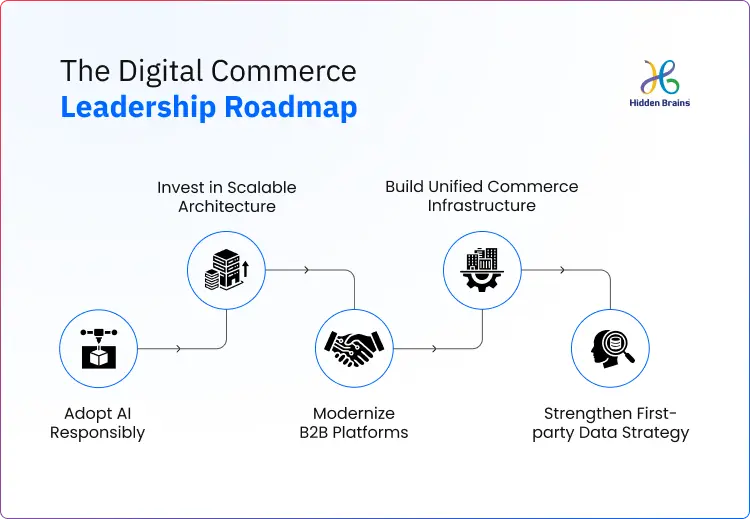
To succeed in 2026, leaders must focus on structured modernization, intelligent automation, and scalable infrastructure that supports both B2C and B2B growth.
Adopt AI Responsibly with Governance Frameworks
AI in ecommerce trends 2026 is the center of attention, but unmanaged automation creates risk. Leaders must establish governance frameworks covering data usage, model transparency, bias monitoring, and performance validation. AI should enhance personalization, pricing, and forecasting without compromising privacy or compliance. Responsible AI adoption strengthens trust while unlocking efficiency and aligns with the broader ecommerce industry focused on sustainable innovation.
Invest in Composable, Scalable Architecture
Rigid monolithic platforms cannot support rapid innovation. Composable commerce, microservices, and API-first ecosystems allow businesses to adapt quickly to evolving digital technology landscapes. Scalable infrastructure ensures faster feature deployment, smoother integrations, and improved system resilience. In 2026, architectural flexibility directly impacts competitive speed.
Modernize B2B Platforms with ERP Integrations
The rise of B2B ecommerce trends 2026 requires enterprise-grade digital transformation. Leaders must modernize B2B portals with real-time inventory visibility, contract pricing automation, and ERP synchronization. Seamless backend integration reduces procurement friction and improves buyer experience. Strong ERP connectivity also supports long-term business-to-business ecommerce trends forecasts centered on efficiency and digital-first trade.
Build Unified Commerce Infrastructure
Unified commerce eliminates channel silos across web, mobile, marketplaces, and physical retail. As mobile commerce trends and omnichannel expectations expand, centralized data systems ensure consistent pricing, inventory accuracy, and customer experience. A unified backend strengthens operational visibility and improves scalability across multiple revenue channels.
Strengthen First-party Data Strategy
Privacy regulations and the decline of third-party cookies make first-party data critical. Businesses must invest in customer data platforms, consent management systems, and secure data pipelines. A strong first-party strategy fuels ecommerce personalization trends, enhances predictive analytics, and reduces regulatory risk while improving customer lifetime value.
To support modernization at scale, enterprises often rely on software development services that provide the engineering expertise and strategic capabilities needed for secure, scalable, and future-ready systems.
Accelerate Your Commerce Transformation with Hidden Brains
With 22+ years of experience and 6000+ projects delivered globally, Hidden Brains helps ecommerce brands transition from legacy systems to AI-powered, scalable commerce platforms.
From headless architecture to B2B digital transformation and omnichannel implementation, our ecommerce development services enable businesses to align with the trending ecommerce trends for 2026.

Frequently Asked Questions
What are the top ecommerce trends in 2026 that businesses should prioritize?
The latest trends in ecommerce include AI-driven automation, hyper-personalization, B2B digital transformation, headless commerce architecture, unified omnichannel infrastructure, and privacy-first data strategies. Businesses focusing on scalable, composable platforms and intelligent decision systems will gain a long-term competitive advantage.
How is AI in ecommerce trends in 2026 changing online shopping behavior?
AI is transforming how customers discover and evaluate products. Consumers increasingly rely on AI assistants for recommendations, comparisons, and purchase research. These innovations are shaping the future of online shopping, where real-time personalization and predictive pricing make digital buying more automated and efficient.
Why are B2B ecommerce trends in 2026 accelerating so quickly?
B2B buyers now expect seamless, self-service digital experiences similar to B2C platforms. Businesses must modernize procurement portals, integrate ERP systems, enable real-time inventory visibility, and automate contract-based pricing workflows to stay competitive. A smooth and transparent purchasing journey is becoming a defining factor in retail online shopping trends and B2B digital commerce alike.
What is the impact of hyper-personalization in the ecommerce industry?
Hyper-personalization uses AI and behavioral data to deliver tailored experiences in real time. It improves conversion rates, customer retention, and average order value. As personalization technology advances, it becomes a core driver of ecommerce growth strategies.
How does an omnichannel strategy support ecommerce growth in 2026?
Omnichannel commerce integrates web, mobile, marketplaces, and physical stores into a unified ecosystem. It ensures consistent pricing, real-time inventory visibility, and seamless customer journeys, which are essential for capturing projected global ecommerce growth.
What risks should businesses consider when adopting ecommerce technology trends?
Key risks include over-reliance on AI without governance, fragmented tech stacks, data privacy violations, and accumulating technical debt. Businesses must prioritize secure architecture, compliance frameworks, and scalable integrations to mitigate long-term operational risk.
How should companies prepare for future trends in ecommerce?
Companies should modernize legacy systems, adopt composable architecture, strengthen first-party data strategies, and implement AI responsibly. Strategic planning, strong integration frameworks, and unified commerce infrastructure are critical to sustaining growth in 2026 and beyond.



Conclusion
AI-led commerce, hyper-personalization, B2B transformation, and unified omnichannel ecosystems are reshaping the digital economy at a structural level. These are not short-term innovations, they represent a permanent shift in how online and B2B commerce platforms are designed, operated, and scaled.
Ecommerce trends in 2026 clearly signal one direction: intelligence, integration, and infrastructure maturity will define market leaders. Businesses must move beyond fragmented tools and reactive experimentation toward composable architectures, governed AI adoption, and data-driven decision systems.