









































































































Summary
- AI is changing the economics of QA, not simply adding another testing tool.
- It reduces the effort involved in test creation, execution, analysis, and maintenance.
- AI-powered quality engineering extends beyond automation into risk analysis, test strategy, and release readiness.
- Self-healing and intelligent testing help enterprises keep pace with constantly changing applications.
- The winning model combines AI’s speed with human judgment, governance, and quality engineering expertise.
QA as a Service (QAaaS) gives enterprises on-demand, scalable quality assurance services, automation, continuous testing, performance, security, and specialist expertise, without building every competency in-house.
It exists because quality is now the constraint on release speed: CISQ estimates the cost of poor software quality in the US at over $2.4 trillion, most of it from failures and rework that better testing prevents.
The pressure is structural. Enterprises no longer ship a single application; they manage a landscape of web and mobile products, APIs, ERP and CRM integrations, data pipelines, and AI-enabled features, each operating on different release cycles.
As software delivery becomes more complex, with AI, features, devices, multiple technology layers, and broader enterprise ecosystems, quality assurance services cover the entire delivery lifecycle, from functional and automated testing to performance, security, API, and integration testing. The real bottleneck is not testing more; it is building quality into the delivery system rather than inspecting it at the end.
This article covers what QAaaS actually includes, where it creates the most enterprise value, how the economics compare to building or outsourcing, and how AI-powered quality engineering is changing the calculation.
| Details | Information |
|---|---|
| Guide Focus | How enterprises can evaluate QA as a Service, understand its benefits, compare delivery models, and build a scalable quality engineering capability. |
| Business Challenge | Growing application complexity, faster release cycles, specialist testing needs, and limited QA capacity are making traditional fixed-team models harder to scale. |
| Target Audience | CIOs, CTOs, QA leaders, engineering leaders, DevOps teams, enterprise architects, and technology decision-makers evaluating QA operating models. |
| TL;DR | QAaaS gives enterprises flexible access to quality engineering capabilities without building every skill in-house. It is particularly valuable when testing demand is complex, variable, or specialized. |
| Key Evaluation Criteria | Testing complexity, release frequency, automation maturity, specialist requirements, application landscape, tooling, scalability, security, governance, and total cost. |
| AI Overview | AI is moving QA beyond test automation by enabling intelligent test creation, risk-based prioritization, defect analysis, self-healing automation, and AI-powered quality engineering across the SDLC. |
The QA Operating Model is Changing
Enterprise QA has evolved from a project-stage function into an always-on capability, and QAaaS is the operating model that delivers it. Quality assurance has moved through distinct stages, each answering a different pressure:
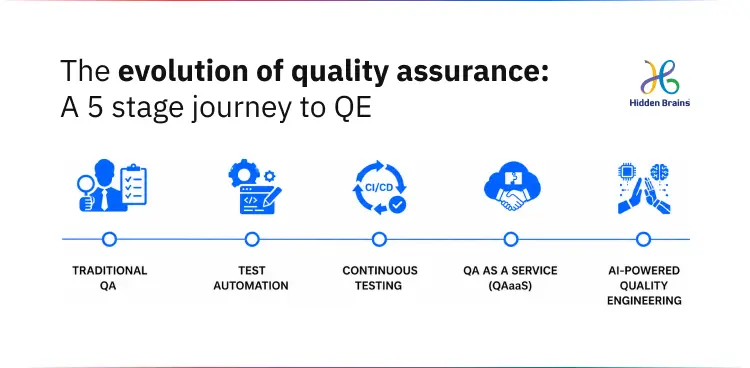
- Traditional QA treated testing as a stage near the end of the project. It worked when releases were infrequent.
- Test automation reduced repetitive manual effort but often stayed bolted onto the old model.
- Continuous testing pushed quality checks into the pipeline so software could be validated on every change.
- QA as a Service turned quality into an always-on capability an enterprise can access and scale, rather than a fixed team it has to own.
- AI-powered quality engineering is now reshaping how that capability is delivered.
The underlying shift is from QA as a project-stage function, to QA as an always-on capability, to quality engineering embedded across the entire software development lifecycle. QA as a Service is the operating model that lets an enterprise plug into that capability without rebuilding its whole engineering organization to get there.
Building something new? Let’s make quality part of the process.
Talk to QA Experts
QA as a Service: From External Testing to an Enterprise Quality Capability
QA as a Service is not simply outsourcing your testing. It is an operating model for accessing scalable quality engineering capabilities on demand. That distinction is the whole point, and it is where a lot of buyers get the model wrong.
Traditional outsourcing hands a defined test scope to an external team and gets a defect report back. QAaaS provides a flexible, continuously available quality function that integrates with how your enterprise already builds software. A mature QAaaS engagement typically includes:
- Flexible teams and specialist capabilities you can scale up or down as complexity changes
- Automation and manual testing working together, not one replacing the other
- Continuous testing wired into your delivery pipeline
- Performance, security, API and integration testing, the specialized disciplines internal teams most often lack
- CI/CD and DevOps integration so quality checks run where your engineering happens, not in a separate silo
The difference between “we outsourced testing” and “we have QA as a service” is continuity and integration. One is a transaction. The other is an operating capability.
Where QAaaS Creates the Most Enterprise Value
The benefit of QAaaS is best understood as business outcomes, not a feature list. For enterprises, five outcomes matter most.
Accelerating Release Speed
QAaaS removes the testing bottleneck that forces teams to choose between speed and confidence. Additionally, specialist capacity is available exactly when a release cycle demands it, so quality stops being the reason a release slips.
Scaling quality without scaling fixed headcount.
Complexity in enterprise software is rarely constant. QAaaS lets you bring in performance, security, or automation specialists when a program needs them. In other words, you can scale up and scale down the team by hiring dedicated developers, without embedding them into the team permanently.
Increasing test coverage.
Enterprises struggle to cover the full surface area of applications, devices, browsers, APIs, and third-party integrations. A service model expands coverage across that surface without a proportional increase in internal hiring.
Reducing production risk.
Catching defects earlier and testing continuously rather than in a pre-release crunch strengthens release confidence and reduces the cost of failures that reach production.
Making QA economics more flexible.
The financial shift is from maintaining a fixed capability to accessing the capability a given quarter actually requires, which is what makes the model attractive to CFOs as well as engineering leaders.
Where the Model Fits: Six Real Enterprise Scenarios
QAaaS is not the right answer for every situation, but it fits five enterprise scenarios especially well.
1. Modernization programs.
During a legacy-to-modern migration, you need to test both environments and the bridge between them. This is high-stakes, temporary, specialist work, a poor fit for permanent headcount and a strong fit for a service model. (This often runs alongside broader enterprise software development initiatives.)
2. Digital product expansion.
More channels, platforms, integrations, and releases multiply the testing surface faster than internal QA can hire.
3. Complex enterprise ecosystems.
ERP, CRM, microservices, APIs, and third-party systems create integration-testing demands that need broad, specialized coverage.
4. High-frequency DevOps environments.
As release cycles compress, continuous testing stops being optional, and standing up that capability internally takes time the roadmap doesn’t have.
5. QA capability gaps.
When internal teams lack automation, performance, security, or other specialized expertise, QAaaS fills the gap without a lengthy hiring cycle.
6. AI products and workflows
Testing AI-enabled features, LLM apps, AI agents, RAG systems, and automated workflows means evaluating non-deterministic outputs, guardrails, and agentic actions rather than fixed pass/fail results, a discipline most internal QA teams have never had to build.
The Economics of QA: Build, Outsource, or Access as a Service?
This is the decision most enterprise buyers are actually weighing. There is no universally correct answer; it depends on how predictable and how complex your quality demand is.
| Model | Best suited for | Main limitation |
|---|---|---|
| Build in-house | Stable, predictable testing demand | Fixed cost and ongoing talent burden |
| Project-based outsourcing | One-off or short-term testing needs | Limited continuity between engagements |
| QA as a Service | Continuous, changing QA demand | Requires the right operating partner |
| Hybrid (in-house + QAaaS) | Complex enterprise environments | Requires stronger governance to run well |
The economics of the model come down to a few key variables:
- Team size: How much testing capacity is needed and how consistently?
- Testing complexity: How many applications, integrations, workflows, and environments need to be covered?
- Automation maturity: How much of the testing lifecycle can already be automated?
- Release frequency: How often do applications and features move into production?
- Specialist requirements: How much expertise is needed across areas such as mobile, ERP, performance, security, or AI?
- Tooling and infrastructure: What platforms, environments, devices, and test infrastructure are required?
- Application landscape: How broad and fragmented is the overall technology estate?
When these factors are variable or highly specialized, a flexible-access model can offer greater cost efficiency and lower delivery risk. When demand is stable, predictable, and self-contained, a fixed in-house team may make more economic sense.

Scale Quality Without Scaling Headcount
Hire Our QA SpecialistAI is Changing the Economics of Software Testing
Here is the pivot that changes the whole calculation. AI is not just “a new tool in QA”, it is changing the economics of testing by altering what gets tested, how it gets tested, how quickly, and how QA specialists spend their time.
Adoption is already mainstream rather than experimental. The Capgemini/OpenText/Sogeti World Quality Report 2024–25 found that roughly 45% of QA teams now use AI in some form during testing, up from about 22% two years earlier, and Gartner has projected adoption approaching 80% by 2027. AI is being applied across:
- AI-generated test cases and automated test creation
- Intelligent test data generation
- Test prioritization based on risk
- Defect prediction — flagging high-risk code areas before failures surface
- Log analysis and anomaly detection
- Test maintenance and self-healing automation, where scripts update themselves when UI elements change instead of breaking
For enterprises, self-healing and AI-assisted maintenance matter most, because the highest hidden cost in automation is not writing tests; it is fixing the ones that break every time the interface changes. This is how AI in Quality assurance works.
From AI-assisted Testing to AI-powered Quality Engineering
The important distinction is between AI that helps testers work faster and AI that becomes part of the quality lifecycle itself. Most teams are doing the first. The advantage goes to those who understand the second.
- AI-assisted QA: An engineer still defines what to test and reviews everything; AI accelerates drafting, data generation, and maintenance.
- AI-powered quality engineering: AI contributes across the lifecycle — Requirements → Risk Analysis → Test Design → Automation → Execution → Defect Analysis → Release Decision — rather than only automating execution.
A word of honesty here, because it reflects how we approach this work: AI adoption in testing is now near-universal, but strong results are not. Teams that point AI at test generation without mature metrics tend to produce more tests, not better risk coverage, “vanity tests” that pass trivial checks and miss the edge cases that actually cause incidents.
AI compresses the drafting and maintenance; human judgment still owns coverage, risk, and the release decision. The QA specialist role does not disappear in this model; it shifts toward test strategy, risk analysis, and governing what the AI is allowed to do. That is exactly why an operating partner with quality-engineering maturity matters more in the AI era, not less.
What a Modern Enterprise QAaaS Model Looks Like
A modern QAaaS engagement for an enterprise is not a testing vendor on call. It is an integrated quality function that combines flexible specialist teams, automation and continuous testing wired into your CI/CD pipeline, AI-assisted test creation and maintenance under human oversight, and clear governance and reporting so leadership has real-time visibility into quality, not a status update after the fact. Crucially, it treats security and compliance as part of the engagement from day one, because giving an external partner access to enterprise systems and data is a governance decision before it is a testing decision.
How to Choose a QA-as-a-Service Partner for Enterprises
Because QAaaS is an operating relationship, the partner selection matters more than any single tool. Evaluate candidates against these criteria:
- Enterprise-scale QA experience — Proven work in environments of comparable complexity, not just app-level testing
- Quality engineering maturity — Process discipline such as CMMI-aligned practices, not ad hoc testing
- Automation capabilities — Frameworks, coverage, and maintainability
- AI testing capabilities — Applied responsibly, with human oversight and clear metrics
- DevOps / CI-CD integration — The ability to run quality inside your existing pipeline
- Security and compliance — Certifications such as ISO 27001, and the ability to handle regulated data
- Specialist talent — Performance, security, API, and integration testing depth on demand
- Reporting and governance — Transparent, real-time visibility into quality metrics
- Scalability — The ability to flex capacity with your release calendar
- Industry expertise — Relevant experience in your sector’s compliance and operational realities
How Hidden Brains Can Help
Hidden Brains works with enterprises and growing businesses to connect quality strategy with delivery, combining automation, continuous testing, performance and security testing, and AI-assisted quality engineering around real release and risk priorities. As a CMMI Level 3-appraised, ISO 27001- and ISO 9001-certified engineering partner with two decades of delivery across 107 countries, the focus is on giving enterprises a governed, scalable quality capability rather than a headcount top-up: quality engineering integrated into your CI/CD and DevOps workflows, with the security and reporting discipline enterprise environments require.
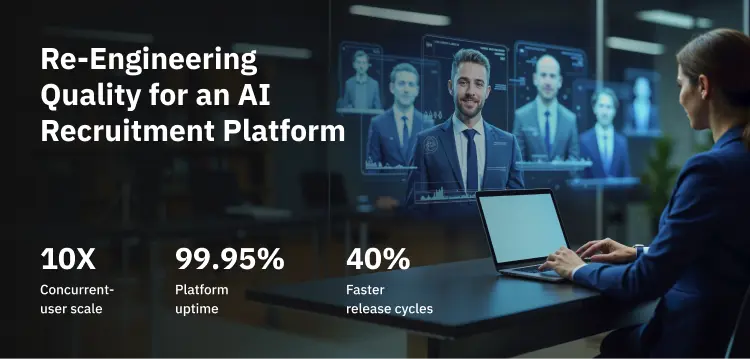
If your releases are outpacing your QA capacity, or you are weighing whether to build, outsource, or access quality as a service, our quality assurance services team can help you map the right model to your delivery landscape. In one recent engagement, Hidden Brains re-engineered quality for an AI recruitment platform, helping it scale from 50 to 500+ concurrent users, reduce errors from 60% to below 0.5%, bring API response time down to 1.1 seconds, and achieve 95%+ test automation coverage.
Frequently Asked Questions
Is QA as a Service the same as outsourcing testing?
No. Outsourcing typically hands a defined test scope to an external team for a fixed period. QA as a Service is a continuous, integrated quality capability that scales with your needs and connects to your existing development and CI/CD workflows.
How is QAaaS priced for enterprises?
Pricing generally reflects the capability you access rather than a fixed team you maintain — driven by testing scope and complexity, automation maturity, release frequency, and specialist requirements. This is what makes the economics more flexible than a permanent in-house team. [INSERT: your standard commercial models — e.g., dedicated team, managed QA, or on-demand capacity — if you want them named.]
Is it safe to give an external QA partner access to our systems and data?
It should be treated as a governance decision from the start. Look for a partner with recognized security certifications (such as ISO 27001), clear data-handling and access controls, and the ability to support your industry’s compliance requirements — not just testing skills.
Does AI-powered testing replace our QA engineers?
No. AI compresses the drafting, data generation, and maintenance work, but human specialists still own test strategy, risk analysis, and the release decision. In practice, the QA role shifts toward higher-value judgment rather than disappearing.
How does QAaaS fit into our existing CI/CD pipeline?
A mature QAaaS engagement integrates quality checks directly into your pipeline so tests run continuously on changes, rather than operating as a separate, end-of-cycle activity. Integration with your DevOps toolchain is a core evaluation criterion for any partner.
When should an enterprise choose QAaaS over building an in-house team?
QAaaS tends to fit when quality demand is variable, complex, or specialized — modernization programs, high-frequency DevOps, complex integrations, or capability gaps. A fixed in-house team makes more sense when testing demand is stable and predictable. Many enterprises run a hybrid of both.
Conclusion
QA as a Service is best understood not as a cheaper way to outsource testing, but as a way for enterprises to treat quality as an always-on, scalable capability, one that flexes with release velocity, complexity, and specialist demand instead of being capped by fixed headcount. AI is accelerating that shift, but it is not removing the need for judgment: the enterprises getting real value are those pairing AI’s speed with mature quality engineering and clear governance. The practical question is no longer whether to modernize your QA operating model, but which model- build, outsource, hybrid, or service- fits how your business actually ships software.
Not sure which model is right for you? Book a free 2-hour consultation to assess your options and get answers tailored to your QA needs.