
































































































Summary
- Customer loyalty is shifting from habit to convenience, value, and relevance.
- Private labels now account for 38.8% of European grocery sales, increasing pressure on branded products.
- Customer data remains fragmented across stores, apps, webshops, and retail partners.
- Many loyalty programmes lose engagement soon after customers sign up.
- Technology is moving loyalty from generic rewards to personalised recognition.
- Connected first-party data, predictive analytics, and mobile apps help brands respond at the right moment.
- A QR-powered DropShop app shows how digital experiences can extend customer engagement beyond the purchase.
- Technology delivers loyalty only when product quality, fulfilment, and reward redemption are already dependable.
Food and beverage (F&B) customers have not stopped caring about brands. They have simply stopped rewarding brands that make them work harder than the alternative. That is why more European brands are turning to custom software to connect their channels, recognize customers, and make the next purchase easier.
A loyalty card in someone’s wallet does not mean they will come back. Signing up takes one tap, and many members never return after the welcome offer. Brands pulling ahead use custom software development services across their own channels to turn one-time buyers into lasting relationships. Technology only works when it improves the customer experience, not just the marketing dashboard.
Why are Traditional Loyalty Strategies Failing F&B Brands?
Traditional loyalty strategies fail because they reward transactions instead of building relationships. Most programs look the same, customers are more price-sensitive, switching costs nothing, and brands cannot see the full customer journey.
Earn points, get a discount, receive a birthday offer. When every brand runs the same formula, the program stops being a reason to choose one brand over another. Generic promotions make it worse. Customers learn to ignore them, or to wait for the next deal, which trains them to be loyal to the discount rather than the brand.
Price Sensitivity is Rising Across Europe
European shoppers are shifting more of their spend toward retailer-owned brands. According to NielsenIQ data for the Private Label Manufacturers Association (PLMA), private label sales across 17 European markets reached €387 billion in 2025, accounting for 38.8% of grocery sales. Private labels also outpaced manufacturer brands, growing 4.1% compared with 2.7%, a clear sign that own-brand products are moving from a value alternative to a mainstream shopper choice.
| Market (2025) | Private label value share |
|---|---|
| Switzerland | 52.3% |
| Portugal | 48.2% |
| Germany, UK and France combined | 40.4% |
| 17-market European average | 38.8% |
| Norway | 23.6% |
| Source: PLMA / NielsenIQ | |
Disconnected data hides your best customers
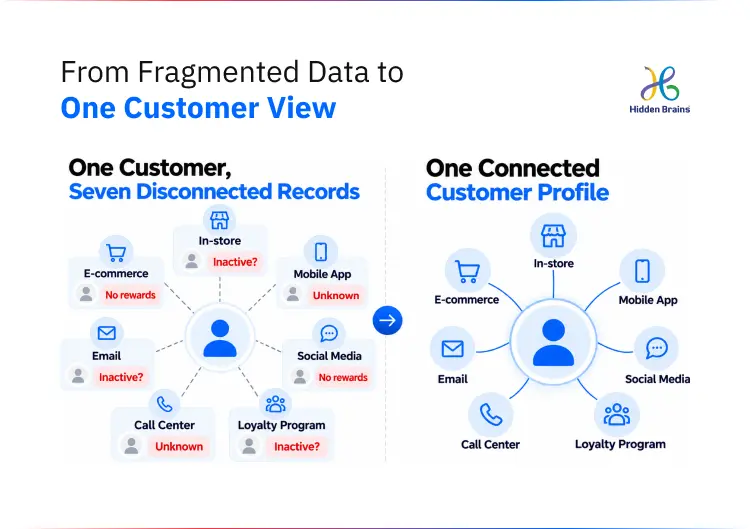
Customer data usually sits in separate systems: store tills, the mobile app, the webshop, delivery platforms, social media, customer support, and email or SMS tools. A frequent in-store buyer can look inactive online. Rewards earned in the app may not work on a delivery order.
For brands that sell through supermarkets, pubs and restaurants, the gap is wider. The retailer or venue owns the customer data, and the brand sees only a sales figure.
Why Doesn’t Loyalty Program Enrollment Lead to Repeat Purchases?
Enrollment measures interest, not loyalty. Deloitte’s 2025 survey of US consumers found the average person belongs to about eight loyalty programs but actively uses only about five.
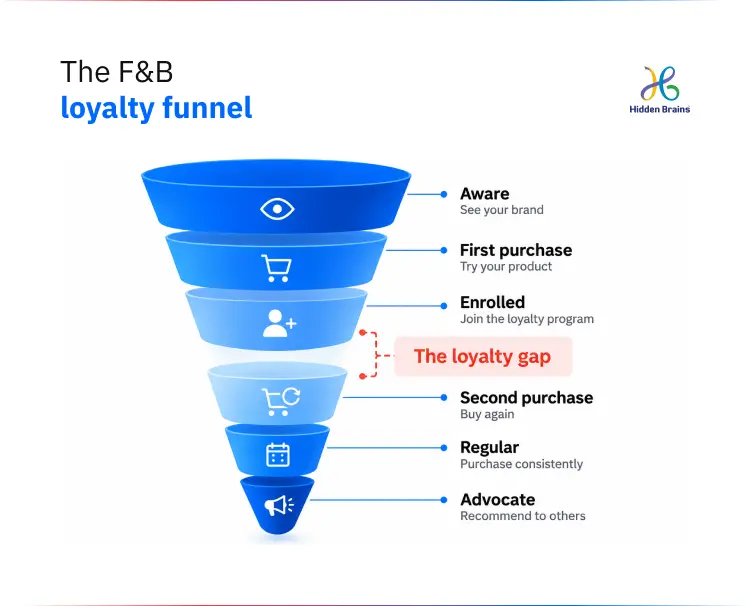
Think of loyalty as a funnel. Customers move from first purchase to enrollment, then to a second purchase, regular buying, and finally advocacy. Most brands invest heavily in enrollment and very little in what happens next.
The second purchase is the real test. The first can be curiosity or a promotion. The second shows the customer chose you again, and it is where your influence is strongest because the first experience is still fresh.
Connected data also shows who is drifting away. A customer who buys every two weeks but has not ordered in five is at risk. You can only act if you can see that pattern. Not every repeat buyer is profitable either, so frequency, basket value, and margin need to be read together.
Win Back Quiet Customers With a Smarter Loyalty Roadmap.
Talk to Our Experts
| Common KPI | Better KPI |
|---|---|
| Total members enrolled | Active member rate |
| Points issued | Second-purchase rate |
| Campaign opens | Retention by customer cohort |
| Discounts redeemed | Margin and lifetime value per member |
How is Technology Changing Customer Loyalty in Food and Beverage?
Technology is shifting loyalty from rewarding purchases to recognizing people. Five technology trends in the food and beverage industry are driving this.
- First-party data and connected profiles. First-party data is information customers share directly with the brand, with consent. An integration layer connects Point of Sale (POS), ecommerce, the app, Customer Relationship Management (CRM), and Enterprise Resource Planning (ERP) systems into one profile. In Europe, this must be designed around the General Data Protection Regulation (GDPR), and in Switzerland around the revised Federal Act on Data Protection.
- AI-powered personalization. Artificial Intelligence (AI) uses that profile to suggest relevant products and offers. A regular buyer of low-alcohol beer hears about a new alcohol-free launch, not a generic discount.
- Predictive churn prevention. Models learn each customer’s normal buying rhythm and flag early drift, so brands can respond before the customer settles on a competitor.
- Mobile apps that add convenience. The strongest apps do more than store points. They offer quick reordering, saved preferences, and rewards that work across channels.
- Unified commerce. Customers are recognized the same way in-store, online, in the app, and on delivery orders, with one balance and one history.

Connect Your Customer Data to Win More Repeat F&B Purchases
Talk to Our ExpertsExample: How Appenzeller Bier Connected With Drinkers It Rarely Met
Appenzeller Bier, the Swiss family brewery behind Quöllfrisch since 1886, sells mostly through retailers and hospitality venues. It needed a direct relationship with drinkers without an awkward app undermining decades of brand trust.
Hidden Brains built DropShop, a loyalty and gamification platform. Drinkers scan a QR code on the bottle, earn “Drops,” and redeem them for exclusive offers. Each scan’s serial number is verified, and points are credited in under 500 milliseconds. Native iOS and Android apps share one Node.js and PostgreSQL backend, so balances stay consistent everywhere. Scratch cards, spin wheels and milestone levels give drinkers reasons to return between purchases.
The platform also integrates Contao CMS (Content Management System), the MagnetHub QR system, and Google Analytics. For the first time, the brand can see scan frequency, location hot spots and campaign performance.
Read the full Appenzeller Bier loyalty platform case study.
What Does Moving From Rewards to Relationships Look Like?
It means recognizing the customer, understanding the moment, and responding with something useful. Points still matter, but they are no longer the main reason to stay.
| From | To |
|---|---|
| Points and discounts | Personalized value |
| Mass promotions | Contextual engagement |
| Scheduled campaigns | Real-time, behavior-triggered messages |
| Reactive win-back | Predictive retention |
| Enrollment counts | Repeat purchases, retention and lifetime value |
In practice, this looks like a thank-you after a first order, or a reminder when a usual reorder is due. It could also be early access to a seasonal product for your most regular buyers. Success is measured over time through repeat-purchase rate, retention, and customer lifetime value.
Can Technology Fix Customer Loyalty on its Own?
No. Technology can recommend the right product at the right moment, but it cannot fix poor quality, late deliveries, wrong orders, hidden charges, or confusing redemption. Those problems break loyalty faster than any app can build it.
AI has limits too. Restaurant business reported in July 2026 that many restaurant brands remain cautious about AI loyalty tools, citing hallucinations, missing context, and weak data foundations. AI built on fragmented data simply sends the wrong offer faster.
Technology should strengthen a good experience, not cover for a weak one.
What Should Food and Beverage Brands do Next?
Start with the customer journey, then fix the data, then improve the second purchase. This is what practical food and beverage digital transformation looks like.
- Map the customer journey. List every channel, including retailers and venues you do not own, and note where recognition breaks down.
- Connect customer and transaction data. Build one GDPR-ready profile across POS, e-commerce, app, CRM, and ERP.
- Improve the second-purchase experience. Design the first 30 to 60 days around an easy first reward and a well-timed reminder.
- Personalize based on behavior. Start with a few simple segments before adding AI models.
- Automate the moments that matter. Trigger messages after a first purchase, when a reorder is due, and when a customer starts to drift.
- Measure retention and profit. Report active members, second-purchase rate, cohort retention, and margin per member.
Should You Build Custom Loyalty Software or Buy a Platform?
An off-the-shelf platform is usually enough if you sell mainly through your own webshop or stores. Custom food and beverage industry software makes sense when your channels, systems, or markets do not fit a standard product. It costs more upfront, so it should solve a problem a license cannot.
| Your situation | Off-the-shelf platform | Custom platform |
|---|---|---|
| Most sales through your own webshop or stores | Usually enough | Often unnecessary |
| Most sales through retailers, pubs or distributors | No transaction to connect to | On-pack QR or receipt capture |
| Regional POS or ERP integrations needed | Limited connectors | Built around your systems |
| Several European markets and consent rules | Often generic | Designed per market |
| Age-restricted product such as alcohol | Check verification support | Age gate and secure login built in |
For a deeper comparison, see custom software vs off-the-shelf. For budgeting, read what custom CRM development costs from here.
At Hidden Brains, loyalty projects usually start before technology selection. We first look at where customer data, channels, and redemption are breaking down. As a CMMIDEV/3℠ and ISO 27001 certified food and beverage software development company in Europe, we work with you to build secure, reliable systems that fit the way your business actually operates.
What Will Customer Loyalty Look Like in the Next Few Years?
Loyalty will belong to the brands customers find easiest to buy from again. Discounts will stay, but they will be the baseline, not the differentiator.
The bigger shift is from knowing what someone bought to understanding why and when they buy. A brand that remembers preferences, removes friction, and shows up at the right moment earns loyalty that a points balance cannot. The winners will not have the most technology. They will be the brands whose technology quietly makes them more useful, relevant, and dependable.
What Should F&B Leaders Take Away From This?
Customer loyalty in food and beverage is not disappearing. It is being earned differently. Customers still return to brands they trust, but only when those brands are easy to buy from, fairly priced, and relevant to the moment.
For most brands, the problem is not a lack of rewards. It is a lack of recognition. Data sits in separate systems, the second purchase gets little attention, and enrollment numbers hide how many members have already drifted away. Adding another discount will not fix that. Connecting the customer journey will.
Technology is the enabler, not the strategy. Connected customer profiles, predictive analytics, and well-designed loyalty apps help brands respond at the right time. They only work when product quality, fulfillment, and redemption are already dependable. The Appenzeller Bier example shows the practical path: start with one real touchpoint, build reliable data behind it, and give customers a reason to come back.
The brands that win the next phase of loyalty will not be the ones with the most features. They will be the ones that use technology to remove friction, understand intent, and make every next purchase a little easier than the last.
Frequently Asked Questions
What return on investment should we expect from a loyalty platform?
Return on investment depends on how many members become repeat buyers, not on how many sign up. Build the business case around incremental repeat purchases, retention, and margin per member compared with non-members. Set a baseline before launch so the impact can be measured against it.
How much does a custom loyalty solution cost compared with a SaaS platform?
A custom platform costs more upfront, while a Software as a Service (SaaS) platform costs less to start but carries ongoing license fees. The real comparison is total cost over three to five years, including integrations, per-member fees, and the cost of workarounds. A scoping session can turn your channels and integrations into a realistic estimate.
How quickly can we launch and start seeing results?
Most brands can launch a focused first version faster than a full platform. Start with one touchpoint, such as an on-pack QR code or app-based rewards, and expand once the core works. Early signals such as the second-purchase rate appear within the first few buying cycles.
Who owns the customer data in a custom loyalty platform?
With a custom platform, the brand owns the customer data, the code, and the product roadmap. With many SaaS tools, the data sits in the vendor’s system, and export options vary. Check data ownership and portability terms before signing any license.
How do we justify a loyalty investment to the board or finance team?
Frame it as a retention and data investment, not a marketing expense. Show the value of moving a share of one-time buyers to repeat buyers, and the long-term cost of relying on retailers for customer insight. Use your own customer data to size the opportunity rather than industry averages.
What are the biggest risks in a loyalty technology project?
The most common risks are low member activity after launch, unreliable integrations, and rewards customers find hard to redeem. Weak consent handling also creates compliance exposure under GDPR. Reduce these risks with a phased rollout, clear success metrics from day one, and a simple redemption journey.
Should we build the platform in-house or work with a technology partner?
In-house teams make sense if you already have mobile, backend, and integration skills and capacity. A partner is usually faster when you need those skills together and want to avoid long hiring cycles. Many brands combine both: a partner builds and scales the platform while an internal owner steers the roadmap.
Can one loyalty platform work across several European markets?
Yes, if it is designed for it from the start. That means multi-language content, market-specific rewards, and consent rules that follow local data protection law. Centralizing reward logic in one backend lets you add markets without rebuilding the core system.
Conclusion
The future of food and beverage loyalty will not be won with more points. It will be won by understanding customers better and making every interaction easier.
Promotions are expected. Relevance is what stands out.
That means knowing not just what customers buy, but when, why, and how they prefer to engage. Connected data, predictive insights, and thoughtful digital experiences can help brands respond with greater context and less friction.
Appenzeller Bier shows what this can look like: turning a simple bottle scan into an ongoing customer relationship.
The goal is straightforward: make every interaction useful, personal, and consistent.
If your current systems are getting in the way, a focused 2-hour consultation can help identify where technology can create the most impact first.
