

























































































































Summary
- Understand what truly makes an app AI-native, and how it differs from simply adding AI features to a traditional mobile application.
- Discover why Irish businesses are embracing AI-native development in 2026, the technology shifts driving adoption, and why it’s now commercially viable.
- Get the complete cost breakdown, including development, infrastructure, AI model usage, inference costs, maintenance, and long-term operational expenses.
- Learn when AI-native development delivers real business value with a practical decision framework to help determine whether it’s the right investment for your business.
- Explore the biggest implementation challenges, from legacy system integration and data readiness to scalability, AI security, and production deployment.
- Understand your compliance responsibilities under the EU AI Act and GDPR when building AI-powered applications for customers in Ireland and across the EU.
- Use a practical readiness checklist and discover the five essential questions to ask before choosing an app development partner in Ireland.
- Find out whether your existing mobile app can be transformed into an AI-native solution, what the migration process involves, and when rebuilding makes more sense.
AI is no longer an emerging technology. It’s becoming a business standard. According to IBM’s Global AI Adoption Index, 42% of enterprise-scale organisations have already deployed AI, while another 40% are actively exploring or experimenting with it. This rapid shift is changing how businesses approach digital products, including mobile apps.
More Irish businesses are asking their app development company in Ireland a new question in 2026: not “iOS or Android?” but “should intelligence be built into the core of the app, or bolted on later?” That single decision now shapes cost, compliance, and how long the app stays competitive.
The guide provides insights about AI-native apps and how a mobile app development company can help you.
| Details | Information |
|---|---|
| Guide Focus | Helping Irish businesses evaluate whether AI-native or traditional mobile app development is the right choice by comparing architecture, costs, business value, implementation challenges, compliance requirements, migration strategies, and partner selection. |
| Business Challenge | Organisations must balance innovation, operational efficiency, long-term AI operating costs, regulatory compliance (EU AI Act & GDPR), technical complexity, and ROI when deciding whether to build AI-native applications or continue with traditional mobile apps. |
| Target Audience | Irish business owners, CTOs, CIOs, founders, product managers, digital transformation leaders, innovation teams, and organisations planning new mobile apps or modernising existing applications. |
| TL;DR | AI-native apps are worthwhile when intelligence is central to the product experience and delivers measurable business outcomes. Irish businesses should evaluate data readiness, ongoing inference costs, compliance obligations, technical architecture, and implementation expertise before choosing between AI-native and traditional app development. |
| Key Evaluation Criteria | Business use case, AI necessity, architecture approach, development and inference costs, data readiness, legacy integration, scalability, security, EU AI Act & GDPR compliance, implementation expertise, and long-term maintenance strategy. |
| Expected Outcome | A practical decision-making framework that enables Irish organisations to determine when AI-native development creates genuine business value, understand the total cost of ownership, prepare for regulatory requirements, and select the right app development partner for long-term success. |
Understanding AI-Native Apps: Key Differences from AI-Powered Apps
An AI-native app is one where the core experience is impossible without artificial intelligence; an AI-powered (or “AI-assisted”) app is a conventional app with intelligent features added on top. The difference is architectural, not cosmetic.
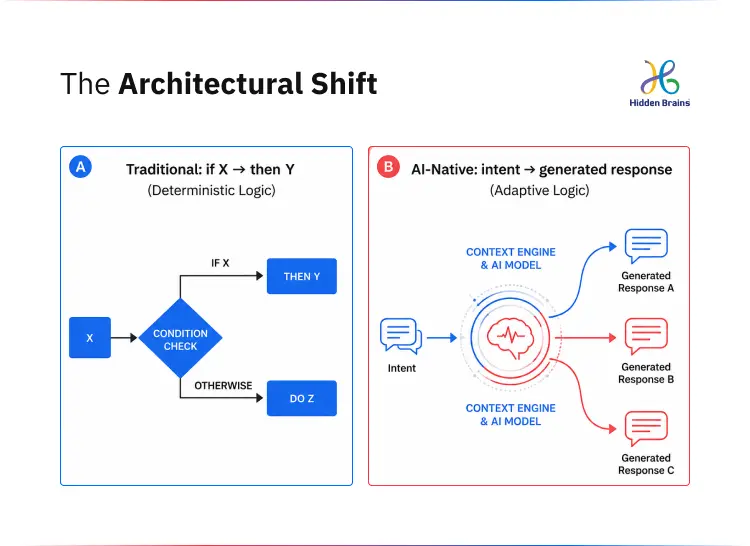
A traditional app runs on deterministic logic: if the user taps X, show Y. An AI-native app runs on probabilistic logic: based on the user’s intent and context, generate the most useful response, interface, or action, and improve as it learns. That shift changes how the app is designed, tested, secured, and priced.
| # | Traditional App | AI-Powered App | AI-Native App |
|---|---|---|---|
| Role of AI | None | A feature (e.g. a chatbot bolted on) | The core of the product |
| Logic | Fixed rules | Mostly fixed, some ML | Adaptive/probabilistic |
| Data | Stores data | Uses some data for features | Learns continuously from data |
| Example | A booking form | Booking form + FAQ chatbot | An assistant that plans and books for the user |
| Runs on | App server | App server + occasional API call | Models, data pipelines, inference engine |
What Makes AI-native Feasible — and Why Irish Businesses are Moving Now
AI-native apps are practical because the cost and complexity of the underlying technology have dropped sharply.
Three things changed:
- Large language model APIs have matured and become cheaper per call, reducing the cost of integrating AI features.
- On-device AI chips (NPUs) now handle inference locally on modern smartphones, improving speed, privacy, and efficiency.
- Cross-platform frameworks such as Flutter and React Native enable AI-native mobile app development from a single codebase, allowing intelligent features to be deployed on both iOS and Android.
For Irish businesses specifically, the pull is competitive and practical. Ireland’s tech-dense market, a large multinational software presence alongside a fast-growing SME and startup base, means customer expectations for app quality are high, and standing still is visible.
Gartner predicts that by the end of 2026, 40% of enterprise applications will feature task-specific AI agents, up from less than 5% in 2025. As AI becomes embedded in mainstream enterprise software, businesses will increasingly need to treat AI-native capabilities as a core product requirement rather than an optional enhancement. The honest version: the technology being feasible does not make it necessary for every app. It makes it achievable; the decision still comes down to whether intelligence solves a real bottleneck for your users. That decision is the next section.

Plan Your AI-Native Application Before the Market Moves.
Get a Free ConsultationWhat Does It Cost to Build and Run an AI-Native App in Ireland?
The economics of AI-native apps extend beyond initial development. While the build phase may require additional investment compared with traditional applications, long-term success depends equally on ongoing capabilities such as AI infrastructure management, model optimisation, AI maintenance and support services, and continuous improvement.
| Cost Factor | Traditional App | AI-Native App |
|---|---|---|
| Design & build | Standard | Higher — data pipelines, model integration, evaluation |
| Data preparation | Minimal | Significant — quality, labelling, governance |
| Ongoing model/inference cost | None | Per-use cost that scales with usage |
| Testing & QA | Deterministic (repeatable) | Probabilistic — needs evaluation, not just pass/fail |
| Maintenance | Bug fixes, OS updates | Above, plus model monitoring and retraining |
The Hidden Running Costs of AI-Native Apps: Model Usage and Inference
Every AI-native interaction may involve calling a model, and each call incurs a cost. A traditional app’s cost is largely fixed once built; an AI-native app’s cost scales with how much people use its intelligent features. This is manageable and often worth the investment, but it should be modelled upfront, because a successful feature can become a significant operational expense if usage grows faster than expected. A capable mobile app development company in Ireland should provide this projection before development begins, not after launch.
Exact pricing varies widely based on scope, AI model selection, integrations, security requirements, and compliance needs. At Hidden Brains, AI development projects typically start from $20,000*, with the final investment depending on the complexity and scale of the solution.
*Terms and conditions apply. Pricing may vary based on project requirements, technology choices, development scope, and delivery considerations.
AI-Native vs Traditional Apps: Is the Investment Worth It for Your Business?
AI-native is worth it when intelligence removes a genuine bottleneck for your users or operations, and it is not worth it when a traditional app would do the same job more cheaply and reliably. The deciding question is value, not novelty.
Go AI-native when: The core value depends on personalisation, prediction, natural-language interaction, or automating a multi-step task the user would otherwise do manually, and you have (or can get) the data to power it.
Stay traditional when: The app’s job is well-defined and rule-based (bookings, forms, catalogues, simple transactions), the user base is small, or you cannot yet justify the ongoing running cost. Adding AI here is cost without payoff.
KPIs AI-native apps are built to move:
- User retention — Personalisation loops that adapt to each user tend to lift repeat engagement.
- Support cost — In-app agents that resolve queries directly reduce human support load.
- Conversion — Intent-based interfaces surface the right action faster than fixed menus.
- Time-to-insight — Embedded analytics turn app usage into decisions without a separate reporting step.
The Challenges of Building AI-Native Apps: What Irish Teams Need to Consider
The four hurdles below are where AI-native projects most often stall, and where an inexperienced team gets it wrong. Naming them honestly is part of choosing the right partner.
| Hurdle | Why It’s Harder for AI-Native | What to Get Right |
|---|---|---|
| Legacy system integration | AI needs clean, real-time access to data often locked in older systems. | Build an API/middleware layer first; often part of a structured application modernization strategy. |
| Data quality, governance & readiness | Models are only as good as the data; GDPR raises the bar on how it’s handled. | Audit data quality and governance before any model work. |
| Infrastructure scalability | Inference load is variable, unlike fixed app logic. | Design for elastic scaling from day one (cost implications: see the cost section above). |
| Security of the AI layer | New attack surface: models, prompts, and pipelines, not just user data. | Secure the AI layer as well as user data (regulatory detail: see the compliance section below). |
Turn The Right AI Use Case Into Real Business Impact
Speak to an Expert
Compliance Considerations for AI Apps in Ireland: Navigating the EU AI Act and GDPR
Any AI-native app serving Irish or EU users must account for two regimes at once: the EU AI Act and GDPR. Treating them as an afterthought is the fastest way to a costly rebuild.
The EU AI Act classifies AI systems by risk, with obligations rising for higher-risk uses. GDPR strategies govern how the app collects, processes, and stores personal data, and AI-native apps, which learn from user data by design, sit squarely in its scope, overseen in Ireland by the Data Protection Commission.
Practical implications: be explicit about what the AI does, minimise the personal data it uses, and build in transparency and data-protection-by-design from the first sprint, not the last. For Irish businesses, getting this right early is also a trust advantage, not just a legal box to tick.
Practical Checklist: Is Your Business Ready For an AI-native app?
You’re ready for an AI-native app when you can answer “yes” to most of the questions below. If you can’t yet, that’s useful information; it tells you what to fix first.
- Bottleneck: Is there a real user or operational problem that intelligence would solve — not just a feature you’d like to have?
- Data: Do you have (or can you access) enough clean, relevant data to power the AI?
- Running cost: Can you sustain an ongoing per-use inference cost, not just a build budget?
- Compliance: Do you know your EU AI Act risk category and your GDPR obligations?
- Integration: Can the AI reach the data it needs across your existing systems?
- Partner: Do you have a team that has actually shipped and maintained AI features, not just experimented with them?
If most answers are “yes,” AI-native is worth scoping properly. If several are “no,” a strong traditional build now, with a clear path to add intelligence later, is often the smarter first step. If you want a second opinion on where you stand, our custom mobile app development services can pressure-test the idea before you invest.
How to Choose an App Development Company in Ireland
Selecting an app development partner requires more than reviewing portfolios or credentials. A comprehensive software development partner checklist should assess whether a provider can translate AI capabilities into reliable business solutions through proven delivery experience, strong engineering practices, effective governance, and long-term operational support.
Use these five questions to evaluate potential partners:
- Show me an AI-native app you built and still maintain. Building a demo is easy; running one in production is where experience shows.
- How will you project and control the ongoing inference cost? A good partner models this before you commit.
- How do you handle EU AI Act and GDPR compliance in practice? You want specifics, not reassurance.
- How do you test probabilistic features? Traditional pass/fail QA isn’t enough for AI behaviour.
- What certifications and process back your delivery? Standards like CMMI Level 3 and ISO 27001 signal repeatable quality and information security, which matter more when models and data are involved.
Can You Turn an Existing App AI-Native?
Yes, an existing traditional app can be evolved toward AI-native, but usually not by simply adding a model on top. It typically requires data engineering, adding an integration layer to feed the AI, and often modernising older components first, which is exactly what a structured application modernization strategy addresses. Done in stages, this lets you add intelligence where it earns its cost rather than rebuilding everything at once.
A typical transformation follows five stages:
- Assess – Evaluate the application landscape, business processes, data assets, technical constraints, and prioritise AI opportunities based on value and feasibility.
- Modernise the Foundation – Establish AI-ready data, cloud, security, governance, and integration capabilities while addressing critical legacy constraints.
- Embed AI into Workflows – Introduce AI into high-value business processes through copilots, intelligent automation, search, recommendations, or decision support.
- Scale Across the Enterprise – Standardise AI platforms, governance, operating models, and reusable capabilities to accelerate adoption across products and functions.
- Continuously Optimise – Measure business outcomes, refine models and workflows, manage AI risks, and continuously improve performance, cost, and user experience.
This phased approach enables organisations to realise value early, minimise transformation risk, and progressively transition from traditional software to AI-native operating models.
Frequently Asked Questions
How long does it take to build an AI-native app?
Longer than a comparable traditional app, mainly because of data preparation and testing probabilistic behaviour rather than the coding itself. A realistic plan phases delivery: a focused first version, then expansion, rather than a single long build.
Can we start small and test the idea before committing a full budget?
Yes, and for most Irish businesses this is the smarter route. A scoped pilot that proves the AI feature earns its running costs lets you validate demand and cost per use before scaling, which significantly de-risks the investment.
Do we need our own AI or data team to build one?
No. You can outsource the build and the ongoing model work, but keep two things in-house: ownership of your data and the product decisions about what the AI should do. A capable partner supplies the AI engineering; the business context and data have to stay yours.
Who maintains the AI after launch, and what does that cost?
An AI-native app isn’t “done” at launch. It needs ongoing monitoring, and models may need retraining as data and user behaviour shift, so budget for a maintenance and monitoring line, not just the build. Agree who owns this, you or your partner, before you sign.
What’s the business risk of staying with a traditional app?
The risk is competitive, not immediate: as rivals ship apps that personalise, predict, and automate, a fixed rule-based experience can start to feel dated to users. That said, switching before you have a clear use case is its own risk; the goal is a timed, evidence-led move, not a rushed one.
How do we keep customer trust with an AI app in Ireland?
Trust comes from transparency and restraint: be clear about what the AI does, collect only the personal data you actually need, and build GDPR and EU AI Act obligations in from the start rather than retrofitting them. For Irish customers, handling this visibly well is a brand advantage, not just a compliance task.


Conclusion
The move beyond traditional app development in 2026 is real, but it is not automatic, and it is not for every app. AI-native makes sense when intelligence removes a genuine bottleneck for your users, when you have the data to power it, and when you can carry the ongoing running cost. Where those conditions aren’t met, a strong traditional build, with a clear path to add intelligence later, is the smarter, cheaper first step.
For Irish businesses specifically, three things separate a good decision from an expensive one: budgeting for the inference cost, not just the build; designing for the EU AI Act and GDPR from the first sprint rather than the last; and choosing a partner who has actually shipped and maintained AI-native work, not just demonstrated it.
Start with the business problem, validate value through targeted AI pilots, build the supporting foundation, and scale successful use cases across the enterprise. Schedule a discovery session to uncover where AI can create measurable business value.