

















































































































Summary
- The costly mistake of rewriting that many CTOs encounter, and the one stack decision that prevents it.
- How Shopify processed 173B requests on a single Black Friday without switching its front-end stack.
- The 6-step roadmap that takes your React MVP to enterprise apps without touching the foundation.
- What makes React the preferred choice for businesses and developers?
- Which engagement model is right for your business?
- The money angle not to miss: one React codebase covering web, mobile, MVP, and enterprise apps simultaneously.
Organizations at every growth stage face the same architectural pressure: validate quickly without building something that becomes a liability at scale. Leading companies solve this tension by selecting a scalable foundation that grows with the product, rather than opting for a costly rewrite.
Shopify started as a snowboard shop. Slack started as an internal tool for a gaming company. Both needed speed, and both survived in explosive growth. Neither had to discard what they’d built to do it.
React is what makes that pattern repeatable. Whether you’re launching a new product or legacy software modernization, the question is the same: how do we build something today that doesn’t become a liability tomorrow?
The answer is ReactJS development.
- 30–50% Lower Development Cost
Shared architecture vs fully separate native builds - Cross-Platform Efficiency
Reusable logic across web and mobile reduces duplication - One Team, Shared Expertise
React + React Native skillsets minimize siloed hiring - Reduced Native Dependency
Less reliance on fully separate iOS and Android teams - Zero Rewrite Mindset
Built to scale from MVP to enterprise software without starting over
Achieve Seamless Growth: From MVP to Enterprise with React
Get ReactJS Services
Why React is Suitable for Both Small and Large-Scale Applications
Many frameworks force tough compromises, move quickly now, and rewrite later due to scalability issues. React, however, offers both agility and future-proofing. You can build MVPs in record time without sacrificing quality, and scale seamlessly as your enterprise expands. With React, you get a robust architecture that supports growth while maintaining flexibility. Discover how React can accelerate your business transformation.
Same Stack, Different Maturity
A React codebase built for an MVP doesn’t become legacy code when you reach Series B. You layer in complexity state management, testing pipelines, CI/CD automation, and design systems without ripping out what already works. The components you built in month one are the same components your enterprise team reuses in year three.
Some Real Stories that Scaled
Shopify Admin started with jQuery and Batman.js. Over time, they migrated to React and TypeScript without a full platform rewrite, evolving strategically as their needs matured. Today, Shopify processes 173 billion requests on a single Black Friday, all on a stack that still has React at the front-end core.
Slack tells a similar story. It launched on the LAMP stack in 2009. As user growth stressed the architecture, the team evolved it by migrating backend systems, scaling databases, and adopting React for their front end. No panic rewrite. Deliberate, staged upgrades.
That’s not luck. That’s what good architecture decisions look like from the start.
How React Pays Off — For Startups and Enterprises
React delivers measurable business value across the full maturity curve. Here’s what that looks like in practice:
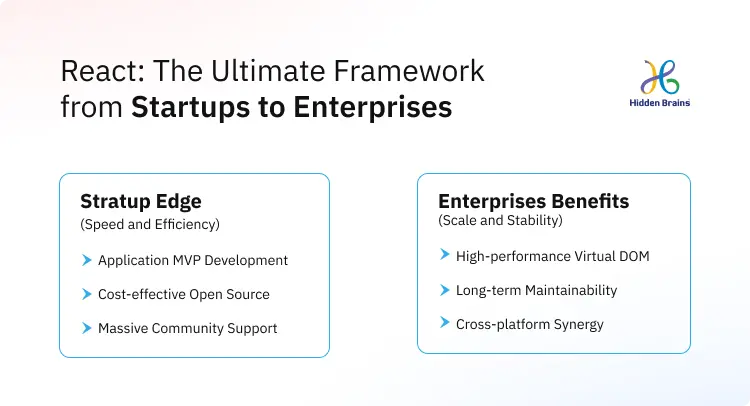
Component reuse – Eliminates redundant development and accelerates feature delivery — no rebuilding from scratch.
Parallel team development — Isolated components allow multiple product teams to build simultaneously without conflict.
Virtual DOM performance – Ensures UI responsiveness at scale, the same engine behind Shopify’s peak traffic days.
Clean backend integration — React works with any backend: Node.js, Python, Java, .NET, REST, GraphQL, ERPs, and third-party services.
Design system enforcement — Shared component libraries maintain consistency across 10+ product teams and multiple surfaces.
No vendor lock-in — Open source, community-maintained, no proprietary licensing risk.
Next.js server-side rendering – Addresses SEO and initial load performance, critical for content-heavy enterprise products.
One-way data flow – Reduces bugs in complex, data-heavy applications, less debugging time, and fewer production incidents.
Largest front-end talent pool — Faster hiring, lower onboarding time, flexible engagement models.
From React MVP to Enterprise Platform — Step by Step
This isn’t a theoretical roadmap. It’s the actual path React teams follow when building to last.
1. Start with Core Features Only
Don’t overbuild the MVP. Identify your 3-5 must-have features. Build them as clean, isolated React components. The goal is validated learning, not perfection. Keep the architecture simple enough that any React developer can pick it up on day one.
2. Establish Architecture Patterns Early
The decisions made in week two follow you for years. Set a clear folder structure. Define your state management approach. Context API works well for lean MVPs; Redux or Recoil as complexity grows. Document component naming conventions. Future developers and future hires will work faster because of it.
3. Layer in Testing Before You Scale
Nobody wants to write tests during an MVP sprint. Do it anyway, even minimal unit tests with Jest. When you’re onboarding your 5th developer post-Series A, that test coverage is the only thing standing between you and a production incident at 2 am. Quality isn’t a phase. It’s a decision made at step one. The teams that skip it don’t rewrite because they grew; they rewrite because they cut corners.
4. Build a Shared Component Library
As the product matures, extract reusable UI patterns into a centralized component library. This keeps design consistent when 3 product teams are building in parallel. Tools like Storybook make this maintainable without slowing down delivery. Shopify runs its entire Admin UI on this principle: React components as reusable building blocks.
5. Integrate Backend Systems and APIs
React sits cleanly on top of any backend, Node.js, Python, Java, .NET. As you move toward enterprise, add GraphQL or REST API layers, connect your auth system, and plug in third-party integrations. React doesn’t care what’s behind the curtain. It renders what you give it.
6. Scale Your Team, Don’t Rebuild Your Stack
This is where most companies make the wrong call. Growth pressure arrives, someone proposes a rewrite, and six months disappear. The smarter move: hire dedicated React developers or bring in a React development team that specialises in scaling existing codebases.

Why React Is the Go-To Choice for Developers and Businesses
There are other frameworks like Angular, Vue, and Svelte. They all have valid use cases. None of them match React’s combination of adoption, ecosystem depth, talent availability, and proven enterprise track record.
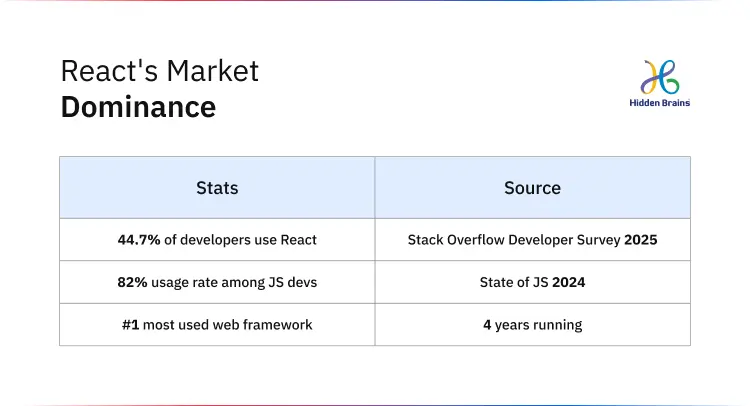
React is used by 44.7% of all developers, making it the most widely used front-end framework for the fourth consecutive year. Among professional JavaScript developers specifically, State of JS 2024 places usage at 82%.
- Largest front-end developer community globally, faster hiring, and lower onboarding time when you hire React developers.
- React Native extends the same framework to iOS and Android development, one team, one stack, both platforms covered without a separate codebase.
- Backed by Meta with active open-source governance, regular releases, and a thriving third-party ecosystem.
- First-class support across AWS, Azure, and GC, no infrastructure compromises at enterprise scale.
- SEO-ready via Next.js server-side rendering, critical for B2C and content-heavy enterprise products.
- Shopify, Slack, Netflix, Airbnb, and Dropbox all run React in production, with real-world validation at every scale.
For businesses, this translates to one thing: lower risk. You’re not betting on an emerging framework with an uncertain future. You’re building on the most adopted, most supported, most hired-for front-end library in production today.
How Hidden Brains Can Help
With over 22 years in software development, we’ve seen countless frameworks rise, plateau, and fade away. React isn’t one of them; we recognized its potential early on.
With a team of 700+ developers and a proven track record across industries, from MVPs to enterprise-grade platforms, we offer more than just execution. We bring deep expertise and pattern recognition, understanding what works and what doesn’t at scale. The key decisions that shape success are almost always made at the architecture level, not during the sprint.
Our React practice isn’t just another service offering; it’s a core discipline, honed over years of experience across versions, teams, and the full project lifecycle, from initial validation to long-term platform ownership.
Hidden Brains Edge
- Compliance First: Security, data privacy, and regulatory requirements are embedded from the start, not bolted on later.
- Foundations Over Shortcuts: We build the architecture that prevents costly rewrites down the line.
- Technical Debt Off The Roadmap: We know where debt accumulates and how to prevent it.
- Scalability on the Rise: Our React teams are structured to grow with you, ensuring sustainable expansion.
- Value, Impact, Purpose: We partner with businesses where the product matters, focused on outcomes that drive real value.
Ways to Work With Us
- Dedicated React Team: A fully integrated team that handles your front-end roadmap from architecture to delivery. Ideal for scaling post-PMF companies with multiple feature tracks.
- Hire React Developers: Add senior React specialists to your team to fill skill gaps, accelerate development, or unlock key features without full engagement overhead.
Frequently Asked Questions
How long does it take to build a React MVP?
A focused React MVP, covering just the core features, moves quickly with the right team. Thanks to React’s component architecture, what you build early carries straight into future versions; nothing goes to waste. Every component is an investment in velocity, setting the stage for faster iterations, smoother scaling, and the flexibility to adapt as your product evolves.
Can the same React codebase scale from MVP to full-scale enterprise app development?
Yes, and it’s verified by real-world examples. Shopify’s Admin interface evolved from jQuery to Batman.js to React and TypeScript over time, without a ground-up platform rewrite. Slack scaled from a LAMP-stack startup to a globally adopted enterprise platform through deliberate, staged architectural evolution. The key is how you structure the code from the beginning.
When should I hire dedicated React developers?
You should hire dedicated React developers when you have complex, long-term projects that require specialized expertise in React’s ecosystem. They’re ideal for building scalable, high-performance applications, optimizing user experience, and maintaining ongoing development. If you need consistent quality, efficient handling of updates, and fast delivery, a dedicated team ensures your project runs smoothly and is future-ready.
Does React work for mobile as well as web?
Yes. React Native, built on the same principles as React, lets you do Android and iOS development with a largely shared codebase. Shopify officially adopted React Native as the future of their mobile stack in 2020, building on top of their existing React web foundation. Many teams start with a React web MVP and expand to mobile via React Native without a stack switch.
Is React still the right choice in 2026, given newer frameworks like Svelte or Solid?
React remains the most widely used front-end framework as of Stack Overflow’s 2025 survey, with 44.7% adoption among developers globally. Newer frameworks like Svelte and Solid offer performance advantages in specific scenarios, but React’s ecosystem depth, talent availability, and enterprise track record make it the lowest-risk, highest-leverage choice for most product teams at scale.



Conclusion
ReactJS is the ideal framework for both startups and enterprises. It enables rapid prototyping and cost-effective MVP development, while providing scalability and long-term performance for larger platforms. By leveraging React’s reusable components and strong architecture, businesses can avoid costly rewrites as they grow. The key to successful scaling from MVP to enterprise lies in having the right strategy and expertise to build a solid foundation that adapts to evolving needs, ensuring sustainable growth.
