






































































































Summary
AI threats are rising, and traditional security systems are struggling to keep up. AI Agents in cybersecurity help businesses detect risks faster, respond in real time, and reduce manual workload across cloud, network, and endpoint environments. These agents improve threat monitoring, automate incident response, and support smarter decision-making for CTOs and CFOs. With growing adoption and strong ROI reports, AI agents are becoming a key part of modern cybersecurity strategy. Businesses that implement them early gain stronger resilience, improved productivity, and better long-term protection.
Cybersecurity is no longer just an IT responsibility. It has become a business survival requirement. Startups, enterprises, and fast-growing digital companies face constant threats such as ransomware, phishing, insider risks, and API breaches. And the reality is simple: human teams alone cannot keep up with the speed of modern attacks.
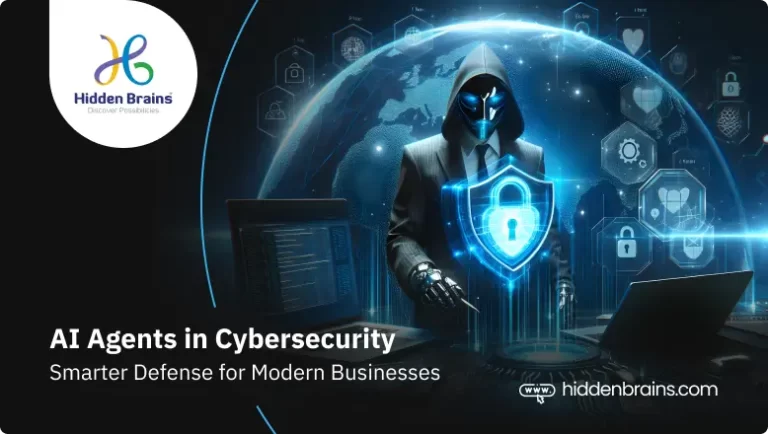
This is where AI agents in cybersecurity are changing the game. Unlike traditional automation tools, AI agents can observe, learn, decide, and act in real time.
With the global agentic AI cybersecurity market projected to reach USD 322.39 billion by 2033 at a CAGR of 34.4%, it is clear that this is not a passing trend. It is a major shift in how security will be built and managed in the next decade.
This blog explains how AI agents work in cybersecurity, why businesses are adopting them, and what leaders like CTOs, CFOs, and product heads need to know before investing.
AI Agent’s Role to Ensure Cybersecurity
AI agents are designed to act like intelligent security workers. They do more than detect threats. They respond, recommend actions, and even execute workflows based on predefined rules and real-time context. To understand their value, it helps to answer a common question: What is an agent in cybersecurity?
An agent is a system that monitors environments, analyzes signals, makes decisions, and performs actions to protect digital assets. In simple terms, it is like a security guard powered by AI, constantly watching and reacting.
How AI Agents Operate in Cybersecurity Environments
AI agents typically work through a cycle:
- Collect data from endpoints, networks, cloud apps, and logs
- Identify patterns and abnormal activity
- Predict potential threats before damage occurs
- Trigger alerts, block access, isolate systems, or start remediation
A modern cybersecurity agent can work across cloud infrastructure, SaaS tools, and internal systems. It is especially critical for businesses operating in multi-cloud or remote work environments.
Why Do Businesses Need AI Agents Now?
Threats are becoming faster and more intelligent. Attackers are now using automation and AI to scale their efforts, which means enterprise IT security must evolve just as quickly.
That is why more businesses are adopting AI-driven security and fraud prevention solutions and seeing strong returns in a short time. With the right enterprise IT security services, companies can accelerate detection, strengthen response capabilities, and build a more resilient security framework that delivers measurable business value.
Explore AI-powered Security for Your Business Growth
Talk to Our Experts
Advantages of Using AI Agents in Cybersecurity
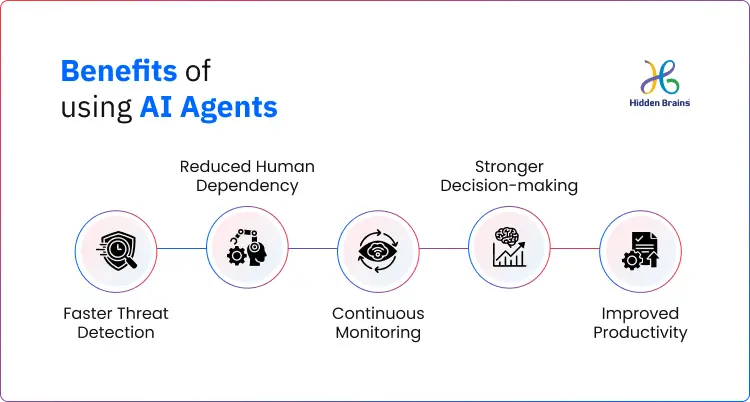
AI agents are not only about protection. They also reduce workload, improve response speed, and help teams make better decisions.
Faster Threat Detection and Response
Speed matters. A single delay can turn a minor breach into a major incident. AI agents can detect anomalies within seconds and trigger automated actions instantly.
This is why businesses are prioritizing detection and response as a core security investment. But a strong response is only possible when the basics are already in place. A clear security foundation, like this cybersecurity checklist, helps ensure your systems are prepared before AI-driven monitoring and automation take over.
Reduced Human Dependency
Security teams are overwhelmed. Alerts are increasing every year, but skilled cybersecurity professionals are limited.
A strong cybersecurity agent reduces manual work by filtering false positives, prioritizing incidents, and handling repetitive investigations.
Continuous Monitoring Without Fatigue
Humans get tired. AI agents do not. They monitor systems 24/7 and continuously analyze behaviors across users, devices, and applications.
Stronger Decision-making for Leadership
For CTOs and CFOs, cybersecurity is about risk management and business continuity. AI agents provide clearer reporting and threat intelligence, helping leadership make faster, smarter calls.
Improved Productivity and Operational Efficiency
Companies adopting AI agents are seeing business-level results. Around 66% of organizations adopting AI agents report measurable value through increased productivity. That means fewer disruptions, faster issue resolution, and smoother operations.
Security AI Agents: Core Features and Functionalities
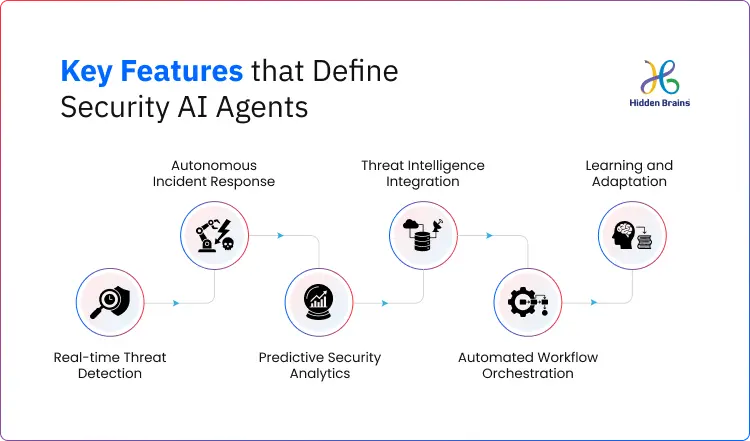
AI agents are powerful because they combine intelligence with automation. They are built to act, not just report.
Real-time Threat Detection
AI agents detect suspicious activities by learning normal behavior patterns. When something unusual happens, they flag it instantly. It includes:
- Unusual login patterns
- Data exfiltration attempts
- Sudden traffic spikes
- Unauthorized privilege escalation
Autonomous Incident Response
Traditional tools send alerts. AI agents go further. They can initiate actions such as:
- Blocking IP addresses
- Isolating endpoints
- Resetting compromised credentials
- Deactivating suspicious user accounts
This autonomous capability is why modern enterprises are adopting AI Agents in Cybersecurity.
Predictive Security Analytics
Predictive models help businesses prevent attacks before they happen. AI agents can analyze trends and detect weak spots, such as misconfigured cloud permissions or outdated security patches.
Threat Intelligence Integration
A good cybersecurity agent integrates with threat intelligence feeds. It continuously updates its knowledge base with new attack patterns, malware signatures, and phishing campaigns.
Automated Workflow Orchestration
Security AI agents can connect with tools like SIEM, SOAR, EDR, IAM, and cloud security platforms. It allows them to automate workflows across multiple systems.
Learning and Adaptation
AI agents improve over time. The more they observe, the better they become at distinguishing normal business behavior from suspicious behavior.
Use Cases of AI in Cybersecurity
AI agents are already being used across industries. Their adoption is growing because they solve real problems that businesses face every day.
Interestingly, while AI adoption is high, only 11% of organizations currently have AI agents in production, while 38% are piloting them. It signals that the industry is shifting from experimentation to real deployment. Here are the most valuable use cases.
Fraud Detection and Prevention
Banks, fintech platforms, and ecommerce businesses use AI agents to detect suspicious transactions and prevent fraud. AI agents can analyze user behavior and identify fraud attempts instantly.
Phishing and Email Threat Protection
AI agents can detect phishing patterns, suspicious email links, and spoofing attempts. They can automatically quarantine emails and alert security teams. A robust generative AI development services provider can help companies generate realistic phishing simulations to train employees.
Endpoint Protection (EDR Enhancement)
AI agents monitor endpoints like laptops, desktops, and servers. They detect malicious processes and isolate infected devices before malware spreads.
Cloud Security Monitoring
Cloud environments are complex. Misconfigurations are one of the biggest causes of breaches. AI agents monitor cloud permissions, workloads, storage buckets, and API traffic to detect threats early.
Insider Threat Detection
Not every threat comes from outside. AI agents can detect abnormal employee behavior, such as:
- Unusual file access
- Large data downloads
- Suspicious login locations
- Sudden permission changes
Automated Compliance Monitoring
Compliance is costly. AI agents help monitor security policies and generate audit-ready reports. This is especially useful for industries dealing with SOC 2, ISO 27001, PCI-DSS, HIPAA, or GDPR.
SOC Alert Reduction and Prioritization
Security Operations Centers often deal with thousands of alerts daily. AI agents reduce noise by filtering false positives and highlighting real threats.
Security AI Agents: Best Practices
AI agents can be extremely effective, but only when implemented correctly. Businesses need to treat them as part of a long-term cybersecurity strategy.
Start with Clear Security Objectives
Before deploying an AI agent, businesses must define what success looks like. It could reduce incident response time, improve phishing detection, lower false positives in SOC alerts, or strengthen compliance monitoring. When goals are clear, implementation becomes structured and measurable. Without defined objectives, AI adoption often turns into an expensive experiment with no clear outcome.
Use Human-in-the-loop Governance
AI agents should not operate without oversight, especially in the early stages. Human validation is essential to ensure decisions are accurate and aligned with business security policies. A practical approach is to let AI agents recommend actions first, while security teams review and approve them. Once confidence grows, organizations can gradually enable more autonomous response workflows.
Secure the AI Agent Itself
AI systems can also become targets. If attackers manipulate the data feeding the agent or interfere with its decision-making process, the entire security setup can become unreliable. That is why organizations must secure AI agents against threats such as data poisoning, model manipulation, unauthorized access, and prompt injection in AI-driven environments. A compromised AI agent can quickly become a major risk instead of a defense layer.
Integrate with Existing Security Tools
A cybersecurity agent should not function in isolation. Its real strength comes from connecting with existing tools and acting as an intelligent layer on top of them. Integration with SIEM, IAM, EDR, firewall systems, and cloud security platforms ensures the AI agent has full visibility and can respond faster across multiple environments. It also reduces gaps that attackers often exploit.
Monitor Performance and Tune Regularly
AI agents are not “set and forget” systems. They require continuous monitoring to ensure accuracy and effectiveness. Businesses should regularly review how well the agent detects threats, reduces false positives, and responds to incidents. Ongoing tuning keeps the system aligned with evolving attack patterns and changing business operations.
Maintain Transparency for Leadership
For AI agents to be trusted at the executive level, they must provide visibility and clarity. CTOs and CFOs need dashboards that highlight threat trends, response timelines, incidents avoided, and measurable risk reduction. When reporting is transparent, leadership can make informed decisions about cybersecurity budgets, compliance priorities, and long-term security planning.
How Hidden Brains Can Help?
Modern businesses need more than standalone tools. They need cybersecurity strategies that scale with growth, changing infrastructure, and evolving threats. At Hidden Brains, we help organizations design AI-driven security architectures where AI agents can monitor, detect, and respond across networks, cloud platforms, and business-critical applications.
It ensures faster threat detection, stronger visibility, and more control over security operations without adding unnecessary complexity. Whether you are a startup needing lean security that grows with your product, or an enterprise requiring compliance-ready frameworks and advanced threat intelligence, we build scalable solutions that support both CTO priorities and CFO risk expectations.

Strengthen Your Cybersecurity With AI Agents Today.
Contact UsFrequently Asked Questions
How are AI Agents in Cybersecurity different from traditional security tools?
Traditional tools mainly detect and alert. AI Agents in cybersecurity can detect, analyze, decide, and take action automatically. They also learn from patterns and improve over time.
What is an agent in cybersecurity?
An agent in cybersecurity is a system that monitors digital environments, identifies threats, and performs actions to protect systems. A modern cybersecurity agent uses AI to make decisions in real time.
What is the role of a cybersecurity agent in modern businesses?
A cyber security agent helps businesses detect threats early, reduce incident response time, automate investigations, and improve overall security monitoring across networks, endpoints, and cloud systems.
Are AI agents safe to use for cybersecurity operations?
Yes, but they must be implemented with governance. AI agents should follow defined rules, include human oversight, and be continuously monitored to avoid errors or misuse.
What industries benefit most from AI Agents in Cybersecurity?
Industries such as fintech, healthcare, e-commerce, SaaS, manufacturing, logistics, and government benefit the most because they face high volumes of attacks and strict compliance requirements.

Conclusion
Cybersecurity threats are evolving fast, and businesses can no longer rely on slow, manual defense systems. AI is now a core part of modern security strategy. AI Agents in cybersecurity help organizations detect threats faster, respond in real time, reduce operational workload, and improve productivity. With global spending increasing and adoption accelerating, early movers gain stronger resilience and lower breach risks. The real question is not if AI agents will be used, but how quickly they will be implemented responsibly.