
























































































































Did you know AI is already transforming how companies like Deloitte and FedEx train their people?
This blog breaks down why AI in eLearning isn’t just hype — it’s the future of business growth. From personalized learning paths to smart chatbots and real-life success stories (think Duolingo, Coursera, Google), you’ll discover how AI helps businesses save time, cut costs, and boost productivity. We’ve made it simple, practical, and human-friendly — no jargon, no fluff. Ready to learn how to make training smarter? Let’s dive in.
Walmart recently rolled out AI-driven VR training modules for over 2 million employees, reducing training time by nearly 95%. And it’s not just Walmart. From IBM and DHL to Bank of America, major enterprises across industries are embracing AI in eLearning to make corporate training faster, more innovative, and more streamlined.
The new approach promises next-generation learning experiences, such as scenario-based training modules and adaptive testing, which make training more capable and interesting.
Sounds impressive, right?
That’s because more and more businesses are turning to AI to level up how they train their people. AI isn’t just a buzzword anymore. It’s helping companies save time, cut costs, and boost performance through more innovative learning tools.
In this blog, we’ll answer simple, practical questions about why AI in eLearning is becoming essential for business growth and how knowing this may help you build the finest eLearning app.
Why Partnering with an AI Development Company Matters
If you’re serious about using AI in your learning strategy, teaming up with an experienced AI development company is the most brilliant move. Whether it’s custom chatbots for learner support, recommendation engines for personalized content, or generative AI tools for interactive scenarios, these companies can offer the following benefits:
- Tailored AI Solutions designed to meet your unique training and business goals.
- Faster Deployment with expert guidance, reducing trial-and-error.
- Cost-efficient Development by avoiding unnecessary tools or features.
- Scalable Architectures that grow with your business needs.
- Expertise in AI Tools & Frameworks, ensuring robust, future-ready systems.
- Enhanced Personalization through advanced algorithms and data insights.
- Integration Support with your existing LMS or business platforms.
AI in the eLearning Market Is Booming: Here’s Why It Matters to You
Let’s get real. This isn’t just hype if you’re an EdTech expert, CTO, startup founder, or investor. AI in eLearning is big, and it’s only getting bigger.
Here’s why it matters.
The global AI in eLearning market is expected to increased USD 9.58 billion in 2026 to USD 111.30 billion by 2034.
But here’s where it gets even more exciting. Generative AI in eLearning alone will explode to nearly $10 billion by 2029.
Speaking of the long term, here’s one thing to consider: global spending on AI in education is a mainstream driver. Meanwhile, the overall eLearning market, a major driver of AI innovation, is projected to grow by approximately $326.9 billion between 2026 and 2030, highlighting massive expansion opportunities for AI-powered learning platforms.
But why should this even matter to you?
AI is not only transforming individual learning modes and how business expands, but also how products will be scaled, and how the future of eLearning will be built. Based on that, you can collaborate with a tech partner that offers generative AI development services.
When you are not listening, you are already falling behind.
Also Read: The Role of Generative AI in eCommerce Technology by 2025
How AI-based eLearning Models Work?
Let’s keep this simple. AI in eLearning works like your smartest team member – always watching, always learning, always improving.
It looks at how people interact with content. Are they stuck? Are they bored? Are they flying through? Based on that, it tweaks the learning journey in real-time. Smarter quizzes, better suggestions, helpful reminders – all tailored to each person.
It can even create new content on the fly, answer questions through chatbots, and track how everyone’s doing without breaking a sweat.
For businesses, that means less guesswork and more results. For learners, it feels like training was built just for them.
That’s why people love it.
Prime Reasons for Adopting AI in eLearning
So, why are more and more companies turning to AI for employee training? Simple. It solves a lot of problems businesses have been dealing with for years. Traditional training can be slow, expensive, and let’s be honest, a little boring.
AI is changing that. It’s helping companies train smarter, faster, and more efficiently. If you’re serious about keeping your team sharp and your business competitive, AI isn’t just friendly to have – it’s a game-changer.
Here’s why businesses are jumping in:
- Saves time: Automates content creation, assessments, and progress tracking.
- Reduces training costs: No need for endless workshops or hiring extra trainers.
- Improves learning speed: Delivers content when and how learners need it most.
- Makes learning flexible: Anytime, anywhere, on any device.
- Boosts engagement: Personalized learning keeps people interested and motivated.
- It helps upskill teams faster: Tailors training to what each person needs to grow.
- Keeps businesses competitive: Better skills lead to better performance and results.
Re-imagining, a leading Learning Management System from Europe used Gen AI in its application to achieve a stunning 47% increase in learning outcomes.
The Use of Artificial Intelligence in eLearning
Artificial intelligence is not an alien term in eLearning; it is already applied as a practical solution in a fascinating way that could lead to practicalities.
Whether it is assisting learners to remain engaged or making the job of training teams harder, AI is changing the future of workplace learning.
And, when you ask yourself how AI allows its presence in the larger context of eLearning, here is the outline of how it can already be doing its magic.
Personalized Learning Paths
AI studies learner behavior and creates customized learning journeys. For example, platforms like Coursera use AI to recommend courses based on user progress and interests.
Chatbots for Instant Support
Companies are adding AI chatbots to learning portals to answer questions in real-time. Think of it as a 24/7 virtual tutor that never gets tired.
Smart Content Creation
AI tools can automatically generate quizzes, summaries, and assessments, saving hours of manual work. Duolingo is an excellent example of using AI to adapt lessons based on your performance.
Data-driven Insights
AI helps track learner performance and identifies gaps early. This way, managers know who needs extra support without waiting for quarterly reports.
Gamification and Engagement Tools
AI enhances interactive elements like games, badges, and challenges to keep learning fun and engaging.
Also Read: Generative AI vs. Agentic AI – Which One Leads in 2025?
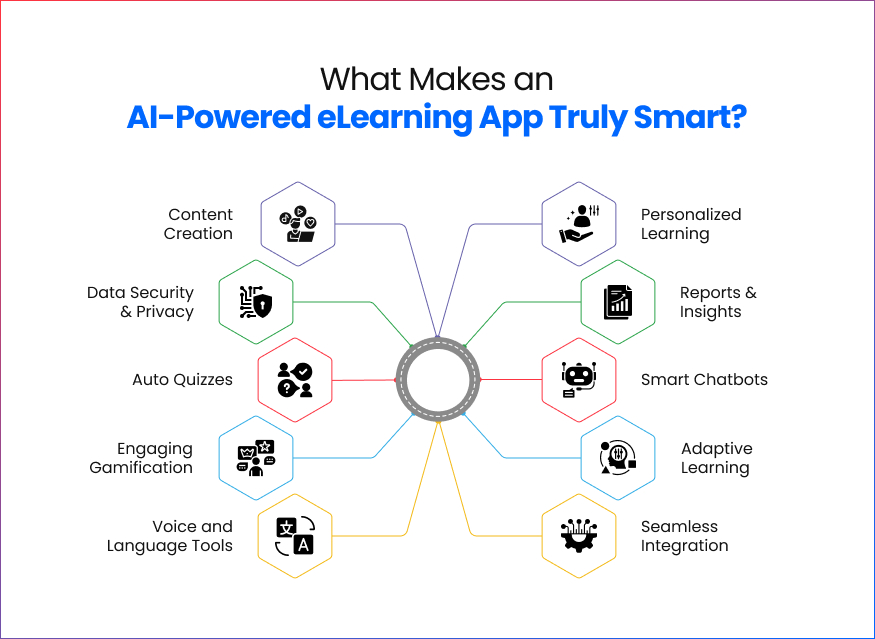
The Essential Characteristics of an AI-powered eLearning App
So, what do you need for an eLearning AI app to run?
It’s not simply to throw the words ‘AI’ into the name. It is about employing smart technologies that actually make it easier, faster and more enjoyable for both the learner and the company.
Here is a simple overview of what must be there.
Personalized Learning
The app understands how people learn. It suggests the right lessons at the right time, based on progress and interests.
Chatbots for Quick Help
Think of it like having a friendly guide who answers questions anytime, day or night. It’s there to support learners whenever they get stuck, so they don’t have to wait for a human trainer. Partnering with an AI chatbot development company can make your chatbot more competent.
Auto Quizzes and Feedback
The app creates quizzes automatically, checks answers in real-time, and gives instant feedback. No waiting for instructors or manual grading. This helps learners know exactly where they stand and improves retention by reinforcing concepts right away.
Adaptive Learning
The AI adapts based on each learner’s performance. If someone struggles, it slows down and offers more practice. If they do well, it moves them ahead faster, so everyone gets a personalized learning path.
Reports and Insights
Admins and trainers get clear, visual reports that show who’s progressing and who might need help. It highlights trends and patterns in learning behavior. This makes it easier to take action quickly and improve training outcomes.
Easy Content Creation
You don’t need to build every lesson from scratch. The app helps reuse templates, auto-suggests questions, and even generates learning materials using AI. This saves time and keeps content consistent across your training programs.
Gamification
The app adds game-like features such as badges, levels, and leader boards. This makes learning more engaging and fun. It encourages people to keep going, compete a little, and celebrate their progress.
Voice and Language Tools
Learners can speak naturally into the app, ask questions, and get answers in different languages. The voice recognition and language processing make learning feel more intuitive and human. It’s especially helpful for global teams and learners with accessibility needs.
Easy Integration
The app connects easily with other tools you already use – like HR systems, Slack, or Zoom. This means you don’t need to switch platforms or duplicate effort. Everything works together for a smoother training experience.
Data Safety
All user data, quiz results, and learning histories are protected with strong encryption and secure storage. The platform follows top industry standards for data privacy. You can trust that your team’s information stays confidential and safe.
Now, let’s list down both essential and advanced features of an AI-based eLearning solution and the benefits offered by them with the help of a table:
| Feature | Benefit |
|---|---|
| Personalized Learning | Tailored content and pace for maximum effectiveness |
| Adaptive Assessments | Real-time, targeted feedback |
| AI Chatbots/Assistants | 24/7 student support and tutoring |
| Automated Content/Translation | Rapid creation & localization |
| Emotion & Engagement Detection | Higher retention and reduced dropout rates |
| Data Dashboards & Analytics | Insightful tracking and interventions |
| Smart Recommendations | Supports ongoing learning and skill expansion |
| Gamification/Microlearning | Boosts motivation and lesson uptake |
| Admin Automation | Streamlined management saves time |
| Secure Proctoring & Credentialing | Trust in testing and achievement validation |
How Businesses Are Winning with AI in eLearning
Enterprises across the world have adopted AI in online learning to power their business growth. It’s already happening. Big brands and popular platforms are using AI to make learning smarter, faster, and way more personal.
Here are a few simple examples to show you how:
Duolingo
Duolingo uses AI to make language learning fun and easy. It watches how you learn, where you’re doing well, and where you’re stuck. Then it adjusts the lessons just for you. That’s why it keeps you moving forward without feeling overwhelmed.
Coursera
Coursera’s AI helps you pick the right courses. It looks at what you’ve already learned, your goals, and your interests. Then it suggests what to learn next. It’s like having a smart friend guiding your career journey.
Pearson
Pearson uses AI to give instant feedback, no need to wait for a teacher or trainer. The system checks your work and shows you where to improve right away. It saves time and helps people learn faster.
Digital LMS (Moodle-based Platforms)
Have you heard of Digital LMS? It uses AI-powered LMS platforms built on Moodle. Digital LMS comes with chatbots that answer questions, suggest the best courses, and even grade tests automatically. They use points, badges, and games to make learning fun. Plus, they give clear reports so businesses can see how everyone’s doing.
Google’s AI for Education
Google uses AI to make tools like Google Classroom smarter. It helps teachers by grading faster, spotting common mistakes, and giving helpful suggestions. It also shows who needs extra help and who’s ready to move ahead. It saves time for everyone.
Also Read: How Will AI in Logistics Transform the Industry in 2025?
How to Implement AI in Your Business’s eLearning Solutions
Have you made up your mind to go with eLearning and AI? If the answer is yes, Great choice. But how do you ever begin?
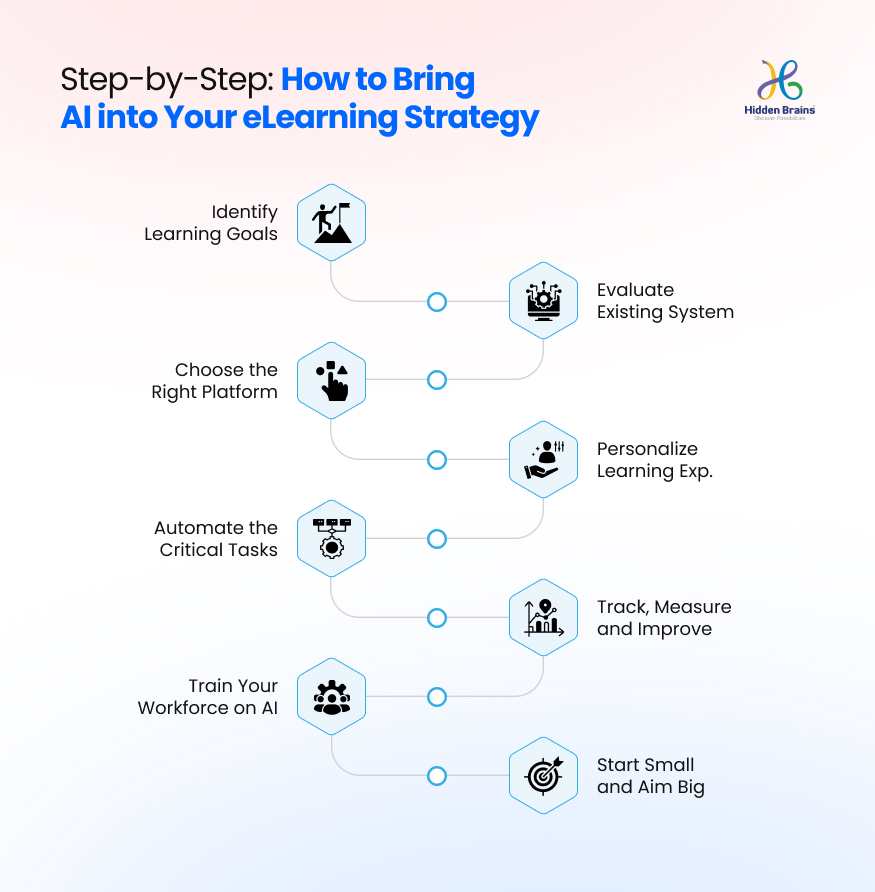
It may sound quite technical initially, though all you need is to make the right movements and go ahead and do things smartly. This is a basic roadmap that you can use to do that:
Identify Your Learning Goals
Start by asking yourself: What do we want to achieve?
Do you want to onboard people faster? Upskill your teams? Improve engagement?
Clear goals will help you pick the right AI tools and void wasting time and budget on features you don’t need.
Analyze Your Current Learning System
Look at what you’re already using. Is it working? What’s missing?
Check where your team struggles: content, engagement, tracking progress? It will show you where AI can help most.
Choose the Right AI-powered Platform
The variety of alternatives available is huge, including AI-driven LMS or even tailor-made products. Choose something that suits your needs, financial capacity, and growth in the future. Ensure that it is easily connected to your systems through effective AI integration services.
Personalize the Learning Experience
One of AI’s biggest strengths is personalization. Use it!
Set up AI to create learning paths based on skills, performance, and goals. It keeps people engaged and helps them learn faster.
Automate Where It Makes Sense
Allow AI to deal with the menial tasks: grading quizzes, reminders, and even progress analysis. It liberates your staff to concentrate on the larger issues, such as strategies and quality of content.
Track, Measure, and Improve
AI gives you data. Use it well.
Check the reports: Who’s learning? Who’s struggling? What’s working?
Refine your approach over time based on real results, not just guesswork.
Train Your People to Work with AI
Don’t forget this step! Just ensure that your HR, L&D, and management teams are trained on the use of these AI tools. A tool is only going to be smart if people can use it smartly.
Start Small, Then Scale Up
You don’t have to do it all at once.
Begin with one department or one project. See how it works. Then expand as you learn what fits your business best.
How Hidden Brains Can Help You Build Your AI-powered eLearning Solution
Looking to build your own AI-powered eLearning platform? Hidden Brains can help. From smart LMS solutions to custom AI integrations, they know how to create learning tools that work for your business, your people, and your goals.
Frequently Asked Questions
Still wondering how AI in eLearning really works? Here are some quick answers to the most common questions people ask.
How does eLearning AI make training personalized for every employee?
AI tracks each employee’s learning patterns, like how fast they learn, where they struggle, and what content they engage with most. It then adjusts the training material in real time to match individual needs. It means every person gets a tailored learning experience, whether they need more support or are ready to move ahead faster.
What is the future of eLearning for the corporate workforce?
The future is all about smarter, faster, and more adaptable learning. AI will power platforms that deliver bite-sized, relevant training at the right time on any device. As automation and real-time analytics evolve, companies will be able to upskill their workforce continuously, keeping pace with changing business needs.
Can AI eLearning tools really replace human trainers or coaches?
Not really. AI can automate repetitive tasks, deliver basic training, and provide personalized feedback, but human trainers bring empathy, mentorship, and real-world experience. Instead of replacing them, AI acts as a support system, making trainers more efficient and allowing them to focus on deeper, strategic interactions.
How can AI in online learning improve productivity?
AI saves employees and trainers time by automating quiz creation, grading, content delivery, and progress tracking. It keeps learners engaged with personalized content and gamified experiences. Most importantly, it provides real-time insights into performance so teams can make faster, better training decisions, leading to quicker results on the job.
How much does it cost to build an AI-powered eLearning app?
Costs vary depending on complexity and features. A basic app with standard AI functionality might start from the mid-range budget, while advanced platforms with adaptive learning, voice tools, integrations, and analytics can reach the higher end. Customization, scalability, and data security also influence the final pricing.


Conclusion
AI is transforming the way in which companies train, upskill, and develop their teams. Smarter learning means better results, happier learners, and a successful business. Getting ready to really learn smarter? Time to get started now.