



































































































































Quick Summary
- Translated AI passes demos but fails on dialects, code-switching, and Arabic documents.
- Arabic-first enterprise AI is a seven-layer stack, not a translated interface.
- Design conversations by market and train on real Arabic data, not translated English.
- Voice, ERP and CRM integration, and human escalation must all work in Arabic.
- RTL layouts, bidirectional text and numerals belong in the design system from day one.
- Saudi PDPL and UAE data laws make hosting location an early design decision.
- Evaluate in Arabic on your own data for accuracy, dialect, and safe action.
Arabic enterprise AI fails most often for an unglamorous reason: the system was designed in English and translated into Arabic afterward. The interface reads correctly, the AI demo passes, and then production traffic arrives in Gulf dialect, mixed Arabic and English, and scanned Arabic contracts the model was never built to handle.
Consider a pattern that recurs across GCC rollouts. A customer-service assistant launches after strong English testing. Within weeks, agents notice it misreads Khaleeji complaints, loses track when a customer switches languages mid-sentence, and escalates more conversations than it resolves. The model is rarely the root cause. The project treated Arabic as a presentation layer instead of an operating language.
That distinction matters because Arabic underpins contracts, customer interaction, and public administration across the region, yet PwC Strategy& notes that most AI systems still operate primarily in English. Translating the screens makes a product look local. It does not make the AI understand the customer, read the document, respect the regulation, or measure success in Arabic.
This guide is written for CIOs, CTOs, and digital leaders in the UAE and Saudi Arabia who are moving Arabic AI from pilot to production. It covers where translation-first approaches break, the seven layers an Arabic-first enterprise stack needs, and how to decide between a global model, an Arabic-first model, and in-country deployment.
What Is Arabic Enterprise AI?
Arabic enterprise AI is AI that understands, reasons, acts, and is evaluated in Arabic inside real business workflows, across Modern Standard Arabic (MSA), regional dialects, and mixed Arabic-English input. It connects to the organization’s data, systems, and governance, so it can complete real work for Arabic-speaking customers and employees.
How Is Arabic Enterprise AI Different From Translated AI?
Translated AI is an English-first system with Arabic added at the input and output. Arabic enterprise AI is designed in Arabic from the start. The difference rarely shows in a demo; it shows in production.
- Who it is built for: Translated AI is built for English users and translated afterward. Arabic enterprise AI is built for Arabic-speaking customers and staff from day one.
- Language coverage: Translated AI mostly handles Modern Standard Arabic. Arabic enterprise AI also handles Gulf and other dialects, plus mixed Arabic-English.
- Data: Translated AI learns from translated English content. Arabic enterprise AI learns from real Arabic conversations and documents.
- Workflows: Translated AI answers questions. Arabic enterprise AI completes tasks in ERP, CRM, and case systems.
- Compliance: Translated AI considers data rules after launch. Arabic enterprise AI designs hosting and data rules from the start.
- How success is measured: Translated AI is judged on fluency. Arabic enterprise AI is judged on accuracy, dialect handling, safe action, and business outcomes.
Basic Arabic support is quickly becoming a baseline expectation in the Gulf. What separates strong deployments now is quality: how well the system understands dialect, completes the task, and hands over to a person when it should.
Why Does Machine Translation Fail for Enterprise Arabic AI?
Machine translation fails because Arabic’s hardest problems sit beneath the words: which variety the user writes in, how words are built, what the script leaves unwritten, and which local knowledge the answer depends on. A translation layer cannot fix any of these.
Where translation-first Arabic AI breaks in production
| Symptom in production | Root cause | Business impact |
|---|---|---|
| Assistant misreads customer complaints | Built or tested on MSA and translated English; customers write in Khaleeji, Egyptian, or Levantine Arabic | Escalations, repeat contacts, lower CSAT |
| Mixed-language messages routed to the wrong intent | Code-switching and Arabizi (Arabic typed in Latin script) | Failed self-service, agent workload shifts instead of shrinking |
| Enterprise search misses documents that exist | Rich morphology: one root, many surface forms, attached prefixes and pronouns | Staff fall back to manual search and colleagues |
| Same question, different answers | Omitted diacritics make words ambiguous | Users stop trusting the system |
| Wrong figures in finance answers | Arithmetic without tools is a known weak spot | Reconciliation and compliance risk |
| Confident but wrong legal answers | Thin background knowledge of local law | Legal exposure in contract and policy work |
| Higher cost and latency than planned | Tokenizers split Arabic words into many subword units | Larger inference bills, less usable context |
The evidence behind the last three rows is recent. In Stanford CRFM’s HELM Arabic Enterprise leaderboard (May 2026), top models scored 0.99 on legal questions when given the source text but only 0.495 without it, which the researchers link to limited knowledge of UAE law. Financial calculation was the weakest finance task. PwC Strategy& reports that generic Arabic-capable models reach only around 30 to 50 percent accuracy on Arabic financial text.
Diglossia: formal Arabic in documents, dialect in conversation
Most enterprise documents are written in MSA, while most customer conversations are not. A Saudi or Emirati customer may type “أبغى” (abgha) or “أبي” (abi) for “I want,” an Egyptian “عايز” (ayez), while the policy document the AI retrieves says “أريد” (ureed). A system tuned only on formal Arabic will read the policy well and the customer poorly, which is the opposite of what a contact center needs.
Morphology, missing diacritics and tokenization cost
Arabic builds words from consonantal roots and patterns, and everyday writing omits short vowels. The same written form “كتب” can mean “he wrote” (kataba) or “books” (kutub), and only context tells them apart. This affects cost as well as accuracy. The DALLA project notes that most LLM tokenizers are optimized for high-resource languages, so common Arabic words are split into many subword units, lengthening sequences and hurting performance. Research from MBZUAI looked at diacritics, the small vowel marks written above or below Arabic letters. It found that modern LLMs cope well with the occasional diacritics in everyday text, but fully diacritized text, common in religious texts and learning material, substantially increases token fragmentation and lowers performance. Underneath it all is a data imbalance:: PwC cites roughly 82GB of English text versus 5.4GB of Arabic in the CC100 dataset, despite more than 400 million Arabic speakers.
Code-switching and Arabizi
GCC professionals and customers routinely mix Arabic and English in one message, and younger users often type Arabic in Latin script with numerals for sounds (“3ayez”). Systems trained mainly on English data struggle with dialects, colloquial expressions and mixed Arabic-English conversations, which is why code-switching has to be part of testing from day one, not an edge case added later.
The Enterprise Stack Must Change: Localization Is an Architectural Requirement, Not a UI Feature
Localization is an architectural requirement, not a UI feature. It spans the data used to train and evaluate the system, the model’s dialect coverage, the prompts and conversation flows, voice, integrations, the interface, governance, and the way success is measured. Each of those decisions starts with the target market and register, not with the English version of the product.
In practice, we break that stack into seven layers. Each one fails differently, and each needs its own owner.
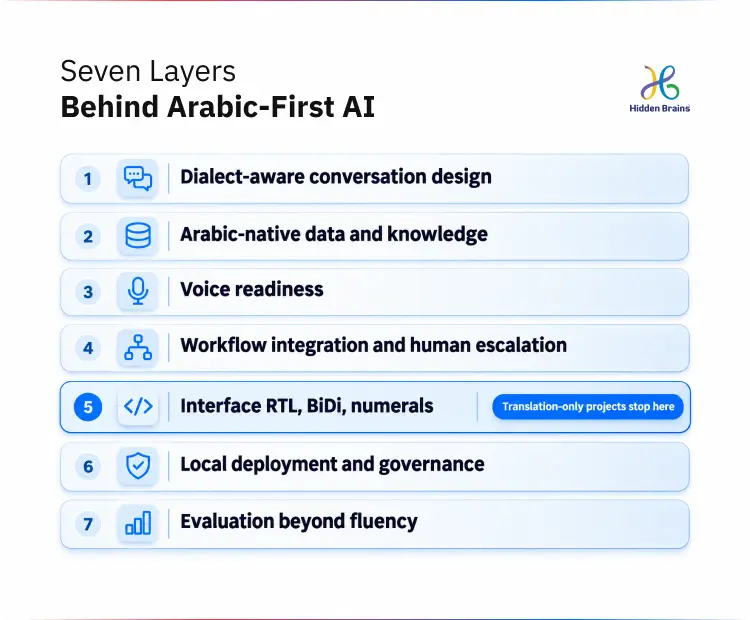
Layer 1: How Should Arabic AI Conversations Be Designed for Different GCC Markets?
Design conversations market by market instead of shipping one pan-Arab assistant. Customers in Saudi Arabia, the UAE, Kuwait, Egypt, Jordan, and Morocco do not communicate identically, and formality and tone vary even within the Gulf.
Three decisions belong at the design stage:
- Register per channel. Formal MSA may suit a regulatory notice; conversational Khaleeji suits a WhatsApp service flow. Write this down before prompts are written.
- Dialect identification at the entry point. A lightweight classifier can route a message to dialect-tuned prompts or models, with MSA as a declared fallback rather than an accident.
- Local reviewers in the loop. Linguists, CX specialists, and frontline agents from the target market should approve flows, greetings, honorifics, and refusal wording.
Layer 2: What Arabic Data Does Enterprise AI Need?
Enterprise AI needs Arabic-native data at every stage: real regional conversation logs for tuning, Arabic source documents for grounding, and Arabic test sets for evaluation. Translated English content teaches the model English patterns in Arabic words. Pipelines should start from Arabic sources, and annotation guidelines should be written in Arabic, with local subject-matter experts resolving ambiguity.
For retrieval-augmented generation (RAG) over Arabic knowledge, the engineering details decide quality. See how RAG differs from a standalone LLM.
In our experience, the recurring work items are:
- Normalization of letter variants (أ / إ / آ to ا, ة and ه, ى and ي) so the same word is indexed once
- Morphology-aware indexing, using analyzers such as CAMeL Tools, so a search for one form finds its variants
- OCR quality checks on scanned Arabic PDFs, because recognition errors flow straight into retrieved context
- Domain glossaries that fix approved Arabic terms for products, regulations, and job titles
Build Your Roadmap to Arabic-First AI.
Talk to Us
Layer 3: Why is Voice Readiness Critical for Arabic Enterprise AI?
Voice remains one of the most important customer channels in the Middle East, so Arabic AI that only works in text leaves a large share of demand unserved. Arabic-first speech recognition and text-to-speech, built for regional accents, dialects, and mixed-language speech, are becoming foundational for AI contact centers and virtual assistants.
A voice-ready stack is tested on:
- Speech recognition accuracy per dialect, on real call audio rather than studio recordings
- Natural Arabic voice output, including correct pronunciation of names, amounts, and dates
- Real-time response latency across the full loop of recognition, reasoning, and speech
- Mid-sentence switches between Arabic and English
Layer 4: How Does Arabic AI Connect to ERP, CRM, and Human Agents?
Arabic AI creates business value when it completes work inside ERP, CRM, and case-management systems, and when it hands over to a person cleanly once it reaches its limits. PwC Strategy& observes that Arabic-native models are still mostly confined to front-end conversational layers, and that more than 20 percent of Arabic chatbot queries still need human handover.
Integration is where Arabic-specific detail tends to surface late. Plan for:
- Name matching and transliteration, because one customer can appear as محمد, Mohammed, Muhammad, and Mohamed across systems
- Dual-language master data, so records carry approved Arabic and English values instead of machine-translated fields
- Hijri and Gregorian dates, stored consistently and displayed by context
- Digit normalization, converting Eastern Arabic numerals (١٢٣) before validation of phone numbers, IDs, and amounts
Human escalation is a designed handoff, not a failure state.
Escalate when confidence is low, or the issue is sensitive, such as complaints, payment disputes, or health questions. The handover should stay in the same channel and pass the full conversation, customer history, and dialect cues to the agent, so the customer does not repeat themselves. This matters most in regulated sectors such as banking and healthcare. Connecting AI to these systems is the core of AI integration services, and it is usually where most of the project effort sits.
Layer 5: What Does RTL UI/UX Design Require in Enterprise Software?
Right-to-left (RTL) design is a layout system, not a right-aligned text setting. Navigation, layout, and directional icons mirror; numbers, media controls, and most charts do not. Apple’s guidance notes that Arabic text may use either Western or Eastern Arabic numerals, and that usage varies by country, so choose one system per product and apply it consistently.
AI interfaces add their own bidirectional (BiDi) problems:
- Streamed answers that mix Arabic prose with English product names, codes or URLs
- Citations, tables and code blocks that must stay left-to-right inside an RTL message
- Input fields where users paste IBANs, emails or reference numbers into Arabic text
Isolate every left-to-right run (W3C’s bidi isolation guidance applies here), test with real mixed content rather than placeholder text, and have native speakers review the live interface, not a spreadsheet of strings.
Layer 6: Where Should Arabic AI Run, and What Do PDPL and Data Residency Require?
Decide where data is stored and where inference runs before choosing a model, because in the GCC that decision can rule models in or out. A prompt that contains personal data is still personal data when it leaves the country for an inference endpoint.
| Area | Saudi Arabia | UAE |
|---|---|---|
| Core law | Personal Data Protection Law (PDPL), supervised by SDAIA | Federal Decree-Law No. 45 of 2021 (PDPL), plus separate DIFC and ADGM regimes |
| Status | Fully enforceable as of 2026 (PwC handbook); amendments to the Implementing Regulations under consultation since 6 October 2026 (Akin Gump) | In force since January 2022; confirm Executive Regulations status for your entity (ATB Legal) [INSERT: legal verification] |
| Cross-border transfers | Permitted only when PDPL conditions are met; stricter rules for some data types and government data (Chambers) | Restricted; adequacy or contractual safeguards required |
| Sector overlays | NDMO, CST and SAMA rules; organizations generally apply the strictest one | Central bank, health-data and free-zone rules |
Local or in-country hosting can also help performance: locally hosted infrastructure can reduce latency and improve resilience for banking, telecom, healthcare and government workloads. Governance itself should be built in, not added later: role-based permissions, audit trails, human review for high-risk decisions, and clear disclosure that customers are speaking with AI. At Hidden Brains, our delivery runs under ISO/IEC 27001:2022 information-security controls, which is the baseline we bring to these designs. For a wider view of regional rules, see our guide to AI governance in the GCC.
Layer 7: How Do You Evaluate Arabic LLM Accuracy for Enterprise Use?
Evaluate on Arabic test sets drawn from your own channels, scored on more than fluency. Scale AI’s recommended dimensions are a practical checklist: factuality, dialect understanding, register, domain terminology, cultural fit, and whether users can safely act on the output and recognize its limits.
A workable protocol has four tiers:
- Baseline: public Arabic benchmarks such as HELM Arabic Enterprise, to shortlist models
- Dialect and code-switching: test sets in each target dialect, including Arabizi and mixed-language input
- Domain tasks: your contracts, policies, product data, and finance questions, with expected answers written by native-speaking experts
- Outcomes: containment rate, escalation rate, answer accuracy with citations, and how much human reviewers edit AI drafts
Re-run the suite whenever the model, prompts or knowledge base change. Evaluation is a standing process, which is also what separates a pilot from production. More on that shift in why AI pilot programs stall.
Which Arabic AI Model and Deployment Should GCC Enterprises Choose?
Treat it as two separate decisions: which model handles the language, and where that model runs. Most teams merge them and end up choosing a hosting option to fix a language problem or the reverse.
The model decision follows the language profile of the use case. The hosting decision follows data sensitivity and sector regulation. “Arabic-first” is also not automatically better. In HELM Arabic Enterprise, older Arabic-specific open-weight models (Falcon3, AceGPT, ALLaM and Jais) were outperformed by newer models, so every option should be tested against your own data.
| Use case | Language profile | Data sensitivity | Sensible starting point |
|---|---|---|---|
| Internal knowledge assistant over policies and SOPs | MSA documents, English queries mixed in | Internal, little personal data | Strong global model with Arabic-aware RAG, hosted in an in-region cloud region |
| Retail banking chat or WhatsApp service | Khaleeji dialect, code-switching | Personal and financial | Dialect-tuned or Arabic-first model, in-country hosting, designed human escalation |
| Voice contact center or virtual assistant | Spoken dialects, accents, mixed speech | Personal, recorded voice | Arabic-first speech recognition and voice, latency-tested in-region deployment |
| Contract review and legal Q&A | Formal legal Arabic | Confidential | Any strong model that answers from retrieved source text, with mandatory human review |
| Finance questions with calculations | MSA plus figures | Financial | Model connected to calculation tools, never arithmetic in free text |
| Workflows touching government or regulated sector data | MSA and dialect | Highest; sector rules apply | In-country or on-premise deployment, model choice tested within that boundary |
Two rows rest directly on HELM results: legal answers improve sharply when the model is given the source text, and financial calculation is weakest without tools. The rest reflects the regulatory and channel realities covered above.
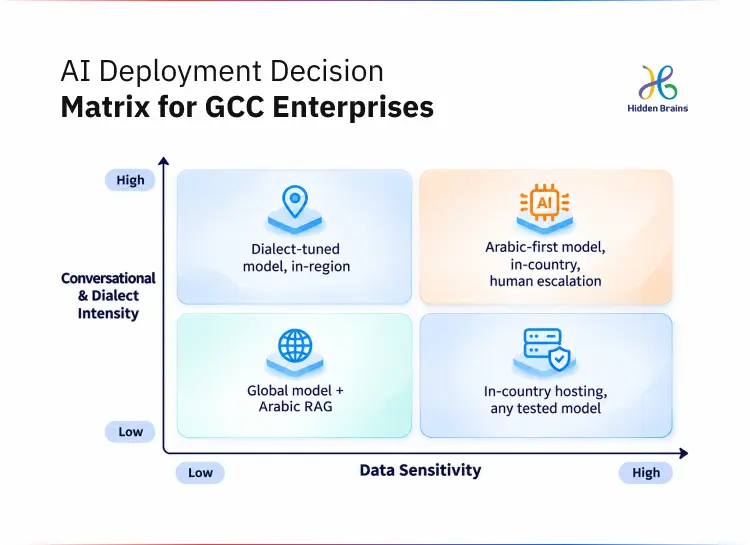
For Saudi programs specifically, sovereign capacity is expanding quickly; our earlier analysis of the US-Saudi HUMAIN AI partnership covers what that means for in-Kingdom options.
What Are the Enterprise AI Localization Best Practices for the Middle East?
Start from the language profile and regulatory boundary of each use case, then build data, evaluation, and governance in Arabic from the first sprint. The sequence below is the order we recommend, because each step changes the one after it.
- Define markets, dialects, and register per channel before a single prompt is written.
- Map every personal-data flow, including prompts, logs, and vendor endpoints, against PDPL and sector rules.
- Build an Arabic evaluation set from real traffic before choosing a model.
- Shortlist models on that set, testing global and Arabic-first options side by side.
- Engineer Arabic retrieval: normalization, morphology-aware indexing, OCR checks, and domain glossaries.
- Design escalation thresholds and handoffs with frontline teams, not only with engineers.
- Put RTL and BiDi rules into the design system, rather than catching them in late QA.
- Measure outcomes such as containment, escalation, and reviewer edits, and re-run evaluation on every change.
- Name an owner for each of the seven layers, so no layer is left to translation by default.

Assess Your Readiness for Arabic-First AI.
Talk to UsWhere Does Hidden Brains Fit in an Arabic AI Program?
At Hidden Brains, our Arabic AI work usually starts before model selection. We map each use case’s language profile, data flows, and regulatory boundary, then integrate the chosen model into the ERP, CRM, contact-center, and knowledge systems where the work actually happens. We stay model-agnostic, so the recommendation follows your evaluation results rather than a product we resell.
That work draws on 23+ years of software delivery for clients in 107 countries, a team in Dubai Business Bay, and CMMI Level 3, ISO/IEC 27001:2022 and ISO 9001:2015 certified processes, which matter most in the governance and evaluation layers. Explore our enterprise AI development services for GCC organizations.
Frequently Asked Questions
What is the difference between AI translation and AI localization in Arabic?
For the business, translation is a launch cost, and localization is a return on investment. Translation makes an English-built AI product look Arabic, which is enough for a demo. Localization makes it work for Arabic-speaking customers and staff: understanding their dialect, completing their requests, and keeping their data compliant. That shows up in fewer escalations, higher self-service adoption, lower cost to serve, and less regulatory risk. Translated AI tends to shift work back to human agents; localized AI removes it.
Can global LLMs handle Gulf Arabic dialects?
Often partly. Leading multilingual models read MSA well and handle common Gulf phrasing reasonably, but quality drops on less common dialects, code-switching, and Arabizi unless the system is tuned and tested for them. Test on your own customer messages before deciding.
Do GCC enterprises need an Arabic-specific LLM such as Jais, ALLaM, or Falcon?
Not always. Internal assistants over MSA documents can run well on a strong global model with Arabic-aware retrieval. Dialect-heavy customer service, voice, and sovereign workloads benefit more from Arabic-first or dialect-tuned models. Benchmark both on your data; Stanford’s HELM Arabic Enterprise results show that “Arabic-specific” alone does not guarantee better performance.
Does Saudi PDPL require AI to run inside the Kingdom?
Not as a blanket rule. The PDPL allows cross-border transfers when its conditions and safeguards are met, with stricter rules for certain data types and government data, and sector regulators can add localization requirements. In practice, AI that processes regulated personal data often ends up hosted in-country. Confirm with legal counsel.
How do you build RAG over Arabic documents and scanned PDFs?
Normalize Arabic letter variants, use morphology-aware indexing so word forms match, validate OCR quality on scanned files, and maintain a domain glossary of approved terms. Then evaluate retrieval with Arabic queries written by native speakers, including dialect queries against MSA documents.
When should an Arabic AI assistant escalate to a human agent?
When model confidence is low, when the topic is sensitive (complaints, payment disputes, health, legal matters), or when the customer asks for a person. The handoff should stay in the same channel and carry the full conversation and context, so the customer never has to repeat themselves.
How do Arabic voice agents handle different Gulf accents?
Through speech recognition trained and tested on real regional call audio, not only studio MSA recordings, plus voice output that pronounces local names, amounts, and dates naturally. Accuracy should be measured per dialect and per channel before go-live.
Should enterprise software use Eastern or Western Arabic numerals?
Either can be correct; usage varies by country and context. Pick one system per product based on your users and documents, apply it consistently in the interface, and normalize both forms in the backend so validation and search work regardless of what users type.



Conclusion
Arabic Enterprise AI Is Won in the Architecture
Arabic enterprise AI succeeds when Arabic is treated as the system’s operating language, not its display language. A translated interface can get a product to launch. It cannot teach the model Khaleeji, ground answers in Arabic contracts, route a sensitive call to the right agent, or satisfy a regulator asking where the data went.
The practical shift for GCC leaders is to stop asking “Does it support Arabic?” and start asking “Which of the seven layers have we actually built for Arabic, and who owns each one?” That question exposes the gaps early, when they are still design decisions rather than production incidents.
Arabic support is quickly becoming a baseline expectation in the Gulf. The enterprises that pull ahead will be the ones whose AI is designed, grounded, governed, and measured in Arabic, so that a customer in Riyadh and a contract in Abu Dhabi are handled with the same precision as an English query. That is the standard behind our custom AI development services.