











































































































Quick Summary
- AI pays off in palm oil only when estate, mill and market data are connected.
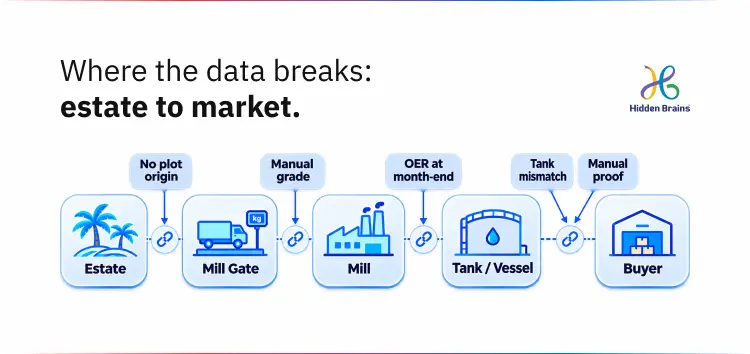
- Visibility breaks at five handovers: plot origin, FFB grading, OER tracking, tank stock and compliance proof.
- Six AI use cases: yield forecasting, FFB grading, OER optimisation, predictive maintenance, stock forecasting and traceability screening.
- ERP is the system of record that lets AI scale beyond one mill.
- Start with a 90-day, one-mill pilot measured against a baseline.
- EUDR applies to large and medium operators from 30 December 2026.
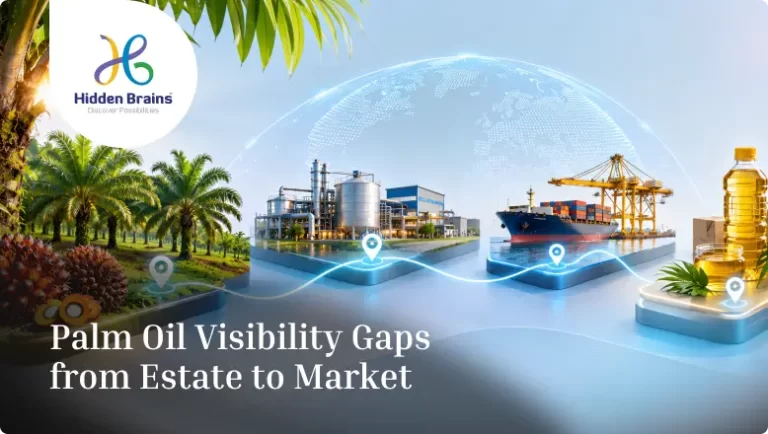
Palm Oil Visibility Gaps from Estate to Market
Most palm oil supply chains don’t lack data. They lack data that moves from one stage to the next. Each handover between estate, mill gate, mill, bulking station, and buyer is a place where records get re-keyed, delayed, or lost.
Estate and smallholder supply: origin is the weakest link
The first mile is the hardest part of the crude palm oil (CPO) supply chain to see. Company estates usually have block-level harvest records. FFB bought through dealers and collection centres often arrives with little more than a weight ticket and a supplier name.
Smallholders make this harder. In Indonesia, smallholders manage about 41% of the national oil palm area, and only around 1% of their 6.2 million hectares is ISPO-certified (Palm Oil Magazine). In Malaysia, sustainability leads at Wilmar have named polygon mapping as the biggest hurdle for smallholders preparing for EUDR (Eco-Business).
Mill gate and FFB intake: grading and weights sit outside the system
FFB grading at most mills is still a visual check by a grader. Two graders can score the same load differently, which drives disputes and deductions. Weighbridge software often runs on its own, so intake volumes reach the ERP as a daily summary rather than a per-truck record linked to a supplier and origin.
Mill processing: losses show up at month-end
Oil extraction rate (OER) is the number every mill manager watches, yet many mills only reconcile it at day-end or month-end. By then, oil lost in sludge, fibre or empty fruit bunches (EFB) can’t be traced back to a shift, a press or a batch of fruit. Maintenance is often reactive: a screw press or steriliser door fails, throughput stops and fruit quality degrades while it waits.
Bulking, refinery and logistics: inventory that doesn’t reconcile
CPO and palm kernel (PK) stocks move through tanks, trucks and vessels. When tank readings, dispatch notes and invoices live in separate systems, the finance team spends days reconciling volumes. Mixed tanks also break the chain of custody that buyers increasingly expect.
Market and compliance: proof assembled by hand
Buyers now want traceability to plantation, not just to mill. Under EUDR, each due diligence statement must include the geolocation of every plot where the commodity was produced (Regulation (EU) 2023/1115). For most groups, that evidence is still pulled together from spreadsheets, certificates, and supplier declarations shipment by shipment.
| Stage | Typical gap | Business impact | Data needed to close it |
|---|---|---|---|
| Estate/smallholder | No plot-level origin for third-party FFB | Loss of EU and premium buyers | Supplier registry with geolocation per plot |
| Mill gate | Manual grading, standalone weighbridge | Grading disputes, unlinked intake data | Per-truck intake record: weight, grade, supplier, origin |
| Mill processing | OER reconciled late, reactive maintenance | Oil losses and downtime found too late | Process and sensor data by shift and equipment |
| Bulking/logistics | Tank and dispatch records in separate systems | Inventory mismatch, broken chain of custody | Tank-level stock linked to intake and dispatch |
| Market/compliance | Evidence compiled manually per shipment | Slow, risky due diligence statements | One traceable record from plot to shipment |
AI Use Cases Across the Palm Oil Value Chain
AI improves palm oil operations in five places: estate yield, mill-gate grading, mill processing, inventory and logistics, and compliance. Each use case below names the problem, what the AI does, the data it needs, and the KPI it should move.
Estate: Yield Forecasting and Palm Health Detection
Satellite and drone imagery, combined with rainfall, fertiliser, and harvest history, lets a model forecast FFB output by block weeks ahead. The same imagery can flag stressed palms or disease early. Plantation groups already use this: Sime Darby Plantation has described using drone and satellite data to choose planting areas and detect palm health hazards early (FoodNavigator-Asia).
KPI it moves: forecast accuracy for mill intake, harvesting round compliance.
Mill gate: computer-vision FFB grading
Cameras over the unloading ramp classify bunches by ripeness, flagging unripe, overripe, rotten, and empty bunches. The model gives every load the same grading standard, and each grade is stored against the truck, supplier, and origin. That record later feeds both OER analysis and traceability.
KPI it moves: grading variance between graders, supplier disputes, ripe-bunch share of intake.
Mill Processing: Oil Extraction Rate (OER) Optimisation
OER optimisation models link fruit quality at intake to process settings (sterilisation time, press pressure, clarification temperature) and to oil losses in sludge, fibre and EFB. Instead of finding a loss at month-end, the mill sees it by shift and can adjust settings the same day.
KPI it moves: OER, oil loss per tonne of FFB processed.
Mill Processing: Predictive Maintenance for Palm Oil Mills
Vibration, temperature and current sensors on screw presses, sterilisers, boilers and kernel recovery equipment feed models that spot wear before failure. Work orders are raised in a maintenance management system (CMMS) before the breakdown, during planned stops. Malaysia’s Plantations and Commodities Minister has said AI could bring significant savings for palm oil processing factories, and has linked it to lower reliance on foreign workers (MPOB).
KPI it moves: unplanned downtime hours, mean time between failures, maintenance cost per tonne.
Logistics and Inventory: CPO Stock and Dispatch Forecasting
With intake forecasts and tank-level stock in one place, models can predict when tanks will fill and plan dispatch and vessel bookings around it. This cuts demurrage risk and keeps CPO quality (free fatty acid levels) within contract limits.
KPI it moves: tank utilisation, demurrage costs, FFA out-of-spec shipments.
Market and Compliance: AI-assisted Traceability and Risk Screening
AI does two jobs here. It checks supplier plot coordinates against satellite forest-cover data to flag deforestation risk after the EUDR cut-off date of 31 December 2020. It also flags anomalies, such as a supplier delivering more FFB than its declared plot area could produce.
Where blockchain fits: blockchain gives several parties a tamper-evident shared ledger of custody events. It does not check whether the data entered was true in the first place. AI and remote sensing do that. Use blockchain when many independent parties need to share one record. Use a well-governed integrated database when one group controls most of the chain. Blockchain development services makes sense only after the data at intake is reliable.
KPI it moves: share of volume traceable to plantation, time to prepare a due diligence statement.
Get EUDR-Ready With One Connected Palm Oil System
Start Your Assessment
The Integration Layer: Why ERP Decides Whether AI Scales
Every use case above depends on the same records: supplier, plot, intake, process, stock and shipment. In most groups, those records sit in four or five systems. The role of ERP in the palm oil industry is to be the system of record that joins them, so procurement, production, inventory, and finance read from one dataset.
AI then sits on top of three feeds: ERP for transactions, Internet of Things (IoT) sensors for equipment and process data, and the weighbridge for intake. Without that layer, each AI model needs its own data pipeline, and pilots stall at one mill. Palm oil ERP software built around this flow (plantation, procurement, production, inventory, logistics, finance, port) is what turns separate models into connected operations. Hidden Brains builds this layer through software integration services and IoT development.
| Use case | Value-chain stage | Data inputs | KPI | Maturity |
|---|---|---|---|---|
| Yield forecasting | Estate | Satellite/drone imagery, weather, harvest history | Intake forecast accuracy | Proven at large estates |
| Computer-vision FFB grading | Mill gate | Camera images, grading standard | Grading variance, disputes | Proven, spreading |
| OER optimisation | Mill processing | Intake grade, process settings, loss samples | OER, oil loss per tonne | Emerging |
| Predictive maintenance | Mill processing | Vibration, temperature, current sensors | Unplanned downtime | Proven in industry, early in mills |
| Stock and dispatch forecasting | Logistics | Intake forecast, tank levels, bookings | Demurrage, FFA out-of-spec | Proven in other commodities |
Implementation Roadmap and Pilot Design
The fastest way to improve palm oil supply chain visibility is to connect the data first, prove one AI use case at one mill, then scale. Groups that start with an AI model before fixing intake data usually end up rebuilding the pilot.
Step 0: Check data readiness before choosing an AI use case
Answer these five questions before any model work starts:
- Is every FFB delivery captured digitally per truck, with supplier and origin?
- Does the weighbridge write directly into the ERP, or is data re-keyed?
- Do the presses, sterilisers, and boilers you care about have sensors, and is that data stored?
- Are OER and losses recorded by shift, or only by day or month?
- Can you list each third-party supplier’s plots with coordinates?
Two or more “no” answers mean the first project is integration, not AI.
Phase 1 to 4: the roadmap
Automate compliance. Generate traceability records and due diligence evidence from the same dataset instead of compiling them per shipment.
Connect. Digitise intake and link weighbridge, mill systems, and ERP into one record per delivery.
Visualise. Build dashboards for intake, OER, downtime, and stock that update daily, not monthly.
Apply AI. Run one pilot (below), then add use cases that reuse the same data.
Turn Your Mill Data Into Measurable AI Gains
Book a ConsultationHow to Design a First AI Pilot
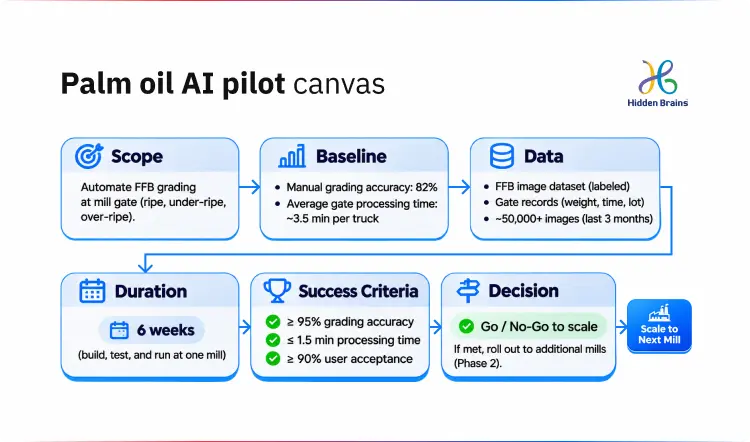
A good pilot is narrow, measured, and time-boxed. It answers one question: does this use case improve this KPI at this mill enough to roll out?
| Pilot element | What to decide | Example: computer-vision FFB grading |
|---|---|---|
| Scope | One use case, one mill | Unloading ramp at one mill |
| Baseline | KPI measured for 4–8 weeks before go-live | Grading variance between graders; disputed loads per month |
| Data | Inputs and who owns them | Camera images, grader scores, supplier ID |
| Duration | Fixed time box | 90 days after go-live |
| Success criteria | Agreed threshold before starting | Disputed loads down at least 30% from baseline, and system grades match the senior grader on 90% or more of sampled bunches |
| Decision | Go, adjust or stop | Roll out to other mills, or retrain and extend |
Pick the pilot with the clearest baseline and the shortest path to value. FFB grading and predictive maintenance on one critical asset are common first choices because the KPI is easy to measure.
Scaling from one mill to many
Scaling is mostly integration and governance work. Each new mill needs the same intake and sensor data standards, the same master data for suppliers and equipment, and trained staff on the floor. Plan for change management: graders and maintenance teams need to trust the model’s output before they act on it.
Honest limits
- Smallholder data is slow to collect. Plot mapping often needs field teams, cooperatives, or dealer programmes, not just software.
- Data quality caps model quality. A grading model trained on poor images, or an OER model fed day-level data, won’t perform.
- Sensors cost money. Start with the assets where one failure costs the most throughput.
- AI supports judgement; it doesn’t replace it. Final grading calls and maintenance decisions should stay with experienced staff during and after the pilot.
What to Look for in a Palm Oil Technology Partner
Look for a partner that can deliver integration and AI together, not one or the other. Check four things:
- Experience with ERP for procurement, production, inventory, and finance in commodity or manufacturing operations.
- IoT and data engineering skills to connect mill equipment and weighbridges.
- AI delivery that starts from a baseline KPI, not a demo.
- A delivery process you can audit. Hidden Brains works to CMMI Level 3 and ISO 27001/9001 standards, with 23+ years of enterprise delivery.
Frequently Asked Questions
How is AI being used in Malaysian palm oil mills today?
Malaysian mills are mainly piloting AI for process monitoring and predictive maintenance. The Plantations and Commodities Minister has pointed to significant savings for processing factories that use AI, and has linked its use to reducing reliance on foreign workers (MPOB).
How does MSPO certification relate to EUDR for Malaysian exporters?
MSPO supports EUDR compliance but does not replace an EU operator’s due diligence statement. The revised MSPO 2.0 standard (MS2530:2022) took effect on 1 January 2025 and made traceability mandatory, where it had been voluntary under the 2013 standard (The Edge Malaysia). In July 2026, the Netherlands’ food safety authority (NVWA) recognised MSPO as a private control system under the EUDR (MSPO). Exporters still need plot-level geolocation data that buyers can include in their filings.
Does ISPO certification help Indonesian producers meet EUDR?
ISPO helps, but certification alone won’t meet EUDR’s plot-level requirements. Indonesia is finalising SI-ISPO, a national traceability platform covering plantation to export, which officials expect to be operational before 30 December 2026. The government also covers ISPO certification costs for smallholders through state funds (UkrAgroConsult). Mills should still hold their own supplier and plot records that link to each delivery.
How can Indonesian mills trace FFB from independent smallholders and dealers?
Register every supplier and dealer, map their plots, and link each delivery to those plots at the mill gate. Under EUDR, plots larger than four hectares need polygons, not just a single coordinate (Regulation (EU) 2023/1115). Working through cooperatives makes mapping practical. Wilmar, for example, supports independent smallholders through cooperatives to reach ISPO and RSPO certification (Eco-Business). Mobile data capture for dealers then keeps the link from plot to delivery intact.
Which mill management systems work alongside MPOB reporting in Malaysia?
The best fit is a palm oil mill management system that produces MPOB figures from the same intake, production, and stock records it uses every day, so nothing is re-keyed. Malaysia is also building a National Traceability System that integrates e-MSPO, GeoSAWIT and SIMS (The Star). Choose software that can exchange data with these national systems as they mature.
What is a realistic first AI pilot for a mid-sized mill in Malaysia or Indonesia?
Computer-vision FFB grading or predictive maintenance on one critical asset, such as a screw press, run for about 90 days. Both have KPIs that are easy to baseline: grading variance and unplanned downtime hours. Start only after intake data is digital and linked to your ERP.
Where should a palm oil group start: ERP, traceability or AI?
Start with integration, because both traceability and AI depend on it. Connect intake, mill systems, and ERP into one record per delivery first. Traceability reporting then comes from that record, and AI use cases can be added without building a new data pipeline each time.
Conclusion
The EUDR deadline will pass, but disconnected systems will keep costing palm oil businesses money. Compliance has only made that cost visible. When every FFB delivery is linked to its batch, tank, dispatch, and invoice, traceability comes as a by-product, along with faster loss detection, fewer supplier disputes, and a clear margin before month-end. Start with one mill and one reconciliation, and let the gaps show you what to connect first.
Not sure where your handoffs break? Book a 2-hour free tech consultation, and we’ll map your weighbridge-to-invoice flow with you.