













Quick Summary
- AI projects fail at integration, not because of the models.
- AI agents need frequent, fresh, and secure API access.
- AI exposes architectural technical debt: missing APIs, stale data and weak governance.
- API wrappers improve access, but the architectural debt stays.
- Choose your approach: a wrapper, middleware, the strangler pattern, or a full replacement.
- Modernize in stages: access, then read-only APIs, then observability, then controlled writes.
Legacy system API integration used to mean letting a portal or mobile app read from an old core system. AI has raised the bar. In a September 2026 survey of 945 CIOs and CTOs, 84% said legacy system limits forced them to cancel an AI pilot or project (GFT Technologies / Wakefield Research).
They are not alone. 83% of IT leaders say they need infrastructure upgrades before agentic AI can run in production (Google Cloud, 2026). The AI models are usually ready. The systems they need to talk to are not.
Picture a simple request to an AI assistant: “Reschedule this customer’s delivery to Friday.” It must check the order in the ERP, stock in the warehouse system, the customer in the CRM, and charges in billing. If two of those have no usable API, the request fails, even though the model works fine.
🔑 Key Takeaway: Most AI projects don’t fail because of the model. They fail because the systems behind the model cannot be safely reached.
What Changes When AI Becomes the Consumer of Your Legacy APIs?
When AI becomes the consumer, your APIs need to handle runtime-driven calls, higher and burstier traffic, near-real-time data, safe retries, permissions scoped to each task, and a full audit trail. Most legacy APIs were built for a few predictable app calls, so you need to add these capabilities before an agent can use them safely.
A traditional app makes a fixed set of calls that a developer designed at build time. An AI agent decides which calls to make while it runs. It makes far more of them, retries when it’s unsure, and may chain several actions together. Interfaces that worked for years can fail under that pattern.
| # | Traditional App | AI Agent |
|---|---|---|
| Who decides the calls | A developer, at build time | The agent, at runtime |
| Call volume | Predictable | Bursty, often much higher |
| Data freshness | Overnight is often fine | Needs near-real-time context |
| Retries | Rare and controlled | Frequent, sometimes duplicated |
| Access | One app account | Scoped per agent and per task |
| Audit needs | Basic logs | A full trace of what the agent did and why |
🔑 Key Takeaway: An API built for an app is not automatically fit for an agent. AI changes who calls the API, how often, and with how much authority.
How Does Architecture Debt Become Explicit When AI Arrives?
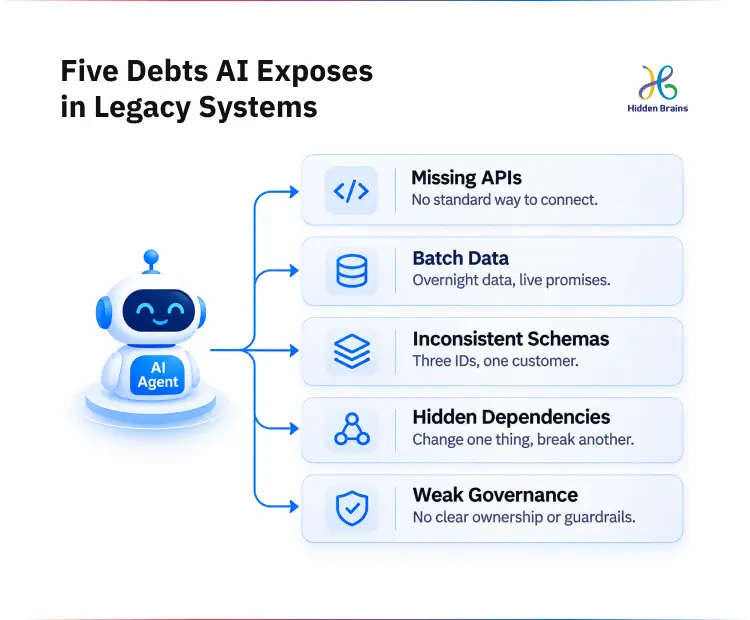
Architectural technical debt is the long-term cost of past design shortcuts in how systems are structured and connected, such as missing interfaces, tight coupling, batch-only data flows, and inconsistent data models. Unlike code-level debt, it can’t be fixed with a quick refactor. It sits in the architecture itself.
Legacy systems carry years of hidden shortcuts. Human users and fixed apps learned to work around them. AI cannot, so the debt shows up in five clear forms.
1. Missing or Partial API Surface
Many core capabilities exist only in screens, stored procedures, batch jobs, or undocumented internal calls. There is no clean API to expose them.
Real-world scenario: A bank’s credit-limit logic lives inside a mainframe screen flow. A team uses robotic process automation (RPA) to “click through” it for an AI assistant. It works, until the screen layout changes and the bot reads the wrong field.
💡 Pro Tip: Treat screen scraping as a temporary bridge, never a foundation. If an AI use case matters, give the underlying rule a real service interface, even a small one.
2. Batch-Oriented Data Flow
Legacy data is often refreshed overnight. AI use cases usually need near-real-time context or event-driven actions.
Real-world scenario: A manufacturer’s inventory syncs from the ERP once a night. Its AI sales assistant confidently promises stock that sold out at 10 a.m. The answer was accurate, but 14 hours old.
Change data capture (CDC) can help here. It streams database changes as they happen, so the AI sees updates without waiting for the nightly job.
3. Inconsistent Schemas and Semantics
The same customer, product, claim, or account may have different IDs and field meanings across systems. Humans know the difference. AI does not.
Real-world scenario: An insurer holds one customer under three IDs across policy, claims, and CRM. The status STAT_CD = 4 means “closed” in one system and “pending review” in another. The AI merges the wrong records and reports a claim as settled.
This is why connecting AI models directly to legacy databases is risky. Raw tables carry data without their business meaning, and data engineering services help add that meaning back before AI uses the data.
4. Hidden Dependencies
Direct database reads, point-to-point integrations, and undocumented workarounds break silently when a source schema changes. Many are built outside IT, which makes them a form of shadow IT.
Real-world scenario: A retail team adds one column to a product table. A forgotten report that reads it directly starts returning blanks, and so does the AI pricing assistant that copied the same query.
💡 Pro Tip: Before any integration work, list every system and script that reads your core database directly. That list is usually longer than anyone expects, and it is where most silent failures start.
5. Weak Observability and Governance
Legacy environments often lack audit trails, fine-grained permissions, and recovery mechanisms for automated actions. That was tolerable with humans in the loop. It is risky with agents.
Real-world scenario: A utility’s AI agent updates field work orders through a shared service account. When a job is wrongly cancelled, nobody can tell whether a person or the agent did it, or why.
Broken authorization and excessive data exposure already rank among the top API risks in the OWASP API Security Top 10. Giving an AI agent broad access through a shared account makes both worse.
🔑 Key Takeaway: AI does not create new debt in legacy systems. It makes existing debt visible, faster and at a larger scale than human users ever did.
What API Contract Does AI Actually Need?
AI needs an API contract that is discoverable, stable, secure, fast, observable, and predictable when things fail. Most legacy interfaces meet only one or two of these.
| Requirement | What It Means in Practice | Legacy Failure Mode |
|---|---|---|
| Discoverability | Developers and agents can find available operations and data | No catalog, no documentation, tribal knowledge |
| Stable Contract | Versioned request and response schemas | Internal tables or proprietary formats leak into integrations |
| Authentication and Authorization | Least-privilege, scoped access per agent or use case | Shared service accounts or database-level access |
| Latency and Scale | Supports interactive workflows | Batch jobs, rate limits, multi-second responses |
| Observability | Logs, traces, metrics, audit history | No way to reconstruct what the agent did |
| Error Semantics | Predictable failure and retry behavior | Silent failures, partial writes, unclear ownership |
| Business Meaning | Fields and statuses have clear, documented definitions | Codes like STAT_CD = 4 that only one person understands |
Error semantics deserve special attention. Agents retry. If a “create payment” call is not idempotent, meaning safe to repeat, one retry can create two payments. The IETF is drafting an Idempotency-Key standard for exactly this reason.
The API contract is only one layer of a safe agent setup. For the full picture, including human oversight and governance controls, see our guide to production-ready AI agent architecture.
🔑 Key Takeaway: The question is not “Do we have an API?” It is “Does our API meet the contract an AI agent needs to act safely?”
Is a Legacy System API Wrapper Enough?
A legacy system API wrapper is enough when the main problem is access, and the data behind it is fresh and well understood. A wrapper places a modern interface, usually REST, in front of an old system without changing its core.
That solves the missing API surface. It is often the fastest way to put a REST wrapper on legacy mainframe APIs or an old ERP.
The same logic applies to older application stacks. For many Microsoft-based systems, legacy .NET modernization rarely needs a full rewrite. A phased approach can expose clean APIs while the core keeps running.
A wrapper inherits everything beneath it, though. It cannot make overnight data real-time, give one customer one ID, or add audit trails the system never had. A wrapper on top of debt is still debt, just with a cleaner front door.
🔑 Key Takeaway: Wrappers fix access, not architecture. Use them when the problem is reachability, not freshness, meaning, or control.
Wrapper, Middleware, Strangler, or Replace: Which Pattern Fits?
The right pattern depends on which debts you face. Matching the pattern to the debt avoids over-engineering simple cases and under-building risky ones.
| Pattern | What It Is | Best Fixes | Doesn’t Fix | Effort and Risk |
|---|---|---|---|---|
| API Wrapper | A modern interface over the existing system | Missing API surface | Batch data, semantics, governance | Low |
| Middleware / Integration Layer | A central layer (API gateway, iPaaS, event bus) that translates, routes, and secures calls | Hidden dependencies, observability, some semantics | Logic still trapped in the old core | Medium |
| Strangler Fig Pattern | Gradually replacing parts of the old system with new services behind the same interface (Martin Fowler) | Most debts, one module at a time | Slow if applied everywhere | Medium to high, spread over time |
| Monolith to Microservices | Rebuilding the system as separate services with their own APIs | Most debts, structurally | High cost, high skills demand | High |
| Replace | Moving to a new platform | Everything, in theory | Migration and change risk | Highest |
Using middleware for legacy system API creation is often the sweet spot for mid-market companies. One managed layer handles security, logging, and translation for every system behind it. Teams can then decide module by module whether to go further. Our software integration services are typically built around this layer.
💡 Pro Tip: Use the strangler pattern on modules that change often or that AI will write to. Leave stable, read-only modules wrapped. Not everything needs rebuilding.
Where Do MCP and AI Tool Layers Fit?
The Model Context Protocol (MCP) is an open standard that lets AI applications discover and call tools and data sources in a consistent way. It sits above your APIs, not in place of them.
An MCP server wrapped around a shared database account and overnight data still has all five debts. MCP makes good APIs easier for agents to use. It does not make poor ones safe.
🔑 Key Takeaway: Choose the pattern by debt, not by trend. MCP and AI tool layers work best on top of a contract that is already sound.
What Should You Fix First to Make Legacy Systems AI-Ready?
Fix identity and access first, then build a narrow read-only contract, then add observability before any write access. Trying to modernize the whole estate before starting AI is how many projects stall.
| Order | Fix | Why It Comes First |
|---|---|---|
| Scoped identity and access per agent | Cheapest fix with the biggest risk reduction; it stops shared accounts from spreading | |
| A stable, read-only contract for the top 2–3 use cases | Delivers visible value with no write risk | |
| Observability and error semantics | Audit trails and safe retries must exist before the agent writes anything | |
| Event or CDC feeds where freshness matters | Only some use cases need real-time data, so fix those, not all | |
| Canonical IDs and shared definitions | The slowest fix, so start early and run it in parallel |
Make Legacy Systems AI-Ready with Secure, Governed APIs
Plan Your Roadmap
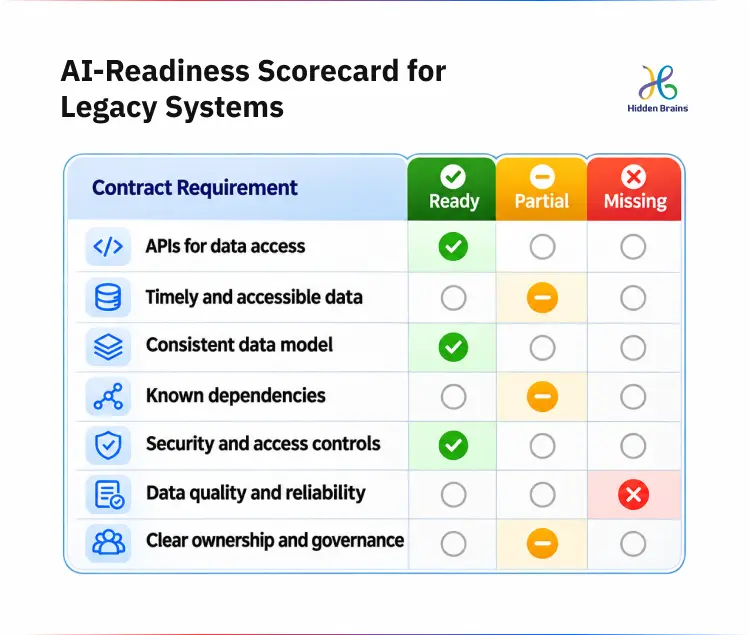
A practical sequence looks like this:
- Pick one use case with clear business value, such as order status or claim lookup.
- Map every system it touches, including direct database reads and spreadsheets.
- Score each system against the API contract table above.
- Fix the gaps in order, starting with access.
- Go live read-only, measure, then add write actions one at a time.
💡 Pro Tip: Start AI read-only. Then add each write action behind three things: audit logging, an idempotency key, and a tested rollback path.
What Timelines, Costs, and Trade-Offs Should You Expect?
Timelines depend mainly on which debts you find, not on the AI itself. A read-only wrapper for one use case is usually the shortest path. Semantic clean-up and module replacement take the longest.
Skills are a real constraint. In a 2026 study of 505 data leaders, 25% said they lack the skills to integrate complex legacy data (Drexel LeBow and Precisely). The same study found that 88% call their data AI-ready, yet 43% name data readiness as their biggest obstacle.
Speed has a hidden cost of its own. Teams that rush integration code with AI assistants can stack new debt on top of old systems. We explain how AI-generated code adds its own technical debt and how to contain it.
The main trade-off is speed against durability. Wrappers ship fast but carry debt forward. Deeper modernization takes longer but lowers the cost of every AI use case that follows.
🔑 Key Takeaway: Budget for debt discovery, not just API build. Teams that assess first usually spend less, because they fix only what their use cases need.
How Does Hidden Brains Approach Legacy API Integration for AI?
At Hidden Brains, our legacy integration work starts before any API is built. We first map where processes, data, and system dependencies break down for the specific AI use case. Then we choose the lightest pattern that makes it safe.
That usually means a scored assessment, a narrow read-only contract, and a governed integration layer. From there, our legacy modernization services team works with you to decide which modules deserve deeper re-engineering, based on business priority and risk.
For Microsoft-stack estates, our .NET modernization services follow the same phased, low-disruption path.
Governance is built in from day one. Our ISO/IEC 27001:2022-certified security practices and CMMI Level 3 delivery processes shape how we handle agent permissions, audit trails, and change control. We have two decades of experience and clients across 107 countries.
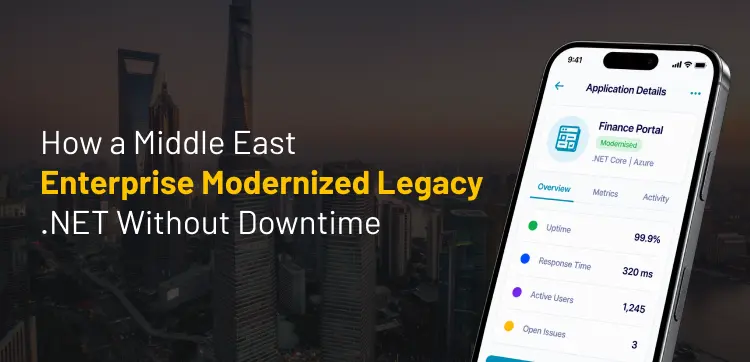
We have done this in our UAE legacy .NET modernization project. A phased approach, with no full rewrite, cut release cycles by about 35%. We cover the decision factors behind it in legacy .NET modernization in the UAE.
When AI is part of the plan, our AI integration services connect models to the new contract with scoped access and full traceability. Teams that need extra capacity can also bring in dedicated legacy system integration developers who work inside their own delivery structure.
🔑 Key Takeaway: The fastest route to working AI on legacy systems is not a bigger rebuild. It is a sharper assessment, followed by the smallest safe fix.

Is Legacy Architecture Blocking Your AI? Identify Gaps and Prioritize Fixes.
Talk to Our ExpertsFrequently Asked Questions
Why are our AI projects stalling when the AI tools work fine in demos?
Demos use clean, ready data. Real AI work needs live access to your ERP, CRM and core systems. When those systems can’t share accurate data quickly and safely, the AI stalls, however good the tool is.
Do we need to replace our legacy systems before we can use AI?
Usually not. Most businesses can start by making one or two high-value use cases AI-ready. Full replacement makes sense only when a system blocks many priorities at once or has become too risky to maintain.
What does it cost to make legacy systems ready for AI?
Cost depends on how much hidden debt sits behind your systems, not on the AI itself. A narrow, read-only integration for one use case costs far less than a broad rebuild. That’s why a short assessment before committing a budget is the best way to avoid overspending.
How quickly can we see business value?
Value comes fastest when you start with one clear use case, such as order status, claim lookup or stock availability. Going live read-only first lets teams show results early, before taking on the risk of AI changing records.
What is the business risk of connecting AI to old systems without fixing them?
The main risks are wrong answers from outdated data, wrong actions from unclear records, and no way to trace what the AI did. In GFT’s 2026 survey, 93% of CIOs and CTOs said running AI on unmodernized legacy systems could eventually cause an enterprise-wide security problem.
How do we keep control when an AI agent can act inside our systems?
Give each AI agent its own limited permissions, log every action, and start with read-only access. Add the ability to change records one step at a time, each with a clear approval and a way to roll it back.
Is an API wrapper a cheap shortcut or a real solution?
Both, depending on the problem. A wrapper is a fast, low-cost way to make an old system reachable. It won’t fix outdated data, mismatched records or missing audit trails, so it works best as a first step rather than the whole plan.
Should we build this in-house or work with a partner?
Build in-house if your team knows the legacy systems well and has integration and security skills to spare. A partner helps when those skills are scarce. In one 2026 study, 25% of data leaders said they lack the skills to integrate complex legacy data.
How do we decide which systems to fix first?
Start where business value and risk meet. Pick the process that matters most to revenue or customers, map the systems it touches, and fix access and data quality there first. Leave stable, low-impact systems as they are for now.
How will we know the investment is paying off?
Track business measures, not just technical ones. Useful measures include time saved per process, fewer manual handoffs, faster customer responses, fewer data errors, and how quickly new AI use cases can launch.
Conclusion
Legacy system API integration decides whether AI succeeds or stalls. The models are ready. The systems behind them often aren’t.
AI doesn’t create legacy debt. It exposes it. The fix isn’t a full rebuild or a wrapper alone. Match the pattern to the debt, start with scoped access and a read-only use case, and add write actions only after audit trails are in place.
Assess first, fix only what matters, and every next AI use case gets faster and cheaper.