


































































































Quick Summary
- A partner builds and runs your dedicated tech team, with the option to bring it in-house later.
- Middle East enterprises are balancing talent gaps, fixed transformation timelines, and 2027 budgets.
- Capability centers are evolving into AI-first product and platform hubs.
- Keep strategy, architecture, security, and AI governance onshore; scale engineering, data, and QA offshore.
- Cross-border data rules usually require controlled access and transfer, not a complete ban on offshore delivery.
Capability Center as a Service is how Middle Eastern enterprises, especially in the UAE and Saudi Arabia, are building tech teams for 2027. The teams are AI-first, organized around products, and split across borders. Onshore hubs in Dubai, Abu Dhabi, and Riyadh set strategy, architecture, and governance. Offshore and nearshore capability centers deliver engineering at scale.
As budgets take shape, enterprises need clarity on how the GCC differs from traditional outsourcing, how the model works, and how regional data laws influence team design and delivery.
What is Capability Center as a Service, and Why are Middle Eastern Enterprises Adopting It?
Capability center as a service is a model where a partner sets up, staffs, and runs a dedicated technology team for your enterprise. The team works exclusively for you, under your governance, and can be moved in-house later. You get most of the control of owning a Global Capability Center without building the legal entity, infrastructure, and hiring engine yourself.
Three pressures are pushing Middle Eastern enterprises toward it:
- Transformation agendas with fixed timelines. Saudi Vision 2030, the UAE Digital Economy Strategy, and Qatar National Vision 2030 all require digital programs to deliver on schedule.
- Specialist talent shortages. In ManpowerGroup’s 2026 Global Talent Shortage Survey, 76% of UAE employers reported difficulty finding skilled talent, and AI skills ranked among the hardest to source across the region surveyed.
- Delivery pressure. Product roadmaps are moving faster than local hiring can keep up.
Hidden Brains delivers this model through its GCC-as-a-Service offering for enterprises across the region.
What is Different About Capability Centers in 2027?
Capability centers in 2027 are expected to build AI, products, and data platforms, not just provide low-cost support. Six shifts define the change.
AI-first operating model
AI is now a strategic program owned jointly by business and IT, not a side experiment run by IT. Boston Consulting Group research on AI leaders stresses joint ownership between business and IT, and redesigning workflows end to end rather than adding AI onto old processes. It summarizes successful AI transformation as roughly 10% technology, 20% algorithms and data, and 70% people, processes, and organizational change. For team design, this means the capability center needs product and change skills as well as engineers.
From cost center to growth engine
The mandate has moved from handling tickets to owning products and platforms. The questions a CIO asks are now about release speed and business outcomes, not cost per seat alone.
Agentic AI squads become standard
Dedicated squads now build AI agents, copilots, and multi-agent workflows. They usually sit under an AI Center of Excellence (CoE) that sets shared tools and guardrails.
Human + AI engineering workflows
Generative AI (GenAI) now handles boilerplate code, test scaffolding, and first-pass documentation. Senior engineers spend more of their time on architecture, complex design, code review and IP. Teams are therefore smaller and more senior than a comparable team was three years ago.
Faster, milestone-based setup
Enterprises now use a phased launch instead of an open-ended build: strategy, then ecosystem and partner selection, then infrastructure, talent and scale. Each phase has a clear exit milestone.
Map Your 2027 Capability Center Roadmap With Our Dubai Team.
Book an Assessment
Why GCC Flexible Capacity Matters as Priorities Shift
Large programs across the region are being rephased as priorities evolve. Technology teams built as fixed headcount for one program become a cost when priorities move. A capability center with agreed ramp-up and ramp-down terms lets you redeploy engineers between programs and shift skills toward new priorities such as cloud, data, and AI platforms.
| Dimension | Earlier capability center model | 2027 model |
|---|---|---|
| Mandate | Support, maintenance, back-office | Products, platforms, AI, analytics |
| AI ownership | IT-led pilots | Business + IT, funded as a program |
| Team shape | Large, junior-heavy | Smaller, senior-weighted, AI-augmented |
| Setup approach | Long, open-ended build | Phased, milestone-based launch |
| Capacity model | Fixed headcount | Ramp up and down with priorities |
| Success metrics | Cost per seat | Release speed, platform reuse, business outcomes |
Capability Center as a Service vs Outsourcing vs Building In-house
Capability center as a service sits between outsourcing and building your own center. It gives more control than outsourcing and faster setup than building alone.
| Factor | Traditional outsourcing | Capability center as a service | Build your own center |
|---|---|---|---|
| Team exclusivity | Shared vendor pool | Dedicated to you | Dedicated to you |
| IP and code ownership | Contract-dependent | Yours, defined upfront | Yours |
| Setup speed | Fast | Fast | Slow |
| Compliance burden on you | Low | Shared with partner | Full |
| Exit or transfer option | Change vendor | Transfer team in-house | Not applicable |
| Best fit | Defined, short-term scope | Multi-year products and platforms | Very large, mature programs |
How are Middle Eastern Enterprises Splitting Tech Teams? The Three-tier Talent Model
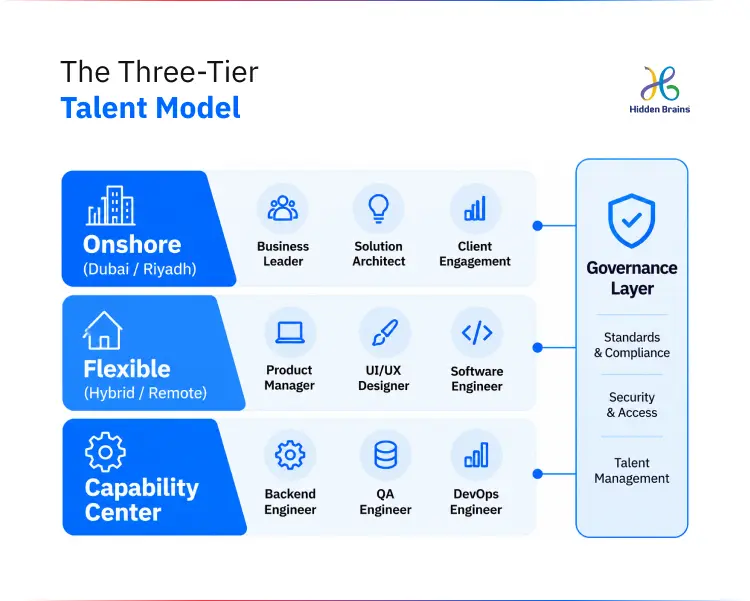
Leading enterprises in the region now use three tiers, not two: onshore, capability center, and flexible. Each tier holds the work it does best.
Onshore: Decisions, governance and relationships
These roles stay in the Middle East market: strategy, senior architects, security leadership, product owners, AI governance, and regulator-facing roles. This tier also includes the partner’s in-region team. That is where requirements, architecture sign-off and stakeholder alignment happen face to face.
Capability Center: Delivery at scale
Mid-level and senior engineers, data and AI specialists, QA, DevOps, platform teams and enterprise application teams work here. This is where most of the engineering hours sit.
Flexible Tier: Senior Engineers Who Move
A small group of senior engineers works in either location as needed. They travel for launches, audits, data migrations, and critical releases, and they carry context between the two locations.
Skills-first Hiring
Employers across the region are moving away from degree-first screening. Technical assessments, portfolios and shipped work now carry more weight. This widens the talent pool, but it requires a real vetting process.
Compliance-aware Design
Nationalisation programs and data rules keep strategy and governance roles in-country. In the UAE, the government’s own guidance says private firms with 50 or more employees must raise Emirati representation in skilled roles by 2% a year, reaching 10% by 2026. Saudi Arabia’s Nitaqat program works on a similar principle.
The practical result is that enterprises fill onshore leadership and customer-facing roles with national talent. Specialist engineering capacity is added in the capability center.
| Function | Tier | Why |
|---|---|---|
| Product ownership, architecture sign-off | Onshore | Close to business decisions and regulators |
| Security leadership, AI governance | Onshore | Accountability and data control |
| Application and platform engineering | Capability center | Scale and specialist depth |
| Data engineering, ML engineering | Capability center | Talent availability |
| QA, DevOps, support | Capability center | Continuous delivery capacity |
| Release leads, migration specialists | Flexible | Critical moments need people on-site |
How do Middle East Data Protection Laws Shape your Team Structure?
Most Middle Eastern data protection laws control how personal data leaves the country rather than banning offshore teams outright. The rules differ by country, by free zone, and by sector. They decide what data your capability center can see, not whether it can exist.
Saudi Arabia
The Personal Data Protection Law (PDPL), overseen by the Saudi Data and AI Authority (SDAIA), reaches beyond the Kingdom’s borders. It applies to entities outside Saudi Arabia that process personal data of people living there. Transfers abroad need a lawful route, such as standard contractual clauses or binding rules for intra-group transfers.
United Arab Emirates
The UAE runs three data protection regimes. The federal Personal Data Protection Law (Federal Decree-Law No. 45 of 2021) applies to mainland companies. The DIFC and ADGM financial free zones have their own frameworks.
Under the federal law, the UAE Data Office can approve transfers to countries with adequate data protection laws, or to countries covered by agreements the UAE has signed. Where neither applies, the law allows transfers on other grounds, including the express consent of the person whose data is being transferred, or where the transfer is needed to carry out a contract.
For an offshore capability center, the practical route is usually a data processing contract that carries the UAE law’s obligations to the delivery team, combined with minimising the personal data offshore engineers can access.
Egypt
Egypt’s Executive Regulations for its data protection law were issued in November 2025. They set operational rules for consent, licensing, breach notification and cross-border data transfers.
Qatar, Bahrain, Oman, Kuwait and Jordan
Each country now has a data protection law or regulation, covered in the table below.
Sector overlays
Banks, telecom operators and critical infrastructure add another layer. Examples include central bank rules (SAMA in Saudi Arabia, CBUAE in the UAE) and the Saudi National Cybersecurity Authority’s controls. These often matter more than the general law.

Launch Your GCC 60% Faster With Flexible Models and Future-Ready Tech.
Book a Call| Country | Main law | Practical implication for an offshore team |
|---|---|---|
| Saudi Arabia | PDPL (SDAIA) | Lawful transfer route plus data minimisation |
| UAE (mainland) | Federal Decree-Law No. 45 of 2021 | Adequacy approval, express consent, or another ground the law allows |
| UAE (DIFC / ADGM) | DIFC DP Law No. 5 of 2020 / ADGM DP Regulations 2021 | GDPR-style transfer tools |
| Egypt | Law No. 151 of 2020 + 2025 Executive Regulations | Follow the new cross-border rules |
| Qatar | Law No. 13 of 2016 | Check transfer conditions |
| Bahrain | Law No. 30 of 2018 | Check transfer conditions |
| Oman | Royal Decree 6/2022 | Check transfer conditions |
| Kuwait | CITRA data privacy regulation | Check transfer conditions |
| Jordan | Law No. 24 of 2023 | Check transfer conditions |
Design patterns that work across the region:
- Keep production data hosted in-region.
- Give offshore teams masked or synthetic data for development and testing.
- Enforce role-based access with full audit logs.
- Sign transfer agreements before the first sprint.
How Should You Design Tech Teams for 2027? Products, Platforms and an AI CoE
Design the capability center around long-lived products and platforms, not one-off projects. Stable teams keep context, reduce handover loss, and make KPIs meaningful.
Organize around products and platforms
Each team owns one product or platform. It has a named owner, a multi-year roadmap, and KPIs tied to that product.
Set up a cross-cutting AI Center of Excellence
The AI CoE standardizes tools, prompts, evaluation methods, and guardrails across teams while connecting onshore AI governance with capability center delivery. This helps keep AI use consistent, auditable, and aligned with defined governance controls.
Measure what matters
Track release frequency, platform reuse, AI adoption within workflows, and business outcomes. Cost per seat is still useful, but on its own it misleads.
Which Engagement Model Fits: Managed, Build-Operate-Transfer, or Hybrid?
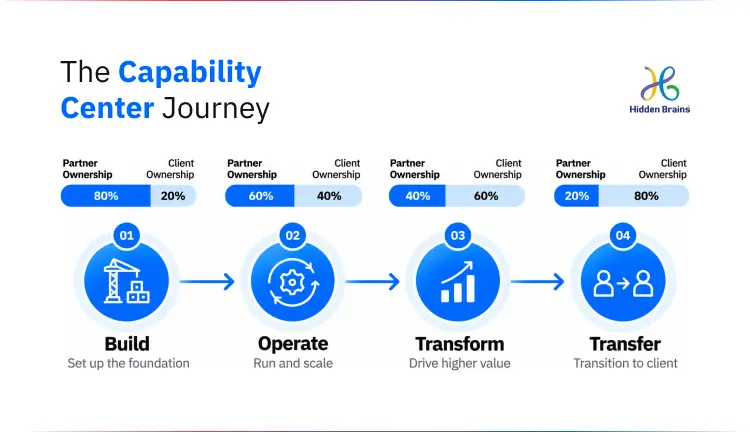
Choose based on how much ownership you want, and when. The market typically offers Build-Operate-Transform and Build-Operate-Transform-Transfer options, with pricing set per seat or per service.
- Managed: the partner runs the team long term, and you own the outcomes and IP. This suits enterprises that want capacity without managing an entity.
- Build-Operate-Transfer (BOT): the partner builds and runs the team, then moves it into your own entity at an agreed point. This suits enterprises that want full ownership within a few years.
- Hybrid: you start managed and keep a transfer option. This is the most common choice for a first capability center.
If you need capacity before committing to a full center, you can hire dedicated development team to build the capability center around that core team. When you are ready to scale, our GCC team can map the path from a dedicated team to a full center.
Why Does an On-the-Ground Partner in the Region Matter?
Most capability centers that struggle do so because of unclear requirements and misalignment, not coding quality. Having the partner physically in the region reduces that risk in four ways:
- In-person discovery. Workshops with business and IT stakeholders in the same room surface requirements that video calls miss.
- Local context. The team knows regional procurement, regulator expectations and how decisions are made in Middle Eastern enterprises.
- Same-time-zone escalation. Issues are resolved within the client’s working day, not overnight.
- One accountable contact. A regional lead owns the relationship while engineering scales offshore.
Hidden Brains supports Middle Eastern clients from its Dubai office in Business Bay, with delivery from our offshore teams.
What Governance Works Across Time Zones and Borders?
Effective governance combines a clear steering structure, shared metrics, and contract terms that settle ownership upfront.
- Steering: a monthly steering group with your leadership and the partner’s regional lead, plus weekly delivery reviews.
- Working-week overlap: Saudi teams work Sunday to Thursday, UAE teams largely Monday to Friday, and India-based teams are 1.5 to 2.5 hours ahead. Plan ceremonies for Monday to Thursday mornings (Gulf time), when all three calendars overlap.
- IP and code: repositories are owned by the client from day one, with IP assignment written into the contract.
- Certified processes: with 23+ years of delivery experience, Hidden Brains operates CMMI Level 3 processes and holds ISO/IEC 27001:2022 and ISO 9001:2015 certifications. These give auditors a documented baseline for delivery and information security.
What do the first 90 days look like?
A well-run capability center reaches its first production release within the first quarter. The sequence matters more than the speed.
- Weeks 1–3, discovery: in-region workshops, architecture review, and a data classification map.
- Weeks 3–6, compliance and setup: transfer agreements, access controls, environments and a masked-data pipeline.
- Weeks 4–8, talent onboarding: the core team is in place, with domain training and knowledge transfer.
- Weeks 8–12, first release: a production release with agreed KPIs and the first steering review.
What Should a Capability Center as a Service Quotation Include?
A useful quotation tells you what you will get, what it will cost as the team changes, and how you can leave. Before you request a consultation or quotation, make sure each proposal covers:
- Pricing basis: per seat, per team, or per outcome, including what is included in the rate.
- Ramp-up and ramp-down plan: team size and seniority mix for each quarter, plus the notice period and cost of scaling down.
- Data protection commitments: hosting location, access controls and transfer mechanism.
- IP terms: assignment of code, models and documentation.
- Exit and transfer clauses: the cost and timeline to move the team in-house.
- Service levels: delivery KPIs, response times and replacement guarantees.
- Exclusions: licenses, travel and third-party tools.
What Risks Should You Plan For?
Every model carries risk. What matters is planning for each one before it happens.
| Risk | How to reduce it |
|---|---|
| Knowledge concentrated in a few people | Documentation standards and a rotating flexible tier |
| Compliance drift as rules change | Quarterly data-flow review with counsel |
| Vendor lock-in | Client-owned repositories and a written transfer clause |
| Communication gaps | In-region lead and fixed overlap hours |
| Data leakage through AI tools | Approved-tool list and prompt logging under the AI CoE |
| Over-reliance on AI-generated code | Mandatory senior review and automated testing gates |
Your 2027 Planning Checklist
The enterprises that will be ready for 2027 are making a few structural decisions now, not waiting for the budget cycle to force them.
Start by deciding what stays close to home. Strategy, architecture, security, product ownership, and AI governance belong onshore, where accountability and regulators sit. With that anchor in place, build or expand an AI-first capability center to carry engineering, data, and platform work at scale.
Next, connect the two with a cross-cutting AI Center of Excellence. It keeps tools, patterns, and guardrails consistent, no matter where a team works. Organize those teams around products and platforms with multi-year mandates, so knowledge stays in the team instead of being lost at the end of each project.
Finally, build flexibility into both hiring and contracts. Skills-first hiring and a three-tier talent model widen the talent pool. Ramp-up and ramp-down terms let capacity follow your priorities as they shift through the year.
If you are working through these decisions for your own organization, our Dubai team can help you map them to a practical plan.
Frequently Asked Questions
What business problem does capability center as a service solve?
It gives you dedicated engineering capacity faster than local hiring can, without the cost and risk of setting up your own offshore entity. You keep control of priorities, IP, and quality while the partner handles hiring, infrastructure, and compliance setup.
Is it cheaper than hiring locally in the UAE or Saudi Arabia?
Usually yes, for engineering roles, but cost should not be the only test. Compare the total cost of a team, including hiring time, attrition, and management overhead. Also compare what the team delivers, not just rates per seat.
How quickly will we see value?
With a phased setup, most enterprises can expect a first production release within the first quarter. Value then builds as the team gains domain knowledge, which is why product-based teams with multi-year mandates outperform short project teams.
How much control do we keep?
You set priorities, approve architecture, and own the roadmap. The team works only for you, under your governance, with regular steering reviews and shared delivery metrics.
What happens to our IP and code?
You own them from day one. Repositories sit in your accounts, and IP assignment is written into the contract before work starts.
What if our priorities change mid-year?
A well-structured agreement includes ramp-up and ramp-down terms, so team size and skills can follow your priorities. Confirm the notice period and cost of scaling down before you sign.
Can we bring the team in-house later?
Yes, if the contract includes a transfer option. Build-Operate-Transfer and hybrid models are designed for this, with the timeline and transfer cost agreed upfront.
Does using an offshore team create compliance risk?
It can, if data access is not designed carefully. Most regional laws regulate how personal data crosses borders rather than banning offshore teams, so in-region hosting, masked data, and proper transfer agreements address most of the risk. Confirm the details with counsel for each market.
Is a Dubai-based team onshore or nearshore for us?
It depends on where your enterprise is based. For UAE companies, a Dubai team is onshore. For companies in Saudi Arabia, Qatar, and the wider region, it works as a nearshore team, close enough for in-person workshops and same-day escalation.
What should we ask for in a quotation?
Ask for the pricing basis, a quarterly ramp-up and ramp-down plan, data protection commitments, IP terms, exit and transfer clauses, service levels, and exclusions. A quotation that leaves any of these vague is a warning sign.
Conclusion
A capability center as a service lets Middle Eastern enterprises scale engineering without giving up control. The model works when three decisions are made early: what stays onshore, which data the capability center can access, and how capacity flexes as priorities change.
Get those right, and the capability center becomes a long-term engine for AI, products and platforms rather than another vendor contract. Leave them to chance, and the same model turns into the outsourcing arrangement you were trying to avoid.
With 2027 budgets being set now, the enterprises that will be ready are the ones making these structural choices this quarter. If you want a clearer view before committing, talk to our Dubai team to map your onshore/offshore split, data constraints, and a phased roadmap to the first release.