


































































































































Summary
- Freelancers fit short, bounded, low-risk work; a dedicated team fits evolving products that need continuity and clear ownership.
- Compare total cost, rework, re-onboarding, lost context, not the hourly rate; that’s where rate savings quietly disappear.
- IP, compliance, and continuity risk are easier to control under one accountable partner than across rotating contractors.
- Use the 5-signal test: project lifespan, complexity, compliance/IP sensitivity, accountability, in-house capacity.
- The most resilient setup is a dedicated core + freelance specialists for spikes, not a freelance core.
- Evaluate providers on delivery capability (ownership, QA, DevOps, SLAs, documentation), not just their ability to write code.
Freelancers are the right choice for short, well-defined work. A dedicated development team is the right choice when you’re building software that has to survive growth, change, and time. Most companies that scale end up using both, and the common mistake is choosing by hourly rate instead of by the problem you’re actually solving.
If you’re deciding whether to hire dedicated developers, freelancers, or a mix of the two, this guide gives you a way to decide, including the cost, compliance, and delivery risks most comparisons leave out. The stakes are higher than a staffing choice. According to the Standish Group’s CHAOS Report, only around a third of software projects fully succeed, and unclear requirements and ownership rank among the most common reasons the rest fail, both directly shaped by how you staff the work.
What’s the Real Difference Between a Freelancer and a Dedicated Development Team?
A freelancer is an independent contractor you hire for a specific task or a fixed period. A dedicated development team is a group of engineers who work exclusively on your product as an extension of your organization, usually provided and managed through a development partner.
The difference isn’t only headcount; it’s ownership and continuity. A freelancer delivers a defined output and moves on. A dedicated team stays with your product, attends your stand-ups, follows your release process, and accumulates knowledge of your architecture and customers over quarters.
A dedicated team is also more than developers. Depending on scope, it typically includes a tech lead, Quality Assurance (QA) engineers, a DevOps engineer, and sometimes a business analyst or designer, assembled around your roadmap rather than a single task.
Freelancer vs Dedicated Team
| Factor | Freelancer | Dedicated development team |
|---|---|---|
| Ownership & accountability | Owns a defined task; limited stake in outcomes | Owns product areas; accountable for delivery over time |
| Continuity & knowledge retention | Context leaves when the contract ends | Context compounds; institutional knowledge is retained |
| Scalability | Re-source and re-onboard for each change | Scale roles up or down through one partner |
| Team composition | Individual specialist | Tech lead, engineers, QA, DevOps, BA/designer |
| Cost model | Hourly or per-task; low upfront | Predictable monthly cost; higher commitment |
| Best-fit work | Short, bounded, one-off tasks | Ongoing products, complex or regulated builds |
| Management overhead | You coordinate each contractor directly | Partner handles delivery management and staffing |
What Does Each Hiring Model Actually Cost?
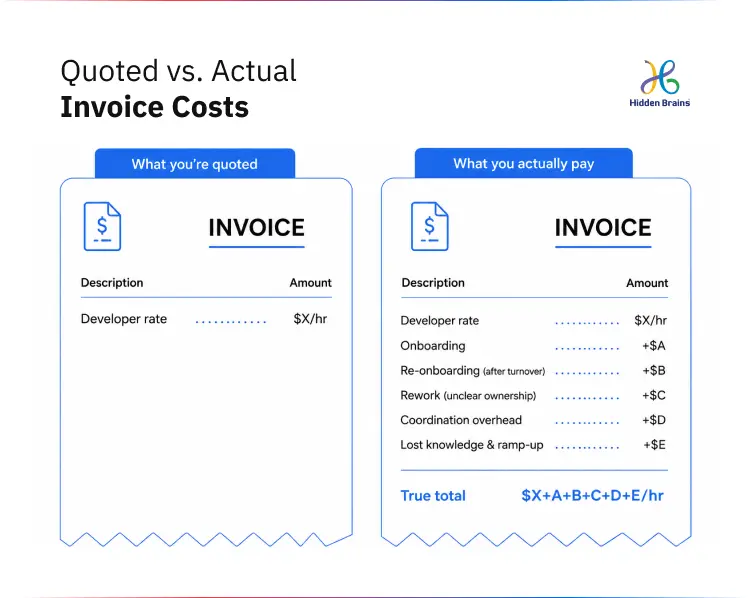
The real cost of a hiring model isn’t the hourly rate; it’s the total cost of getting reliable, maintainable software into production and keeping it there. On paper, freelancers are cheaper. In practice, cost surfaces later as rework, re-onboarding, and lost context each time someone joins or leaves.
Two data points make the pattern concrete. The Standish Group’s CHAOS Report attributes a large share of project failures to unclear requirements and weak ownership, exactly the gaps that widen when no one owns the product long-term. And research by McKinsey with the University of Oxford found that large IT projects run, on average, 45% over budget while delivering 56% less value than predicted. The thread connecting both is continuity: rate savings rarely survive repeated context loss.
For a freelancer, the hidden costs are onboarding time, coordination effort, rework from unclear ownership, and knowledge that walks out the door at contract end. For a dedicated team, cost is more predictable: a steady monthly rate, and the context you pay to build stays and compounds.
Compliance, IP, and operating risks: the comparison most guides skip
Cost and speed get the attention, but intellectual property (IP) ownership, data compliance, and business continuity are where hiring decisions quietly go wrong. These risks scale with the sensitivity of your data and the lifespan of your product, so a model that’s fine for a prototype can be a liability for a regulated platform.
| Risk area | Freelancer | Dedicated team | Dedicated core + specialists |
|---|---|---|---|
| IP ownership & assignment | Depends on each contract; gaps are common | Assigned through one governed agreement | Core covered by contract; verify each specialist |
| Contract / NDA enforceability | Harder across individuals and borders | Single accountable entity | Single entity for core; per-contract for specialists |
| Data protection & regulatory compliance | Ad hoc; hard to audit | Repeatable controls (e.g., GDPR, HIPAA, PCI-DSS as applicable) | Governed by the core team’s controls |
| Security controls | Varies by individual setup | Standardized (e.g., ISO 27001-aligned) | Core-standardized; specialists scoped tightly |
| Business continuity & knowledge loss | High risk if a contractor leaves | Low; knowledge is retained and handed over | Low for core; specialists are non-critical path |
| Accountability/liability | Distributed across contractors | Clear, single point of accountability | Clear for core scope |
A dedicated model concentrates these controls in one accountable partner. That’s where certifications matter in practice: a CMMI Level 3 delivery process and ISO 27001 / ISO 9001 certification mean security, quality, and process discipline are repeatable rather than dependent on any one person.
Note: IP assignment and contract enforceability vary by jurisdiction. Treat the table as a planning guide and confirm specifics with your own legal counsel before signing. **
When is a Freelancer the Right Call?
A freelancer is the right call when the work is bounded, short-lived, and doesn’t need long-term ownership. If you can write a clear brief with a defined “done,” a freelancer is often faster and cheaper.
Good freelancer fits include:
- A landing page, a one-off script, or a specific design asset
- A narrow specialist skill for a fixed, isolated piece of work
- A short prototype or spike to test an idea
- Filling a temporary capacity gap on an existing, well-owned codebase
The risk isn’t freelancers themselves; it’s treating them as a long-term engineering strategy. When a growing product depends on a rotating cast of contractors, onboarding, rework, and unclear ownership start to compound.
When Should You Hire a Dedicated Development Team?
Hire a dedicated development team when you’re building or scaling a product that will keep evolving. The signals are continuity, complexity, and compliance: a multi-quarter roadmap, an architecture that must scale, integrations, regulated data, or a need for clear accountability.
This is the model that fits most product companies, funded startups, and enterprises modernizing systems. If you’re weighing it for an early-stage build, our guide on how to hire a developer for a startup walks through the in-house, freelance, and dedicated-team trade-offs in more depth. When you’re ready to evaluate the model itself, see our Hire Dedicated Developers service overview.
Choose the Right Delivery Model Before You Commit Budget.
Talk to Our Experts
The Smarter Scaling Model: Build a Core Team, Then Add Specialists
You don’t have to pick a side. The most resilient setup is a dedicated core team that owns architecture, releases, and product knowledge, plus freelance specialists pulled in for short spikes — a niche integration, a design sprint, a one-time migration.
This is different from pure staff augmentation, where you add individual engineers into your own management structure and carry the coordination yourself. Our guide to software development outsourcing models breaks down staff augmentation, dedicated teams, managed services, and offshore side by side. In the blended model, the core team gives you continuity and accountability; the specialists give you flexibility without diluting ownership. The failure pattern is the inverse: a freelance core with no one accountable for the long-term health of the codebase.
Understand Your Project Requirements Before Deciding
Before you compare models, get clear on what you’re building. The right model falls out of the requirements, not the other way around. Choosing a model first, then forcing the project into it, is how teams end up over- or under-staffed.
Define these before you decide:
- Product goals and a 12-month roadmap — Is this a one-off or an evolving product?
- Required roles and skill map — Backend, frontend, mobile, QA, DevOps, data/AI, design
- Data sensitivity and compliance needs — Which regulations apply to your sector and markets
- Integration surface — How many systems must this connect to and stay connected to?
- Expected change and lifespan — How long will this software live and keep changing?
- In-house capacity gaps — What can your team own, and what genuinely needs outside help?
A 5-signal Framework to Decide
Score your project on five signals. The more they point toward continuity, complexity, and compliance, the more a dedicated team pays off. The more they point to short, isolated, low-risk work, the more a freelancer makes sense.
| Signal | Points to a freelancer | Points to a dedicated team |
|---|---|---|
| Project lifespan | One-off or short-term | Ongoing, multi-quarter roadmap |
| Complexity & architecture | Simple, isolated task | Complex, integrated, must scale |
| Compliance & IP sensitivity | Low-risk, non-sensitive | Regulated data, high IP value |
| Accountability & continuity | Not business-critical | Needs clear ownership over time |
| In-house capacity | You can manage directly | You need a managed, complete team |

Build a Dedicated Team That Fits Your Goals
Get StartedWhat a Long-term Dedicated Team Looks Like in Practice
The clearest evidence the dedicated model works is a relationship that compounds rather than restarts. According to his testimonial on our site, US entrepreneur Chris Folayan has worked with Hidden Brains across more than 70 projects over a relationship spanning roughly a decade — the kind of continuity and accumulated product knowledge a rotating freelance bench structurally can’t reproduce. Each new build started with a team that already understood his standards, architecture history, and business context.
That continuity also shows up in complex, long-lived platforms. Our real-time iron & steel trading platform was built and maintained by a dedicated team, including real-time monitoring across trading operations, the sort of integrated, evolving system where handing work to short-term contractors would fragment ownership.
Why the model held up in both cases maps back to this article’s themes: one accountable team, retained knowledge, and process governance (CMMI Level 3, ISO 27001/9001) rather than delivery that depended on any single person. See how this works in practice; explore our case study.
How to Evaluate a Dedicated Development Company
Evaluate whether a provider can deliver reliable software, not merely write code. The strongest signal isn’t a portfolio of logos; it’s whether they can show ownership, engineering discipline, and supportability. Judge candidates across these areas:
| Area | What to assess |
|---|---|
| Product ownership | Who converts business goals into backlog items, user stories, priorities, and acceptance criteria? |
| Architecture | Can they justify design decisions, performance approach, scalability limits, and integration choices? |
| Quality engineering | Are unit, integration, end-to-end, regression, security, and performance tests built into delivery? |
| DevOps maturity | Do they use Continuous Integration/Continuous Delivery (CI/CD), infrastructure as code, monitoring, logging, rollback plans, and separate environments? |
| Documentation | Will they maintain API docs, architecture diagrams, runbooks, Architecture Decision Records (ADRs), onboarding material, and handover guides? |
| Code health | Are pull requests reviewed, coding standards enforced, dependencies scanned, and technical debt tracked? |
| Supportability | Who handles production incidents, defect triage, patching, and releases — and what are the agreed Service Level Agreement (SLA) and incident response times? |
| Domain knowledge | Do they understand your vertical — such as healthcare, fintech, logistics, or enterprise SaaS? |
Ask candidates to walk through a comparable delivered system, explain the trade-offs they made, and show anonymized artifacts: a sprint board, test strategy, CI/CD pipeline, architecture diagram, incident runbook, or sample technical documentation. What they can show tells you more than what they claim. For a step-by-step version of this, see our guide to the key steps to hire dedicated developers.
Red flags when hiring a dedicated team
- Only a project manager is available, you never get direct access to engineers
- Scaling the team up or down requires renegotiating the whole contract
- No testing or DevOps story; “we’ll add tests later”
- Vague or missing answers on IP assignment, security, and data handling
- No documentation or handover plan, knowledge lives in individual heads
- They quote a rate before understanding your requirements
Hidden Brains works with growing businesses and enterprises to provide dedicated teams that integrate into existing delivery structures rather than operating as a detached vendor. That means accountable ownership, CMMI Level 3 process discipline, and ISO 27001 / ISO 9001-aligned security and quality, the controls that make the risk table above manageable. For the roles, engagement options, and process, see our Hire Dedicated Developers page.
Frequently Asked Questions
We’re on a tight budget — won’t freelancers save us money?
On short, bounded work, yes. For an evolving product, the rate savings are often erased by rework, re-onboarding, and lost context when contractors rotate. Compare total cost to production and maintenance, not the hourly rate, that’s where a dedicated team usually wins on a longer horizon.
How fast can a dedicated team start delivering versus hiring in-house?
A dedicated team is typically live in weeks, because the partner handles sourcing, vetting, and replacement. Building the same team in-house means months of recruitment plus ongoing retention risk time that directly delays your roadmap.
Who owns the code, IP, and data if we use a dedicated team?
With a dedicated team, IP assignment, security, and compliance are concentrated in one governed agreement that’s easier to audit and enforce. With multiple freelancers, those terms are handled contract-by-contract and are harder to standardize. Because rules vary by jurisdiction, confirm the specifics with your legal counsel before signing.
What happens if a key developer leaves mid-project?
This is the core risk with freelancers: when they go, their knowledge goes too. A dedicated team retains context across the group and handles replacement and handover through the partner, so continuity doesn’t depend on any single person.
Can we scale the team up or down as priorities change?
Yes, a good dedicated-team arrangement lets you adjust roles and size without renegotiating the whole contract. If scaling requires a new contract every time, treat that as a red flag during evaluation.
How do we keep control if the team is remote or offshore?
Control comes from direct access to engineers, your own release process, agreed SLAs and reporting, and clear ownership, not from co-location. Insist on direct communication with the team rather than only a project manager, and set incident-response expectations up front.
Is a dedicated team overkill for a startup or MVP?
Not necessarily. A lean dedicated team can build an MVP and then scale with it, avoiding the costly rebuild that happens when freelance-built prototypes can’t support growth. The deciding factor is whether the product will keep evolving after launch.



Conclusion
The real question isn’t “which is cheaper.” It’s how much ownership, continuity, and accountability the software you’re building actually requires. Freelancers are an efficient answer to bounded, low-risk work. A dedicated team is the answer when a product has to keep evolving, integrate deeply, and hold up under compliance and scale, and when losing context between contractors would cost more than you’d save on rate.
Most companies don’t stay in one model forever. A prototype validated by a freelancer becomes a product that needs a dedicated core; a growing platform pulls in specialists for spikes. Treat the decision as one you’ll revisit as the product matures, not a permanent label. Run your project through the five signals, weigh the total cost and the compliance and IP risks, not just the hourly rate, and choose the model that keeps ownership clear as the work grows. If you’re tracking where the market is heading, our overview of developer hiring trends adds useful context.
If you’re unsure which model fits, we can help you find the right balance of flexibility, continuity, and ownership, from hourly or part-time support to monthly engagements and dedicated teams. Talk to us.