
















































































Summary
- Understand the business and technology signals: Know when it is time to modernize.
- Assess your application portfolio: Analyze business value, cost, risk, and complexity.
- Find the right approach: Decide whether to retain, modernize, replace, rehost, replatform, or retire.
- Follow the modernization process: Move from assessment and architecture to migration and measurement.
- Know what to modernize, replace, or rebuild: Match the approach to each application’s needs.
- Build for what’s next: Prepare your applications for scalability, integration, AI, and changing business needs.
- Avoid common modernization mistakes: Plan for data, people, costs, and change from the start.
- Choose the right modernization partner: Find a team that can assess, execute, and guide the journey.
Most modernization projects do not start with a technology decision. They start with a frustration. A report that always arrives a day late. A core application that everyone is afraid to touch because no one fully understands it anymore. A simple change request that takes three weeks because two old systems have to be updated by hand.
Enterprise modernization is the work of updating those aging applications, systems, and processes so they can support how the business actually runs today. It is not one big upgrade. It is a series of practical decisions about what to keep, what to change, and what to let go.
The cost of waiting is easy to underestimate. Old systems keep running, so the risk feels low. But maintenance bills rise, the people who understand the code retire or leave, security gaps widen, and every new feature takes longer to ship. The right time to plan is before a failure or a missed opportunity forces the decision on worse terms.
This guide walks through how to approach modernization in a clear, low-risk order: read the signals, assess your full application portfolio, decide what to do with each system, and then execute in phases.
Start With the Signals
Before choosing any technology, look for the signals that tell you a system is holding the business back. Modernization becomes worth the investment when several of these show up together. This is where you actually get the idea to keep, modernize, or leave as it is.
Maintenance is crowding out everything else. When most of the effort around a system goes into keeping it running rather than improving it, the budget is being spent on the past. Industry analyses have long attributed a large share of enterprise IT budgets to maintaining existing systems rather than building new capability.
The knowledge is walking out the door. Fewer people understand the technology, specialist skills are expensive or unavailable, and changes increasingly depend on one or two individuals.
It cannot integrate. New tools, partners, or AI and analytics initiatives stall because the system has no usable APIs and was never designed to share data.
Security and compliance risk is rising. Unsupported components, missing patches, and weak access controls create exposure that is hard to defend to auditors or customers.
Release cycles are slow. Even small changes take weeks, so the business cannot respond to market or regulatory change at the speed it needs.
Reporting arrives after the decision window. Data exists, but leaders still wait for someone to reconcile and prepare it, so information supports explanation rather than action.
If several of these are true at once, the question is no longer whether to modernize, but which systems to modernize first and how.
Assess the Whole Portfolio, Not One App at a Time
The correct approach is to assess the entire application portfolio and decide whether each application should be retained, retired, migrated, replaced, or modernized. Application rationalization frameworks exist precisely because different systems justify different decisions.
Applying one modernization strategy across the whole enterprise, usually because a senior stakeholder heard about microservices or cloud at a conference, is the most common and most expensive mistake in this space.
Assessment works best when the unit is the portfolio, not the individual application. For each system, capture a small, consistent set of facts:
- What breaks if it goes down
- What it costs to run and maintain each year
- How many people actually understand it
- What it integrates with
- How much technical debt it carries
Once that map exists, most decisions become obvious, because every conversation shares the same factual baseline instead of competing opinions.
The right decision rule
Once each application is scored on two things- its value to the business and the health of its technology- the decision usually becomes clear.
| Situation | Recommended action |
|---|---|
| Low business value + high cost to run | Retire |
| High business value + healthy technology | Retain and improve selectively |
| High business value + outdated technology | Modernize |
| Low business value + acceptable to run for now | Retain temporarily, with a review date |
| Standard capability already available in the market | Replace or repurchase |
| Stable application that only needs a new hosting environment | Rehost or replatform |
This rule keeps effort where it creates the most value. The high-value, outdated systems are where deeper modernization pays off. Everything else gets a lighter, cheaper answer.
Confused between 7 R’s to move with legacy modernization?
Get a Free Consultation
The Step-by-Step Modernization Process
With the portfolio assessed and the decisions made, execution follows a clear sequence. Each step should leave behind something concrete, not just a discussion.
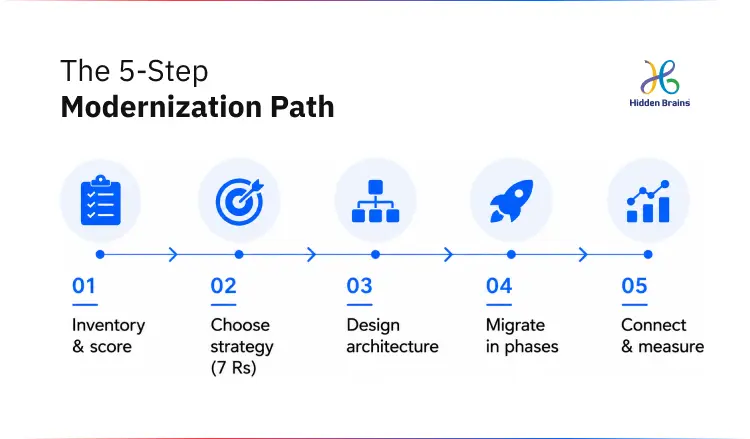
Step 1: Inventory and Score Your Applications
Turn the assessment above into a working document. The deliverable is an application inventory that lists each system with its business value, technology health, dependencies, running cost, and the decision you have made for it. This inventory becomes the plan of record. It also settles debates early, because every conversation now starts from the same facts.
Step 2: Choose the Right Strategy for Each Application
For the systems you are keeping and changing, match each one to a strategy. The industry-standard set is often called the 7 Rs. It began as Gartner’s framework and was later expanded by cloud providers such as AWS.
In plain terms:
- Rehost (“lift and shift”): Move the application as-is to a new environment, usually the cloud. Fastest, lowest change.
- Replatform: Move it and make small optimizations, such as switching to a managed database.
- Repurchase: Replace it by buying a ready-made product, often a SaaS subscription.
- Refactor / re-architect: Redesign the application to take full advantage of modern architecture. The most work, and the highest long-term payoff.
- Retire: Switch it off.
- Retain: Leave it as-is for now.
- Relocate: Move the infrastructure without changing the application.
One field-service application we modernized had no staff-efficiency tracking, geolocation, geofencing, or clear visibility into pending work orders. Since these capabilities were critical to the client’s unique operations, we chose to modernize rather than replace, adding geolocation, geofencing, work-order tracking, and role-based access without forcing the team onto a generic product. See the full legacy application modernization case study.
Step 3: Design the Target Architecture
Decide where you are going before you move. The choices you make here- cloud provider, how applications talk to each other, and how you handle security and identity- will shape every project that follows.
For most enterprises, the goal is a system that can scale and connect. That usually means cloud-native design so capacity can grow and shrink with demand, and an API-first approach so systems can share data cleanly instead of through manual exports.
This is also how you make enterprise software scalable in practice: break large, tightly coupled applications into smaller parts that can be updated on their own, and expose them through well-defined APIs. Build security into the design from the start rather than adding it later. Our cloud integration services focus on exactly this connective layer.
Step 4: Migrate in Phases, and Validate the Data
Moving data from old systems to new platforms is the highest-risk part of modernization. Do it in small, managed batches rather than one large cutover, and validate the data before, during, and after each move. Prioritize by business function so the most important capabilities move first and get proven early. A phased approach also means you can pause, check, and correct course without putting the whole business at risk.
Step 5: Connect Operations, Then Measure
A modern application that still runs in isolation solves only half the problem. Many businesses believe they have connected operations because transactions are recorded in software. But if managers still wait for reports built by hand, or departments still reconcile their own numbers, the organization has digitized transactions without truly connecting operations.
The real goal is information that flows across the business in something close to real time, so leaders can act on a problem rather than only explain it afterward. Once systems are connected, measure the outcomes you set out to improve: response times, release frequency, support tickets, maintenance cost, and how quickly reliable information reaches decision-makers. Those numbers are also your business case for the next phase. For how this ties into a wider plan, see our guide to a legacy platform transformation and a full application modernization strategy.
Enterprise Software Modernization Best Practices for 2026
A few practices separate projects that deliver value from projects that stall:
- Tie every decision to business value. Modernize the systems that matter most, and stop over-investing in the rest.
- Simplify as you go. Retiring unused applications and cutting duplicate tools is a modernization strategy in itself. Fewer moving parts means faster progress.
- Make each phase produce a deliverable. A roadmap that leaves behind real artifacts gets used. A roadmap that only lives in a slide deck does not.
- Design for AI and integration now. Even if you are not adding AI today, modern systems need clean APIs and reliable data so they can connect to analytics and automation later. Fragmented data is the most common thing that blocks it.
- Plan for the people, not just the code. Modernization changes how staff work. Training and clear ownership decide whether the new system is actually adopted.
Common Mistakes and Honest Trade-offs
Modernization is a real investment, and it carries real trade-offs. Being honest about them upfront protects the project.
The upfront cost can be significant, and it can be hard to justify to stakeholders without a clear business case tied to numbers. The fix is to lead with the cost of not acting: rising maintenance, security exposure, and slow delivery.
Rushing data migration is the fastest way to undermine an otherwise solid project. So is choosing a strategy for convenience rather than fit, or starting before success is defined. And modernization is rarely “done.” In 2026, it is better treated as an ongoing capability than a one-time event, because business needs and platforms keep moving. Also, it needs architecture that survives present and future advancements to keep business moving.

Outdated Doesn’t Always Mean Replace. Find Out Best Way
Talk to UsChoosing an Enterprise Software Development Partner
Modernization touches architecture, data, security, and day-to-day operations at the same time. That is a lot to carry with an internal team that is already busy keeping current systems running.
This is where an experienced enterprise software development company earns its place. The value is not simply extra developers. It is a partner who can assess a portfolio objectively, recommend the right strategy per system, and execute without disrupting the business. Look for a track record in real legacy migrations, strength in both cloud and integration, and clear governance around security and delivery.
Hidden Brains works with enterprises and growing businesses to connect modernization strategy with execution across engineering, cloud, integration, and enterprise systems. Our approach starts before technology selection, with understanding where processes, systems, and decisions are breaking down.
You can see this consultative method in a real legacy application modernization case study and explore our enterprise software development services and dedicated enterprise application modernization services. For teams that need to scale engineering capacity for a modernization program, enterprise software development outsourcing can provide accountable capability rather than just headcount.
Frequently Asked Questions
What is enterprise modernization, in business terms?
It is the ongoing work of updating the applications a business runs on so they stop limiting growth, reduce the cost and risk of keeping legacy systems alive, and let the organization move and integrate faster. It is a decision about risk, cost, and capability more than a technology upgrade.
How much does enterprise modernization cost?
There is no single price. It depends on how many applications are in scope, the strategy chosen for each one (rehosting is far cheaper than a full rebuild), and how complex the data migration is. The more useful comparison is against the cost of doing nothing: maintenance, risk, and lost speed that compound every year the decision is delayed. Phased programs also spread the investment rather than demanding it all upfront.
How long does it take?
Long enough that it should run in phases, not as a single cut-over. Modernizing one or two high-priority systems moves faster than an estate-wide program, which is why prioritization matters. Sequencing lower-risk systems first lets the business see value early while protecting critical operations.
Will modernization disrupt our operations?
It does not have to, when it is sequenced properly. Phased migration with data validation keeps current systems running while change happens in the background, and contains the impact if something goes wrong. Most disruption comes from big-bang replacements and rushed data migration, both of which are avoidable.
Should we modernize or replace a legacy system?
Modernize when the system still delivers value specific to how you operate and the core logic is worth keeping, but the technology is dated. Replace when the capability is standard and a market product covers it well without forcing your processes to bend. Rebuild only when the logic is worth keeping, but the technology is a dead end.
How do we decide what to modernize first?
Score every application by business value, run-and-maintain cost, risk, and how many people understand it, then start where risk and cost are highest, and value is greatest. Prioritizing by business impact rather than by what is technically easiest keeps the program tied to outcomes.
How do we know the investment is paying off?
Define the measures before you start: lower run-and-maintain cost, faster release cycles, fewer incidents, and quicker access to decision-ready information. If a program cannot be tied to outcomes like these, revisit the business case before spending more.
Conclusion
Modernization isn’t simply about replacing old technology or giving legacy systems a fresh look. It’s about building an application and technology foundation that can adapt to what comes next, new business models, evolving customer expectations, emerging technologies, and changing operational needs.
The goal isn’t to modernize everything. It’s to create a foundation that can evolve without requiring a complete rebuild every few years. That means knowing what to modernize, what to maintain, what to integrate, and what to retire.
In that sense, modernization is an ongoing discipline: maintaining what works today while creating the flexibility to support what the business needs tomorrow.
You don’t have to figure it all out alone. Talk to Hidden Brains to assess where your application landscape stands today, identify what could be next, and explore the modernization possibilities that make sense for your business.
