





















































































































Summary
- Enterprise AI guardrails control how users, apps, models, data, and agents interact.
- A sovereign AI gateway centralizes those controls across models and teams.
- The need grows with complexity, especially with sensitive data, multiple providers, and AI agents.
- Agentic AI raises the risk because AI can take actions, not just respond.
- Guardrails have limits, including false positives, latency, cost, and incomplete protection.
- Layered security works best, combining guardrails with identity, least privilege, and human oversight.
- Ownership should be shared across security, architecture, data, legal, and business teams.
- Build a gateway when AI risk and complexity outgrow app-level controls.
Enterprise AI is scaling faster than enterprise AI governance. 63% of organizations surveyed in IBM’s 2025 Cost of a Data Breach research lacked AI governance policies, while one in five reported a breach linked to shadow AI, with high levels of shadow AI associated with $670,000 higher average breach costs.
At the same time, AI is moving from chatbots to agents that can access data, call tools, and take business actions. Deloitte’s 2026 research found that 74% of organizations expect to use agentic AI at least moderately by 2027, yet only 21% report mature governance for autonomous agents.
This is why enterprise AI guardrails are becoming infrastructure, not just application features. A sovereign AI gateway gives organizations a centralized layer to control what AI can access, which models it can use, where data is processed, what actions agents can take, and what gets recorded.
The question is no longer simply which AI model an enterprise should use. It is who controls everything that happens between the enterprise and its AI systems.
| Details | Information |
|---|---|
| Guide Focus | How enterprises can use AI guardrails and sovereign AI gateways to control model access, protect sensitive data, govern AI agents, and centralize policy enforcement across enterprise AI environments. |
| Business Challenge | Rapid AI adoption, multiple model providers, shadow AI, sensitive data exposure, fragmented controls, and autonomous agents are making application-level governance harder to manage at scale. |
| Target Audience | CIOs, CTOs, CISOs, enterprise architects, IT leaders, AI platform teams, security leaders, and senior decision-makers responsible for enterprise AI adoption and governance. |
| TL;DR | Enterprise AI guardrails help organizations control how models, data, users, and AI agents interact. A sovereign AI gateway brings those controls into one governed layer, making it easier to enforce policy, protect sensitive data, manage model access, and monitor AI activity as adoption scales. |
| Key Evaluation Criteria | Model access, data sensitivity, identity and permissions, prompt and output controls, agent actions, tool access, observability, auditability, data residency, model routing, latency, cost, scalability, and governance ownership. |
AI Guardrails Are Becoming Core Enterprise Infrastructure
The first generation of generative AI guardrails was relatively easy to understand. A user submits a prompt. The system checks it. The model generates an answer. Another check looks at the response. Block hate speech. Detect inappropriate requests. Remove personally identifiable information. Reject obvious jailbreaks.
Those controls remain useful, but enterprise AI has become more complicated. Companies are connecting language models to internal knowledge bases, customer records, software repositories, financial information, and operational systems. AI agents can call APIs and tools rather than simply produce text. Different business units use different models. Developers integrate directly with model providers. Employees use consumer AI products the security team does not know about.
IBM’s Cost of a Data Breach Report 2025 illustrates the problem. One in five organizations (20%) reported a breach involving shadow AI, while only around 37% had governance policies to manage or detect it.
The answer cannot simply be to block AI. Employees and developers have strong incentives to use tools that make their work faster. If the approved route is too restrictive, usage moves outside the organization’s visibility.
The better question is: how can an enterprise provide useful access to AI while retaining control over data, models, permissions, and actions?
That is where the conversation shifts from individual guardrails to enterprise AI architecture.
Map risk across your enterprise AI environment.
Let’s Talk
What AI Guardrails Need to Control Across the Enterprise
Enterprise AI guardrails should not be confused with a single content filter. NIST’s Generative AI Profile treats generative AI risk as a much broader problem spanning privacy, information security, confabulation, information integrity, intellectual property, and other organizational risks.
OWASP reinforces the same point from a security perspective, highlighting risks such as prompt injection and excessive agency.
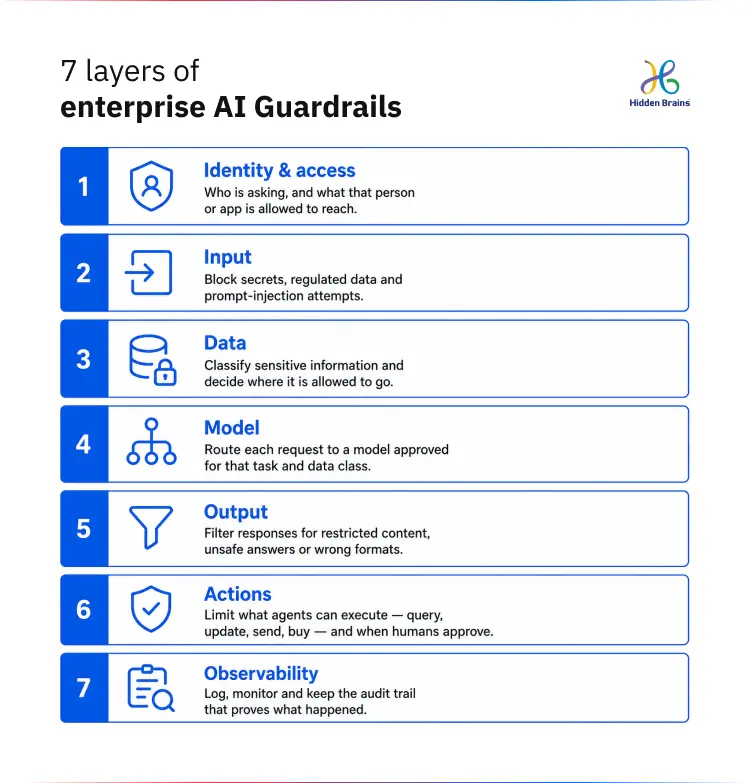
A useful enterprise guardrail system therefore thinks across several boundaries:
- Input controls examine what is being sent to an AI system: malicious instructions, secrets, regulated information, intellectual property, or data the user isn’t allowed to share.
- Identity and access controls determine who is making the request and what that person or application is permitted to access.
- Model controls determine which models may be used for a given task or data classification.
- Output controls inspect responses for restricted information, unsafe content, unsupported formats, or other policy violations.
- Tool and action controls matter when AI agents can search databases, invoke APIs, modify records, send messages, or start business processes.
- Operational controls cover rate limits, usage quotas, logging, cost thresholds, and observability.
This is why the term enterprise AI guardrails is more useful than thinking only about model safety. The object being controlled is increasingly not one model; it is an entire network of AI interactions.
In practice, a platform such as Guardian Layer can provide the shared technical boundary, while responsibility for the policies enforced through it remains distributed across security, architecture, data, legal, and application teams. The technology centralizes enforcement; it should not centralize every governance decision.
Where an AI Gateway Fits Into the Enterprise
Picture 50 AI apps across a company, some on OpenAI, some on Anthropic, one on a private open-source model, several running agents. Each could build its own auth, logging, and safety rules. But that means duplicated controls, scattered logs, and credentials spread everywhere.
A gateway replaces that.
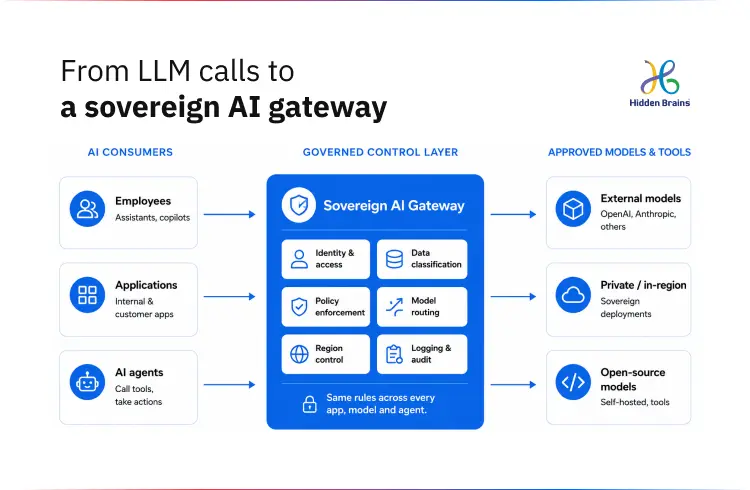
Microsoft now offers exactly this in Azure API Management, a central point to authenticate, route, log, and govern access to models and tools. The signal isn’t the product; it’s that enterprises increasingly want to manage AI access centrally.
What Makes an AI Gateway Truly Sovereign?
Three ideas sit underneath the term:
- Data residency — Where data physically sits
- Data sovereignty — Whose laws govern it
- AI sovereignty — Control over models, infrastructure and dependencies
A sovereign AI gateway enforces these in the routing itself. Say a European employee asks an assistant to analyse customer data. Instead of trusting the employee to remember the rule, the gateway checks the data classification and either routes to an approved in-region model or refuses. Governance moves from a document nobody reads into a rule the system applies.

Build your sovereign AI gateway
Talk to Our AI TeamAgentic AI Raises the Stakes
A chatbot can give a bad answer. An AI agent with permissions can act on it, update a CRM, run a workflow, raise a purchase order. So the question shifts from “Is this response safe?” to “Is this action allowed?”
The more consequential the action, the less you should let a model decide alone. Reading supplier data is low risk; approving payment should require deterministic authorization and human sign-off. With 74% of companies expecting agentic AI by 2027 and only 21% governing it well, runtime control is exactly what’s missing.
When You Actually Need a Gateway
Not every project needs one. A small internal prototype on public data is fine as-is. A shared gateway starts to make sense when several of these appear together:
- Multiple model providers are in use across the organization
- Sensitive or regulated data can reach AI systems
- Different teams build independently, creating inconsistent controls
- Agents can take actions, call tools, or interact with business systems
- Security needs consistent audit records across models, apps, and users
Even then, the gateway shouldn’t be your only boundary. Identity, application authorization, database controls, and least-privilege agent tools all still apply. Good AI security is layered; the gateway coordinates the AI-specific parts of enterprise IT security; it doesn’t replace the rest.
Where Guardrails Stop and Governance Begins
Guardrails reduce risk; they don’t make AI deterministic. They produce false positives and false negatives, add latency and cost, and can’t fully stop prompt injection (still OWASP’s top LLM risk). A model-based guardrail is itself a model; treat it as one layer, not a guarantee. The practical approach is defence in depth: least privilege, human approval for high-stakes actions, continuous testing, and policies that update as the business changes.
Who Should Own the Security Boundary Ownership
This can create internal tension, because several teams have a legitimate claim: security sees a cybersecurity platform, the CIO sees shared infrastructure, the CTO sees the application platform, data teams care because sensitive information passes through, and legal influences regulated workloads. The better model separates platform ownership from policy ownership:
- Platform/enterprise architecture team — Operates the gateway and integration layer
- CISO and security — Owns mandatory controls application teams can’t bypass
- Data, privacy and legal — Define rules for sensitive data, retention and jurisdictions
- Application owners — Configure business-specific rules within those boundaries
- Executive AI governance group — Sets risk appetite and resolves conflicts
The principle is simple: Centralize the rules that must be universal, delegate the rest.
Security shouldn’t manage every use case, and application teams shouldn’t be able to switch off critical policies because they’re inconvenient.
Why the Layer Above the Model Matters
The regulatory environment is becoming more formal. The EU AI Act has phased in obligations since entering into force in 2024, with major provisions now applying, and ISO/IEC 42001 gives organizations a reference for structured AI management systems. A gateway doesn’t make a company compliant; compliance depends on the use case, documentation, risk management, and accountability, but centralized observability makes the key questions answerable: which AI systems are in use, which models are involved, what data was processed, what policy applied, who initiated the request, and where it went. For multinationals, these are architectural questions as much as governance ones.
There’s a strategic dimension too. The model market keeps changing, and private, open-source, and external models will coexist inside large enterprises. If applications connect through a governed layer, you can switch providers more easily, route sensitive workloads differently, apply policies consistently, and give developers an approved path instead of rebuilding the same controls in every team. The value of a gateway isn’t that it makes AI perfectly safe — it doesn’t. It’s that it gives the enterprise one place to exercise control.
What Enterprises Should Build First
Don’t build a huge platform before proving the basics. Start with the obvious sources of fragmentation: one approved entry point for models, centralized authentication, clear model and provider rules, logging, sensitive-data controls, and quotas with cost visibility. Then expand into dynamic model routing, regional policies, agent permissions, tool governance, and deeper observability.
This is where an experienced enterprise AI development company becomes relevant. Connecting an app to an LLM API is easy; integrating AI with enterprise identity, security, cloud architecture, data governance, existing APIs, and business workflows is the hard part. As a CMMI Level 3, ISO 27001/9001-certified partner with two decades of experience with enterprise software, Hidden Brains focuses on that surrounding architecture, not just model integration and prompt engineering. When you evaluate a partner, ask to see the enforcement architecture, not just the chatbot.
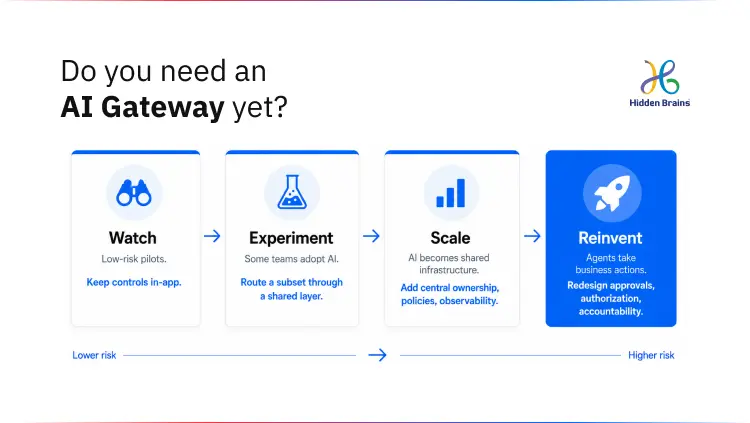
Watch, Experiment, Scale, or Reinvent?
Not every organization needs the same response:
- Watch — A few low-risk experiments, little sensitive-data exposure, no real agent activity. Building infrastructure too early just adds complexity.
- Experiment — Several teams starting to use AI independently. Route a limited set of apps through a shared layer and measure security coverage, latency, developer experience, cost, and false-positive rates.
- Scale — AI is becoming shared infrastructure. You now need clear ownership, reliable policy management, observability, model onboarding, and incident procedures.
- Reinvent — Agents are performing material business actions. When autonomous systems can initiate transactions or change production systems, filters around existing workflows aren’t enough; authorization, approval, and accountability may need redesigning.
Frequently Asked Questions
Do we actually need a sovereign AI gateway, or is it overkill?
It’s overkill for a single low-risk pilot on public data. It becomes worth it once several things are true at once: multiple model providers, regulated or sensitive data reaching AI, teams building independently, agents taking actions, and a need for consistent audit records. Below that threshold, controls inside each app are enough.
What’s the business risk of not having one?
Loss of visibility and control. Unsanctioned “shadow AI” is now tied to roughly $670,000 in higher average breach costs (IBM, 2025), and without a central control point you can’t easily prove what data went where, enforce policy at runtime, or switch providers without rebuilding apps. The cost shows up as breach exposure, compliance gaps, and vendor lock-in.
Will guardrails slow our teams or our AI down?
They add some latency and cost, so the answer is to apply controls by risk rather than everywhere. The bigger operational risk is over-restriction: if the approved path is painful, people route around it and recreate the shadow AI problem you were trying to solve.
Should we build this in-house or bring in a partner?
Build the basics yourself: a single entry point, authentication, logging. The hard part is integration with enterprise identity, security, cloud, data governance, and existing systems, which is where most projects stall. When evaluating a partner, ask to see the enforcement architecture, not a chatbot demo.
Does a gateway make us compliant with the EU AI Act or data-protection law?
Not on its own. Compliance depends on your use cases, documentation, and accountability. What a gateway does is produce the evidence regulators expect: centralized visibility, runtime policy enforcement, regional routing, and audit trails, which is otherwise very hard to assemble across scattered integrations.
Who in our organization should own it?
Not one department. Separate running it from setting policy: platform/architecture operates it, the CISO sets non-negotiable controls, data/privacy/legal define rules for regulated information, app owners configure use-case rules, and an executive group sets risk appetite.


Conclusion
AI guardrails started with a simple goal: prevent models from accepting or producing things they shouldn’t. Enterprise AI has made the challenge bigger—governing the relationships between employees, applications, models, corporate data, tools, and increasingly autonomous agents.
A sovereign enterprise AI gateway provides a shared control layer where AI interactions can be authenticated, inspected, routed, governed, and observed. It’s not a complete security solution, and it won’t eliminate hallucinations or prompt injection. But as AI becomes shared enterprise infrastructure, managing controls separately across every application becomes harder to scale and creates its own risk.
For CIOs, CTOs, and CISOs, the question is shifting from “Which AI model should we use?” to “Who controls what these models can access, what data reaches them, and what actions agents can take?” Getting these controls right early gives enterprises more freedom to experiment, adopt new models, and scale AI with confidence.
Find out whether your AI environment needs a stronger control layer. In a free 2-hour consultation, our experts can assess model access, sensitive data exposure, agent permissions, auditability, and where Guardrails can fit into your enterprise architecture.