











































































Overview
Choosing the right AI framework in 2026 isn’t just a tech decision; it’s a strategic one. LangChain may still dominate agentic apps, but new frameworks are emerging with stronger governance, faster iteration, and industry-ready flexibility. Whether you’re building RAG workflows, complex agents, enterprise-grade systems, or low-code prototypes, the landscape is shifting fast. This blog breaks down what truly matters: use-case fit, team capability, compliance needs, scalability, and long-term ownership. You’ll also see how tools like LlamaIndex, Vellum AI, Flowise, AutoGen, and cloud-managed platforms stack up. Read on to find the framework that actually fits your business.
You’ve probably used LangChain at some point. Maybe you still love it. But as we step into 2026 and your AI plans grow, you might be wondering… is it still the best fit? Should you explore LangChain alternatives for your next AI project?
It’s a fair question. The AI landscape is shifting fast. Agentic AI is taking center stage.
LangChain still leads the market. It gets over 1M downloads every month. Nearly 40% of agentic apps run on it today. Open-source frameworks remain strong, too. They hold about 60% of the market because they’re flexible and have powerful community support. PyTorch and TensorFlow are still the giants of deep learning. But the landscape is shifting. Tools like LlamaIndex and Vellum AI are rising fast. Why? Because teams in 2026 want more control. They want tighter governance. They want smoother collaboration.
So this blog helps you pause, compare, and pick the AI framework that truly fits your business. And probably can help you pick the right custom AI development company for your next project. Not just the trend everyone follows.

Choose The Right AI Framework for a Scalable AI Solution
Contact UsHow to Choose the Right AI Framework for Your Business?
Choosing the right AI framework isn’t just a technical decision. It’s a business decision. And if you’re evaluating alternatives to LangChain, the best choice depends on what you’re trying to build and how your team works. So let’s break it down in simple terms.
Use-case Alignment
Start from this point. What are you really building? A quick prototype? A retrieval-driven knowledge system? A full agent? Or a heavy enterprise workflow? Different frameworks shine in different areas. Pick the one that meets your end goal, not just the one trending on X.
Team Composition & Expertise
Look at your team. Is it developer-heavy? Or do non-technical stakeholders also need to contribute? Some platforms, like Vellum AI, make collaboration easier because they support both visual workflows and code. If you need real-time, actionable business insights, platforms like Datums are available. Choose a platform your people can actually work with.
Governance, Compliance & Deployment Flexibility
If you’re in finance, healthcare, legal, or any regulated space, this matters a lot. You need guardrails. Audit trails. Access controls. Specialized platforms score well here because they offer enterprise-grade governance. Make sure the framework can deploy where your data must live: cloud, hybrid, or on-premise.
Observability, Maintenance, Scalability & Integrations
Think long term. Can you monitor your pipelines easily? Track versions? Debug failures? Scale workloads without headaches? This is where enterprise-ready platforms stand out with monitoring, logs, and “do not-break-production” tooling. Because the bigger your AI footprint gets, the more these things matter.
Speed to Value vs. Control & Customization
Some teams want speed. Others wish for deep control. Visual or low-code tools help you move fast and involve more people. Code-first frameworks give power and flexibility, but require stronger engineering ownership. Pick based on your pace and your tolerance for complexity.
Snapshot of Top Alternatives in 2026: What They are Best for?
AI frameworks are exploding in demand. And it’s not hype anymore. Generative AI is maturing fast, and agentic tools are becoming the new normal. The global AI software market hit $254.5 billion in 2025, growing 29% YoY, and frameworks already make up 40%+ of that value. By 2030, the space is projected to grow another 25–37% CAGR, touching $467B to $1.77T. Generative AI alone sits at $59B in 2025, shooting toward $400B by 2031.
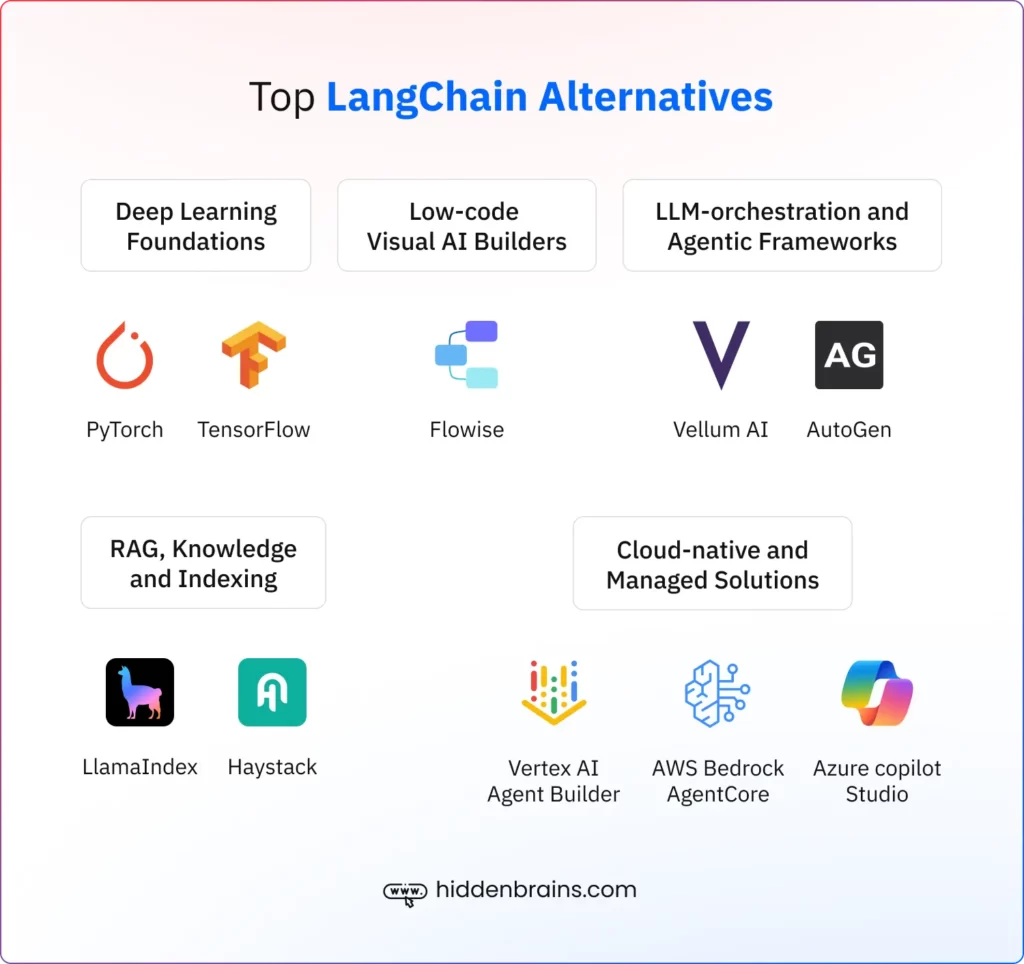
In short, it’s huge, it’s growing, and your framework choice matters more than ever. Below is a clear snapshot of the top players, including major LangChain competitors, and what they’re best suited for.
Deep Learning Foundations (The Core Engines)
These LangChain alternatives power the majority of new AI projects and sit at the base of most advanced systems.
PyTorch
- Type: Deep Learning Framework
- Key Stats: 70%+ adoption in research; 2.5M+ GitHub stars
- Best For: Rapid prototyping, NLP, and computer vision.
Why It Matters: Dynamic computation graphs make experimentation feel natural. Perfect when you want speed and flexibility.
TensorFlow
- Type: Deep Learning Framework
- Key Stats: 65% enterprise adoption; 100M+ deployments
- Best For: Production-scale ML, distributed systems, mobile/edge AI.
Why It Matters: Great for long-term, scalable deployments and regulated industries.
LLM-orchestration & Agentic Frameworks
These AI frameworks help teams build agentic apps, orchestrate logic, and combine LLMs with real-world tools.
Vellum AI
- Type: Enterprise AI Orchestration Platform
- Best For: Teams needing governance, observability, and cross-team collaboration.
- Strengths: Visual builder + SDK, Audit trails + versioning, Enterprise-grade monitoring, The perfect choice when reliability and compliance matter.
AutoGen
- Type: Multi-Agent Systems
- Key Stats: Microsoft-backed; 300K+ stars
- Best For: Complex agent setups, code generation systems, enterprise automation.
- Strengths: Deep customization, strong security posture, and multi-agent debugging.
RAG, Knowledge Systems & Data Indexing
These AI frameworks shine when your value depends on documents, structured data, or enterprise search.
LlamaIndex
- Type: Data Indexing & RAG Framework
- Key Stats: 500K+ users, 30% YoY growth
- Best For: RAG pipelines, knowledge bases, data-heavy products.
- Strengths: Handles unstructured data incredibly well. Ideal for enterprises with chaotic document systems.
Haystack
- Type: Search & QA Framework
- Key Stats: 200K+ integrations
- Best For: Production-grade search, QA systems, and document workflows.
- Strengths: Strong Elasticsearch integration; highly modular; enterprise-friendly.
Low-code / No-code AI Builders
This AI framework is designed for speed, accessibility, and fast iteration cycles.
Flowise
- Type: Visual AI Workflow Builder
- Best For: Teams that want rapid prototyping or have non-technical contributors.
- Strengths: Easy drag-and-drop interface; great for demos, prototypes, and internal tools.
Cloud-native & Managed Enterprise Solutions
Perfect if you’re already deep in a specific cloud ecosystem.
- Vertex AI Agent Builder (Google)
- AWS Bedrock AgentCore
- Microsoft Azure Copilot Studio
- Best for: Teams that prefer managed services, turnkey deployment, and cloud-based scaling.
- Strengths: Security, compliance, deployment speed, enterprise integrations.
- If you’re married to a cloud, these are usually the fastest way to production.
Together, these frameworks alongside LangChain power nearly 90% of new AI projects. Open-source options like PyTorch and TensorFlow help teams cut costs by up to 50%. They’re flexible. Fast. Community-driven. And when you need enterprise guardrails?
Tools like TensorFlow Enterprise or governance layers from platforms like Vellum AI step in. They fill the compliance gaps. They keep your data safe. They keep your workflows clean and auditable. You get speed, savings, and security, all depending on what your business needs most.
Matching Frameworks to Business Needs- Industry- specific Insights
Choosing the right AI framework isn’t just about features. It’s about your context. Your team. Your industry. And how fast you want to move.
Let’s map real-world needs to the best-fit frameworks, so you pick which langchain alternative actually works for your business.
When You Need Speed and Simple Prototyping
If you want to test ideas quickly, involve non-technical teammates, or build internal demos fast, go visual. For this work, the best fit for Flowise, Vellum, and other low-code builders. These tools keep things simple. Drag. Drop. Iterate. Perfect for startups and product teams that want momentum over complexity.
When Your Product Is Data-centric (Knowledge Bases, RAG, Search)
If your value comes from documents, structured data, or enterprise search, you need serious retrieval power. The best fits are LlamaIndex and Haystack. Both shine in RAG workflows and large knowledge systems. They index. They retrieve. They scale.
Industry Fit:
- Healthcare: LlamaIndex helps query patient records securely. Hospitals already use AI in 60%+ of drug discovery workflows, cutting timelines by 30%.
- Retail/eCommerce: Haystack upgrades product search and reduces overstock issues by 18% through better forecasting.
When You Need Enterprise-grade Security, Compliance & Governance
If you’re in a regulated industry, you need more than a cool workflow.You need safety. You need guardrails. The best-fit AI frameworks for these tasks are Vellum AI, Vertex AI Agent Builder, AWS Bedrock, and Azure Copilot Studio. These Langchain alternatives bring RBAC, audit trails, versioning, and managed infrastructure.
Industry Fit:
- Healthcare: TensorFlow is popular for diagnostic models using CNNs, while federated learning keeps systems HIPAA-aligned.
- Finance: LangChain powers compliant chatbots, while PyTorch runs fraud-detection systems that reduce losses by 25%. The sector spends $20B+ annually on AI.
When You Need Complex Logic, Agents & Full Customization
If your engineering team wants maximum control, coding freedom, or multi-agent coordination, you go code-first. The best fit is AutoGen. It’s modular. Flexible. Built for complex agent workflows and deep customization.
Industry Fit:
- Manufacturing: AutoGen supports predictive maintenance via agent orchestration. The sector is growing 35% CAGR, with APAC leading at 42%.
- Autonomous Systems: JAX helps run high-speed simulations, while ONNX ensures models run smoothly on edge devices. Agentic setups already reduce logistics delays by 20%.
When You’re Embedded in a Cloud Ecosystem and Want to Scale Fast
If your infrastructure is already on AWS, GCP, or Azure, managed AI platforms are the fastest way to production. On these occasions, the best AI frameworks are Vertex AI, AWS Bedrock AgentCore, and Azure Copilot Studio. You get tight integration. Smooth deployment. Effortless scaling.
Industry Fit:
- Retail & E-com: Transformers from Hugging Face run recommendation engines that push higher conversions.
- Finance & Healthcare: Cloud-managed governance helps teams stay compliant without building everything in-house.
Pitfalls: What to Watch Out for Before Picking LangChain Alternatives
Even the best AI development stacks come with trade-offs. Teams often rush into tools without considering long-term impact: costs, flexibility, and scalability. Here are the key pitfalls to stay alert to when exploring modern frameworks and alternatives to LangChain.
Over-abstraction Limits Flexibility
Visual builders and “all-in-one” automation platforms speed up early development. But they can restrict deep customization, making it harder to implement complex, domain-specific logic later.
Vendor Lock-in with Cloud-native Solutions
Cloud-exclusive AI frameworks offer convenience, but moving away becomes expensive and technically difficult. Once data pipelines, models, and workflows are embedded, migrating to another provider can be painful.
Hidden and Ongoing Costs
Managed platforms, SaaS tools, and licensed AI systems often bring extra charges. It includes API usage, storage, autoscaling, and compliance add-ons. What looks affordable upfront can grow into a heavy operational expense.
Maintenance & Governance Overhead in Open-source
Self-hosted and open-source stacks are powerful but require constant updates, monitoring, and security management. Teams must invest time in governance, version control, and infrastructure upkeep.
How Hidden Brains Can Help You
Hidden Brains brings 22+ years of proven expertise in building scalable, secure, and intelligent AI development solutions. From custom AI development services to end-to-end integration, our team delivers precision, speed, and innovation. We ensure your business adopts AI confidently, efficiently, and with measurable impact.

Build a Frictionless Custom AI System with Confidence for Your Business
Contact Now!Frequently Asked Questions
Not all questions about LangChain alternatives fit neatly into the main flow of the blog. This quick FAQ clears up the most common doubts teams have when evaluating other frameworks. It covers governance, complexity, deployment options, and industry-specific use cases.
1. Are LangChain alternatives better for enterprise governance?
Often, yes. Tools like Vellum or Vertex AI offer stronger RBAC, audit trails, and compliance controls.
2. Which option works best for non-technical teams?
Flowise, Vellum, and other low-code platforms. Fast, visual, and beginner-friendly.
3. Do any alternatives support on-premise deployment?
Yes. Haystack, LlamaIndex, and AutoGen can be fully self-hosted.
4. What’s better than LangChain for complex agent workflows?
AutoGen and other code-first frameworks that offer deeper control and orchestration.
5. Are some frameworks better for specific industries?
Absolutely. LlamaIndex for healthcare data, PyTorch for finance models, Hugging Face for retail, and JAX for robotics.

Conclusion
Choosing the right AI framework isn’t about trends; it’s about fit, clarity, and long-term value. Start small. Iterate fast. Pick tools that match your workflow, not the other way around. Hopefully, our blog will help you pick the right LangChain alternatives for your next AI project. With the right foundation, your AI strategy becomes simpler, smarter, and built for real results in 2026 and beyond.