










Summary
- Explore the top healthcare technology trends transforming patient care, clinical workflows, and digital health.
- Learn how AI, machine learning, and NLP are improving diagnostics, documentation, and decision-making.
- Discover how IoMT, telemedicine, and wearable devices enable continuous remote patient monitoring.
- Understand the growing role of predictive analytics, AR/VR, and 3D bioprinting in modern healthcare.
- See how healthcare organizations are modernizing legacy systems while ensuring HIPAA-compliant data security.
- Find out how custom healthcare software helps providers improve operational efficiency and patient outcomes.
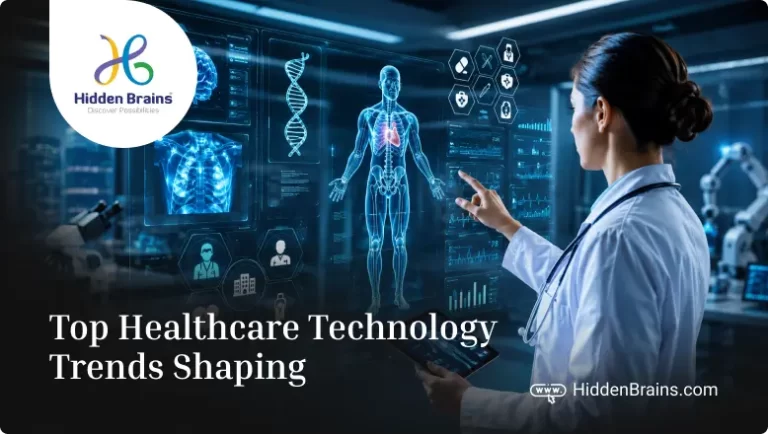
Being a healthcare service provider, staying updated with the top healthcare technology trends in 2026 is essential to deliver superior patient care, ensure regulatory compliance, and optimize clinical workflows. Following the rapid digital acceleration of recent years, the healthcare industry continues to evolve at an unprecedented pace.
| Details | Information |
|---|---|
| Guide Focus | Explore the healthcare technologies transforming patient care, clinical operations, and digital health ecosystems in 2026 and beyond. |
| Target Audience | Healthcare providers, hospital administrators, HealthTech leaders, CIOs, digital transformation teams, medical startups, and healthcare decision-makers. |
| TL;DR | AI, IoMT, telemedicine, predictive analytics, wearables, AR/VR, and 3D bioprinting are redefining healthcare by improving patient outcomes, operational efficiency, and regulatory compliance. |
| Main Takeaways | Discover the top healthcare technology trends, their real-world applications, business benefits, and how custom healthcare software accelerates secure digital transformation. |
| Recommended For | Organizations planning healthcare digital transformation, modernizing legacy systems, building digital health platforms, or investing in AI-powered healthcare solutions. |
According to Gartner’s market research on enterprise healthcare digital transformation, over 80% of healthcare organizations are significantly increasing their IT investments in artificial intelligence, cloud infrastructure, and connected care ecosystems.
Furthermore, recent industry analyses show the global healthcare IT market is projected to exceed $600 Billion by 2026, driven by the need to streamline administrative overhead and handle billions of patient transactions securely.
From AI-powered diagnostics to remote patient monitoring and 3D bioprinting, key innovations are reshaping modern care delivery. Before partnering with a custom software development company to revamp your digital ecosystem, let’s explore the top technology trends driving the future of healthcare.
Top Healthcare Technology Trends to Watch Out
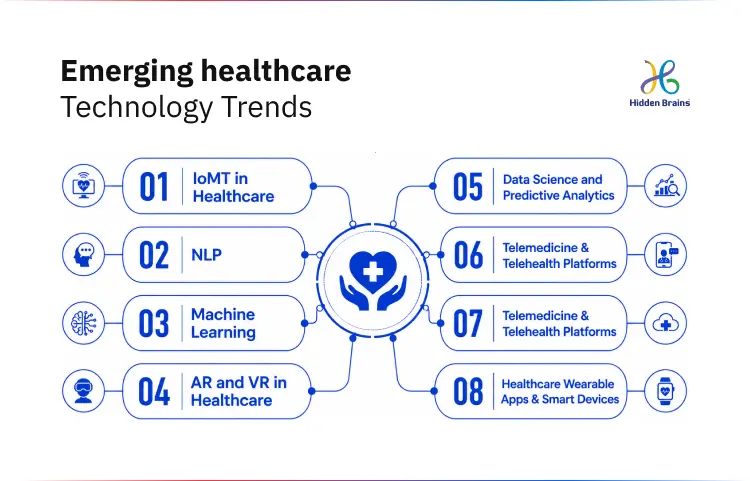
1. Internet of Things (IoT) & IoMT in Healthcare
Traditional methods of collecting patient data and managing chronic conditions often lead to administrative delays and fragmented medical records. Integrating the Internet of Medical Things (IoMT) solves this by connecting smart medical devices directly to healthcare networks.
As highlighted in Forbes’ analysis on Internet of Things adoption in healthcare, connected medical devices allow clinicians to track vital metrics in real-time, extending care beyond hospital walls.
- Continuous Remote Patient Monitoring : Smart sensors continuously monitor glucose levels, heart rate, and blood pressure.
- Automated EHR Integration : Real-time device data feeds directly into Electronic Health Records (EHRs), offering clinicians a holistic patient view.
- Streamlined Operations : Automated asset tracking reduces equipment downtime and improves hospital resource management.
2. Natural Language Processing (NLP)
Healthcare providers generate vast volumes of unstructured clinical text daily, from doctor notes to discharge summaries. NLP development services enable systems to parse, analyze, and extract actionable insights from this textual data.
- Enhanced Clinical Documentation : NLP converts spoken clinician notes into structured EHR entries in real time.
- Clinical Decision Support : NLP algorithms scan patient histories to highlight risk factors and assist doctors during diagnosis.
- Optical Character Recognition (OCR) : Legacy paper medical records are digitised and categorized automatically for instant retrieval.
3. Machine Learning (ML)
Machine Learning (ML) is moving rapidly from experimental phases to core production workflows across diagnostic imaging, predictive triage, and treatment planning.
- Radiology & Diagnostics : ML algorithms assist radiologists in detecting subtle abnormalities in X-rays, MRIs, and CT scans at early, treatable stages.
- Predictive Health Care : Machine learning models analyze historical patient data to predict hospital readmissions and disease progression.
- AI-Powered Virtual Assistants : Intelligent chatbots handle initial patient intake, answer routine queries, and triage symptoms effectively.
Ready to Modernize Your Healthcare Software Solutions?
Talk to Our Experts
4. Augmented Reality (AR) & Virtual Reality (VR) in Healthcare
Virtual and Augmented Reality are transforming medical education, surgical planning, and patient therapeutic care.
- Surgical Simulation & Planning : Surgeons use 3D AR overlays to visualize complex anatomical structures prior to performing intricate procedures.
- Medical Training & Education : Medical students train in risk-free, highly realistic 3D virtual environments.
- Patient Rehabilitation : VR-guided physical therapy and mental health relaxation programs accelerate patient recovery.
5. Data Science and Predictive Analytics
Modern healthcare facilities collect massive volumes of operational and clinical data. Predictive analytics converts this raw data into strategic foresight, reducing healthcare delivery costs and improving care quality.
- Resource & Staffing Allocation : Predictive algorithms forecast patient admission rates to optimize nursing schedules and bed management.
- Early Outbreak & Trend Detection : Data models track regional health trends to predict potential viral spikes or community health risks.
- Personalized Treatment Plans : Data science enables precision medicine by matching patient genetic profiles with targeted therapies.
6. Telemedicine & Telehealth Platforms
Telemedicine has solidified its position as a primary care delivery model rather than a temporary alternative. Industry surveys reveal that over 80% of patients have used telehealth services, with 61% preferring digital platforms for routine prescription management.
- Virtual Consultations : Patients consult specialists from home, reducing travel time and clinic overcrowding.
- E-Prescriptions & Follow-ups : Secure messaging channels streamline prescription renewals and post-operative follow-up visits.
- Hybrid Care Models : Seamlessly combines remote monitoring with in-person visits for chronic disease management.
7. Healthcare Wearable Apps & Smart Devices
Wearable health technology, including smartwatches, fitness bands, and wearable ECG monitors empowers individuals to take proactive control of their wellness.
- Real-time Health Metrics : Wearables continuously track heart rhythm, sleep architecture, oxygen saturation, and physical activity.
- Instant Emergency Alerts : Advanced wearables detect sudden falls or irregular heart rhythms (e.g., AFib) and automatically alert emergency care teams.
- Patient Engagement : Mobile apps paired with wearables encourage healthier daily habits through gamified goals and insights.
8. 3D Bioprinting & Additive Manufacturing
3D bioprinting is pushing the boundaries of regenerative medicine, tissue engineering, and custom prosthetics.
- Custom Prosthetics & Implants : 3D printing enables the fast, precise creation of patient-specific joint replacements and dental implants.
- Surgical Models : Surgeons create exact 3D-printed anatomical replicas of complex patient organs to practice complex surgeries.
- Tissue Engineering : Researchers continue making breakthroughs in bioprinting artificial tissue patches for drug testing and organ research.
How Does Hidden Brains Contribute to Healthcare Digital Transformation?
Modernizing healthcare software requires navigating strict data privacy regulations, complex legacy architecture, and high uptime demands. Hidden Brains partners with healthcare providers, medical startups, and healthtech enterprises to overcome common operational challenges:
- Overcoming Legacy System Overhead : We modernize outdated legacy EHR/EMR systems into cloud-native, scalable microservices architectures.
- Eliminating Patient Frustration : We design intuitive, accessibility-compliant patient portals and mobile health apps to elevate satisfaction.
- Ensuring HIPAA & Regulatory Compliance : End-to-end encryption, multi-factor authentication, and robust access controls guarantee total patient data privacy.
- Optimizing Complex Workflows : Our healthcare software development services eliminate manual data entry, administrative bottlenecks, and staff burnout.
Transform Patient Care with Custom Digital Health Apps
Contact Us
Frequently Asked Questions
Here we have our frequently asked questions section where we have listed all the common questions that our clients asked while looking for the top trends in healthcare in 2025.
What are the top healthcare technology trends driving digital transformation in 2025?
The top healthcare technology trends in 2025 include Artificial Intelligence (AI), Internet of Medical Things (IoMT), Telemedicine, Natural Language Processing (NLP), and Predictive Data Analytics. These technologies work together to automate administrative workflows, enable continuous remote patient monitoring, improve diagnostic accuracy, and deliver personalized patient care.
How are AI and Machine Learning improving modern patient care?
AI and Machine Learning improve patient care by analyzing diagnostic images for early disease detection, predicting hospital readmission risks, and automating clinical documentation. By processing complex clinical data in seconds, AI assists physicians with accurate diagnostic decision support, reducing human error and freeing clinicians to focus more time on direct patient treatment.
What is the role of IoMT (Internet of Medical Things) in remote patient monitoring?
IoMT connects smart medical devices and wearables directly to healthcare networks, enabling continuous real-time monitoring of patient vitals. This interconnected ecosystem automatically transmits critical health metrics like blood glucose, blood pressure, and heart rate to doctors, facilitating timely clinical interventions and reducing unnecessary emergency hospital visits.
How do custom healthcare software solutions ensure HIPAA compliance and data privacy?
Custom healthcare software ensures HIPAA compliance through advanced end-to-end data encryption, role-based access controls, multi-factor authentication, and automated security audit logs. Partnering with an experienced healthcare software development company ensures that your digital health platforms adhere strictly to international patient data security standards like HIPAA and GDPR.
Why is EHR interoperability crucial for modern healthcare organizations?
EHR interoperability is crucial because it enables seamless, secure patient data exchange across different software platforms, clinics, and hospital networks. Eliminating fragmented medical records prevents duplicate diagnostic testing, improves patient safety during emergency transitions, and equips clinicians with instant access to complete, real-time health histories.
How is Generative AI transforming administrative efficiency in healthcare?
Generative AI transforms healthcare efficiency by automating clinical charting, drafting routine patient communications, summarizing complex medical records, and streamlining insurance claim processing. By cutting administrative documentation time by up to 30%, Generative AI reduces clinician burnout and enables care teams to focus on direct patient treatment.



Conclusion
The rapid evolution of healthcare technology trends is fundamentally changing how medical organizations deliver care, manage data, and optimize administrative workflows. Integrating innovations like AI-driven diagnostics, IoMT remote patient monitoring, and predictive analytics is no longer just a competitive advantage; it is a necessity for providing modern, patient-centric care. As regulatory standards tighten and patient expectations rise, healthcare providers must build secure, HIPAA-compliant custom software capable of scaling alongside these technological shifts.
Partnering with an experienced digital transformation leader like Hidden Brains ensures your organization can navigate complex implementations smoothly, streamline clinical operations, and pioneer future-ready health solutions.