









































![Sales & Distribution [Oil & Gas]](https://www.hiddenbrains.com/blog/wp-content/themes/blankslate/assets/images/sales_and_distribution-icon.74d08193.svg "Sales & Distribution [Oil & Gas]")

![Fluid Terminal Management [Oil & Gas]](https://www.hiddenbrains.com/blog/wp-content/themes/blankslate/assets/images/fluid_terminal_management-icon.4b3a27a4.svg "Fluid Terminal Management [Oil & Gas]")


![Sales & Distribution [Oil & Gas]](https://www.hiddenbrains.com/blog/wp-content/themes/blankslate/assets/images/sales_and_distribution-icon.74d08193.svg?1.0.0 "Sales & Distribution [Oil & Gas]")
![Fluid Terminal Management [Oil & Gas]](https://www.hiddenbrains.com/blog/wp-content/themes/blankslate/assets/images/fluid_terminal_management-icon.4b3a27a4.svg?1.0.0 "Fluid Terminal Management [Oil & Gas]")















































Summary
- Product prototyping is the process of creating early versions of a product to test ideas, design, and functionality before full development.
- It helps identify design flaws, usability issues, and feasibility early, reducing risks and rework.
- Types include paper prototypes, wireframes, high-fidelity, and functional prototypes for different development stages.
- Enables user feedback, experimentation, and continuous iteration for better outcomes.
- Saves time and cost by validating concepts before heavy investment.
- Aligns stakeholders and improves decision-making across the product lifecycle.
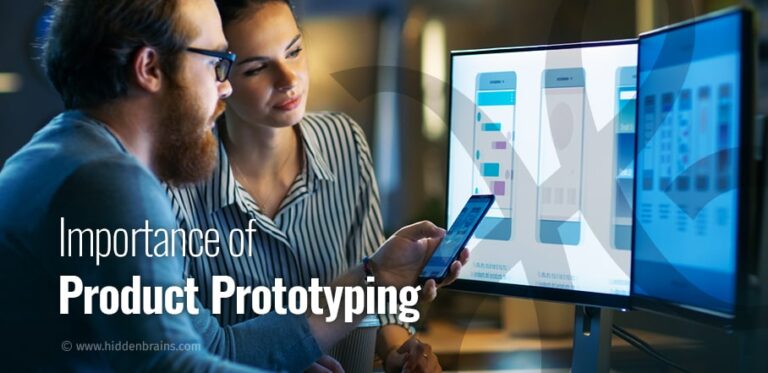
Prototyping is one of the most critical functions to ensure testing of your ideas. It is a scaled-down or miniature version of your plan. It is about clearly depicting your product design and navigation, as well as a workflow to streamline development processes. Prototyping leaves no room for ambiguity before the actual development process begins, minimizing errors discovered during the initial phase of a project.
what is a prototype?
“Prototyping refers to an initial stage of a software release in which developmental evolution and product fixes may occur before a bigger release is initiated. These kinds of activities can also sometimes be called a beta phase or beta testing, where an initial project gets evaluated by a smaller class of users before full development.”
There are several methods for Prototyping, but in mobile app development, a prototype starts with rough sketches or a paper interface or a scaled replica of the mobile application or product.
Paper interfaces come across as a quick fix at the very early stages of Prototyping for digital products. You can create paper interfaces by simple sketches (no artistic skills) required, or by creating usable parts of a user interface with cutouts.
Why use prototypes?
Prototyping is at the crux of the user experience and requires testing designs on real users—and prototypes are a way out without spending loads of time and money.
Prototypes can help you to:
Get actionable insights into user mindset and how your users will interact with the product or mobile app. Getting a chance to experience and see an early version of the product shows you the possible real-life working of your product or application.
- Identify any usability issues or design flaws. If an idea or design is doomed for failure or not workable, you’d rather find out in the early stages.
- Prototypes highlight failure early and cheaply to find a weak or unsuitable approach before investing too many resources in terms of time, man-hours and money.
- Test different versions in the form of prototypes and see which works best.
Prototypes allow you to iterate, refine, rework and make improvements until you have a market-ready product.
Different Types of Prototyping
Paper prototyping
Paper prototyping comes with a series of advantages such as a quick and affordable way to document the transformation of your design, giving you tangible artefacts. However, it comes with a catch. The chances of presenting complex interfaces might not be feasible in paper prototyping. It is best to explore a variety of broader ideas or concepts quickly.
Clickable Wireframes
Clickable wireframes provide some layout and interactivity to the prototype. This a simulation that a user might experience with hyperlinked or clickable buttons giving an actual flow of ideas.
High-fidelity Prototypes
Well, this is a more realistic prototype which operates as the final product. It gives you a closer look at how the final product will work and its build. This type of prototype will help refine the design and get ready for the ball rolling.
Native Prototyping
This type of Prototyping is done natively where code is written and built on real devices. Native Prototyping aims to understand the real-world application of your product for a particular system and how your product works in the real world to validate your ideas with real users. While native prototypes are close to fully functioning versions of a product or application, it requires strong development skills to build native prototypes. Without good development skills, creating a native prototype might turn out to be cumbersome and time consuming.
Prototype Best Practices
Now that we know about Prototyping and its different types, here are some best practices related to Prototyping to create your application.
Here are some points that will assist along the way:
- Choose the right type of prototype: There are several factors that will determine the right type of prototype. Low-fidelity prototypes might work best for the project in early-stage whereas hi-fidelity or native prototypes might work the best when it comes closer to product shipping date.
- Set concrete goals: Do you want to validate your app idea or understand user behaviour with your app? It is essential to remain focused on the requirements all the time.
- Right tools: There are several tools out that streamline the prototyping process in terms of features and functionality. Select the right tool based on your needs and project requirements. Tools make it easy to fasten the prototyping process.
Let’s go over a few of the benefits in more detail.
Leverage Ideas and Identifying Product Improvements
Application prototyping can help leverage new ideas and identify loopholes in the initial stage of the development process to identify improvement and enhance the application continuously. Prototyping is the best way to build a strong foundation for mobile application.
Cost Arbitrage
It goes without saying that mobile app prototypes save costs in the long run. While the process might look and sound tedious, it is relatively easier to overcome problems and ensure a seamless experience for app users. After all the closer you get to launch the expensive changes become.
Save Time
App developers can gauge the working of an application with the prototype. With the prototype, the focus is on functioning rather than user documentation or description which is typically required in wireframes.
Allows for experimentation
Rapid Prototyping helps formulate and experiment with diverse approaches and ideas, streamlining discussion through visuals to engage with that information.
Client and Stakeholder Involvement
During the prototyping phase, stakeholders gain insights into the project’s strategic direction and ensure implementation of functionality which align closely with the long-term strategy of the project.
Frequently Asked Questions
What is product prototyping?
It is the process of creating a preliminary version of a product to test its design, functionality, and feasibility before final development.
Why is prototyping important?
It helps identify flaws early, gather user feedback, and reduce risks, saving time and development costs.
What are the types of prototypes?
Common types include paper prototypes, wire frames, high-fidelity prototypes, and functional prototypes.
How does prototyping reduce costs?
Detecting issues early, it prevents expensive changes during later development stages.
What challenges are involved in prototyping?
It can be time-consuming, require resources, and involve iterative refinements and feedback integration.
Can prototyping help attract investors?
Yes, a working prototype demonstrates feasibility and builds confidence among investors and stakeholders.



Conclusion
Product prototyping is a critical step in transforming ideas into successful, market-ready solutions. By enabling early validation, user feedback, and iterative improvements, it minimizes risks and ensures better alignment with user expectations. From low-fidelity sketches to advanced functional models, prototyping enhances clarity, reduces development costs, and accelerates time-to-market. While it may involve time and effort, its long-term benefits far outweigh the challenges. Businesses that embrace prototyping are better equipped to innovate, refine their products, and deliver high-quality, user-centric solutions.