

















































![Sales & Distribution [Oil & Gas]](https://www.hiddenbrains.com/blog/wp-content/themes/blankslate/assets/images/sales_and_distribution-icon.74d08193.svg "Sales & Distribution [Oil & Gas]")

![Fluid Terminal Management [Oil & Gas]](https://www.hiddenbrains.com/blog/wp-content/themes/blankslate/assets/images/fluid_terminal_management-icon.4b3a27a4.svg "Fluid Terminal Management [Oil & Gas]")


![Sales & Distribution [Oil & Gas]](https://www.hiddenbrains.com/blog/wp-content/themes/blankslate/assets/images/sales_and_distribution-icon.74d08193.svg?1.0.0 "Sales & Distribution [Oil & Gas]")
![Fluid Terminal Management [Oil & Gas]](https://www.hiddenbrains.com/blog/wp-content/themes/blankslate/assets/images/fluid_terminal_management-icon.4b3a27a4.svg?1.0.0 "Fluid Terminal Management [Oil & Gas]")








































































Summary
- OpenAI intelligence partnership + Hidden Brains engineering for production-ready enterprise AI.
- Move from pilot to production with stronger architecture, integration, and controls.
- Build AI-native applications and agents around real enterprise workflows.
- Add guardrails and governance for controlled, accountable AI execution.
- Use data and context engineering to make AI relevant to the business.
- Modernize systems for AI readiness across APIs, cloud, and enterprise architecture.
- Engineer for scale, cost, and observability from day one.
- Tie AI adoption to measurable business outcomes, not just model capability.
We have reached an important milestone in our AI journey.
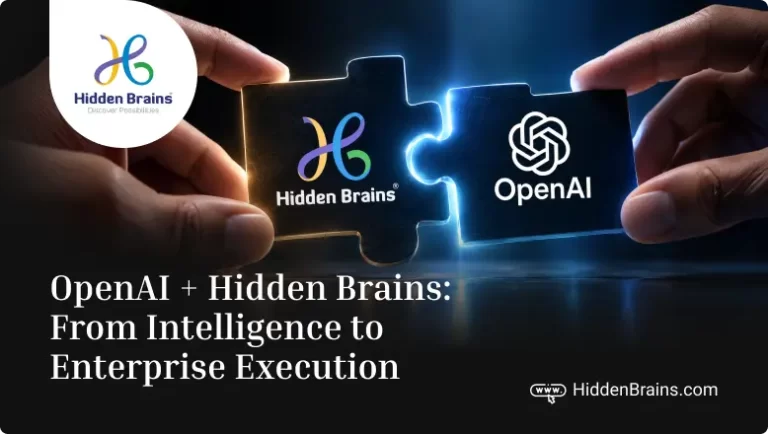
Hidden Brains is now an OpenAI partner, bringing together OpenAI intelligence with Hidden Brains engineering, enterprise guardrails, and governed execution.
For us, this partnership is bigger than gaining access to another technology ecosystem. It strengthens how we help enterprises move from experimenting with AI to building AI systems they can actually run across products, operations, customer experiences, and business-critical workflows.
OpenAI brings the intelligence layer: frontier models, advanced reasoning, multimodal capabilities, agents, and a rapidly evolving platform for building with AI.
Hidden Brains brings the engineering around that intelligence: more than two decades of experience across enterprise software development, product engineering, cloud, data, modernization, APIs, integrations, DevOps, quality engineering, and large-scale technology delivery.
Then come the layers enterprises increasingly cannot afford to overlook: guardrails and governance.
Put together, the equation is straightforward:
OpenAI Intelligence + Hidden Brains Engineering + Guardrails + Governed Enterprise Execution
That combination matters because access to powerful AI is no longer the only challenge.
OpenAI itself has described the limiting factor for enterprise AI as moving beyond model capability toward identifying the right use cases, redesigning workflows, integrating with existing systems, and driving adoption at scale. Its Partner Network is designed around helping organizations turn AI ambition into measurable outcomes through partners with technical expertise, delivery capacity, and industry understanding.
For enterprises, this is where the next phase begins.
The Model Is Powerful. But the Model Is Not the Enterprise System.
A model may be able to reason through a problem, interpret a document, understand an image, generate software, summarize a complex knowledge base, or decide which tool it needs to use next.
But it does not automatically understand how your organization works.
It does not inherently know which source of customer information should be trusted.
It does not know that one employee can access a particular financial record while another cannot.
It does not know whether a particular action requires management approval, whether a legacy API is safe to call, or whether an apparently correct response violates an internal business rule.
That surrounding context has to be engineered.
This is why enterprise AI quickly becomes a broader problem involving software architecture, data, integration, infrastructure, security, workflow design, testing, and governance.
And this is precisely where Hidden Brains’ engineering foundation becomes important.
Our role is not simply to connect a model to an interface. It is to engineer the environment around the model so that intelligence can work with the systems, data, processes, and controls an enterprise already depends on.
That could mean building an enterprise knowledge architecture around OpenAI, connecting an AI agent with ERP and CRM systems, modernizing a legacy application so its capabilities can be safely exposed through APIs, creating a cloud-native AI application, or designing approval and escalation paths around autonomous workflows.
Partnership in Practice: OpenAI provides the intelligence layer. Hidden Brains engineers the architecture, integrations, controls, and enterprise context around it.
How the OpenAI + Hidden Brains Partnership Closes the Pilot-to-Production Gap
One of the easiest things to do with generative AI today is to build an impressive demo. The difficult part comes afterward.
A proof of concept typically answers: Can AI do this task?
Production requires a much broader answer.
- Can it retrieve the right information consistently?
- Can it work within enterprise permissions?
- Can it interact safely with other applications?
- Can the organization understand why an action happened?
- Can it recover when a system or model fails?
- Can it operate reliably under real-world demand?
- Can the business afford the inference cost once thousands of users begin using it?
And most importantly:
Can the organization prove that the AI improved the business outcome it was introduced to change?
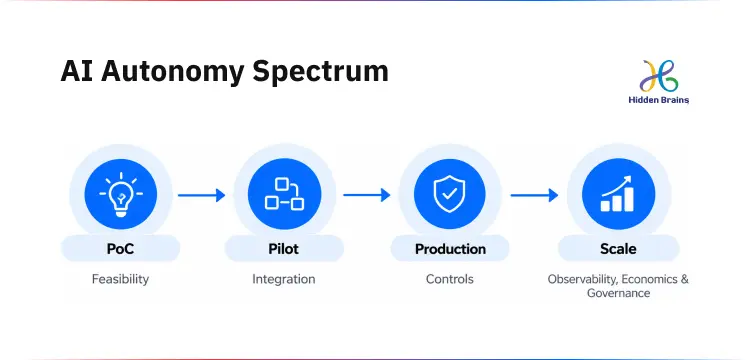
This is the distance between: PoC → Pilot → Production → Enterprise Scale
Each stage introduces more engineering complexity.
At Hidden Brains, this is where disciplines that we have spent years building come together: custom software engineering, enterprise architecture, cloud, data engineering, system integration, quality engineering, DevOps, modernization, and now deeper AI engineering.
The objective is not merely to demonstrate that intelligence works. It is to make that intelligence something the enterprise can depend on.
AI-Native Engineering Goes Beyond Adding AI Features
Much of the first generation of enterprise generative AI was additive: chatbots, AI search, summarization, content generation, and copilots layered onto existing products and workflows. These applications can create meaningful value, but they still represent only the early stage of the shift AI is creating in software engineering.
We see enterprise AI evolving across three levels: AI-assisted, AI-integrated, and AI-native. The difference is not simply how much AI is used, but how deeply intelligence becomes part of the product, workflow, and operating model itself.
AI-Assisted
AI helps a user perform an existing task more efficiently. Think drafting, summarization, search, recommendations, analysis, or coding assistance.
AI-Integrated
AI becomes part of an existing business workflow. It may retrieve information from enterprise data, analyze a situation, generate a recommendation, and pass that recommendation into another business system.
AI-Native
The application or workflow itself is designed around intelligence. AI can interpret context, determine next steps, interact with tools, coordinate actions, escalate exceptions, and adapt the workflow around the situation.
This third layer is where AI-native engineering becomes a significantly different discipline. It is also where traditional software engineering experience becomes even more important.
An intelligent application still needs scalable architecture. It still needs excellent UX. It still needs APIs, infrastructure, security, monitoring, integration, testing, and resilience.
AI does not remove these requirements. It raises the bar for how they work together.
Also Read – Vibe Coding For Startup Growth
From Copilots to Agents: Engineering AI That Can Act
Copilots largely changed how people interact with applications. AI agents have the potential to change how work itself moves through an application.
The architecture begins to move from: Ask → Answer
Toward: Goal → Reason → Retrieve → Use Tools → Act → Verify → Escalate
That is an important transition.
An enterprise agent may eventually be able to investigate an operational exception, gather relevant information from different systems, recommend an action, update another platform, generate documentation, and escalate only the situations that require human judgment.
OpenAI is also explicitly developing its partner ecosystem around areas such as agents and deeper enterprise deployment, reflecting the growing importance of these capabilities in business AI.
But the more AI is allowed to act, the more important engineering discipline becomes.
An enterprise has to decide:
- What can the agent see?
- What tools can it use?
- What can it change?
- What should require human approval?
- What happens when confidence is low?
- How can its actions be traced?
- How should failures be contained?
That takes us to another critical layer of the partnership equation.
Guardrails: Engineering the Boundary Around Intelligence
For enterprise AI, the goal should not be maximum autonomy. It should be appropriate autonomy.
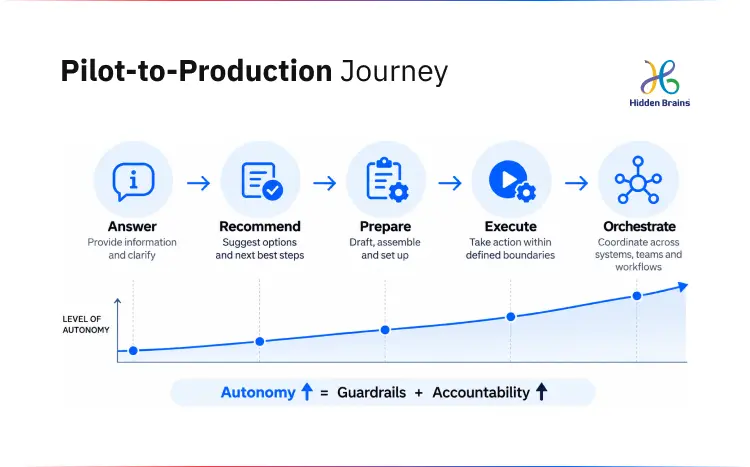
Consider a simple progression: Answer → Recommend → Prepare → Execute → Orchestrate
At one end, AI provides information. At the other, it coordinates actions across multiple systems and workflows. Not every enterprise process should immediately move to the far end of that spectrum.
The level of autonomy should depend on business risk, data quality, system reliability, the consequences of failure, and the degree of accountability required. This is why guardrails need to be engineered into AI systems from the start, creating a governed AI gateway that controls how models access enterprise data, interact with systems, execute actions, and escalate decisions.
That can include:
- Role-based access,
- Restricted tool permissions,
- Human approval points,
- Policy enforcement,
- Escalation thresholds,
- Audit trails,
- Fallback mechanisms,
- Output evaluation,
- Transaction limits,
- Exception handling,
- Operational monitoring.
For an AI agent interacting with financial systems, customer records, internal applications, or operational infrastructure, these controls are not optional enhancements.
They are part of the system architecture.
Remember – The more responsibility we give AI, the more deliberately we need to engineer its boundaries.
Governance Needs to Move From Policy to Execution
Guardrails control individual systems.
Governance provides the wider operating discipline around them.
This matters because responsible AI cannot be something an organization adds after development.
It has to influence how AI systems are selected, designed, evaluated, deployed, monitored, and improved.
Governance needs clear ownership, defined data boundaries, risk thresholds, human oversight, auditability, and measurable performance. It should also establish how AI incidents are handled and when a system needs to be changed, restricted, or retired.
At Hidden Brains, this perspective is reinforced by our ISO/IEC 42001:2023 certification for AI management systems, alongside the broader engineering and process disciplines we have built over the years.
Our approach is therefore not: Build first. Govern later.
It is: Engineer capability and governance together.
Because as enterprises move from assistants toward agents, governance increasingly has to manifest in technical controls, approval workflows, permissions, monitoring, auditability, and measurable accountability.
Enterprise Data Turns General Intelligence Into Business Intelligence
Frontier models bring powerful general intelligence. But general intelligence is not the same thing as understanding a specific enterprise.
The differentiated value comes from combining the model with the context that belongs to the business:
- Customer history,
- Product information,
- Operational data,
- Internal policies,
- Technical documentation,
- Industry knowledge,
- Business rules,
- Transaction history and
- Institutional knowledge accumulated over years.
This is why enterprise AI calls for strong data engineering and context engineering to turn business data into usable AI context.
Depending on the use case, the architecture may involve retrieval-augmented generation, enterprise search, vector databases, knowledge graphs, structured data pipelines, semantic layers, real-time data feeds, permission-aware retrieval, and other mechanisms for delivering relevant context.
The engineering question becomes:
Can we give the model the right information, at the right moment, for the right user, without exposing information it should not see?
Hidden Brains’ experience across data engineering, enterprise applications, cloud, analytics, and system integration becomes highly relevant here.
Because the model may know a great deal about the world.
Your enterprise context is what teaches it about your business.
Sometimes AI Readiness Starts With Modernization
There is another barrier enterprises often discover once they begin moving AI into core workflows.
The AI may be ready. Their architecture may not be. Important business logic may still sit inside tightly coupled legacy systems.
Data may be fragmented. Applications may lack APIs.
Identity and permissions may differ across platforms. Critical information may still depend on batch processes.
Systems built years ago may never have been designed to expose actions safely to an autonomous agent.
This makes enterprise modernization increasingly connected to AI strategy. It does not mean rewriting everything. It means modernizing deliberately.
Our approach can often be described as: Expose → Integrate → Decouple → Modernize
Expose useful legacy capabilities through controlled interfaces. Integrate the data and applications AI needs. Decouple workflows where greater intelligence or automation is valuable.
Modernize the systems that materially prevent AI from scaling.
This is where Hidden Brains’ experience in legacy modernization, API engineering, cloud-native development, platform architecture, and enterprise systems becomes part of the AI readiness conversation.
Sometimes the first AI project is actually a modernization project.
Move Faster With the Expertise, Accountability, and Rollback Strategy.
Talk to Our Experts
Production AI Needs Production Economics
Another thing changes when AI moves out of the pilot phase: economics. A prototype handling a few hundred requests looks very different from a production platform processing millions of interactions.
AI workloads introduce variable costs through model calls, reasoning depth, context size, retrieval, multimodal processing, and agent execution.
So enterprises need to think beyond: Which model is most capable?
They also need to ask:
- Which model is appropriate for this task?
- Can simpler requests be routed differently?
- How much context does the model actually need?
- Can responses or retrievals be cached?
- How many steps should an agent be allowed to take?
- What latency is acceptable?
- What is the cost of completing the workflow compared with its business value?
This is why cloud infrastructure services, architecture, observability, and FinOps thinking increasingly intersect with AI engineering.
The most useful metric will rarely be just cost per token. What matters more is:
Value per inference.
If an AI interaction costs more but eliminates a costly operational process, it may have excellent economics. If millions of model calls create little measurable improvement, cheap inference still does not make the system valuable.
AI Evaluation Becomes a Core Engineering Discipline
AI also changes what quality means. Traditional software testing often evaluates deterministic behavior. Input A should produce outcome B.
AI systems behave differently.
They may produce different but equally valid answers. They may perform exceptionally across most scenarios but fail on specific classes of input. An agent may reason correctly but invoke the wrong tool. This means production AI needs additional evaluation layers.
Organizations may need to monitor:
- Accuracy,
- Groundedness,
- Hallucination frequency,
- Task completion,
- Tool-call success,
- Latency,
- Escalation rate,
- Human override,
- Cost per task,
- Policy violations,
- And the business KPI being affected.
Hidden Brains’ quality engineering experience becomes part of this new AI lifecycle. Because uptime alone cannot tell you whether an AI system is performing well.
A system can be available and still make bad decisions.
The evaluation loop therefore has to continue after deployment.
How Hidden Brains Turns OpenAI Intelligence Into Enterprise Execution
This is ultimately where the partnership comes together. OpenAI provides increasingly capable intelligence. Hidden Brains engineers how that intelligence enters the enterprise.
Our approach spans the full journey:
Discover
Identify the business workflow, desired outcome, data requirement, feasibility, and risk.
Design
Define the architecture, model strategy, enterprise context, integrations, guardrails, and operating boundaries.
Engineer
Build AI applications, agents, enterprise software, APIs, integrations, and user experiences.
Validate
Test technical reliability, AI behavior, security, performance, and business outcomes.
Deploy
Operationalize through scalable cloud infrastructure, DevOps, observability, and production controls.
Govern
Create accountability, oversight, access controls, auditability, monitoring, and continuous improvement.
Scale
Take what works across more workflows, products, geographies, users, and business functions.
The OpenAI Partner Network itself is designed around helping partners build and deploy OpenAI solutions, integrate them into real environments, and translate AI strategy into business outcomes.
That aligns closely with how we see our own role.
A Stronger AI Capability Built on an Existing Engineering Foundation
Our OpenAI partnership does not mark the beginning of Hidden Brains’ work with AI.
It strengthens an engineering foundation already built across AI, software products, enterprise systems, cloud, data, and modernization.
Our work on PlantVillage, for example, demonstrates how AI, machine learning, computer vision, and data can be applied to practical agricultural challenges at scale.
Our work around Boardroom IQ explores another side of the opportunity: applying intelligence to enterprise information and decision-making. These are only a glimpse of a broader portfolio built on the right mix of architecture, technology, domain context, and engineering depth to turn AI ideas into scalable business systems.
Across industries, we have also spent years building and modernizing the digital systems into which AI increasingly needs to integrate.
That distinction matters. Because enterprise AI cannot live permanently as an isolated innovation project. Sooner or later, it has to meet the rest of the technology estate.
What This Partnership Adds Up To
That brings us back to where we started.
OpenAI Intelligence
Frontier models, reasoning, multimodal capabilities, agents, and an evolving AI platform.
+ Hidden Brains Engineering
Enterprise applications, AI-native products, architecture, data, cloud, integration, modernization, quality, and delivery.
+ Guardrails
Access controls, human oversight, policy boundaries, evaluations, permissions, escalation, and operational controls.
+ Governed Enterprise Execution
Accountability, risk management, auditability, continuous monitoring, and a structured path from pilot to production.
The result is not simply more AI. It is a stronger way to make AI usable, controllable, scalable, and relevant to the enterprise.
The Next AI Advantage Will Be Built Beyond the Model
Access to powerful models is becoming easier. What matters now is what enterprises can build around them.
Bringing intelligence, architecture, engineering expertise, guardrails, and governance under one roof creates the foundation to move AI from experimentation to reliable enterprise execution.
OpenAI brings the intelligence. Hidden Brains brings the engineering and governed execution to make it work in the enterprise.

Ready to Build Enterprise AI With an OpenAI Partner?
Get a 2-Hour Free AI Consultation.