





























































































































Summary
- Outsource when QA delays releases or impacts product quality.
- Production defects often signal gaps in testing coverage.
- Automation, performance, security, and AI testing need specialist skills.
- In-house QA offers context; outsourcing adds flexibility and expertise.
- Choose between project-based, dedicated, managed, or hybrid models.
- Evaluate security, SLAs, communication, tooling, and process maturity.
You should outsource software testing when the risk and cost of under-testing inside your own team start to outweigh the cost of bringing in a specialist partner, typically when releases slow down at the QA stage, defects start reaching production, or automation and performance demands outgrow your in-house skills. This guide is a practitioner’s checklist for making that call, so you can evaluate software quality assurance testing services on evidence rather than pressure at the end of a sprint.
It won’t tell you to outsource everything. It will help you spot the specific points where your internal QA capacity has stopped keeping up, and show you what to hand off, what it costs, and how to structure the engagement.
When Should You Outsource Software Testing?
Outsource when a capacity, skill, or economics gap in your QA is now costing you release velocity or product quality, and closing that gap by hiring would be slower or more expensive than partnering. Quality assurance isn’t a phase you can compress indefinitely; when it becomes the constraint on every release, adding external capacity is often faster and cheaper than expanding headcount.
If you want a refresher on where QA sits in the delivery lifecycle before deciding what to delegate, get a free consultation with experts who help you out with it. The eight signs below are the concrete triggers we see most often in real engagements.
8 Signs Your Internal QA Capacity Isn’t Enough
If three or more of these describe your team today, outsourcing at least part of your testing is worth a serious evaluation. Read them as a scorecard, not a sales pitch.
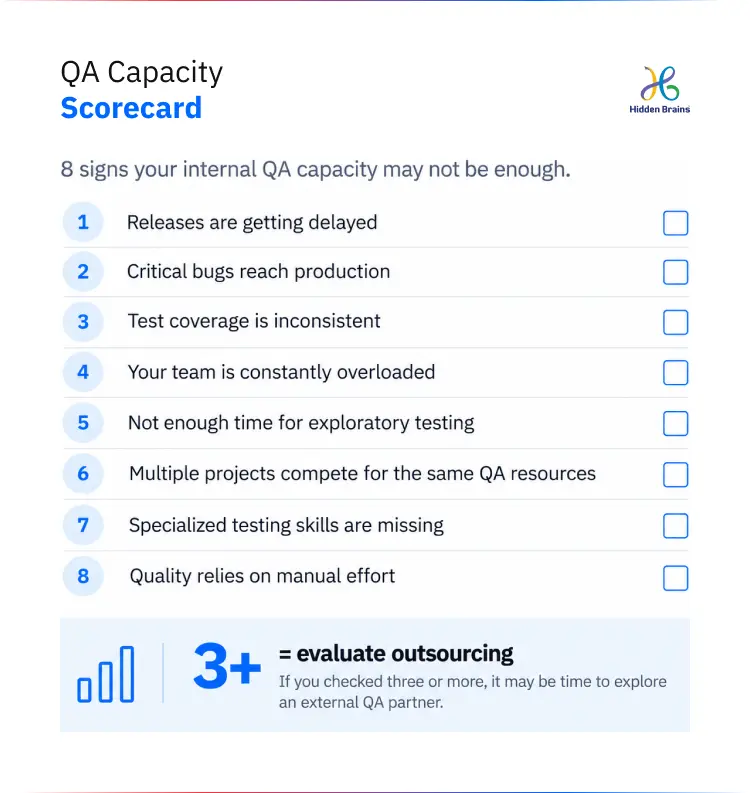
1. Releases keep bottlenecking at the QA stage
When every release stalls waiting on testing, QA has become your delivery constraint. If your developers finish on time but ship late because testing can’t keep pace, especially in short agile development cycles, you either need more QA throughput or a partner who can absorb the peaks.
2. Defects are escaping to production
If users routinely find bugs before your team does, your test coverage has gaps you can’t see. Escaped defects are the most expensive kind: the later a defect is caught, the more it costs to fix, and a production incident carries support, reputation, and rollback costs a pre-release catch never would. Rising production defect rates are a direct signal that current coverage isn’t enough.
3. You need test automation at scale but lack the frameworks, talent, or maintenance bandwidth
Automation pays off only if someone can build the frameworks and maintain them as the product changes, and that’s where most in-house efforts stall. Writing a few scripts is easy; sustaining a reliable, low-flake suite across a growing application is a specialist discipline. If your team wants automation at scale but has no one to own it, a partner with established test automation in DevOps and Agile practices closes the gap faster than hiring from scratch.
4. Frequent releases now demand continuous regression, performance, and security testing you can’t sustain
If you release weekly (or daily) but can only run full regression, load, and security checks occasionally, your testing cadence no longer matches your release cadence. Continuous delivery depends on continuous testing wired directly into the pipeline through DevOps automation tools, and sustaining regression, performance testing, and security coverage on every build is often more than an in-house team can staff, which makes it a natural candidate to outsource.
5. You serve multiple platforms, devices, and regions and can’t economically maintain every environment
If your product runs across browsers, OS versions, physical devices, and regional configurations, maintaining all of that test infrastructure in-house gets expensive fast. Device labs, cloud device grids, and cross-platform environments are costly to build and keep current. A testing partner amortizes that infrastructure across clients, so you get broad platform and device coverage without owning the hardware.
6. QA cost is rising, but coverage and release stability aren’t
When your QA spend keeps climbing while defects and instability don’t fall, you’re paying more for the same risk. Poor software quality is not a minor line item: CISQ estimated the cost of poor software quality in the US alone at roughly $2.41 trillion in 2022, with unaddressed technical debt accounting for about $1.52 trillion of it. If your internal QA costs are growing without a matching drop in escaped defects, restructuring how testing is delivered, including outsourcing parts of it, is worth modeling.
7. You’re shipping AI-powered features with no one equipped to test them
Testing AI-driven functionality requires methods most traditional QA teams haven’t built yet. Non-deterministic outputs, model drift, bias, and prompt-based behavior can’t be validated with fixed pass/fail scripts alone. If you’re adding AI features but your QA team has no approach for evaluating them, that’s a clear expertise gap, and one specialist partners are actively building capability around.
8. Senior engineers are stuck on repetitive QA and firefighting
When your best developers spend their time on manual regression and production firefighting, you’re paying senior salaries for work a dedicated QA function should own. Every hour a senior engineer spends re-running the same checks is an hour not spent on core product. Freeing them by moving repetitive and maintenance-heavy testing to a partner is often the single clearest ROI case for outsourcing.
Stop letting QA bottleneck releases.
Talk to Our QA Experts
Which Tests You Can Outsource
You don’t have to outsource all testing to benefit; most teams start by handing off the repetitive, infrastructure-heavy, or specialist work and keeping domain-critical testing in-house. Here are the tests that outsource cleanly:
- Functional testing — verifying features work to specification. → outsourced software testing services
- Regression testing — confirming new changes don’t break existing functionality (high-volume, repetitive, ideal to offload).
- Performance testing — responsiveness, stability, and scalability under load.
- Security testing — surfacing vulnerabilities before attackers do; see common security testing challenges.
- Test automation — building and maintaining automated suites and CI/CD integration.
- Exploratory testing — skilled testers finding defects beyond scripted cases.
- Localization testing — ensuring correct behavior across languages, regions, and cultural settings.
- UAT / beta support — validating the product against real business and end-user expectations.
In-house vs Outsourced QA — the honest cost picture
Outsourcing converts fixed QA cost (salaries, tooling, device labs) into variable cost you can scale per release — but in-house retains deeper product context. Neither is universally cheaper; the right answer depends on how variable your testing demand is and how specialized the skills you need are.
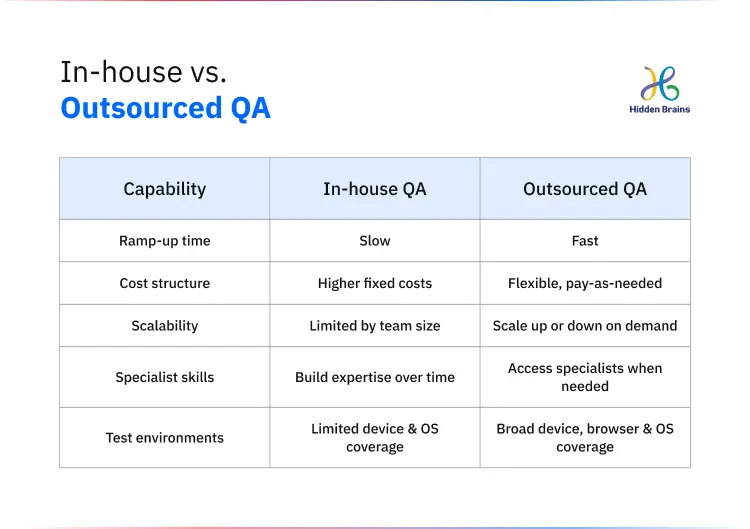
The cost that’s easiest to miss is the cost of inadequate testing, escaped defects, rework, and technical debt. When you model in-house vs outsourced, weigh that risk cost alongside the visible salary cost, not just headcount rates.

Scale QA without the overhead.
Get a QA AssessmentCommon Software Testing Engagement Models
Once you’ve decided to outsource, the engagement model determines how much control you keep. There are four common structures:
| Model | What it is | You keep control of | Best for |
|---|---|---|---|
| Project-based testing | Fixed scope for a specific release or migration | Everything after delivery | One-off releases, migrations, audits |
| Dedicated QA team | A long-term embedded squad that scales with your roadmap | Strategy and priorities | Ongoing product development |
| Managed testing services | End-to-end QA ownership with SLAs, reporting, and continuous improvement | Outcomes, not day-to-day execution | Mature teams offloading QA fully |
| Hybrid | In-house owns strategy and critical paths; the vendor handles regression, automation, performance, and device coverage | Critical paths and release decisions | Teams wanting leverage without losing control |
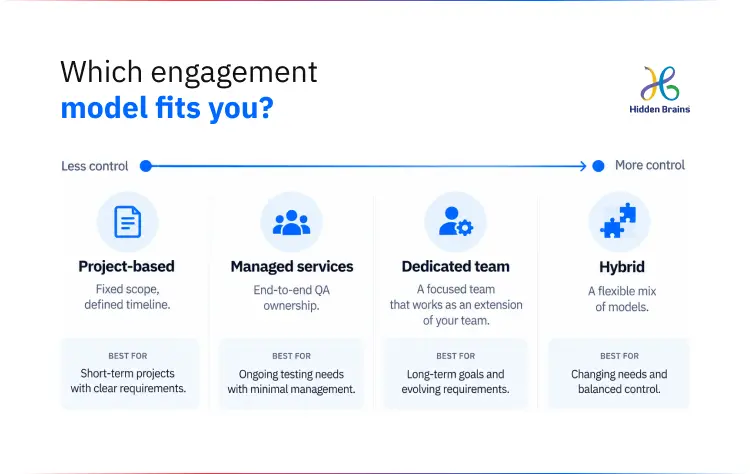
Most teams that are new to outsourcing start with hybrid or project-based and move toward a dedicated team or managed services as trust builds.
What to Check Before You Outsource QA
Before signing with any partner, verify five things; this is where an outsourcing decision succeeds or fails:
- Data security and confidentiality. Confirm ISO 27001 certification, clear NDAs, and how they isolate your code and data.
- Compliance alignment. If you operate under GDPR or regional data-protection regimes, confirm the partner can test within those constraints, including data handling and residency.
- Time-zone and communication overlap. Agree on working-hour overlap, reporting cadence, and escalation paths up front.
- SLAs and reporting. Define measurable service levels — turnaround, coverage, defect-detection expectations — and the reporting you’ll receive.
- Tooling and integration. Ensure they work in your stack: your CI/CD pipeline, test-management, and defect-tracking tools.
How to Choose a Software Testing Services Company
Choose a partner on proven QA process maturity, relevant domain and platform experience, and transparent reporting, not on rate alone. The cheapest team that can’t sustain automation or misses release-critical defects costs more than a mature partner.
Look for demonstrable process maturity (for example, CMMI-aligned delivery), a track record in your platform and domain, real automation and performance capability, and clear SLAs. Hidden Brains delivers this through structured quality assurance and software testing support and, for teams building a broader delivery relationship, an established software development outsourcing model with global delivery and mature engineering processes.
Frequently Asked Questions
When should a business outsource software testing?
Outsource when in-house QA starts costing you revenue through delayed releases, defects reaching customers, or senior engineers tied up in testing instead of building product. The trigger is business impact, not team size: if slow or incomplete testing is holding back launches or eroding customer trust, a specialist partner usually closes that gap faster and cheaper than hiring.
Does outsourcing software testing actually save money?
It can, because it turns a fixed cost — full-time QA salaries, tooling, and device infrastructure — into a variable cost you scale up or down with each release. The larger saving is often indirect: catching defects before they reach production avoids support, rework, and reputation costs that dwarf testing spend. It pays off most when your testing demand fluctuates or needs specialist skills you’d otherwise hire full-time.
What’s the ROI of outsourced QA versus building an in-house team?
Outsourced QA typically delivers faster time-to-value: pre-built teams start in days instead of the weeks or months hiring takes, and you avoid the fixed overhead of salaries, benefits, and test infrastructure. In-house wins on deep product context for business-critical paths. Most businesses get the best return from a hybrid model, keeping critical testing in-house while outsourcing the repetitive, specialist, and infrastructure-heavy work.
What are the business risks of outsourcing testing, and how are they managed?
The main risks are data security, losing control of quality, and communication gaps across teams or time zones. They’re managed with ISO 27001-certified partners and NDAs, a hybrid model that keeps critical-path testing under your control, and contractual SLAs with defined reporting and escalation. Handled properly, outsourcing reduces delivery risk rather than adding to it.
Will outsourcing testing slow down or speed up our releases?
It speeds them up when done right, because a dedicated partner absorbs the QA workload that bottlenecks your pipeline and can run continuous regression, performance, and security testing your in-house team can’t sustain on every build. The key is integration, a partner who works inside your CI/CD pipeline and toolchain accelerates delivery instead of adding handoffs.
How do we choose the right software testing services company?
Choose on proven process maturity, relevant industry and platform experience, and transparent reporting, not the lowest hourly rate. Look for CMMI-aligned delivery, real automation and performance capability, security certifications, and clear SLAs. The cheapest vendor that misses release-critical defects or can’t sustain automation costs far more than a mature partner over time.


Conclusion
Software quality assurance testing services give you specialist QA capacity, functional, regression, performance, security, automation, and AI-feature testing, without the cost and lead time of building that team in-house. If any of the eight signs above sound like your team, that’s exactly the gap these services close: releases that stall at QA, defects reaching production, or automation and performance demands your current team can’t sustain on every build.
Hidden Brains delivers that capacity through mature, process-driven software quality assurance testing services, backed by 23+ years in engineering, 6,000+ projects delivered, and CMMI-aligned, ISO-certified delivery. Whether you need to hire QA developers to embed alongside your team, hand off end-to-end testing under clear SLAs, or run a hybrid model that keeps critical paths in-house, we scale to fit your roadmap and release cadence, so QA becomes a source of release speed instead of a bottleneck.
Not sure which model fits?
Start with a conversation. Our free 2-hour consultation puts you in front of quality engineering specialists who’ll review your current testing setup, pinpoint the gaps costing you the most, and map the right in-house, outsourced, or hybrid approach — with no obligation.