







































































































































Summary
- Assess whether your enterprise data is truly ready for AI before investing in models.
- Check 7 key areas: business goals, data quality, access, governance, infrastructure, security, and skills.
- Understand why reporting-ready data isn’t necessarily AI-ready data.
- Identify gaps in data ownership, integration, adoption, and governance.
- Score your readiness, then focus on the weakest dimension first.
- Build the data foundation before scaling AI.
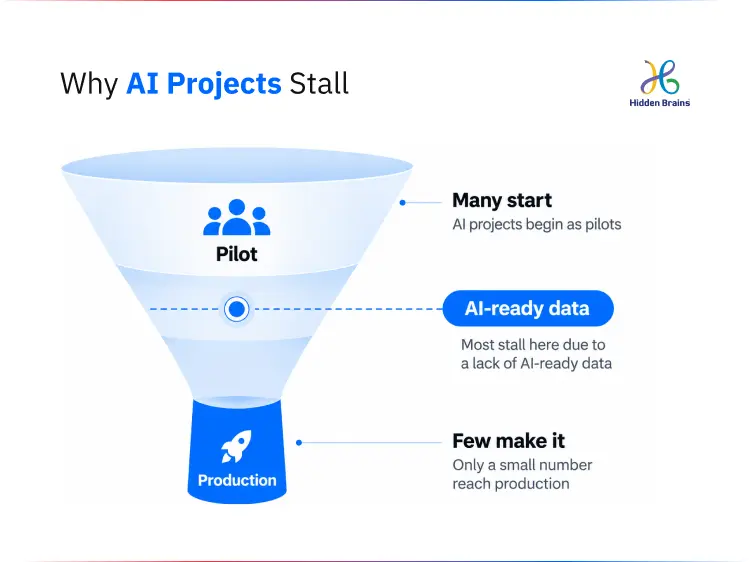
Most AI projects don’t fail because the model was wrong. They fail because the underlying data was never ready, and Gartner predicts organizations will abandon 60% of AI projects that aren’t supported by AI-ready data. If you are weighing an AI investment, the highest-value question isn’t “which model?” It’s “is our data ready?” This checklist helps you answer that honestly before you commit the budget.
We’ve watched the same pattern repeat across implementations: a promising pilot works in a controlled demo, then stalls the moment it meets real production data. The technology rarely breaks. The data foundation does.
| Details | Information |
|---|---|
| Guide Focus | A practical checklist to assess whether your data, systems, governance, and teams are ready for AI. |
| Business Challenge | AI projects often stall because data is fragmented, inaccessible, poorly governed, or not production-ready. |
| Target Audience | CIOs, CTOs, data leaders, AI teams, and digital transformation leaders. |
| TL;DR | Assess 7 readiness areas, find the weakest one, and fix the foundation before scaling AI. |
| Expected Outcome | A clearer view of whether your organization is ready to move from AI pilots to production. |
What “AI Readiness” Actually Means — and Why Data is Where it Breaks
AI readiness is how prepared your organization’s strategy, data, infrastructure, people, and governance are to build and scale AI that produces measurable value, not just a working demo. It’s a multi-dimensional assessment, but the dimensions are not equal in how often they cause failure.
Data is the recurring root cause. Gartner’s Q3 2024 survey of data management leaders found that 63% of organizations either do not have, or are unsure whether they have, the right data management practices for AI. That uncertainty is the problem the checklists below are designed to remove. A company can have modern cloud infrastructure, funded pilots, and executive sponsorship, and still fail on data quality, ownership, or governance.
AI-ready Data vs. The Data You Already Have
AI-ready data is a stricter standard than the “reporting-ready” data most enterprises already have. The difference is not cosmetic; it’s the gap that quietly kills projects.
The Traits of AI-ready Data
Gartner defines AI-ready data as data that is aligned to a specific use case, actively governed at the asset level, supported by automated pipelines with quality gates, managed through live metadata, and continuously quality-assured. The operative word is continuously. Traditional data management runs on reporting cadences, quarterly audits, monthly pipeline checks. A model in production needs data quality signals measured in hours, not months.
Why “Fine for Reporting” Isn’t “Ready for AI”
If your data was built to fill a monthly dashboard, it was built for a different job.
Here is the practical contrast:
| Dimension | Reporting-ready data | AI-ready data |
|---|---|---|
| Purpose | Answer known questions after the fact | Feed a model making live decisions |
| Quality cadence | Checked periodically (monthly/quarterly) | Checked continuously, at consumption speed |
| Governance | Owned loosely by IT/BI | Owned at asset level, with clear accountability |
| Structure | Aggregated, cleaned for humans | Granular, labelled, machine-consumable |
| Metadata & lineage | Often incomplete | Active, tracked, auditable |
Build AI on a Foundation of Data, Governance & Compliance.
Talk to Us.
The Universal AI Readiness Checklist
Use this as your baseline. Score each of the seven points from 0 (absent) to 4 (scalable). It is deliberately data-weighted, because that’s where the evidence points, but treat it as a scaffold, not a verdict. The next section shows how to adapt it to your reality.
| # | Readiness dimension | What “ready” looks like |
|---|---|---|
| 1 | Business outcome alignment | One measurable target defined (e.g., reduce handling time, improve forecast accuracy) before any model is chosen |
| 2 | Data quality & completeness | Data is accurate, current, sufficiently complete, and relevant to the use case |
| 3 | Data access & integration | Critical data is reachable via APIs, not locked in disconnected legacy systems |
| 4 | Data governance & ownership | Clear owners, definitions, permissions, and accountability at the asset level |
| 5 | Infrastructure & pipelines | Automated pipelines with quality gates; the environment can support the model in production |
| 6 | Security, compliance & permissions | Sensitive data flagged, access-controlled, and compliant before it reaches a model |
| 7 | Skills & build-vs-buy | Honest view of in-house ML/MLOps capacity vs. partner-led delivery |
Two of these dimensions, access/integration and governance, are where most mid-market organizations lose the most points. Fragmented systems mean the data exists but can’t be assembled; integrating fragmented data sources is often the unglamorous first project that makes everything after it possible.
A pre-owned car retailer we worked with in Dubai is a clear example. Before any intelligent features were possible, its inventory lived across 17+ spreadsheets with duplicate and mismatched listings, test drives were booked over WhatsApp with no tracking, and sales staff had no unified view of customer history. We consolidated that into a single centralized platform on a scalable cloud architecture, deliberately built to integrate AI later, and manual processing time dropped by around 50%.
Beyond the Checklist: What a Readiness Score Won’t Tell You
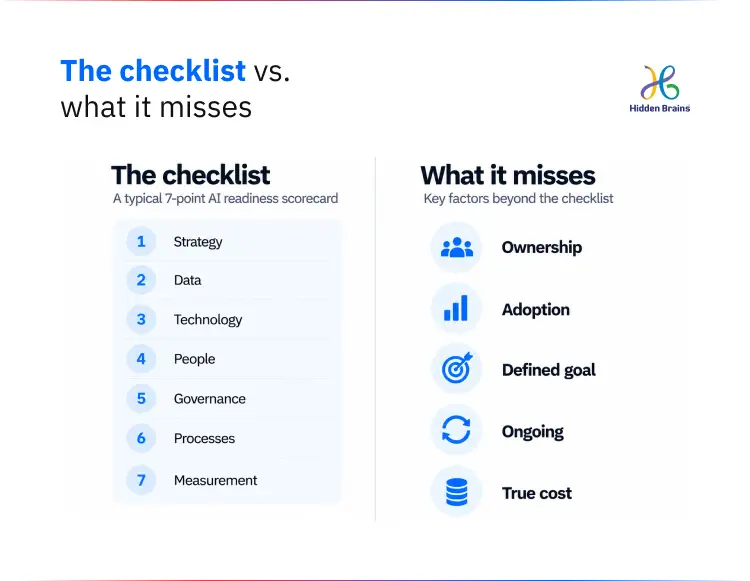
The checklist tells you what you have. It won’t tell you whether “good” is good enough for your context, or whether the factors that actually decide AI outcomes, ownership, adoption, and a clear goal, are in place. Score the seven points first. Then pressure-test the result against the two things below: how relative your score is, and what no checklist captures.
Your Score is Relative, Not Absolute
A strong score for a retailer chasing personalization is a failing score for a bank under audit. The same seven dimensions carry different weights depending on four things.
By industry and regulation. Sector constraints reshape which dimensions dominate:
| Sector | Where the checklist tightens |
|---|---|
| Regulated (banking, insurance, healthcare, energy) | Compliance mapping, audit trails, model explainability, data residency, formal AI governance |
| Manufacturing & industrial | OT/IT integration, sensor and production-data quality, safety-critical governance, workforce capability |
| Professional services (law, consulting, accounting) | Knowledge accessibility, IP and confidentiality controls, partner alignment |
| Retail, ecommerce, media | Customer-data unification, personalization use cases, speed-to-value over heavy governance |
By company size and resources.
Mid-market organizations should simplify, one owner, one use case, one clean workflow, not stand up enterprise governance committees they can’t staff. Enterprises need the reverse: formal governance and multi-system integration.
By AI maturity stage.
Your next step depends on where you already are: not using AI (find one repetitive workflow and test it), light user (turn prompts into shared templates), or moderate/advanced (connect AI to core systems and add monitoring).
By data and technology reality.
Two companies in one industry can have completely different data landscapes. Is critical data legacy-locked or API-accessible? Structured documents, or unstructured logs? Cloud, hybrid, or on-prem? In-house MLOps or partner-led? A company on twenty-year-old on-prem systems usually needs modern data infrastructure before it needs a model.

Know if Your Data is Ready for AI
Assess AI ReadinessWhat No Checklist Captures
These decide outcomes and rarely fit a 0–4 score. Check them honestly.
Who actually owns the data?
A readiness gap is usually an accountability gap in disguise. When no one owns data quality and governance, when it’s treated as an IT ticket rather than a leadership decision, the score looks fine on paper, and the project still fails. Ownership needs a name, not a department.
Will anyone actually use it?
Capability is not adoption. A technically sound AI tool that people route around, or that has no feedback loop to improve after launch, delivers zero value regardless of its readiness score. Change readiness, training, incentives, and workflow fit are the dimensions checklists most often skip.
Is there a defined outcome before the build?
“We want to use AI” is not a goal. Projects that start without one measurable target- reduce handling time, improve forecast accuracy, cut a specific cost- are the ones that can’t prove value at budget review. Define the outcome, then the workflow, then the model. In that order.
Is readiness treated as ongoing, not a one-time audit?
A model’s data needs are continuous; a one-off assessment goes stale the moment production data drifts. Readiness is a practice you maintain, not a certificate you earn once.
Have you been honest about cost and value?
Gartner attributes AI project abandonment not only to poor data quality but to escalating costs and unclear business value. A checklist that ignores the running cost of pipelines, monitoring, and model upkeep flatters the decision. Price the whole lifecycle, not just the build.
How to Score Your Readiness — and What Your Score Means
Add your seven scores and divide by 28 to get a readiness percentage. Treat the bands below as a planning tool for internal discussion, not an industry benchmark:
- Below 40% — Foundational gaps. Fix data access and governance before funding an AI build.
- 40–70% — Selectively ready. Launch a controlled pilot with production intent on your strongest use case; remediate weak dimensions in parallel.
- Above 70% — Ready to scale. Focus on MLOps, monitoring, and moving pilots into production.
The most useful output isn’t the total; it’s the lowest dimension. If data quality is strong but governance is a 1, governance is your binding constraint, and no amount of model tuning will fix it.
From Assessment to Action: Closing the Data Gap Before You Scale
Once you know your weakest dimension, the work becomes concrete. In most cases, the first project isn’t AI at all — it’s the foundation that makes AI possible, and that’s where data engineering services come in: consolidating sources, establishing ownership, and setting up pipelines that keep data trustworthy at the cadence a model consumes it.
That sequencing- data foundation first, model second- is what separates the AI projects that reach production from the majority that don’t. If you want a structured assessment, our free 2-hour consultation can show where your organization stands and what to fix first. Our AI strategy and readiness consulting team runs this diagnostic against your actual environment, not a generic template.
Frequently Asked Questions
Is AI readiness worth the spend, or should we just start building?
Readiness is what protects the AI, not what delays it. Gartner predicts that through 2026, organizations will abandon 60% of AI projects unsupported by AI-ready data, so skipping the assessment is what wastes budget, not spending a few weeks on it. A short readiness check is cheap insurance against a six-figure pilot that stalls before it reaches production.
Do we need to fix all our data before we start AI?
No. You need one high-value dataset ready for one clear use case, not perfect data everywhere. Trying to clean every system first is how readiness efforts stall for a year. Pick the use case with the clearest business payoff, make that data AI-ready, prove value, then expand.
How long does it take to get our data AI-ready?
It depends on your starting point, not a fixed timeline. A company with clean, API-accessible data may need weeks; one whose data sits in disconnected legacy systems or spreadsheets needs a foundation project first. The honest first step is an assessment that tells you which of the two you are, before you commit to a date or a budget.
Who should own AI readiness — IT or the business?
Both, but accountability sits with leadership, not the IT ticket queue. Most readiness gaps are ownership gaps in disguise: no one has been made responsible for whether data is trustworthy enough to build on. Naming a business owner for each critical dataset is often the single highest-leverage move a leader can make.
What’s the real risk of moving ahead without readiness?
The risk is a pilot that demos well, fails in production, and can’t be defended at the next budget review. When data is scattered or ungoverned, the model produces outputs no one can act on, and the project quietly gets shelved. The cost isn’t just the wasted build; it’s the lost year and the internal skepticism that makes the next AI proposal harder to fund.
Should we build data readiness in-house or bring in a partner?
Build in-house if you have MLOps and data-engineering capacity to spare; bring in a partner when speed matters or those skills are thin. The deciding question is honesty about your own bench: readiness work competes with everything else your engineering team already owns. A partner is worth it when the alternative is your readiness project sitting behind six other priorities.
How do we know if a vendor’s AI pilot will actually scale?
Ask what data foundation the pilot depends on, and whether that foundation exists in production, not just in the demo. A pilot built on hand-cleaned sample data tells you nothing about whether it survives real, live data. The pilots that scale are the ones designed against your actual data reality from day one.
We’re behind competitors on AI — is it too late to start?
No, most organizations are earlier than the headlines suggest. McKinsey’s 2025 research found that while the large majority of companies use AI in at least one function, nearly two-thirds have not scaled it enterprise-wide. The gap between leaders and laggards is rarely who started first; it’s who built the data foundation to move pilots into production. Getting readiness right now is how you close that gap rather than widen it.
What’s the first practical step for a leader who wants to move?
Score your data against the seven readiness dimensions and act on the lowest one first. Define one measurable business outcome, identify the data that use case needs, and check whether that data is accessible, owned, and trustworthy. If it isn’t, the first project is the data foundation, not the model.



Conclusion
AI readiness is a leadership call about sequencing, data foundation first, model second, not a score to file away. The organizations that get value from AI aren’t the ones with the best models; they’re the ones that were honest about their data before they built it.
The good news for any leader: most AI projects fail on the data underneath, not the technology on top, and data is fixable, controllable, and largely in your hands. Score your seven dimensions, fix the lowest one, and you’re already ahead of the majority that jump straight to the build. If that points to gaps worth closing before you commit an AI budget, that’s the work to do first, and you don’t have to do it alone. Talk to our experts; they will help to find the right path for you.