


































































































Summary
- Learn how large UAE dealership groups digitize multi-branch operations efficiently.
- Understand the core modules of modern automotive dealership software.
- Discover common operational gaps affecting dealership scalability and control.
- Explore the step-by-step implementation of a dealership management system in the UAE.
- See how centralized systems improve visibility, reporting, and performance.
UAE dealership groups are expanding across branches, but operational complexity is growing just as quickly. Disconnected systems across sales, inventory, service, and finance create data gaps, reporting delays, and limited visibility, making it harder to manage performance at scale.
In a market where speed, accuracy, and control directly influence profitability, this fragmentation can become a significant operational bottleneck. A modern dealership management system in the UAE brings these functions together on a single platform, enabling real-time visibility across branches, vehicles, customers, and transactions.
The objective goes beyond digitization. It is about building a structured, scalable operating model that gives dealership groups greater control as they grow.
Here’s how to create a dealership management system that works, and how we built one specifically for the UAE market.
What a Dealership Management System Actually Solves for Enterprise Groups
If you’re managing multiple dealership branches, you already know the challenge: everything is connected in business, but disconnected in systems. A dealership management system helps you solve:
- Lack of visibility across your branches
- Delayed updates from individual locations
- Duplicate or conflicting vehicle and customer data
- Poor coordination between sales, service, and finance
- Limited control from headquarters
Instead of chasing updates, you operate from a single source of truth. Every decision you take becomes faster, clearer, and more accurate.
Struggling With Disconnected Dealership Operations?
Contact Us
Essential Steps to Digitize Multi-branch Automotive Dealerships
If you’re planning to digitize your dealership network, you cannot approach it like a standard software implementation. Multi-branch dealership operations involve interconnected sales, inventory, service, finance, and customer workflows that require a well-structured digital ecosystem.
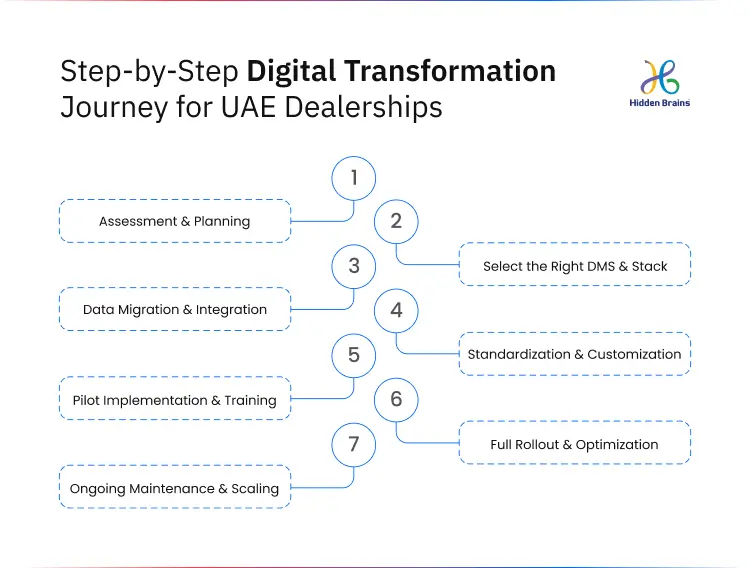
This is where strategic enterprise software development services becomes critical, helping you build scalable systems that unify operations, improve visibility, and support long-term dealership growth. Here’s how you should approach the transformation in a practical, phased way.
Assessment & Planning (1–4 Weeks)
You start by mapping your entire dealership ecosystem across all branches. It includes sales, inventory, service, parts, accounting, CRM, and inter-branch vehicle transfers.
At this stage, you should clearly identify:
- Stock mismatches between branches
- Delayed or inconsistent reporting
- Revenue leakage points
- Lack of standardized processes
- Poor visibility of customer data
You then define what you actually want to achieve with a dealership management system in the UAE, such as:
- Real-time inventory visibility
- Consolidated financial reporting
- Faster sales cycles
- Scalability for new branches
- Better compliance control
You should also involve key stakeholders from management, sales, service, and finance teams to understand data quality and workflow gaps.
Finally, you choose your deployment approach; cloud-based DMS is typically preferred for multi-branch operations due to scalability and real-time access. For UAE enterprises, ensure the system supports multi-entity, multi-brand, and multi-location structures.
UAE-specific consideration: VAT compliance, RTA integration, warranty handling, and bilingual (Arabic/English) support are critical from day one.
Select the Right DMS & Technology Stack (2–6 Weeks)
This is where you evaluate whether the best dealership management system truly aligns with your operational complexity, scalability goals, and multi-branch workflows. At this stage, choosing the right technology partner becomes equally important. You should work with a trusted software development company in Dubai that understands enterprise automotive operations and has proven experience in building scalable dealership platforms using modern, integration-ready technologies.
Look for core capabilities like:
- Centralized dashboard with branch-level controls
- Real-time inventory synchronization
- Integrated sales, service, parts, CRM, and finance modules
- Multi-branch KPI reporting (profitability, efficiency, sales performance)
- Mobile access with role-based permissions
- Automation and AI-driven operational insights
- Integration support for third-party systems
You should also prioritize vendors with GCC/UAE experience, especially those familiar with:
- Floor plan financing workflows
- Import/export vehicle operations
- Regional compliance requirements
Pro tip: Always test the system using your real multi-branch scenarios, not generic demos. Also, validate reference from similar automotive car retailers platforms in the UAE before you decide.
Data Migration & System Integration (4–8 Weeks)
This phase determines how smooth your transition will be.
You begin by cleaning and standardizing all existing data, including:
- Customer records
- Vehicle inventory history
- Service records
- Financial data
Instead of migrating everything at once, you should move in phases: starting with one branch or one module (like inventory or sales).
Next, you integrate your automotive dealership software with existing systems such as:
- Websites and digital retail platforms
- Accounting and ERP systems
- Manufacturer/OEM portals
- RTA or regulatory systems
You also establish inter-branch workflows for stock transfers, centralized purchasing, and consolidated reporting.
Process Standardization & Customization
Before full rollout, you need to standardize how your dealership operates across branches.
You define:
- Common sales and service workflows
- Unified pricing policies
- Standard CRM and follow-up processes
At the same time, you allow controlled flexibility at the branch level where needed.
Your car dealership management system should also be configured for UAE-specific requirements, like:
- VAT-compliant invoicing
- Multi-currency handling (if applicable)
- Branch-wise financial reporting with group consolidation
You also customize dashboards so that:
- HQ gets strategic-level visibility
- Branch managers get operational control
Pilot Implementation & Training (4–6 Weeks)
Instead of a full-scale rollout, you first deploy the system in one or two branches.
During this phase, you:
- Identify real-world workflow gaps
- Train teams with role-based, hands-on sessions
- Appoint internal champions in each department
- Run old and new systems in parallel for stability
It helps you build confidence across teams before full adoption of the dealership management system in the UAE.
Full Rollout & Optimization
Once the pilot is stable, you scale the system across all branches with a structured rollout plan.
At this stage, you actively track:
- Inventory accuracy across branches
- Sales cycle time reduction
- Customer retention rates
- Workshop efficiency
- Revenue leakage reduction
You also use analytics to:
- Compare branch performance
- Improve forecasting accuracy
- Optimize inventory distribution
This is where your automotive dealership software starts delivering measurable business impact, not just operational digitization.
Ongoing Maintenance & Scaling
Digitization is not a one-time project, it’s an evolving system.
You should continuously:
- Update and audit system performance
- Scale cloud infrastructure as new branches are added
- Improve automation and reporting capabilities
- Introduce advanced features like predictive analytics and AI-based insights
- Expand into omnichannel customer journeys and EV workflows
Ultimately, you measure success through:
- Higher operational efficiency
- Reduced manual errors
- Improved profitability across branches
- Faster decision-making at the leadership level
It ensures your dealership management system in the UAE continues to evolve with your business, not lag behind it.
How a Dealership Management System Digitizes Your Operations
A car dealership management system helps you move from fragmented operations to a fully connected digital ecosystem. Here’s what changes for you:
- All branches operate on one centralized platform
- Inventory updates reflect instantly across locations
- Leads are automatically assigned based on logic and availability
- Customer journeys are tracked end-to-end
- Financial data is consolidated in real time
- Manual reporting is replaced with live dashboards
Instead of coordinating operations manually, you control everything from one system.
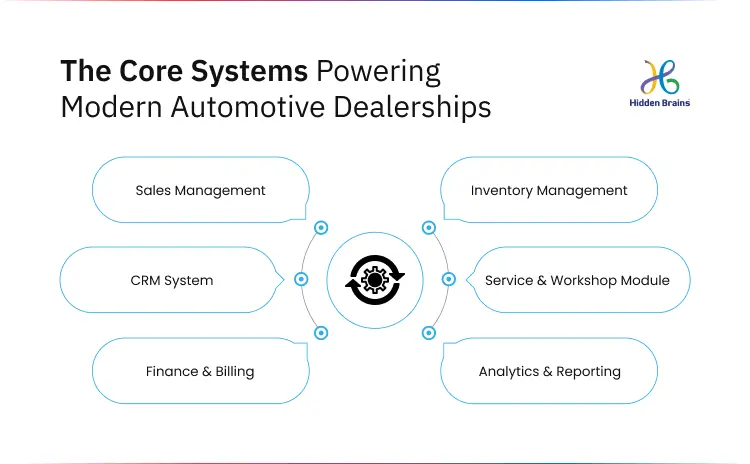
Core Modules of Automotive Dealership Software
A modern automotive dealership software is not a single tool, you should see it as a connected ecosystem of modules that control your entire operation.
Sales Management
Your sales module tracks every lead from inquiry to closure across all branches. With a car dealership management system, you ensure no lead is lost, duplicated, or ignored. You also get a clear view of which branch is performing and where deals are stalling.
Inventory Management
You gain real-time visibility of every vehicle across all locations. A dealership management system in the UAE ensures that whenever a vehicle is sold, moved, or reserved, the update reflects instantly across the logistics software system. You stop dealing with stock confusion and start planning inventory with accuracy.
CRM System
Your CRM becomes the backbone of customer relationships. Every interaction: sales inquiry, service request, or follow-up is stored in one unified profile. Custom CRM implementation helps you maintain consistent communication across branches and build long-term customer retention instead of fragmented engagement.
Service & Workshop Module
You manage the full after-sales journey in one place. From service booking to job completion, everything is tracked digitally. It helps you reduce delays, improve workshop efficiency, and ensure your service centers are aligned with real-time demand.
Finance & Billing
Your financial operations become transparent and automated. Invoicing, payment tracking, and reconciliation are handled in one system. Instead of waiting for manual reports from branches, you get instant visibility into revenue and cash flow across your entire dealership group.
Analytics & Reporting
You stop guessing and start analyzing. This module gives you live dashboards for sales, inventory, service, and revenue performance. The best dealership management system helps you make faster, data-backed decisions instead of relying on delayed reports.

Losing Visibility Across Multiple Branches?
Talk to an Expert
Build the Finest Dealership Management System in the UAE with Hidden Brains
If you’re looking to implement a system built for enterprise dealership complexity, Hidden Brains focuses on exactly that. With over 23 years of experience in building custom enterprise solutions for global businesses, we help automotive dealership groups digitize and streamline multi-branch operations with scalable, future-ready platforms.
Our experienced team leverages state-of-the-art technologies and has successfully delivered more than 6000 projects worldwide. We also follow ISO-certified processes and build GDPR-compliant solutions, helping UAE enterprises maintain high standards of security, compliance, and operational reliability.
Here’s what you get:
- A custom-built dealership management system tailored to your operations in the UAE
- Scalable architecture designed for multi-branch growth
- Seamless integration with your existing enterprise tools
- Workflow customization based on your dealership hierarchy
- Real-time synchronization across all branches
- A focus on operational efficiency, not just digitization
The goal is simple: help you remove operational friction and give you complete visibility and control.
Frequently Asked Questions
What is a dealership management system in the UAE?
A dealership management system (DMS) is a centralized software platform that helps automotive dealerships manage core operations such as sales, inventory, CRM, service, finance, and reporting from one system. For UAE dealership groups operating across multiple branches, a DMS creates real-time visibility and operational consistency across all locations. It helps eliminate disconnected workflows, reduces manual coordination, and improves decision-making through centralized data and reporting.
How does a dealership management system help multi-branch dealership groups?
Managing multiple branches becomes difficult when every location operates on separate systems or manual processes. A dealership management system connects all branches into one unified platform, allowing you to monitor inventory, sales performance, customer interactions, service operations, and financials in real time. It improves coordination between teams, reduces operational delays, standardizes workflows, and gives leadership better control over the entire dealership network.
Is a dealership management system suitable for large enterprise dealerships?
Yes. Enterprise-grade dealership management systems are specifically designed for large automotive groups managing multiple brands, branches, and operational departments. These systems support high-volume operations, multi-location access control, consolidated reporting, and integration with existing enterprise tools. They are built to scale as dealership groups expand into new locations, add more brands, or increase operational complexity.
Can a dealership management system integrate with existing business systems?
Most modern automotive dealership software solutions are built with integration capabilities. A dealership management system can typically connect with ERP platforms, accounting software, CRM tools, manufacturer portals, payment gateways, and regulatory systems like RTA integrations in the UAE. It ensures that data flows seamlessly across your business instead of remaining isolated in different platforms, helping improve operational efficiency and reporting accuracy.
What is the difference between basic dealership software and a dealership management system?
Basic dealership software usually focuses on isolated functions like billing, inventory, or lead management. A dealership management system, on the other hand, connects your entire dealership ecosystem into one centralized platform. It allows sales, service, finance, CRM, and inventory teams to work within the same system, creating real-time operational visibility and better coordination across all dealership branches. For enterprise dealerships, this level of integration is critical for scalability and operational control.



Conclusion
Your dealership network is growing, but your systems may not be growing with it. That gap creates inefficiency, delays, and missed revenue opportunities.
A unified automotive dealership software closes that gap by connecting your entire operation, sales, inventory, service and finance into one system. If you want to scale across multiple branches without losing visibility or efficiency, this is the operational foundation you need.