Tangible business success showcasing
proven tech expertise
15+ Years of Consistent Delivery
Across 4 Projects
Hidden Brains has remained a trusted technology partner through four successful
projects, bringing strong healthcare domain knowledge, compliance expertise,
reliability, and long-term support.
15+ Years of Consistent Delivery
Across 4 Projects
Hidden Brains has remained a trusted technology partner through four
successful projects, bringing strong healthcare domain knowledge, compliance
expertise, reliability, and long-term support.
Revolutionize healthcare with tailored, advanced
solutions.
Client Testimonials
Case Studies
Portfolio
Quick Technologies Services
Tangible business success showcasing proven
tech expertise
15+ Years of Consistent Delivery Across 4
Projects
Hidden Brains has remained a trusted technology partner through four successful
projects, bringing strong healthcare domain knowledge, compliance expertise,
reliability, and long-term support.
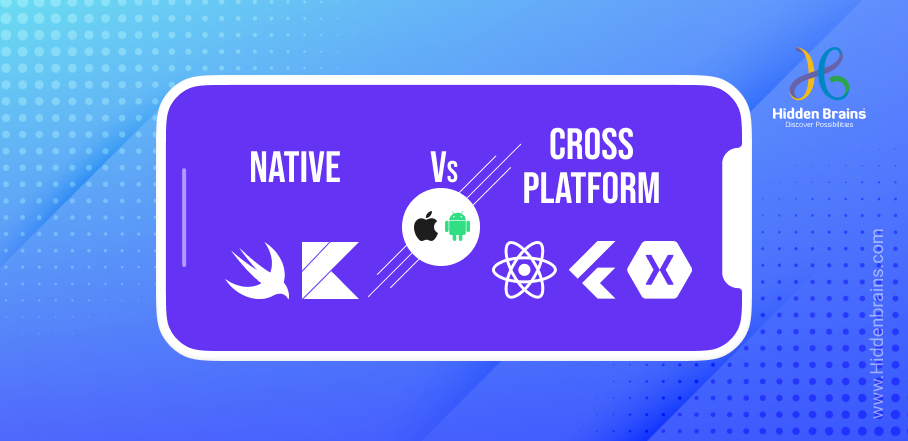
Native vs. Cross-Platform App Development: Pros and Cons Breakdown
Posted on
16 Mar 2023 9 min read
Albert Smith
Albert Smith
Marketing Manager at Hidden Brains
With 18+ years of experience in quality testing, Albert Smith understands that quality is an ongoing journey, not just a final goal. He collaborates closely with product teams to ensure... Read Full Bio
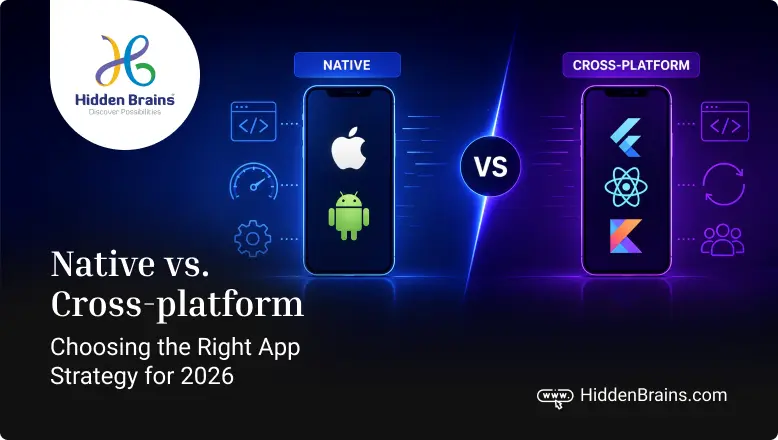
This blog compares native and cross-platform mobile app development approaches. Native development builds apps specifically for Android or iOS, offering high performance, better UX, and full access to device features, though at a higher cost and time. Cross-platform development uses a single codebase for multiple platforms, reducing development time and expense, but may compromise on speed and native functionality. Enterprises must choose based on performance needs, budget, timeline, and audience reach.
Apps are here to stay!
This statement is an undeniable fact with a powerful message behind it. We are in the age of mobility, and with time, our dependence on apps has been growing steadily. Native vs. Cross-Platform is a critical decision that developers need to make when creating mobile applications.
The modern mobile app market is an incredibly lucrative space to enter! By launching a mobile app, you can open up new revenue streams for your business, creating a new customer base and appealing to existing customers in a way that was not possible before.
As per Statista Statistics show that more than 3.55 million apps are available on the Google Play Store and 1.6 million on Apple’s App Store.
Voila! That sounds interesting!
Well, looking at the burgeoning number of apps in the respective stores, it can be stated that apps are a great investment for your business.
Advanced Frameworks to Craft Apps
Indeed, with the advent of new technologies, there are different ways to develop mobile apps- cross, native, and hybrid apps.
With such a variety of ways to develop apps, it can be a daunting task to decide which app development method to choose.
It has been observed that business leaders and developers often fall into the debate while selecting the best mobile app development framework to develop an app.
You can make the best decision once you are aware of the ins and outs of the two most promising frameworks – Cross-Platform and Native.
Native or Cross- the Battle Begins
Well, to be precise, first we should understand that, with the unprecedented increase in the number of apps available in app stores, businesses are faced with the dilemma of Native vs Cross-platform.
With better insight into the pros and cons of both, you can make an informed decision that benefits your business.
In this article, we’ll explore differences between Native vs Cross platformsand weigh the pros and cons of each.
Native App Development- a Quick Walkthrough
Indeed, native app development is a much-needed solution for businesses, as it brings out an exclusive user experience.
There are not just one but multiple advantages that are associated with native, as it allows building stable app products, having the potential to transform engagement rates for users.
Leveraging Native, developers can build apps that can be used on a particular platform or device. In other words, it has the ability to use device-specific hardware and software.
Pros of Native App Development
Vast Functionality
Enables developers to access all the APIs and tools offered by the platform
Offers better control over the development process to build a faster and more efficient product
Developers can understand the platform and use its native features and capabilities
Creates a more stable product with the potential for better performance and user experience
Store Support
Helps in easily publishing the app on stores
Usually rank higher on the platform’s app store because they deliver better performance, speed, and user experience.
These apps are more secure and reliable than cross-platform apps, as they can be custom-built for a specific platform.
Improved Scalability
In this war of cross-platform vs native; naive apps are more scalable than their cross-platform counterparts, as they are built to be compatible with the native environment.
Allows developers to relish flexibility in resource management and access to a wide range of tools.
Makes it easier to develop a wide range of features and functions, allowing for a more dynamic and user-friendly app.
Incredible UX
Native apps provide a more consistent and intuitive user experience that is tailored to the platform.
They are designed to take advantage of the platform’s native features and capabilities.
Cons of Native App Development
Expensive
Native apps can be costly, especially if you need to launch for both iOS and Android.
Each platform requires its own native development environment and tools.
Any changes or updates to the app must be done separately for each platform, which adds to the overall cost.
Time-Consuming
Can be time-consuming, as the development process must be tailored to the platform it is being developed for.
The app updates are done on each platform, leading to an increase in the development time significantly.
Cross-Platform App Development- a Quick Walkthrough
Cross-platform app development is the process to build an app that works on several platforms. This means that the app can be used on different types of devices, such as smartphones and tablets, as well as on different operating systems, such as Android and iOS.
Pros of Cross-Platform App Development
Pocket-Friendly
Offer a streamlined development process, as the same codebase can be used to create apps for multiple platforms.
Only one team of developers is needed to create the app, reducing the overall cost and complexity of the project.
Faster Development
An efficient way to create an app that runs on multiple platforms.
It saves time, as changes and updates only need to be made once and applied to all platforms
Fosters faster development and deployment.
Single Code Base
It enables developers to create one codebase that can be used across multiple platforms.
Cons of Cross-Platform App Development
Slower App
A cross-platform app is typically slower than a native app.
It requires an additional abstraction layer and rendering process which can slow down the overall performance of the app.
Limited Functionality
Developers usually face difficulty accessing certain smartphone functionalities like the microphone, camera, and geolocation in ways that are possible for a native app.
Restricts app’s functionality and builds obstacles in giving a truly native experience.
Many cross-platform frameworks are unable to access the full range of device-specific features, such as the accelerometer or NFC.
Not-So Strong UX
Cross-platform apps are unable to take advantage of native UX components such as animations, transitions, and gestures.
Hard to deliver the same immersive experience that is accustomed to the platform.
Comparison of Native vs Cross-Platform- Who Is the Winner?
Ahhh, this is a MILLION-DOLLAR question!
Well, to answer this, you should know that while deciding which development model is best for your mobile app, then it is important to consider the goals and expectations of the app.
For example, if an app requires complex device-specific features such as the accelerometer or NFC, it would be more beneficial to go with a native approach since these features are more easily accessible with a native app.
On the other hand, if the app only requires basic features, then a cross-platform approach may be the better option since it is typically more cost-effective and faster to develop.
Ultimately, the decision should be based on what the app needs to accomplish and what its users expect from the experience.
However, you can select native development, if you want to build:
Apps aiming for maximum performance, responsiveness, and speed
A complex app that can be used on multiple device functions
Using multiple extensive updates and enhancements
You can select cross-platform app development services if you want to build:
An MVP model for your business app idea
An app that has the shortest time-to-market
A simple app with not-so-complex or dependent features on the hardware functions
We know you are waiting for this section impatiently since the start of this blog read.
But there is a CATCH!
To be precise, there is no right or wrong answer to this question, businesses must take into account the user experience, cost, and time-to-market while choosing the right platform to fulfill their business objectives.
You should remember that technology is constantly changing and it is hard to predict the future of app development in terms of frameworks. The disadvantages experienced in the past may no longer be valid in the coming time, or they may be completely irrelevant.
Hence, you need to make an informed decision and research your business requirements before making a choice. You can always consult an app development company to help you navigate through the right and most cost-effective development approach.
Summary
To conclude, it would not be wrong to say that each of these platforms comes with their own set of pros and cons.
Overall, when considering the pros and cons of native and cross-platform apps, businesses must choose the right platform that meets the needs of their app and offers the best user experience.
Native apps offer a seamless user experience, as they are built for a particular platform and are typically faster than cross-platform apps. On the other hand, cross-platform apps are easy to maintain, as all the changes and updates can be applied on all platforms with one single codebase.
If you are still unsure about whether to choose native or cross-platform development, Hidden Brains– a cross-platform app development company with its team of experienced professionals can help.
With our expertise, we can provide you with valuable advice and guidance to help you make the best decision for your app.
FAQs
1. What is native app development?
Native development builds apps specifically for one platform (iOS or Android) using native languages and tools, ensuring high performance and optimal UX.
2. What is cross‑platform app development?
Cross‑platform development uses a single codebase to deploy apps on multiple platforms like iOS and Android, saving time and cost.
3. Which approach offers better performance?
Native apps generally offer better performance and responsiveness because they fully leverage the device’s hardware and platform capabilities.
4. Is cross‑platform development more cost‑effective?
Yes — cross‑platform development reduces costs by reusing a single codebase, requiring fewer resources and faster development.
5. When should I choose native over cross‑platform?
Choose native if your app requires complex features, advanced hardware access, or the best possible user experience.
Choosing between native and cross‑platform app development is crucial for mobile success. Native apps deliver superior performance, seamless user experience, and full access to device features, ideal for complex or high‑performance applications. Cross‑platform apps, built on a single codebase, reduce development time, cost, and simplify maintenance, making them a strong choice for startups and a broad audience reach. Understanding your project’s goals, budget, and feature needs ensures you pick the approach that aligns best with business objectives.
With 18+ years of experience in quality testing, Albert Smith understands that quality is an ongoing journey, not just a final goal. He collaborates closely with product teams to ensure that each solution meets the highest performance standards through a combination of manual and automated testing techniques. Albert’s proactive approach guarantees reliable, top-quality products.