



















Quick Summary
- Discover why Node.js powers scalable real-time applications.
- Identify essential technical and soft skills for developers.
- Follow five steps to hire the right talent.
- Compare hiring models for flexibility, cost, and control.
- Understand costs and benefits of outsourcing Node.js developers.
Hiring the right Node.js developer is critical for building fast, scalable, and event-driven web applications. Built on Google Chrome’s V8 engine, Node.js powers backend systems for global giants like Netflix, PayPal, Uber, and LinkedIn.
According to the latest Stack Overflow Developer Survey, JavaScript and Node.js remain among the most widely used technologies, with over 48.7% of professional developers actively utilizing Node.js for web frameworks development.
Furthermore, industry insights from Gartner emphasize that modernizing legacy monoliths into cloud-native microservices architecture, where Node.js excels, is a top strategic priority for over 85% of enterprise tech leaders.
However, finding developers with the right technical proficiency and domain experience remains a challenge. This guide walks you through essential skills to evaluate, hiring models, and cost breakdowns to help you onboard top-tier Node.js talent.
Why Node.js Dominates Modern Web & Backend Development
Node.js is not a framework; it is an open-source, cross-platform JavaScript runtime environment that executes JavaScript code server-side.
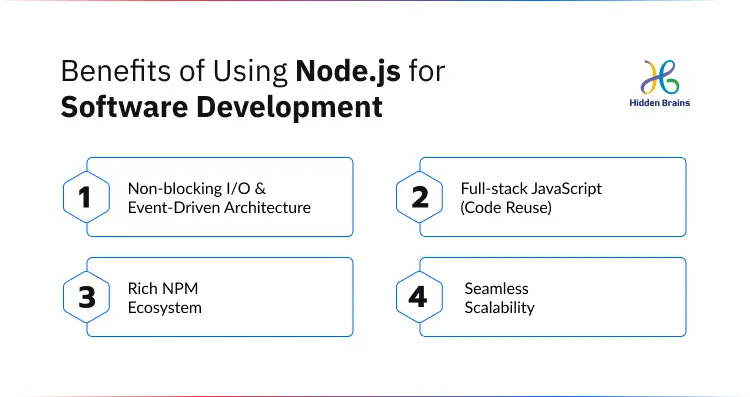
Key reasons why enterprises choose Node.js include:
- Non-blocking I/O & Event-Driven Architecture : Handles thousands of concurrent connections with minimal latency, making it ideal for real-time applications like chat platforms, streaming services, and IoT dashboards.
- Full-stack JavaScript (Code Reuse) : Enables developers to write both frontend and backend code in JavaScript, drastically improving team productivity and reducing context switching.
- Rich NPM Ecosystem : Access to npm (Node Package Manager), the world’s largest software registry containing over 2 million reusable modules, accelerating time-to-market.
- Seamless Scalability : Fits microservices and serverless architectures natively, allowing applications to scale horizontally without heavy infrastructure overhead.
7 Essential Skills to Evaluate When Hiring a Node.js Developer
When assessing candidates for your custom web application development services, balance core JavaScript knowledge with backend engineering practices.
Technical Competencies :
- Core JavaScript & Asynchronous Programming : Mastery of ES6+, Promises, async/await, Event Loop mechanics, and callback management to prevent blocking code.
- Framework Proficiency : Hands-on experience with popular Node.js frameworks such as Express.js, NestJS (for enterprise architecture), Koa, or Fastify.
- API Design & Integration : Expertise in building secure RESTful APIs and GraphQL endpoints, as well as WebSocket integration for real-time data streaming.
- Database Management : Proficiency in working with both SQL (PostgreSQL, MySQL) and NoSQL databases (MongoDB, Redis for caching).
- Error Handling & Security : Strong troubleshooting skills, proper error logging, input validation, and familiarity with OWASP top security risks (CORS, XSS, SQL injection).
Soft Skills & Process Alignment:
- Agile & Team Collaboration : Ability to write clean, modular, and self-documenting code while collaborating via Git workflows.
- Problem-Solving & Aptitude : Strong logical reasoning to debug complex async memory leaks and performance bottlenecks under load.
Are You Ready to Accelerate Your Web Development Project?
Talk to Our Experts
Step-by-Step Guide: How to Hire the Right Node.js Developer
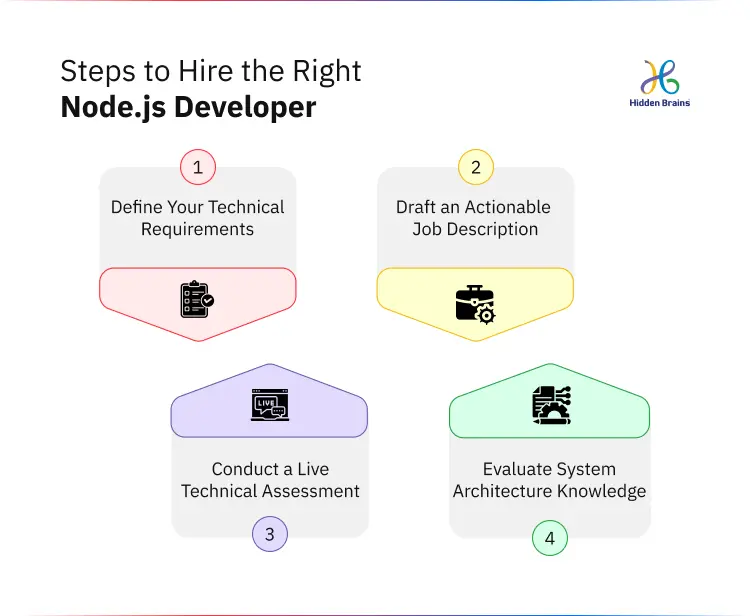
To streamline your recruitment process and reduce hiring friction, follow this 5-step framework:
- Step 1: Define Your Technical Requirements : Clearly delineate frontend vs. backend responsibilities. Document whether you need a dedicated backend engineer or a full-stack engineer proficient in React or Angular.
- Step 2 : Draft an Actionable Job Description : Outline project deliverables, required framework experience (e.g., NestJS vs. Express), database stack, and expected time zone coverage.
- Step 3 : Conduct a Live Technical Assessment : Use practical coding tests focused on asynchronous logic, REST API creation, and error handling rather than theoretical algorithm puzzles.
- Step 4 : Evaluate System Architecture Knowledge : Ask candidates how they would design a scalable Node.js architecture for high-concurrency traffic spikes.
- Step Review Past Portfolios & Code Quality : Request GitHub repositories or past project case studies to check code organization, testing coverage (Jest, Mocha), and documentation.
Comparing Node.js Hiring Models
As highlighted by Forbes, the growing global tech talent gap has led enterprise leaders to favor flexible engagement models such as dedicated development teams to lower operational overhead by up to 40%.
“`html| Engagement Model | Best Suited For | Pros | Average Hourly Rate |
|---|---|---|---|
| Freelancers | Short-term bug fixes or micro-tasks | Highly flexible, low initial cost | $20 – $45 / hr |
| In-House Employees | Core long-term products requiring physical presence | Deep brand alignment, full control | $60 – $100+ / hr (Plus benefits) |
| Outsourcing Agency / Dedicated Team | End-to-end web/mobile development, scaling existing teams | Access to vetted talent, zero recruitment overhead, managed delivery | $25 – $50 / hr |
Looking to scale your engineering team without lengthy recruitment cycles? You can hire dedicated Node.js developers with flexible, pre-vetted engagement models.
Cost to Hire a Node.js Developer in 2026 (By Region & Experience)
The cost of hiring Node.js developers varies significantly based on geographic location, seniority, and technical complexity.
1. By Experience Level
- Junior (1–3 Years) : $20 – $35 / hour
- Mid-Level (3–5 Years) : $35 – $65 / hour
- Senior / Tech Lead (5+ Years) : $65 – $110+ / hour
2. By Geographic Region
Different locations have different living costs, and accordingly, the hourly cost of the Nodejs developer varies depending on the location.
Let’s understand the average cost of hiring a web app developer in various countries.
- North America : The United States and Canada have higher hourly rates. In the U.S., the hourly cost to hire a Node. js js developer can range from $75* to $150+*, depending on the developer’s expertise.
- Europe : Western European countries usually charge expensive hourly costs ranging from $50* to $110+. Eastern European countries may offer slightly lower prices than other locations in Europe, ranging between $35 to $70+* per hour.
- Asia : Partnering with an established offshore software development company in regions like India allows enterprises to access senior Node.js talent at highly competitive rates without compromising on code quality or security standards.
Different locations have different living costs, and accordingly, the hourly cost of the Nodejs developer varies depending on the location.
Build Your Node.js Team With Expert Developers Today
Contact Us
Frequently Asked Questions
Here is our frequently asked question section that will help you get answers to the most common questions that you may come across while hiring nodejs developer.
What are the most important technical skills to look for when hiring a Node.js developer?
When hiring a Node.js developer, look for core proficiency in asynchronous JavaScript (async/await, Promises, Event Loop mechanics), framework expertise (Express.js or NestJS), RESTful and GraphQL API design, and database management across PostgreSQL, MongoDB, and Redis.
Essential Skill Checklist:
• Core Runtime Mechanics : Deep understanding of non-blocking I/O and memory leak debugging under high traffic.
• Framework Mastery : Hands-on experience with Express.js (lightweight) or NestJS (enterprise TypeScript).
• Database & Caching: Ability to optimize SQL/NoSQL queries and implement Redis for caching.
• Security Standards : Familiarity with OWASP top security risks, CORS policy, rate limiting, and JWT authentication.
What is the average cost to hire a dedicated Node.js developer in 2026?
The average cost to hire a dedicated Node.js developer ranges from $20 to $45 per hour in offshore regions like India, $35 to $70 per hour in Eastern Europe, and $75 to $150+ per hour in North America, depending on seniority and project complexity.
How do I evaluate a Node.js developer’s skills during a technical interview?
Evaluate a Node.js developer using a practical, live coding test that assesses asynchronous error handling, RESTful API creation, database query optimization, and memory leak debugging under high concurrency rather than abstract algorithmic puzzles.
Recommended Evaluation Steps :
• Live Code Review : Ask candidates to identify blocking code or unhandled promise rejections in a sample script.
• API Architecture Test : Request the design of an authenticated REST API or WebSocket connection.
• System Design Scenario : Ask how they would scale a Node.js backend to handle 10,000 concurrent user requests.
What is the difference between Express.js and NestJS for enterprise Node.js development?
Express.js is a lightweight, unopinionated framework ideal for fast, minimalist APIs and microservices, whereas NestJS is a heavily structured, TypeScript-first framework designed for enterprise-grade, highly maintainable server-side applications.
• Choose Express.js when : You need rapid prototyping, simple microservices, or absolute flexibility over project structure.
• Choose NestJS when : You are building complex enterprise systems requiring modular architecture, built-in dependency injection, and native TypeScript support.
Should I hire an in-house Node.js developer or outsource to a dedicated team?
Hire an in-house developer for long-term proprietary products requiring physical presence, but outsource to a dedicated development agency if you need immediate access to pre-vetted talent, faster time-to-market, flexible team scaling, and up to 40% lower operational overhead.
Key Comparison Factors :
• In-House : Higher initial hiring cost, 4–8 week recruitment cycle, full internal culture alignment.
• Outsourced Agency : Zero recruitment overhead, pre-vetted senior talent, flexible month-to-month contracts.
Why is Node.js preferred over Java or Python for real-time web applications?
Node.js is preferred for real-time applications because its single-threaded, event-driven, non-blocking I/O model handles tens of thousands of concurrent connections with extremely low latency, whereas traditional multi-threaded Java or Python setups require significantly higher server memory.
Primary Use Cases for Node.js :
• Real-time chat and collaboration software
• IoT device data telemetry streams
• High-throughput API gateways and microservices
• Video/audio streaming platforms (e.g., Netflix)



Conclusion
Hiring the right Node.js developer requires looking beyond basic JavaScript knowledge. Focus on candidates who demonstrate mastery in asynchronous architecture, microservices design, REST/GraphQL APIs, and enterprise security.
Whether you need a single developer to augment your existing team or a complete dedicated team to build your application from scratch, Hidden Brains offers pre-vetted Node.js experts tailored to your business goals.
