

















































































































Summary
- Policy is not enough. AI governance needs technical controls.
- Weak controls drive risk. 97% of breached organisations lacked proper access controls.
- December 2027 matters. EU AI Act high-risk obligations become enforceable.
- Use all three frameworks. NIST AI RMF, ISO/IEC 42001, and the EU AI Act.
- Governance and security are connected. Access, lineage, and logging are critical.
- Build one governance core. Map EU, UK, UAE, and Saudi requirements onto it.
- Start with the hard foundations. Inventory, risk tiering, access control, and audit logs.
An AI governance framework is the set of policies, decision rights, technical controls, and audit evidence that determines how an organization builds, buys, secures, and retires AI systems. Most enterprises now have some version of the policy half. Far fewer have the control half, where the data actually sits, and breaches happen. That gap is the reason this checklist exists.
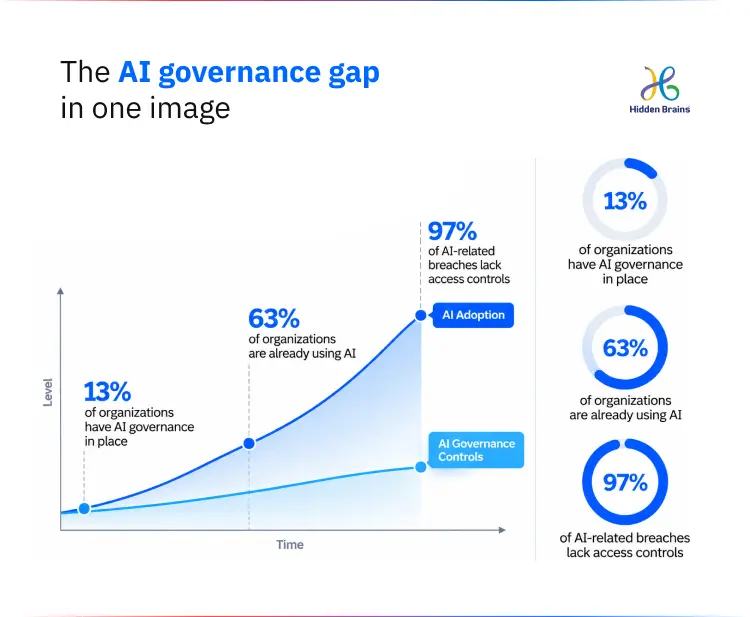
The pressure is no longer abstract. IBM’s Cost of a Data Breach Report 2025 found that 13 percent of organizations had already suffered a breach of an AI model or application, and 97 percent of those breached had no proper AI access controls in place. In the same study, 63 percent of breached organizations either had no AI governance policy or were still writing one. AI adoption has moved faster than the controls meant to keep it safe, and attackers have noticed.
This guide gives enterprise leaders a practical readiness path organized around a real deadline: December 2, 2027, when the EU AI Act’s obligations for high-risk AI systems become enforceable. Whether or not you operate in Europe, that date has become the planning baseline most global programs are building toward. If your organization is still deciding how to structure an AI adoption roadmap, governance is the foundation everything else stands on.
What an AI Governance Framework Actually Is
An AI governance framework is a living management system, not a one-time compliance document. It answers a short list of questions that every deployment must satisfy: Who can approve an AI system? What data is it allowed to touch? How is its output monitored? Who is accountable when it fails, and how fast must someone act?
A complete framework has six working parts: A maintained inventory of every AI system in use, a documented risk classification method, named decision rights for approval and retirement, technical controls that run on the systems themselves, audit artifacts that prove what a system did, and a review cadence, because models drift and rules change.
The distinction that trips up most teams: AI governance is not a subset of your existing data governance or information security program. It adds model-specific concerns those programs were never designed for, including bias, explainability, human oversight, and the behavior of systems that act on their own.
Book a Consultation and Close Your AI Governance Gaps Now.
Talk to Experts
Why December 2027 is the Deadline That Matters
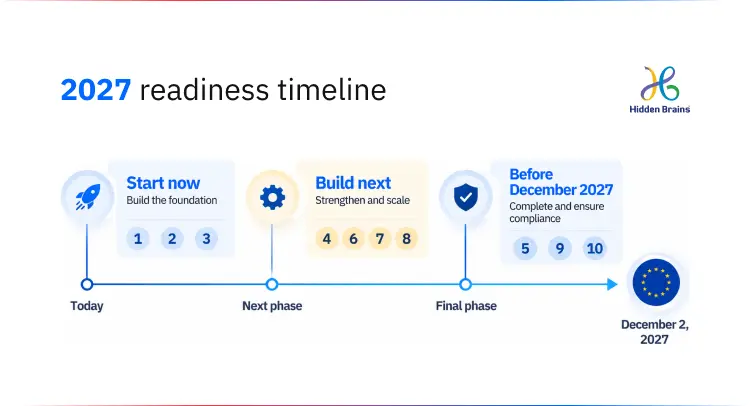
December 2, 2027 is the date high-risk AI obligations under the EU AI Act become enforceable for standalone systems listed in Annex III. This was confirmed when the EU adopted the Digital Omnibus (Regulation (EU) 2026/1744), which entered into force on July 27, 2026, and moved the high-risk deadline from August 2026 to December 2027. AI embedded in regulated products under Annex I follows on August 2, 2028.
The delay is runway, not relief. The obligations themselves did not shrink. High-risk systems will still need risk management, technical documentation, logging, human oversight, and conformity assessment. Annex III covers exactly the systems many enterprises already run: recruitment and candidate screening, credit scoring, and tools used in education and essential services. Article 50 transparency duties, such as telling people when they are interacting with AI, have already applied since August 2, 2026.
Two practical points for leaders. First, if your compliance plan is to wait until late 2027, you are building against half the timeline, because parts of the Act are already live. Second, the work that takes the longest, which is inventory, classification, and getting clean audit logging in place, is exactly the work you can start now with no downside.
The Three Frameworks You Are Being Measured Against
Three reference frameworks define enterprise AI governance today, and mature programs use all three rather than choosing one. They serve different purposes.
| Framework | What it is | What it gives you | Status |
|---|---|---|---|
| NIST AI Risk Management Framework | US-originated, voluntary, sector-agnostic risk framework organized around four functions: Govern, Map, Measure, Manage | A common language and structure for identifying and managing AI risk | Voluntary reference |
| ISO/IEC 42001 | International standard for an AI management system, structured like ISO 27001 | A certifiable management system you can be audited against and show to customers | Certifiable |
| EU AI Act | Binding EU law using risk tiers, with obligations for high-risk systems | Specific legal obligations, including documentation, logging, and human oversight | Law, high-risk from Dec 2, 2027 |
A useful way to think about it : NIST gives you the risk structure, ISO 42001 gives you a certifiable system and audit evidence, and the EU AI Act gives you the legal obligations you cannot negotiate. If you are choosing where to start, NIST AI RMF is the least disruptive entry point, and ISO 42001 is worth pursuing where customers or regulators want proof rather than assurances.
Where governance and data security meet
The controls that prevent AI breaches are data-security controls, and they are the ones governance policies most often skip. IBM’s finding that 97 percent of AI-breached organizations lacked proper access controls is not a story about weak policies. It is a story about policies that were never wired into the systems handling the data. Identity, security operations, and AI governance have become one control surface, and teams that manage them separately end up with policies no system enforces.
That is what the checklist below turns into specific controls, from least-privilege access and encryption to tamper-evident logging and data lineage. Clean data lineage and quality and enforced enterprise data security controls are what separate a defensible AI system from a guess.

Get 2027 Ready Now, Before the Compliance Window Gets Tight.
Talk to Our ExpertsThe 2027 AI Governance and Data Security Readiness Checklist
This is the operational core of the framework. It is organized into ten domains, each tagged by priority so you know what to start now versus what to complete before the December 2, 2027 deadline. Start the foundation domains today, because they are the slowest to build and everything else depends on them.
1. Governance and ownership
One person owns the risk and a small cross-functional group makes the calls, so no AI decision falls between departments.
| Priority | Action item |
|---|---|
| Start now | Appoint a single accountable owner for enterprise AI risk (for example, Chief AI Officer, CIO, or CRO). |
| Start now | Form an AI governance council with Legal, Security, Data, HR, and Business Unit leaders. |
| Start now | Define decision rights: who can approve models, prompts, data connections, and production deployments. |
| Start now | Establish escalation paths and clear accountability for AI-related incidents. |
2. AI Inventory and Risk Tiering
You cannot govern what you cannot see, so list every AI system and sort it by how much damage it could do.
| Priority | Action item |
|---|---|
| Start now | Build a complete AI inventory (internal models, third-party APIs, embedded copilots, shadow AI). |
| Start now | Record for each system: business purpose, data classes accessed, jurisdictions, vendors, and integrations. |
| Start now | Classify by regulatory risk (EU AI Act, NIST AI RMF, ISO 42001) and business impact (revenue, safety, reputation). |
| Start now | Apply controls proportionally: high-risk systems require explainability, human-in-the-loop, and immutable logs. |
3. Data Security and Privacy by Design
Lock down who and what can reach the data your AI touches, and keep a record of every request.
| Priority | Action item |
|---|---|
| Start now | Enforce least-privilege, authenticated access for all AI data pathways. |
| Start now | Encrypt prompts, responses, and embeddings in transit and at rest, using FIPS-validated cryptography where required. |
| Start now | Implement tamper-evident audit logging of requests, responses, and configuration changes. |
| Start now | Document data lineage, consent, and lawful basis for training and inference data. |
| Start now | Prevent leakage of PII, secrets, and IP through data loss prevention on prompts and outputs. |
4. Runtime Guardrails and Kill Switches
Put automatic limits and stop controls around AI so a bad prompt or a runaway agent cannot cause real harm.
| Priority | Action item |
|---|---|
| Build next | Deploy guardrails to block or redact PII, financial data, health records, and proprietary code. |
| Build next | Set budget and rate limits at team and customer levels to prevent cost spikes. |
| Build next | Implement kill switches and override protocols for autonomous agents. |
| Build next | Test against the OWASP Top 10 for LLM applications and system-specific threat models continuously. |
5. Explainability and Evidence for High-risk Decisions
For decisions that affect people, be able to show how the system reached them and who signed off.
| Priority | Action item |
|---|---|
| Before Dec 2027 | Require explainability documentation for models affecting hiring, credit, safety, or customer rights. |
| Before Dec 2027 | Maintain immutable decision logs (inputs, model version, confidence scores, human overrides). |
| Before Dec 2027 | Export evidence to existing data lakes or SIEM for auditor and regulator access. |
6. Vendor and Third-party Risk Management
Most enterprise AI runs on someone else’s model, so hold vendors to the same standard you hold yourself.
| Priority | Action item |
|---|---|
| Build next | Update vendor data processing agreements and AI addenda (data use, sub-processors, breach notification). |
| Build next | Require security certifications (ISO 27001, SOC 2, ISO 42001) and test reports. |
| Build next | Document dependency failure plans (model retirement, term changes, outages). |
| Build next | Reserve the right to audit and require evidence for critical AI vendors. |
7. Human Oversight and Transparency
Keep a person in the loop on decisions that matter, and tell people when they are dealing with AI.
| Priority | Action item |
|---|---|
| Build next | Require human-in-the-loop for high-risk decisions (complex complaints, financial approvals, safety-critical actions). |
| Build next | Equip frontline staff with AI tools and clear override controls. |
| Build next | Disclose AI interactions to customers and employees where material to trust. |
| Build next | Publish internal AI usage policies and approved tool lists to reduce shadow AI. |
8. Monitoring, Incident Response, and Change Control
Watch AI in production the way you watch any critical system, and have a plan for when it misbehaves.
| Priority | Action item |
|---|---|
| Build next | Stand up live dashboards for usage, cost, errors, drift, and policy violations. |
| Build next | Define incident response playbooks (hallucinations, data leaks, model failures, vendor outages). |
| Build next | Require testing and approval before material changes to prompts, models, or connected tools. |
| Build next | Plan for AI system retirement (data deletion, model de-registration, handover procedures). |
9. Alignment to Global AI Regulations
Match each use case to the rules of every market it touches, from the EU AI Act to the UAE and Saudi Arabia.
| Priority | Action item |
|---|---|
| Before Dec 2027 | Map AI use cases to EU AI Act, UK, UAE, Saudi Arabia, and sector-specific regulations. |
| Before Dec 2027 | Confirm data residency and cross-border transfer rules for each jurisdiction. |
| Before Dec 2027 | Document oversight, incident response, and conformity assessments for high-risk AI. |
10. Business Value and ROI
Governance should pay for itself, so measure what each deployment returns and report it to the board.
| Priority | Action item |
|---|---|
| Before Dec 2027 | Define outcomes per deployment (cost saved, revenue enabled, risk reduced, cycle time improved). |
| Before Dec 2027 | Track total cost of ownership (vendor spend, internal compute, operational costs). |
| Before Dec 2027 | Report quarterly to the board on adoption, control maturity, incidents, and ROI. |
Shadow AI and autonomous agents
The fastest-growing governance gap is the AI no one approved. IBM found that one in five organizations reported a breach tied to shadow AI, the tools employees adopt without sign-off, and that shadow AI added roughly 670,000 dollars to the average breach cost. That is why inventory and an approved-tool list sit near the top of the checklist. You cannot govern what you cannot see.
Autonomous agents raise the stakes further, because they take actions rather than just producing text. An agent with access to systems and data needs the same identity, permission, and logging discipline as a privileged user, plus the kill switches and override protocols in domain 4. If agents are part of your roadmap, treat governing autonomous AI agents as a first-class part of the framework, not an afterthought.
Governing AI Across Multiple Jurisdictions
For global operators, AI governance is not one rulebook but several, layered by where you operate and whose data you process. The table below summarizes what four active regimes ask of enterprises and what each implies for your controls. Treat regulation as a moving target and design controls that can be re-mapped as rules evolve.
| Jurisdiction | Key requirements for enterprises | Governance implication |
|---|---|---|
| EU (AI Act) | Risk tiers, technical documentation, post-market monitoring, human oversight for high-risk AI; high-risk obligations from Dec 2, 2027 | Inventory, risk classification, explainability, immutable logs, conformity assessments |
| UK | No standalone AI law; pro-innovation, sector-led approach via existing regulators (ICO, Ofcom, CMA, FCA); emphasis on safety, transparency, accountability | Map to existing regimes (UK GDPR, sector rules); document oversight and incident response |
| UAE | Horizontal statutes and sector rules rather than one AI act; PDPL full compliance by Jan 1, 2027; Federal Authority for AI and Data; DIFC Regulation 10 AI rules live since Jan 2026 | Confirm data residency and cross-border transfer rules; run AI impact assessments; follow sector-specific guidance |
| Saudi Arabia | SDAIA AI Adoption Framework (mandatory baseline, aligned to PDPL); NCA Essential Cybersecurity Controls; PDPL 72-hour breach notification | Align with PDPL and NCA controls; classify data; document AI use in critical infrastructure |
The design principle across all four is the same. Build one governance core (inventory, classification, access control, logging, oversight) and treat jurisdiction-specific rules as a mapping layer on top. Rebuilding governance per country does not scale, and it is not necessary.
How Mid-market Teams Implement This Without a Huge Team
You do not need a large dedicated governance office to be ready. You need clear ownership, a small set of enforced controls, and a partner who has done the plumbing before. The most common failure is not lack of policy. It is policy that no system enforces, written by a team with no time to wire it in.
A workable approach for a growing enterprise: assign one accountable owner, start with the three foundation domains from the checklist, and get audit logging and access control right before you expand AI usage further. Where internal capacity is thin, a certified custom AI development company can build governed AI systems with the controls in place from the start, which is far cheaper than retrofitting them after an audit or an incident. This is also where an ISO 27001-certified partner earns its place, because the information-security discipline behind that certification is the same discipline AI governance now demands.
Frequently Asked Questions
What does it cost us to wait until 2027 to act on AI governance?
The cost shows up as regulatory exposure and breach exposure. Under the EU AI Act, non-compliance with high-risk obligations can reach 15 million euros or 3 percent of global annual turnover, and prohibited practices up to 35 million euros or 7 percent, though SMEs are capped at the lower amount. Separately, IBM found the global average data breach cost was 4.44 million dollars in 2025, and ungoverned AI raised both the odds and the price. Waiting does not remove the work; it compresses it into a smaller, more expensive window.
Will an AI governance framework slow down our AI adoption?
No, and the opposite is usually true. When AI use can be approved, monitored, and documented as a repeatable process, scaling becomes a planning decision instead of a fresh risk each time. The teams that stall are the ones with no inventory and no clear owner, because every new use case reopens the same unanswered questions. Governance done well removes friction from the second, third, and tenth deployment.
What is the return on investment for AI governance?
The return comes from avoided breach costs, faster deployment, and won business. IBM reported that organizations using AI and automation extensively in their security operations saved an average of 1.9 million dollars per breach and resolved incidents about 80 days faster. On the growth side, AI governance controls are increasingly a procurement requirement, especially for public-sector and regulated buyers, so a defensible program keeps you on shortlists rather than off them.
Should we build AI governance in-house or work with a partner?
Build in-house where you have the security and compliance capacity to wire controls into live systems and keep them current. Work with a partner where that capacity is thin, or where you want the controls in place.
Should we build AI governance in-house or work with a partner?
Build in-house where you have the security and compliance capacity to wire controls into live systems and keep them current. Work with a partner where that capacity is thin, or where you want the controls in place from day one rather than retrofitted. The most expensive path is neither: a policy written by a team with no time to enforce it, which passes an internal review and fails at the first real audit or incident.
Who in the business should own AI governance?
One accountable owner, supported by a cross-functional group. AI governance is not an IT-only task, because a policy written without Legal, Security, HR, and a business unit lead will miss the operational context that makes it enforceable. Practically, that means a single named owner for the program, clear owners for each AI system, and a standing group that meets on a set cadence rather than only after something breaks.
We operate mostly outside the EU. Does the EU AI Act still matter to us?
Usually yes. The Act reaches AI systems whose output is used in the EU, so exposure is not purely about where your office sits. The December 2027 obligations have also become the default benchmark that global customers, auditors, and partners measure against, alongside local rules such as the UAE PDPL and Saudi Arabia’s SDAIA framework. Building one governance core and mapping local rules onto it is cheaper than treating each market as a separate project.
How long does it take to get ready?
Plan in months, not weeks, and start with the slowest items. A realistic sequence is a few weeks to stand up an owner and a first-pass inventory, a couple of months to classify systems and turn on access control and audit logging, and additional time to produce documentation and pursue certification where customers expect it. Because inventory and logging are the long poles, beginning them now is what makes a 2027 deadline comfortable instead of tight.
What happens if our AI vendor changes or retires the model we depend on?
Treat it as a continuity risk, not just a procurement detail. Document a dependency failure plan for every critical AI vendor covering model retirement, pricing or term changes, and outages, and know in advance what you would switch to. Your vendor agreements should require advance notice of material changes and give you the right to audit and to export your data, so a vendor’s roadmap decision never becomes your production emergency.
How do we handle employees already using unapproved AI tools?
Start by making the unapproved use visible rather than punishing it, because shadow AI is usually a sign people lack a sanctioned tool that does the job. Inventory what is actually in use, publish an approved-tool list and a clear usage policy, and give teams a fast path to request new tools. IBM linked shadow AI to roughly 670,000 dollars in added breach cost per incident, so replacing it with governed options is cheaper than the exposure it creates.

Conclusion
The organizations that will move fastest with AI in 2027 are the ones building governance now, while it is still a planning exercise rather than a scramble. An AI governance framework is not paperwork you produce to satisfy an auditor. It is the operating model that lets you approve, monitor, and expand AI use as a repeatable process, with a defensible record when a regulator, a customer, or your own board asks how the program is run.
The core message of this checklist is simple. Governance and data security are one problem, not two. The breaches happen at the data layer, the controls that prevent them are data-security controls, and the policy only matters if a system actually enforces it. December 2, 2027 is a useful deadline to plan against, but the real reason to start today is that the slowest work, which is inventory, classification, and clean audit logging, is also the work that protects you regardless of which jurisdiction you answer to.
You do not have to build all of this alone, or wait for an incident to expose the gaps. Our AI strategy and consulting services help you define the right roadmap, governance structure, and adoption plan, with controls placed where the real risk sits.