















































































































































Summary
- Staff augmentation solves capacity gaps, not capability or leadership gaps.
- It works best with strong technical leadership, a clear roadmap, and an 18-month need.
- A five-minute decision tree helps you choose between augmentation, a dedicated team, a managed build, or fixing leadership first.
- Seven key signs can tell you when augmentation is the right fit.
- The guide shows when another model works better, and why.
- Compare 18–24 month total costs, not hourly rates versus salaries.
A high-stakes project lands on your roadmap. It needs expertise your team does not have in-house, and the deadline is already set. Both of your obvious moves work against you. A full-time senior engineer means a premium salary you carry for years, and just finding one takes time while the clock keeps running. Hiring is expensive and slow at exactly the moment you need to move fast. So what is the next option?
For many small and mid-size businesses, the answer is IT staff augmentation services: vetted engineers who join your existing team in weeks, work under your direction, and scale back down when the work is done, with no permanent headcount and no loss of control over your codebase.
Quick Takeaway
- Use staff augmentation when you already know what to build and how to govern it, but you’re short on speed or scarce skills.
- It accelerates a team with a clear roadmap, architecture, and leadership.
- It does not fix a team that lacks product clarity, technical direction, or strong internal management.
- For SMBs, the main win is: get senior talent fast without long‑term headcount risk, while keeping control of your architecture, codebase, and IP.
- Rule of thumb: If you can clearly write the tickets, run the standups, and own the quality bar, augmentation can work. If you can’t, fix leadership and scope first.
Check out the guide that tackles the hiring challenges founders, CTOs, and heads of product often face. You’ll learn why SMBs use staff augmentation, how to know if it’s right for your problem, a five-minute decision tree to evaluate it, when another model makes more sense, what it really costs, and how to choose the right partner.
Why SMBs Turn to External Tech Talent
SMBs use staff augmentation as a strategic lever, not just a way to add hands. Five reasons come up repeatedly with the leaders we work with:
- De-Risk Hiring in Uncertain Markets. Scale capacity up or down as milestones and funding shift, instead of over-hiring before revenue is secure.
- Compress Time to Value. Launch a product line, complete a migration, or hit a compliance deadline without waiting weeks per full-time hire.
- Access Scarce, High-Cost Skills on Demand. Cloud architects, ML engineers, and security specialists when you need them, without carrying premium salaries year-round.
- Keep IP and Architecture In-house. Your team owns the repository, sets the vision, and runs code reviews. Augmented engineers work inside your processes.
- Convert Fixed Cost to Variable Cost. Trade permanent salaries and benefits for a predictable monthly burn you can adjust as priorities change.
Staff Augmentation in Simple Terms
IT staff augmentation means adding external specialists to your existing team, who work under your direction, in your tools, and within your sprint rhythm. You keep control of priorities and delivery. The staffing partner supplies the skills or the bandwidth.
Staff augmentation is just one of several ways to outsource engineering capacity. To understand how it compares with dedicated and extended teams, explore our guide to dedicated team vs staff augmentation vs extended team.
Capacity Gap or Capability Gap?
Staff augmentation solves a capacity gap, not a capability gap. That single distinction predicts most of the successes and failures we see.
A capacity gap means you know what to build and how to build it, but you do not have enough hands to do it on time. Augmentation is built for this. Add senior engineers, keep your architecture and standards, ship faster.
A capability gap means the harder problems are unclear architecture, weak engineering governance, no documented processes, or no one who owns delivery. Adding developers to a capability gap does not remove the constraint. It moves it. Now you have more people producing work that no one has the clarity or bandwidth to direct, review, and integrate.
Before you count how many engineers you need, be honest about which gap you actually have. And what you need to solve it.
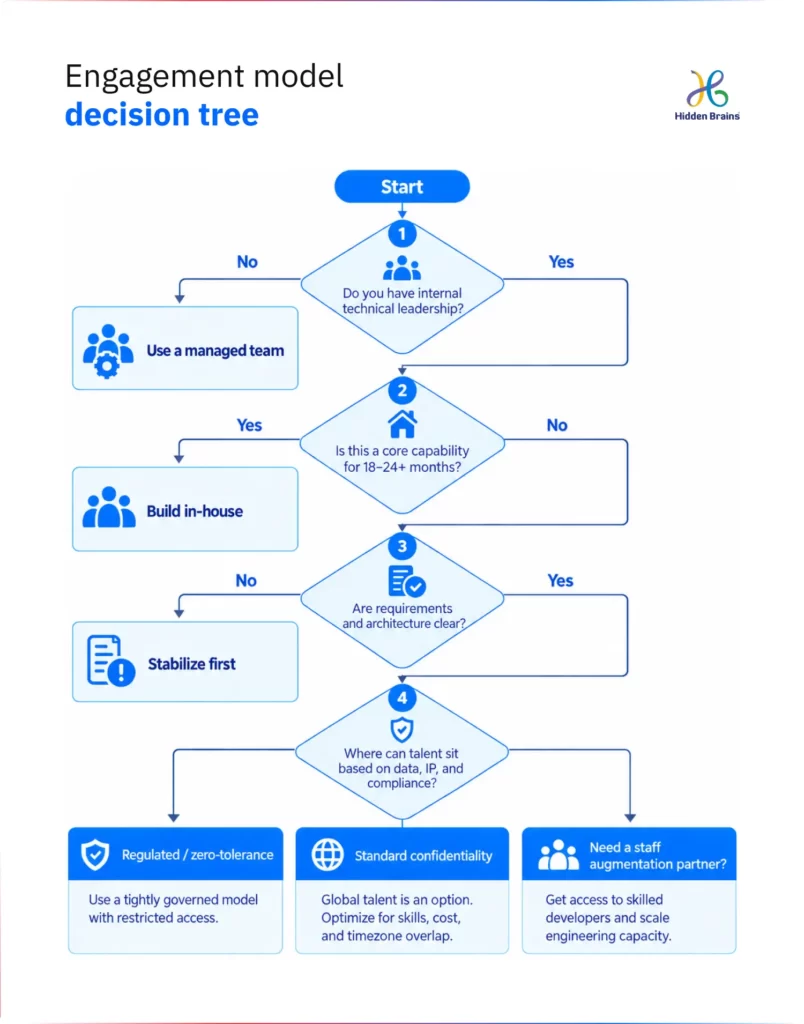
The SMB Staff Augmentation Decision Tree
Run this before you talk to any vendor. It routes you to the model that fits, which is not always augmentation.
-
Do you have internal technical leadership to direct the work?
- No → Start with a managed or dedicated team where the vendor supplies delivery ownership. Build internal leadership first.
- Yes → Go to 2.
-
Is this a core capability you must own for 18–24 months or more?
- Yes → Plan an in-house team. Use augmentation only as a bridge while you hire.
- No → Go to 3.
-
Are requirements and architecture clear enough for a senior developer
to ramp up in 1–3 weeks?
- No → Stabilize the product and technical leadership first. Consider a small, outcome-based pilot.
- Yes → Go to 4.
-
Where can the talent sit, given your data, IP, and compliance requirements?
- Regulated or zero-tolerance data → Use a tightly governed model with restricted access and a certified vendor.
- Standard confidentiality → Global talent is an option. Optimize for skills, cost, and timezone overlap.
Final Recommendation: If you answered Yes to Step 1, No to Step 2, and Yes to Step 3, and your data requirements allow external talent, you are a strong candidate for staff augmentation.
Next step: Define a focused pilot, establish clear success metrics, and use the results to determine whether to scale augmentation or build an internal team.
7 Signs Staff Augmentation Makes Sense
Businesses are not about one size-fits all. But you are likely a good fit for staff augmentation if you recognize several of these:
- You have a specific skill gap, not a general headcount gap.
- You face a deadline that in-house hiring cannot realistically hit.
- Your initiative runs 6 to 18 months with a clear direction.
- Your requirements will evolve, and you want to keep control of how the work is done.
- A departure or extended leave threatens your delivery velocity.
- You are in a pre-funding or pre-launch sprint where speed matters more than permanent headcount.
- You have a one-off specialist project such as a migration, security hardening, or compliance remediation.
The signs rarely show up early; most teams recognize them only once a deadline is already slipping. If two or more describe you right now, the gap is easier to close this month than next quarter.
When Another Delivery Model Makes More Sense
Staff augmentation is one of several ways to add external engineering capability, and for some situations a different model fits better. Three cases come up most often:
- You Are Building Core Engineering Capability From Zero. No internal tech leadership, unclear processes, a vague roadmap. A dedicated development team or a managed model fits better, because the vendor supplies the engineering manager and delivery ownership while you grow internal leadership, then bring work in-house over time.
- Requirements Are Chaotic, and Leadership Is Overloaded. Priorities shift weekly, and no one has time to direct extra people. A smaller, outcome-based engagement, a fixed-scope pilot, or handing a self-contained deliverable to a outsource software development services, fits better until your product and technical leadership stabilize.
- IP or Compliance Has Zero Tolerance for Risk. Regulatory or business constraints demand full, long-term control over code and data. A tightly governed dedicated model, or a small in-house core with external help only for non-sensitive work, fits better.
Saying “not yet” here is not a loss. Choosing the right model at the right stage is what protects your budget, your timeline, and your control over your own product.
Common SMB Use Cases
These are the patterns where augmentation reliably works for SMBs.
- New Product or Module Build (6 to 9 Months). Your core team is strong but understaffed for a new line or major module. Add 2 to 4 senior engineers (backend, frontend, QA). Your tech lead owns architecture and sprint planning; external seniors plug into the existing stack; the team scales down after launch without layoffs.
- One-Off, High-Stakes Projects. ERP or CRM integration, cloud migration, security hardening, compliance remediation. Augment with specialists for 3 to 12 months. You avoid hiring expensive niche talent permanently, and the project has clear success criteria and an end date.
- Coverage for Leaves, Turnover, or Hiring Gaps. A key person leaves or goes on extended leave. Bring in an augmented engineer at similar seniority to hold velocity while you search for the right permanent replacement instead of a rushed one.
- Pre-Funding and Pre-Launch Sprints. A startup or SMB needs to hit milestones before a raise or launch. Use augmentation to build the MVP or critical features quickly, then reassess headcount after the milestone. Speed and cash preservation matter most here.
- Scaling After a Raise. Post-round, augment a few senior contractors who work shoulder to shoulder with your future full-time hires, so the eventual team helped build the system rather than inheriting it.
What Roles Are Best to Augment?
Augment the roles that plug into your existing direction quickly, and keep the roles that set direction in-house.
Best to augment (they execute inside your plan): Hire full-stack engineers, QA and automation, DevOps and cloud engineers, cloud and solution architects for a defined initiative, security engineers, ML and data engineers, and mobile specialists.
Usually keep in-house (they own direction and context): core product ownership, foundational architecture for your differentiating systems, and engineering leadership. If you are tempted to augment these, revisit the capacity-versus-capability question above, because that is usually a sign of a capability gap.

Close Skill Gaps Fast. Scale Within 48 Hours
Hire DevelopersStaff Augmentation vs. Other Models: The Quick View
The fastest way to separate the four common models is one question: who runs the work day-to-day?
| Model | Who Runs the Work Daily | Best For | Speed | Control and IP |
|---|---|---|---|---|
| Full-Time Hire | You | Long-term core capability | Slowest | Full |
| Staff Augmentation | You | Skill or capacity gaps, with direction | Fast | High |
| Dedicated Team | Shared | Sustained scope in one product area | Medium | High |
| Managed Delivery | Vendor | Defined, non-core deliverables | Medium | Negotiated |
We run three of the four. For staff augmentation, our engineers work inside your team under your direction. For a hire dedicated developers, we run a standing unit for one product area. For managed delivery, we own an outcome you define. Which one fits depends on your leadership capacity and time horizon, covered next.
Staff Augmentation vs. Full-Time Hiring
Choose full-time hiring when the capability is core and enduring, and you will need it for years. Choose augmentation when you need speed, flexibility, and a variable cost model, or when you are not yet certain the role is permanent. Augmentation ramps in weeks; a full-time hire is slower to find and far more expensive to reverse if the roadmap changes.
Staff Augmentation vs. Dedicated Teams
Choose augmentation when you direct the work daily and want engineers integrated into your own sprints and standups. Choose a dedicated development team when you want a standing external unit for one product area over a longer horizon, with more of the coordination handled for you. The dividing line is how much day-to-day management you want to keep.
Staff Augmentation vs. Managed Delivery
Choose augmentation when you own the “how” and simply need capability inside your process. Choose managed delivery, a form of outsourcing, when you can define an outcome and hand off the process, team assembly, and quality assurance to the vendor. Managed delivery works best for well-defined, non-core work; augmentation works best when requirements evolve and control matters.
The Real Cost Comparison (18 to 24 Month TCO)
Compare total cost of ownership over 18 to 24 months, not hourly rate versus salary. The rate comparison hides the costs that actually decide the question for an SMB.
| AI testing shift | 2027 readiness | Best first use |
|---|---|---|
| AI-generated test cases | Production-ready (with review) | Regression suite drafting |
| Autonomous/agentic testing | Emerging | Routine regression only |
| Self-healing scripts | Production-ready | Large UI / web test suites |
| Testing AI code & AI features | Emerging / necessary | Behaviour, security & LLM eval |
| Shift-left + production testing | Production-ready | Live web & mobile products |
| Synthetic test data | Rising | Privacy-sensitive datasets |
| Predictive, risk-based prioritisation | Production-ready | Large regression cycles |
| Continuous quality in CI/CD | Standard | Every pipeline |
| Evolving tester role | Now | Upskilling / strategy |
| Governance & compliance guardrails | Now (mandatory) | Before scaling AI in regulated software |
Neither model is automatically cheaper. Augmentation usually wins when your horizon is uncertain, because you pay for output and flexibility instead of locking in long-term fixed cost. A full-time hire usually wins when the role is permanent and core. Model your own numbers before deciding.
Your Staff Augmentation Readiness Checklist
If most of these are true, augmentation is likely a strong fit. If several are false, revisit the decision tree.
Strategic Fit
- This need is mainly for the next 3 to 18 months, not a 3-year-plus core capability.
- We know whether this work is core IP or more commodity and project-based.
Leadership and Process
- We have a named tech lead or engineering manager who will own tasks, reviews, and delivery.
- Our architecture, coding standards, and CI/CD are documented enough for a senior to ramp in 1 to 3 weeks.
- We can allocate 10 to 20 percent of a senior or EM’s time to onboarding and coordination per 2 to 4 augmented engineers.
Risk and Compliance
- We have identified any data residency, IP, or compliance constraints.
- Our vendor can demonstrate the relevant controls and certifications where needed.
Commercials
- As a 2026 benchmark, offshore development in India typically ranges from $25–$50/hour, depending on seniority and specialization, while a 5-person dedicated team can cost roughly $20,000–$25,000/month.
- Factor in recruitment, onboarding, management, QA, replacement, and knowledge-transfer costs before comparing models.
Meet Your Deadline Without Over-Hiring Staff
Hire Experts
How to Choose an IT Staff Augmentation Company
Once you’ve decided augmentation is the right fit, evaluate a partner by how well it protects delivery, governance, security, and your control, not by headcount claims. Look for:
- Seniority You Can Verify. Real technical screening, not resumes. Ask to interview the actual engineers.
- Ramp-Up Speed. How fast can a vetted engineer start and reach productivity inside your stack?
- Retention and Continuity. Low churn and a plan for knowledge continuity if someone rolls off.
- Engineering Governance. The standards and review discipline the partner brings, so quality does not depend only on your oversight.
- Clear IP and NDA Terms. IP assignment written in from the start, with confidentiality and access controls.
- Timezone Overlap. Enough working-hours overlap for a global team to collaborate, not just hand off.
- Clean Scale-Down. The ability to reduce or change roles without penalty as priorities shift.
A strong partner will also tell you when augmentation is not the right model for your situation or when IT outsourcing fits best. That candor is a signal, not a red flag.
How Hidden Brains Approaches Staff Augmentation
Hidden Brains provides accountable engineering capability, not just additional headcount. Our engineers integrate into your delivery structure, follow your standards, and are backed by our own engineering governance, so you gain speed without giving up control. As a CMMI Level 3, ISO 9001:2015, and ISO/IEC 42001:2023 certified company delivering technology solutions since 2003, we help SMB leaders scale the right way for their stage, without overbuilding teams, overspending on permanent hires, or slowing delivery.
Frequently Asked Questions
What Does IT Staff Augmentation Actually Cost an SMB?
It depends on role, seniority, and region, so compare total cost of ownership over 18 to 24 months rather than hourly rate against salary. Augmentation removes recruiter fees, ramp-up loss, and over-hire risk, and converts fixed salary into a variable monthly cost you can scale down. It usually wins on uncertain roadmaps; a full-time hire usually wins for permanent, core roles.
How Fast Can We See Results?
Vetted engineers typically reach productivity in 1 to 3 weeks when your architecture, standards, and CI/CD are documented, versus 6 to 12 or more weeks to hire and onboard a full-time engineer. The clearer your onboarding materials, the faster the return.
What Is the Financial Risk if Our Roadmap Changes?
Lower than with a permanent hire. You can scale down, pause, or switch roles as priorities shift, so you are not carrying salary and benefits for a role the business no longer needs. That flexibility is the main reason SMBs use the model in uncertain markets.
Will We Lose Control of Our Product or IP?
No, when the contract is set up correctly. Augmented engineers work inside your environment under your direction, so IP ownership is generally cleaner than in outsourcing. Confirm IP assignment, confidentiality, and access controls in writing before the engagement starts.
How Do We Measure Whether It Is Working?
Set success metrics before the engagement: delivery velocity, defect rate, time to deliver against milestones, and stakeholder satisfaction. A 90-day pilot with a defined scope lets you prove the model on a low-risk footprint before scaling it.
When Should We Bring the Work Back In-House?
When the capability becomes core and enduring, meaning you will need it for 18 to 24 months or more as a differentiator. Use augmentation as the bridge that keeps delivery moving while you


Conclusion
The decision isn’t whether staff augmentation is good or bad. It’s whether you have a capacity gap you can direct or a capability gap you can’t. If you have the leadership to run the work, a clear enough roadmap for a senior hire to ramp up in weeks, and a need that fits within an 18-month horizon, staff augmentation can give you speed and specialized skills without the fixed cost and hiring risk of permanent headcount. If any of these are missing, a dedicated team, managed build, or stronger internal leadership may serve you better. And you don’t need to do the math alone; a free 2-hour consultation can help you get clarity on which model fits your situation.