






































































Summary
- Build remote engineering teams around the business use case, not location alone.
- Match the team model, capabilities, and ownership to the outcome you want to achieve.
- Use async-first workflows and reserve overlap hours for decisions, blockers, and complex collaboration.
- Reduce dependencies so teams can continue meaningful work when another region is offline.
- Standardize handoffs, onboarding, security, and engineering practices across locations.
- Measure delivery outcomes and productivity, not online activity.
- Choose between individual remote developers, IT staff augmentation, and a dedicated remote team based on skill gaps, capacity, and ownership needs.
If you are trying to understand how to build remote engineering teams that perform consistently across locations and time zones, the challenge is bigger than communication. In Stack Overflow’s 2024 Developer Survey, 42% of respondents worked in hybrid environments while only 20% worked fully in person, reinforcing how distributed development has become part of mainstream engineering operations.
Yet putting developers in different locations does not automatically create a high-performing remote development team.
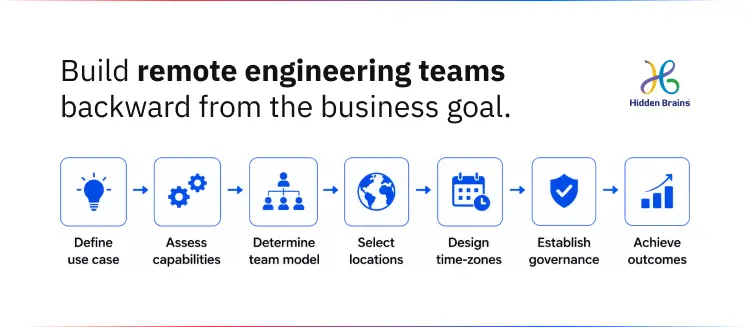
Enterprises need to work backward from the business objective:
Business use case → Required capabilities → Team model → Time-zone design → Governance → Measurable outcomes
A business launching a SaaS product needs a different remote engineering model from one modernizing legacy systems, implementing AI, providing 24/7 support, or adding specialist capacity.
The key is therefore not to maximize overlap between regions. It is to design a distributed engineering operating model in which people have enough context, ownership, processes, and technical controls to keep work moving even when another region is offline.
Why Remote Engineering Teams Fail Across Time Zones
Remote engineering itself is rarely the problem. Time-zone differences usually expose weaknesses that already exist in the engineering operating model.
A decision waits for a product owner. The product owner needs an architect. QA cannot proceed until both respond. What should take a few hours can stretch into days.
As remote development teams grow, these gaps show up as delayed reviews, poor handoffs, unclear ownership, excessive meetings, and dependency bottlenecks.
The better question is:
Can the team keep moving when another region is offline? If not, the problem may be less about time zones and more about process, ownership, or documentation.
Start With the Business Use Case
There is no single structure that works for every remote engineering team. Before choosing locations, overlap hours, or an engagement model, define what the business actually needs the team to achieve.
| Business Use Case | Recommended Team Structure | Time-Zone Model | Primary Priority |
|---|---|---|---|
| New product development | Cross-functional product squad | Limited overlap + async delivery | Speed and ownership |
| Legacy modernization | Dedicated modernization team | Regional ownership | Risk and continuity |
| AI implementation | AI, data, cloud and governance specialists | Planned technical overlap | Security and governance |
| 24/7 support | Regional engineering rotations | Follow-the-sun | SLA and resilience |
| Staff augmentation | Specialists embedded into existing teams | Client-aligned hours | Skills and capacity |
| Cost-efficient scaling | Offshore or hybrid engineering pod | Async-first | Scale and predictability |
The point is simple: choose the team model after defining the outcome, not before.
Instead of asking, “Where should we hire developers?” ask:
“What team structure gives this initiative the best chance of succeeding?”
That keeps the section strategic without overexplaining.
Match the Remote Team Model to the Outcome
Once the business goal is clear, choose a team model that matches the level of ownership and capability required.
For new product development, a cross-functional squad works best when it can move from requirement to release with minimal external dependencies.
For legacy modernization, the team needs stronger architecture, migration, QA, and knowledge-transfer capabilities because continuity and risk matter as much as delivery speed.
For staff augmentation, external specialists work best when the internal team already has product ownership, engineering leadership, standards, and delivery processes in place.
A dedicated remote team is more suitable when the initiative needs sustained, multi-role capacity and deeper product or domain knowledge over time.
Hidden Brains offers flexible engagement models for businesses looking to hire dedicated teams that extend their in-house team. You can build a team around your required technical skills, project scope, and delivery needs, with the flexibility to scale as your requirements evolve.
Design Time Zones Around the Work
One of the biggest mistakes in remote software development project management is treating all engineering activities as if they require real-time collaboration.
They do not. A stronger model categorizes work based on how much synchronous interaction it genuinely needs.
| Work Type | Best Approach |
|---|---|
| Feature development | Async-first |
| Code reviews | Async |
| Documentation and updates | Async |
| Architecture decisions | Planned overlap |
| Complex debugging | Synchronous when needed |
| Critical incidents | Immediate escalation |
| Customer support | Regional or follow-the-sun |
The question should not be: “How can everyone work the same hours?”
Instead ask: “Which activities benefit enough from real-time interaction to justify shared working hours?”
For many distributed engineering teams, the answer is architecture decisions, dependency resolution, planning, incident response, and complex technical discussions. Routine implementation should not require continuous overlap.
Need a Remote Engineering Team Built Around Your Delivery Goals?
Talk to Us
Understand the Benefits of Asynchronous Development
The benefits of asynchronous development go beyond fewer meetings. Done well, async work helps remote engineering teams keep moving even when colleagues in another region are offline.
It improves documentation, protects developer focus time, reduces unnecessary meetings, and makes decisions easier to trace later.
The principle is simple:
Use documentation to share information. Use meetings to resolve ambiguity and make decisions.
This gives distributed teams more autonomy without eliminating the synchronous collaboration that complex engineering work still requires.
Build Teams for Autonomy, Not Constant Coordination
Remote teams slow down when engineers need permission, clarification, or input at every step.
Imagine this flow:
Developer → Architect → Product Owner → QA → DevOps → Release Manager
If every stage requires a synchronous conversation, time-zone differences quickly turn small dependencies into delivery delays. High-performing distributed engineering teams reduce this friction by defining clear ownership, decision rights, and working boundaries.
Explicitly define:
- Product ownership
- Service ownership
- Architecture boundaries
- Technical decision rights
- Coding standards
- Review expectations
- Escalation paths
- Definition of Done
- Quality thresholds
Async work should support this autonomy. Routine updates, documentation, code reviews, status sharing, and non-urgent questions should move forward without waiting for everyone to be online. Shared overlap should be reserved for architecture discussions, blockers, planning, incidents, and complex decisions.
The goal is not to eliminate collaboration. It is to eliminate unnecessary dependencies and use synchronous time where it adds the most value.
A useful test: If one region goes offline, can the other region continue meaningful work?
If not, the team may have a documentation, ownership, process, or architecture gap.
Engineer Better Cross-Time-Zone Handoffs
Autonomy reduces the number of handoffs a remote engineering team needs, but it does not eliminate them.
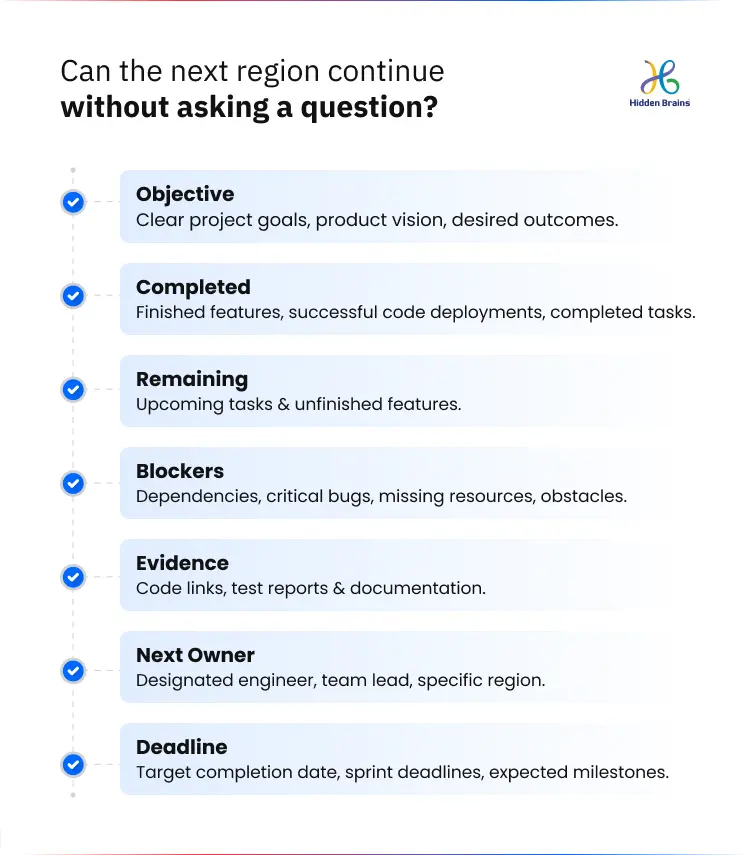
When work moves between regions, the handoff should transfer enough context for the next engineer to continue without reopening the entire discussion. That means capturing what is complete, what remains, key decisions, open risks, relevant links, and the next owner.
A weak handoff transfers status. A strong handoff transfers context, ownership, and momentum.
For teams using a follow-the-sun model, this is what turns time-zone coverage into a delivery advantage instead of another source of delay.
Create One Operating Model Across Locations
Distributed teams can work different hours. They should not work by different engineering rules. This is one of the most important principles in remote software development project management.
When teams in different regions follow different standards for code reviews, testing, documentation, releases, escalation, or communication, coordination becomes harder with every additional location.
The answer is not more process. It is a shared operating model.
That model should define how work moves from idea to production and make the expectations clear enough that teams do not need to renegotiate them every sprint. The value of this consistency is easy to underestimate. Without it, every handoff becomes a negotiation. With it, engineers can focus on delivery because the rules of engagement are already understood.
The goal is not to standardize every working habit. It is to standardize the parts of engineering that directly affect quality, speed, security, and accountability.
Onboard Remote Developers for Faster Contribution
One of the most important remote developer onboarding best practices is to treat onboarding as a productivity issue, not just an HR process.
A strong developer can still take weeks to become effective if access is delayed, documentation is weak, or project context is missing.
Before Day 1, repositories, environments, tools, and permissions should be ready. The first week should focus on product context, architecture, engineering standards, and how decisions are made.
From there, move the developer quickly toward a small, real contribution.
The goal is not simply to complete onboarding. It is to help the engineer become confident enough to make useful decisions with less support.
Protect Security Without Slowing Engineering
Security becomes more important as engineering becomes more distributed, but the wrong controls can create exactly the delays remote teams are trying to avoid.
If every environment change, repository request, production check, or data-access need requires manual approval from another region, security becomes a delivery bottleneck.
The better approach is to define secure boundaries in advance. That means designing access around role, responsibility, and risk.
A remote engineer should have access to the systems required to do their job, but not broad access simply because they are part of the development team.
Done well, security should not reduce autonomy. It should create the boundaries that make autonomy safe.

Missing a Niche Technology Expert?
Hire a DeveloperImprove Remote Developer Productivity by Fixing the System
When a remote engineering team underperforms, the instinct is often to look at individual developers. That is frequently the wrong place to start.
When leaders ask how to improve remote developer productivity, they should first examine the system around the engineer. Delayed code reviews, unclear ownership, poor handoffs, excessive meetings, difficult environment access, and dependencies on people in other regions can all slow delivery even when individual engineers are performing well.
That is why productivity should be measured through delivery and business outcomes rather than online activity. Metrics such as lead time, deployment frequency, code review turnaround, blocker age, defect escape rate, recovery time, release predictability, and handoff-related rework provide a clearer picture of how effectively the engineering system is working.
The central shift is simple: Improve the system around the engineer, and productivity usually follows.
Choose the Right Remote Engineering Model
Once the business objective, delivery model, governance, and collaboration needs are clear, the hiring decision becomes much easier. The hiring model plays an important role because you need to understand the bandwidth required, who owns delivery, where accountability sits, and which tasks each person or team will handle.
Based on that, you can decide whether to hire remote software developers, extend an existing team, or build a dedicated remote team. The right model should give the organization the right balance of control, capability, continuity, and flexibility.
Hire Individual Remote Developers
Use this when you need one or a few named specialists for a defined capability gap. The relationship is skill-specific and narrow in scope.
For example, you may hire a remote backend developer, AI engineer, DevOps specialist, or QA automation engineer to support an existing initiative. The internal team still owns delivery, while the remote developer fills a specific capability gap.
IT Staff Augmentation
Use this when the requirement is broader than one specialist, and you need to increase team capacity over time while still retaining day-to-day control.
Here, the focus is not just on a single skill. It is on extending engineering bandwidth across an existing delivery structure as priorities change.
Dedicated Remote Team
Use this when you need a stable, multi-role team with deeper ownership, continuity, and long-term product or domain knowledge.
So the progression becomes much clearer:
- Specific skill gap → Hire individual remote developer
- Ongoing capacity gap → IT staff augmentation
- Long-term multi-role delivery → Dedicated remote team
The best model is not the one with the most developers. It is the one that matches the business outcome and gives the organization the right level of ownership and control.
A Build-to-Fit Framework for Remote Engineering Teams
No universal template exists for building a remote engineering team. The right model depends on what the business is trying to achieve, how much ownership the team should carry, and where delivery risks sit.
A practical way to design the model is to work through seven connected decisions:
Business Objective — What measurable result should the initiative deliver?
Required Capabilities — Which engineering, product, domain, security, data, cloud, QA, and operational skills are required?
Team Model — Should the work stay internal, use staff augmentation, move to a dedicated remote team, or be outsourced as a broader delivery responsibility?
Location Model — Which locations offer the right mix of talent, domain expertise, time-zone compatibility, language, cost, and regulatory fit?
Collaboration Model — Which activities can move asynchronously, which require overlap, and what response times are acceptable?
Governance Model — Who owns product, architecture, security, quality, delivery, budget, and operations?
Success Measures — How will leadership know whether the model is working across delivery speed, quality, productivity, cost, and business outcomes?
This is the difference between simply hiring remote developers and designing a distributed engineering capability around the needs of the business.
How Should You Build Your Remote Engineering Team?
There is no single best hiring location. But if you are considering it based on your business use case, required skills, time-zone overlap, compliance needs, budget, and level of ownership, then Hidden Brains can be your partner in need.
We offer different delivery models, whether you need IT staff augmentation, individual remote developers, or a dedicated remote team, so your goals are served in the way your business works best.
Every engagement starts with consulting and discovery. From there, we handpick candidates, pre-assess them for technical and project fit, and present the right options based on your engagement model. With a streamlined selection and onboarding process, we help you get the right developer or team in place within 48–72 hours, depending on your requirements.
Frequently Asked Questions
How do you build a high-performing remote engineering team?
Start with what the team needs to deliver, then define the skills, ownership, time-zone model, and governance around that outcome. The team structure should follow the business need, not the other way around.
How much time-zone overlap does a remote engineering team need?
There is no universal number. Most teams need enough overlap for architecture decisions, blockers, planning, and complex discussions, while routine development, reviews, and updates can continue asynchronously.
How do you manage remote developers without micromanaging?
Set clear ownership, deliverables, engineering standards, and measurable outcomes. Track delivery progress and blockers rather than hours online or constant activity.
How do you measure remote developer productivity?
Look at outcomes such as lead time, deployment frequency, review turnaround, blocker age, defects, recovery time, and delivery predictability rather than online presence.
When should a business hire remote software developers?
It makes sense when an existing team has clear leadership and delivery processes but needs additional capacity or a specific technical skill such as AI, cloud, DevOps, QA, or backend development.
Staff augmentation or dedicated remote team: which is better?
Staff augmentation works well when you want to extend an existing team while retaining day-to-day control. A dedicated remote team is generally better when you need sustained, multi-role capacity, continuity, and deeper product ownership.
What should businesses consider before choosing a remote hiring location?
Evaluate talent availability, required skills, time-zone compatibility, language, cost, compliance, data requirements, and how much delivery ownership the remote team will carry.
How should remote developers be onboarded?
Give developers access, project context, architecture documentation, engineering standards, and clear ownership from the beginning. A strong onboarding process should move them toward a real contribution quickly rather than keeping them in passive orientation.
What are the biggest risks of building remote engineering teams?
Common risks include unclear ownership, weak documentation, dependency delays, poor handoffs, security gaps, inconsistent engineering standards, and choosing a staffing model before defining the business need.
Can remote engineering teams reduce development costs?
They can improve access to talent and provide more flexible capacity, but cost should not be evaluated through developer rates alone. Businesses should also consider productivity, management overhead, compliance, continuity, quality, and the total cost of the engagement model.



Conclusion
High-performing remote engineering teams are built by aligning the right skills, team structure, time-zone model, governance, and delivery practices with the business outcome.
Whether you hire remote software developers, use IT staff augmentation, or build a dedicated remote team, the engagement model should match the level of ownership, flexibility, and capacity your business needs.
The real advantage of remote engineering is not just access to a wider talent pool. It is choosing the right talent from the right location, working through a model that gives you the flexibility to scale up or down as priorities change.
When the location, capabilities, and engagement model fit together, remote engineering becomes a scalable way to strengthen delivery without being limited by geography. Want to know which program fits your business? Get a free 2-hour consultation.