









































































































































Summary
- Cross-platform is ideal for lower cost, faster launches, smaller teams, and iOS + Android reach.
- Native is better for high performance, advanced hardware, AR/VR, gaming, and platform-specific UX.
- Native generally has higher development and maintenance costs due to separate codebases.
- React Native and Flutter have narrowed the traditional performance gap.
- Consider cost, performance, timeline, UX, security, device features, and team capabilities.
- A hybrid approach can combine cross-platform development with native modules.
- Choose cross-platform for speed and efficiency; choose native for performance and deeper platform control.
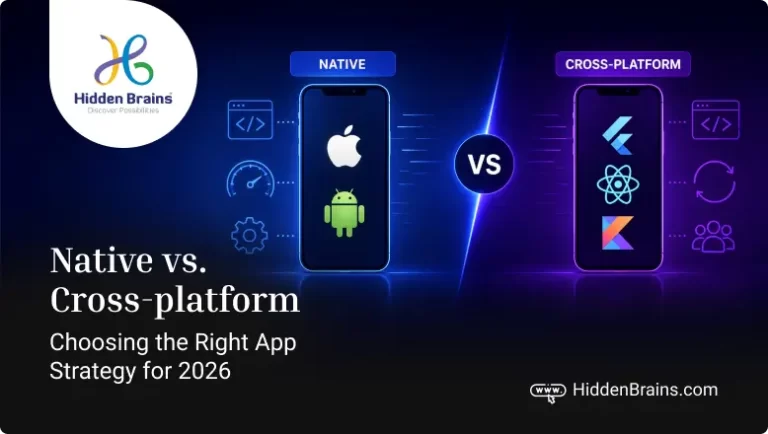
Cross-platform vs native app development comes down to a fundamental trade-off: one shared codebase that can reach multiple platforms faster and with less engineering duplication, or platform-specific codebases that provide maximum control over performance, hardware, and OS capabilities.
For most standard business applications in 2026, cross-platform is the practical default. Native becomes the stronger choice when performance, advanced hardware access, platform-specific UX, or strict technical requirements justify the additional cost and complexity.
This guide compares both approaches across the factors that matter to technology leaders: performance, cost, time to market, security, scalability, device capabilities, AI/ML support, and long-term operating model, and provides a four-part checklist to help you make the decision.
| # | Native | Cross-platform |
|---|---|---|
| Best for | Performance-critical, hardware-heavy, tightly regulated apps | Fast launches, MVPs, standard business apps |
| Product stage | Mature product or enterprise flagship | MVP or early-stage build |
| Competitive edge | UX/performance differentiation | Speed-to-market, cost efficiency |
| Platform roadmap | Mobile-only or mobile-first | Multi-platform (mobile + web + desktop) |
The decision is not simply native vs cheaper cross-platform. It is a choice about where your engineering organization wants to invest: platform-specific depth or shared development velocity.
The decision is not simply native vs cheaper cross-platform. It is a choice about where your engineering organization wants to invest: platform-specific depth or shared development velocity.
| Information | Details |
|---|---|
| Guide Focus | Helps businesses compare native and cross-platform app development based on performance, cost, speed, scalability, platform needs, and long-term goals. |
| Business Challenge | Businesses need to balance development budget, time to market, app performance, user experience, technical requirements, and multi-platform expansion. |
| Target Audience | Business owners, CTOs, product managers, startup founders, and decision-makers planning or upgrading a mobile application. |
| TL;DR | Choosing between native and cross-platform app development depends on your business goals, technical requirements, budget, and growth plans. This guide compares both approaches across performance, cost, time to market, UX, security, scalability, device access, and AI/ML to help you choose the right strategy for your app. |
What is Native App Development?
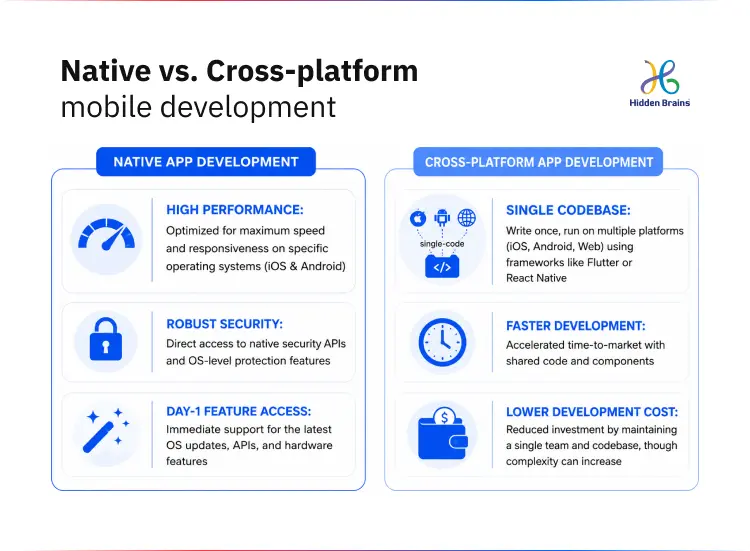
Native app development means building a separate app for each operating system using that platform’s own language and tools, Swift for iOS and Kotlin for Android. Because the code speaks directly to the OS, native apps get the best possible performance, full hardware access, and the newest OS capabilities the day they ship.
The cost is duplication: two codebases, typically two skill sets, and two release cycles to maintain. If you need platform-perfect behaviour on both stores, you’re effectively funding two builds. Hidden Brains delivers these as dedicated iOS app development and Android app development engagements.
How Does Native App Development Work?
You build a separate app for each operating system using its native language and tools, Swift/Xcode for iOS and Kotlin/Android Studio for Android. Each codebase works directly with the platform’s APIs, hardware, and OS features, giving you maximum performance and control, but requiring separate development and maintenance for each platform.
What is Cross-platform App Development?
Cross-platform app development means writing one shared codebase that runs on both iOS and Android. Modern frameworks, React Native, Flutter, and Kotlin Multiplatform, let a single team build and maintain both apps rather than two, which drives cost and time savings.
How Does Cross-platform Development Work?
You write your app logic and UI once in the framework’s language (JavaScript/TypeScript for React Native, Dart for Flutter). The framework then renders that code to real native components or through its own rendering engine, and a “bridge” layer connects your shared code to device features like the camera or GPS. The result is two installable apps from one project, with most of the code reused across them.
The Core Technical Difference Between Cross-Platform and Native Apps
The fundamental difference is how your application interacts with the operating system.
Native applications communicate directly with their target OS, providing maximum access to platform APIs and hardware capabilities. The trade-off is that you maintain separate implementations.
Cross-platform applications share a common development layer that connects application code to the underlying platforms. Modern frameworks have significantly improved this layer, reducing many of the performance limitations associated with earlier generations of cross-platform development.
That distinction explains most of the differences in cost, speed, maintenance, and platform control.
| Factor | Native | Cross-Platform | Business Impact |
|---|---|---|---|
| Performance | Maximum performance | Near-native performance | Native for gaming, AR/VR, and real-time apps |
| Time to Market | Longer development | Faster with shared code | Cross-platform speeds up launches |
| Development Cost | Higher | Lower through code reuse | Cross-platform reduces costs |
| UX & UI | Full platform-specific control | Excellent for standard apps | Native for premium user experiences |
| Device Access | Full access to latest features | Plugin/framework dependent | Native supports new hardware faster |
| Security | Greater platform control | Strong, framework-dependent | Architecture matters more than framework |
| Maintenance | Separate codebases | Shared codebase | Cross-platform simplifies maintenance |
| AI/ML | Native AI framework access | SDK and API support | Native leads for advanced on-device AI |
| Best Fit | Performance-first products | Speed and broader reach | Align with business goals, not trends |
Still deciding between native vs. cross-platform?
Book a Free Consultation
Native vs. Cross-platform: The 2026 Trade-offs at a Glance
Here’s how the two approaches compare on the nine factors that most affect a build decision.
| Factor | Native | Cross-Platform | When to Choose |
|---|---|---|---|
| Performance | Maximum performance with direct OS and hardware access | Near-native performance for standard applications | Choose Native for AR/VR, gaming, real-time media, or low-latency workloads |
| Time to Market | Longer due to separate iOS and Android development | Faster with a shared codebase | Choose Cross-Platform for MVPs, rapid launches, and competitive timelines |
| Cost | Higher due to separate codebases and development teams | Lower with one shared codebase | Choose Cross-Platform when budget efficiency matters; Native for highly specialized experiences |
| UX & UI Fidelity | Platform-specific, highly polished experiences | Very close to native with minor abstraction | Choose Native when platform-specific interactions are critical; Cross-Platform for standard app flows |
| Device Features & OS Updates | Day-one SDK support and full hardware access | Dependent on framework and plugin support | Choose Native for the latest biometrics, NFC, AR, or emerging OS APIs |
| Security & Compliance | Greater control over custom security layers | Strong capabilities, but may depend on third-party plugins | Choose Native for highly regulated or security-sensitive applications |
| Maintenance & Scalability | Higher maintenance across two codebases and fix cycles | Easier maintenance through one shared codebase | Choose Cross-Platform for lean teams and faster multi-platform expansion |
| AI/ML Feature Support | Day-one access to native, on-device AI capabilities | Supported through plugins and bridges | Choose Native for intensive on-device inference; Cross-Platform for most app-level AI features |
| Strategic Business Fit | Requires separate Swift and Kotlin expertise | One team can support multiple platforms | Choose Cross-Platform when reducing headcount and accelerating multi-platform delivery are priorities |
Note – Annual maintenance typically ranges from 5K–150K+, depending on app size, complexity, infrastructure, and support requirements.
The Nine Factors to Compare
The table above is the quick verdict. Here’s the reasoning behind each factor, and where 2026 has changed the answer.
1. Performance.
Native has the higher ceiling because it talks to the OS directly with no translation layer, which is what AR/VR, gaming, and real-time media need. For standard business apps, cross-platform now performs close to native; React Native’s New Architecture and Flutter’s Impeller engine have removed most of the old overhead. Verdict: native for performance-critical apps; cross-platform is sufficient for the rest.
2. Time to market.
Cross-platform is faster because one codebase ships to both stores instead of running parallel iOS and Android tracks. That advantage is largest for MVPs and competitive launches where being first matters more than platform-perfect polish. Native’s two-track build takes longer by design.
3. Costs.
One shared codebase means one team and one maintenance cycle, so cross-platform is typically cheaper to build and to run over three years. Native costs more because you’re effectively funding two builds. The exact gap depends on app complexity and how much native-specific work remains.
4. User experience and UI fidelity.
Native delivers platform-perfect behaviour; every gesture, transition, and control matches the OS exactly. Cross-platform gets very close for standard patterns (forms, lists, navigation, e-commerce), with only minor abstraction. If pixel-level, animation-heavy UX is your competitive edge, native still has the advantage.
5. Access to device features and OS updates.
Native gets day-one access to new SDKs and full hardware control the moment Apple or Google ships them. Cross-platform reaches device features through plugins, so newer or niche capabilities can lag until the framework or community adds support. For most standard features (camera, GPS, push, biometrics), the gap is negligible; for bleeding-edge hardware, native leads.
6. Security and compliance.
Native gives you full control to implement custom encryption, audit trails, and platform-level security, which is why regulated industries often default to it. Cross-platform is capable and secure but leans on plugins and framework constraints for some controls. For HIPAA, PCI-DSS, or GDPR-heavy apps, weigh whether you need native-level control.
7. Maintenance and long-term scalability.
One codebase is cheaper and simpler to maintain: you fix a bug once, not twice, and you scale one team, not two. Native’s two-codebase model raises long-term cost but gives you independent control over each platform’s evolution. For apps shipping frequent updates, cross-platform’s single codebase is the more scalable operating model. [INSERT: verified HB 3-year TCO range.]
8. AI/ML advanced feature support.
This is where the choice matters more in 2026 than it used to. Native gets day-one access to on-device AI frameworks, Apple’s Core ML and Android’s ML Kit / on-device models, and the best performance for heavy on-device inference. Cross-platform reaches AI/ML through bridges and plugins (for example, TensorFlow Lite and generative-AI SDKs for Flutter and React Native), which now cover most mainstream use cases well but can trail for cutting-edge, latency-sensitive on-device inference.
Verdict: Native if real-time on-device ML is core to the product; cross-platform is fine for most AI-assisted features that call cloud models.
9. Strategic business factors.
Beyond the build itself: cross-platform needs one team instead of separate Swift and Kotlin specialists, which lowers headcount and makes hiring easier, and it extends more readily to web and desktop if your roadmap is multi-platform. Native makes strategic sense when a single platform is your focus, when platform-specific UX is a differentiator, or when you’re building a long-lived flagship where independent control per platform is worth the cost.

Got a Project in Mind? Let’s Estimate Your Project Cost—Free.
Request a QuoteWhere Native App Development Wins
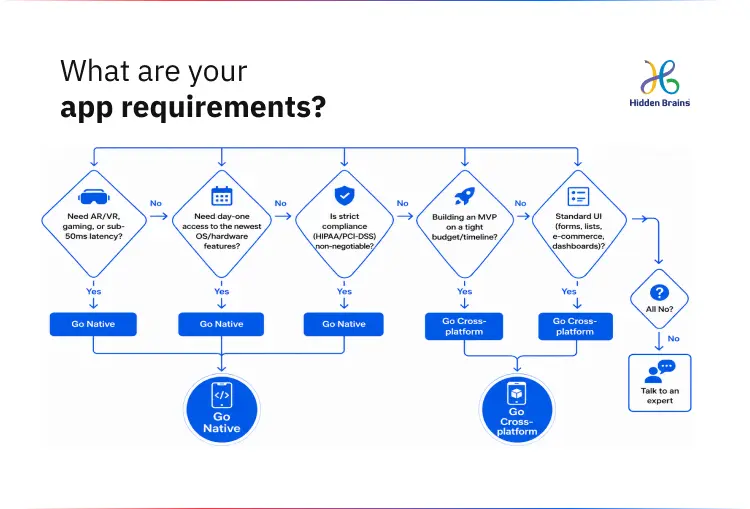
Choose native when the platform itself is doing the heavy lifting:
- Performance is the product
AR/VR, gaming, real-time video/audio, or sub-50ms latency requirements.
- You need day-one OS features
The latest biometrics, NFC, ultra-wideband, or new platform AI APIs the moment they release.
- Compliance is non-negotiable
Healthcare, fintech, or enterprise apps needing custom encryption, audit trails, and platform-level security controls.
- UX differentiation is your edge
A flagship product where platform-perfect animations and gestures are a competitive advantage. - You’re building for one platform only
An iOS-only enterprise tool doesn’t benefit from cross-platform overhead.
What are the Benefits of Cross-platform App Development?
Cross-platform wins whenever speed, budget, and reach matter more than squeezing out the last few points of native performance:
- Faster validation — Launch an MVP on both iOS and Android from one build to test the market quickly.
- Standard UI patterns — Forms, lists, content browsing, e-commerce, and internal dashboards run well cross-platform.
- Budget and timeline pressure — One codebase means one team and one set of updates.
- Smaller teams — You maintain a single codebase instead of two specialised native teams.
- Multi-platform roadmap — Frameworks like Flutter and React Native extend more easily to web and desktop later.
Hidden Brains delivers cross-platform app development with experienced React Native and Flutter specialists, helping businesses build faster across iOS and Android. Hire cross-platform developers who combine technical depth with business context to build for scale, speed, and measurable outcomes.
Where Does Hybrid Fit? Native vs Cross-platform vs Hybrid
These three get conflated constantly, so here’s the clean distinction:
- Native — Separate apps per OS in Swift/Kotlin. Best performance, highest cost.
- Cross-platform — One shared codebase compiled or rendered to real native components (React Native, Flutter). Near-native for standard apps.
- Hybrid — A web app (HTML/CSS/JavaScript) wrapped in a native container. Cheapest and fastest for content-style apps, but furthest from a native feel.
If you’re evaluating frameworks, our guide to Flutter for cross-platform app development explains when it makes strategic sense. For delivery, Hidden Brains provides hybrid app development services through the same mobile engineering practice.
Which is Right For Your Business? A Four-part Decision Checklist
Don’t choose by framework popularity; choose by answering these four sets of questions. This is the scoping checklist our team actually walks clients through before recommending an approach.
1. Product and use-case clarity
- What core problem does the app solve, and for whom (consumer, internal tool, B2B workflow)?
- What are the top three user workflows and the top three failure modes?
- Does it need to work offline, or is online-only acceptable? (Offline-first often pushes toward native storage and sync logic.)
2. Technical and integration requirements
- Which device features are mandatory (camera, GPS, biometrics, NFC, BLE, background location)? (Advanced hardware can expose cross-platform plugin gaps.)
- What must it integrate with (payments, CRM, ERP, identity providers, legacy APIs)?
- Are there compliance constraints (HIPAA, PCI-DSS, GDPR, SOC 2, accessibility)?
- What’s the expected user scale at launch and at 12 months?
3. Business model and timeline
- Is this an MVP to validate an idea, or a flagship product? (MVP → cross-platform; flagship → native may be justified.)
- Is there a hard launch deadline, and what happens if you miss it?
- What’s the realistic budget for build plus three years of maintenance?
- Will you expand to web or desktop within two years?
4. Team and operational readiness
- Who owns the app after launch — in-house, vendor, or hybrid?
- What’s your team’s existing stack (JavaScript, Swift, Kotlin)? (Aligning the framework to existing skills cuts hiring and training costs.)
- How often will you ship updates? (High-frequency iteration favours one codebase.)
Rule of thumb: If most of your answers point to speed, budget, standard UI, and a multi-platform future, cross-platform is your default. If they cluster around performance, hardware, compliance, or single-platform depth, native earns its cost.
The 2026 reality check
The old “native is always faster” rule no longer holds for standard business apps, because both leading frameworks rebuilt the layer that used to cause the slowdown. React Native’s New Architecture (Fabric, TurboModules, JSI) became the default in React Native 0.76, and the legacy architecture was frozen in mid-2025, meaning new work targets the faster architecture only. Flutter renders through its own Impeller engine for smoother, more consistent animations across platforms.
The honest picture on adoption: In Statista’s cross-platform developer survey, roughly 46% of surveyed developers reported using Flutter, and 35% reported using React Native. Treat that as framework usage among surveyed developers, not “market share,” and not a 2026 figure, since developers can report multiple frameworks. Both sit firmly in the top tier of tools teams actually use.
Where native still clearly leads in 2026: Gaming, AR/VR, professional media tools, regulated industries, and flagship consumer apps where performance is the product. For most other categories, a well-built cross-platform app is hard to distinguish from native.
When React Native is the Right Call — and When it Isn’t
Choose React Native when your team already knows JavaScript/TypeScript, you want to share logic with an existing React web codebase, you’re shipping standard UI to both stores fast, and you value a large ecosystem and hiring pool. Its New Architecture has closed much of the old performance gap for these apps.
Look elsewhere when you need pixel-perfect, animation-heavy UI across many surfaces (Flutter often fits better), or when you’re building a performance- or hardware-critical app where native is warranted.
If React Native fits your build, you can hire React Native developers who work within our CMMI Level 3 process, or hire mobile app developers across native and cross-platform for a blended team.
Not sure yet? Our team will pressure-test your requirements against the checklist above before a line of code is written.
Real example: Hidden Brains’ Lohalive platform delivered 2X digital transactions and 10% growth in market share, combining web, admin, and React Native mobile capabilities backed by 30+ years of industry experience.
Frequently Asked Questions
How should a CTO decide between native and cross-platform development?
Start with the business constraint, not the technology. Assess product differentiation, performance requirements, device dependencies, time to market, three-year TCO, internal capabilities, and platform roadmap. The right mobile app development company should help validate these trade-offs before recommending an architecture.
When does the higher cost of native development actually make business sense?
Native earns its premium when platform depth directly affects business value, for example, advanced hardware, real-time processing, AR/VR, high-performance media, or a highly differentiated mobile experience. If those capabilities are not strategic, native app development services may add cost without creating equivalent value.
Is cross-platform still a sensible choice for enterprise applications?
Yes, when the application does not depend heavily on platform-specific capabilities. Modern cross-platform app development services can support complex enterprise workflows while reducing duplicated development and maintenance. The decision should still account for security, integrations, performance, and long-term governance.
Should we optimize for development cost or total cost of ownership?
TCO. A lower initial development quote can become expensive through duplicated maintenance, specialist hiring, platform updates, technical debt, and rework. Mobile app development services should therefore be evaluated across the expected product lifecycle, not just the first release.
What if our requirements need both cross-platform speed and native capabilities?
You don’t necessarily have to choose one exclusively. A shared cross-platform foundation can handle common product functionality while native modules address hardware, performance, or platform-specific requirements. This can provide a better balance than forcing the entire application into one model.
What should we evaluate before choosing a mobile app development company?
Evaluate more than technical skills. Look at architecture capability, relevant product experience, security and governance, engineering maturity, scalability, communication, ownership model, and ability to challenge assumptions. The strongest partner helps identify the right engineering model rather than simply supplying developers.
Is React Native suitable for long-term product development?
It can be, particularly where shared development, a strong JavaScript/TypeScript talent pool, and multi-platform delivery are priorities. Businesses should still assess native dependencies, performance requirements, team capability, and roadmap complexity before they hire React Native Developers.
Can we start with cross-platform and move to native later?
Yes, but migration should not be treated as a free option. If the roadmap is likely to require deep platform capabilities, those requirements should influence the architecture from the beginning. Good mobile app development services anticipate where the product is going, not just what version one needs.
What is the biggest mistake businesses make with this decision?
Choosing based on technology popularity or development rates instead of the problem being solved. A faster codebase does not help if the product needs native capabilities, and a technically powerful native build does not create value if the business primarily needs speed and reach.



Conclusion
Native vs cross-platform is ultimately a business and operating-model decision, not a framework decision.
Choose cross-platform when speed, efficiency, and multi-platform reach matter most. Choose native when performance, hardware access, or platform-specific differentiation justify the additional investment.
The right architecture is the one that supports your product strategy today and your roadmap tomorrow. Stuck between native vs. cross-platform architecture? Get 2 Hours of Free Expert Consultation—bring your questions, challenge your assumptions, and leave with a clear app strategy built for today and tomorrow.