
































































![Sales & Distribution [Oil & Gas]](https://www.hiddenbrains.com/blog/wp-content/themes/blankslate/assets/images/sales_and_distribution-icon.74d08193.svg "Sales & Distribution [Oil & Gas]")

![Fluid Terminal Management [Oil & Gas]](https://www.hiddenbrains.com/blog/wp-content/themes/blankslate/assets/images/fluid_terminal_management-icon.4b3a27a4.svg "Fluid Terminal Management [Oil & Gas]")


![Sales & Distribution [Oil & Gas]](https://www.hiddenbrains.com/blog/wp-content/themes/blankslate/assets/images/sales_and_distribution-icon.74d08193.svg?1.0.0 "Sales & Distribution [Oil & Gas]")
![Fluid Terminal Management [Oil & Gas]](https://www.hiddenbrains.com/blog/wp-content/themes/blankslate/assets/images/fluid_terminal_management-icon.4b3a27a4.svg?1.0.0 "Fluid Terminal Management [Oil & Gas]")




























































































Summary
- React Native app costs depend on what you build, not just the framework you choose.
- Your biggest cost drivers are features, integrations, design, backend, and compliance needs.
- An MVP-first approach helps validate ideas while keeping initial investment under control.
- The right hiring model can impact your budget as much as the development scope.
- Maintenance, infrastructure, and updates are part of the real app cost.
- React Native works well for businesses that need speed, flexibility, and scalability.
- Choosing the right development partner helps reduce risk and improve long-term ROI.
Ask ten development teams to quote the same React Native app, and you’ll get ten numbers far enough apart to buy either a used car or a house, and none of them is lying. That gap is what a $322 billion market with no standard pricing looks like: Grand View Research projects the global mobile application market to reach $322.6 billion in 2026, up from $285.7 billion in 2025.
React Native powers a large share of it, used by roughly 8% of the world’s professional developers (Stack Overflow Developer Survey), so the talent to build your app is everywhere, at wildly different rates.
So here’s the honest answer up front: if you want to hire React Native developers in 2026, expect a build to cost from $15,000 for an MVP (feature-rich MVPs can range up to $100,000) to $300,000+ for an enterprise-grade product. The spread is that wide because scope, hiring model, and team location set the price, not the framework. This guide breaks down what actually moves that number so you can build a budget you can defend instead of reacting to whichever quote lands first.
The essentials at a glance:
- Cost by stage: Cost by stage: MVP $15K–$100K · Mid-market $50K–$120K · Enterprise $150K–$300K+.
- Biggest levers: feature complexity, integrations, AI features, compliance, and where your team sits (rates range ~$15/hr in Asia to $150+/hr in North America).
- Hiring model matters as much as rate: freelancer, agency, dedicated team, and staff augmentation carry different total costs of ownership.
- Don’t forget maintenance: budget 15–25% of build cost per year.
- Hidden Brains starting rate: you can hire react native developers from $25/hour, with CMMI Level 3 process and ISO 27001:2022 security intact.
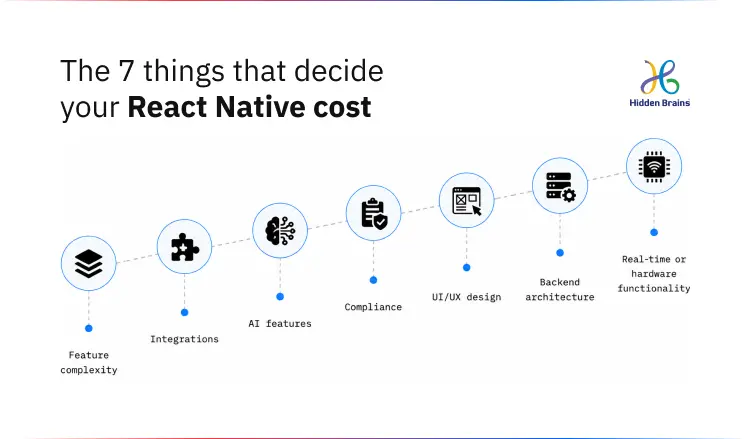
“The 7 things that decide your React Native cost.”
Complexity, integrations, AI, compliance, design, backend, real-time/hardware.
Alt text: “Seven factors that determine React Native app development cost in 2026: feature complexity, integrations, AI features, compliance, UI/UX design, backend architecture, and real-time or hardware functionality.”]
Why React Native Is Still a Smart Investment in 2026
React Native continues to be the preferred choice when the business objective is to launch faster, control development costs, and scale efficiently. Its value comes from the combination of engineering efficiency and long-term operational flexibility rather than any single technical feature.
| Section | Details |
|---|---|
| Guide Focus | How Malaysian logistics companies can modernise their operations with Transport Management Systems (TMS), Warehouse Management Systems (WMS), fleet tracking, and AI-powered logistics solutions. |
| Target Audience | Freight operators, 3PL providers, warehouse managers, supply chain leaders, COOs, operations heads, and businesses evaluating logistics technology investments in Malaysia. |
| TL;DR | Malaysian logistics operators are moving beyond spreadsheets and disconnected tools as customer expectations, cross-border complexity, and operational pressures increase. This guide explains how TMS, WMS, fleet tracking, and AI capabilities improve visibility, reduce inefficiencies, and support scalable growth. It covers when to buy, configure, or build custom logistics software, key ROI areas, implementation considerations, and how to choose the right logistics software development partner. |
| Main Takeaways | Learn why generic logistics platforms often fall short in Malaysia, explore essential TMS/WMS/fleet features, understand AI opportunities in logistics, evaluate software ROI, and identify the right approach for building a future-ready supply chain platform. |
| Business Challenges Covered | Manual processes, disconnected systems, inventory inaccuracies, poor fleet visibility, inefficient route planning, compliance requirements, cross-border logistics complexity, and difficulties scaling operations. |
| Recommended For | Logistics companies planning digital transformation, custom TMS/WMS development, fleet management platforms, AI-enabled supply chain solutions, or integrated enterprise software initiatives in Malaysia. |
| Expected Outcome | A practical framework to choose the right logistics technology approach, improve operational efficiency, reduce costs, and build a scalable digital foundation for future growth. |
Best suited for: Startups, SaaS platforms, healthcare, fintech, logistics, eCommerce, and enterprise business applications.
Consider native development when: Your app depends heavily on advanced graphics, intensive gaming, AR/VR, or deep platform-specific hardware capabilities.
Typical React Native Development Costs by Project Type
Rather than asking, “How much does a React Native app cost?”, a better question is, “What stage of product development are you funding?” Investment requirements change significantly as products move from market validation to enterprise-scale operations. The table below provides a practical benchmark for each stage.
| Project Type | Typical 2026 Cost | Timeline | What It Usually Includes |
|---|---|---|---|
| MVP / startup app | $15,000 – $40,000 | 6–16 weeks | One core flow, simple backend, basic auth, single-region launch. |
| Mid-market app | $50,000 – $120,000 | 16–28 weeks | Custom UI, payments, real-time features, 2–4 integrations, analytics. |
| Enterprise-grade app | $150,000 – $300,000+ | 28+ weeks | Complex logic, compliance, multiple integrations, scale/security hardening. |
The decision to launch with an MVP often determines whether a project stays within budget. While lean MVPs typically fall between $15K and $40K, products requiring complex workflows, AI capabilities, multiple integrations, or enterprise-ready architecture can extend to approximately $100K.
What Actually Drives React Native Development Costs: 7 Key Factors
Cost variance comes down to seven scope drivers. Understand these, and you can read any quote critically instead of trusting the headline number.
- App complexity and feature scope. The single largest driver. “Login” isn’t one thing; email/password is a day; social sign-in with biometric fallback, cross-device sessions, and 2FA is two weeks. Count the features that touch the network or the device; those set the price, not screen count.
- Third-party integrations and APIs. Each integration- payments, maps, chat, CRM, ERP, identity, adds build, testing, and maintenance. Stable, well-documented APIs are cheap to add; legacy or undocumented enterprise systems cost more than the feature they support because the work is in the edge cases.
- AI capabilities introduce a different cost profile than traditional application features. Beyond implementation, they require model selection, pipeline engineering, evaluation, governance, and recurring inference costs. Budget AI separately to avoid underestimating both development and operating expenses.
- Compliance and security. Regulated apps cost more because compliance is engineering work, not paperwork. Healthcare (HIPAA), fintech (PCI-DSS, KYC, encryption, fraud checks), and government-adjacent apps need secure architecture, audit trails, and heavier testing:
| App category | Typical 2026 range | Why it’s higher |
|---|---|---|
| eCommerce | $30,000 – $100,000 | Catalog, payments, inventory, analytics |
| Logistics / on-demand | $40,000 – $150,000+ | GPS, real-time dispatch, route optimization |
| Healthcare | $50,000 – $200,000+ | HIPAA compliance, secure patient data |
| FinTech | $70,000 – $250,000+ | Encryption, KYC, fraud detection, banking APIs |
For regulated builds, ISO/IEC 27001:2022 and ISO 9001:2015 controls behind the code are part of what you’re buying, not an afterthought.
- User experience is a business differentiator, not simply a design exercise. Professional UI/UX development services help translate business objectives into intuitive digital experiences that improve adoption and retention. Although custom interfaces require greater investment than standard templates, they often generate stronger long-term returns through higher customer engagement.
- Backend and infrastructure architecture. Unless your app is genuinely backend-less, someone builds and hosts APIs, databases, and business logic. Architecture decisions made early (monolith vs services, real-time vs batch) shape both build cost and the recurring bill.
- Real-time functionality and device-hardware access. Live chat, location tracking, video, offline sync, camera, Bluetooth, and payments each add engineering and QA. Every feature that syncs data in real time or reaches into device hardware multiplies effort.
Planning your app? Get a clear cost estimate based on the project.
Get Free Consultation
How Hiring Decisions Influence Your Total Development Budget
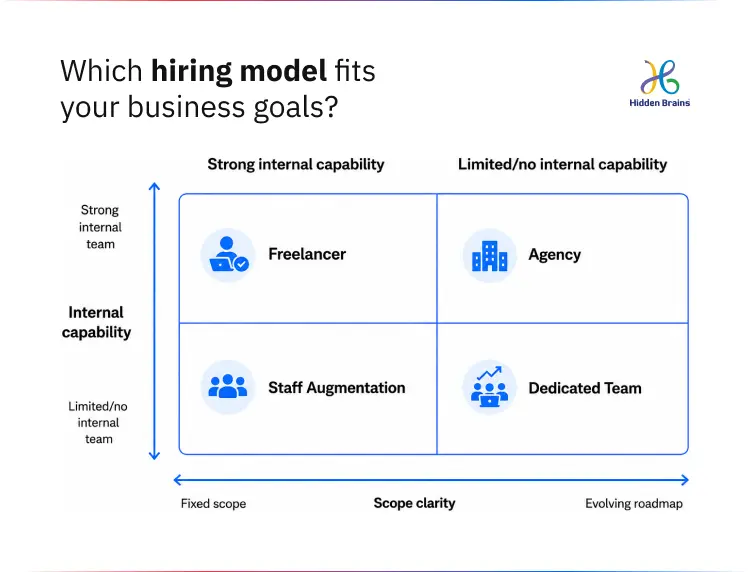
Your hiring model and team location change both the cost structure and the risk you carry, often more than the feature list does. Same app, priced four ways, before you even pick a country.
Start with location, the most visible lever; the same scope can vary 3–4x purely on where the team sits:
| Region | Typical hourly rate (2026) |
|---|---|
| North America (US / Canada) | $60 – $150+ |
| Western Europe | $50 – $120 |
| Eastern Europe | $30 – $60 |
| Latin America | $30 – $70 |
| South / Southeast Asia (incl. India) | $20 – $50 |
Agencies in India and similar hubs often deliver comparable scope at 60–70% below US/UK pricing, which is why cost-conscious teams split the difference, senior ownership onshore, and build capacity offshore. React Native specialists also carry a 15–25% premium over general React web developers, since cross-platform mobile is a distinct skill set.
At Hidden Brains, hiring dedicated developers starts at $25/hour, allowing organizations to optimize development costs without compromising access to experienced engineering talent. Pricing scales according to seniority, technical specialization, and project requirements.
Then the model itself:
| Model | Cost structure | Best when… | Main risk |
|---|---|---|---|
| Freelancer | Hourly, lowest headline rate | Small, well-defined task or a single specialist gap | Continuity and accountability; no backup if they drop off |
| Agency (fixed project) | Fixed bid/milestones | Defined scope, one-off turnkey build | Change requests get expensive mid-project |
| Dedicated team | Monthly per person, all-in | Evolving product with an ongoing roadmap | Needs product ownership on your side to steer |
| Staff augmentation | Monthly per engineer, you manage | You have a team but a capacity or skills gap | You own delivery governance |
The honest framing: freelancers minimize the invoice, not the total cost of ownership. For anything with a roadmap past launch, a dedicated React Native team or staff augmentation usually costs less over 18 months because knowledge stays in one place and rework drops.
We break this down in our guide to when to hire a dedicated team. A functioning build also needs more than one role: React Native engineer(s), backend developer, UI/UX designer, QA, and a product owner, so “hourly rate” is the wrong number to optimize alone.
Hidden Costs Businesses Often Miss
The “final” quote rarely is; these are the line items that quietly inflate a React Native budget. Account for them upfront and the number stops surprising you:
- Maintenance — The big one. Budget 15–25% of build cost per year for OS updates (iOS/Android ship yearly and break things), library upgrades, security patches, and incremental features. An $80,000 build carries roughly $5,000–$15,000/year. An unmaintained app degrades fast.
- Backend hosting and infrastructure. Cloud, databases, and API ownership, often 10–20% of build cost, recurring monthly.
- App Store and Play Store. Apple Developer Program ($99/yr) and Google Play ($25 one-time), plus real engineering time for store-review readiness.
- QA and device coverage. Testing across the fragmented Android device landscape is a real cost, not a rounding error.
- Third-party service fees. Maps, SMS/OTP, push, analytics, and AI inference bill monthly and scale with your users.
- Project management. Coordination is real work, visible in every honest quote, hidden in cheap ones.
The 18-month rule is worth internalizing: skip routine updates past 18 months and linear fixes turn into exponential problems. Planned maintenance is far cheaper than emergency rescue work

Need a Team to Execute Your React Native Vision?
Hire Now!React Native vs Flutter vs Native: Total Cost of Ownership
Judge frameworks on total cost of ownership over 2–3 years, not the initial build quote; that’s where the real money is. Both React Native and Flutter build one app instead of two, commonly reducing development cost 30–50% versus maintaining separate iOS and Android native teams. Native’s cost problem is structural: every feature, fix, and OS update is done twice, in two languages, forever.
| Dimension | React Native | Flutter | Native (iOS + Android) |
|---|---|---|---|
| Codebase | Single (JS/TS) | Single (Dart) | Two separate |
| Initial build cost | Lower for JS teams; fast MVP | Slightly higher upfront (Dart) | Highest (≈2x cross-platform) |
| Talent pool/hiring | Largest (JavaScript) | Growing, smaller | Deep but split across two skill sets |
| Long-term maintenance | Moderate; needs dependency discipline | Often lower; consistent UI | Highest; changes made twice |
| Time-to-market | Fastest with React teams | Fast | Slowest |
| Best fit | React/JS ecosystem, fast iteration, OTA updates | UI-heavy, brand-consistent, performance | Deep platform-specific features |
The key consideration:
React Native often wins on upfront investment and hiring flexibility. Its larger talent ecosystem, faster MVP development, and cross-platform capabilities help businesses launch and iterate faster.
Flutter can offer advantages for long-term maintenance through its unified UI framework and consistent development experience.
However, the biggest factor in total cost of ownership is not the framework alone. Architecture quality, engineering practices, and product planning have a greater impact on long-term success.
A well-built application with the right technical foundation will deliver better results than a poorly planned implementation, regardless of the framework chosen.
For a deeper technical comparison, see our Flutter vs. React Native vs. Kotlin.
How to Reduce Development Costs Without Compromising Quality
You cut cost by cutting scope and rework, not by cutting rate until quality collapses and you pay twice. The moves that actually work:
- Scope ruthlessly, then ship an MVP. Validate the one thing that matters before funding everything else.
- Reuse before you build. Mature React Native libraries and proven components beat custom code for standard features.
- Invest in discovery. A tight product brief and early architecture decisions are the cheapest hours you’ll spend, it prevents expensive mid-build pivots.
- Blend your team by geography. Senior ownership where it counts; build capacity where it’s cost-efficient.
- Budget maintenance from day one. Planned upkeep is far cheaper than emergency rescue on a neglected codebase.
- Choose a partner on demonstrated output, not the lowest hourly rate. The cheapest quote is regularly the most expensive project once rework is counted.
Choosing the Right React Native Development Partner
The right React Native partner is the one whose delivery process, security posture, and hiring model match your stage, not simply the lowest bid. Rate tells you the invoice; process tells you the total cost. What to check before you commit:
- Demonstrated output. Ask for shipped apps and references, not a portfolio of logos. Real delivery experience is the strongest signal.
- Process maturity. CMMI Level 3 excellence means fewer defects reach production, which directly lowers rework cost and post-launch firefighting.
- Security and compliance. For regulated or data-sensitive apps, ISO/IEC 27001:2022 and ISO 9001:2015 certification is table stakes, not a nice-to-have.
- Flexible engagement models. A partner who can move between fixed-scope, dedicated team, and staff augmentation lets you match spend to your roadmap as it changes.
- Maintenance commitment. Confirm who owns updates, security patches, and OS compatibility after launch, before launch.
- Communication and time-zone overlap. Delivery governance and overlap hours matter more to total cost than the headline rate.
The Hidden Brains Advantage
Hidden Brains combines engineering expertise, delivery discipline, and flexible engagement models to help businesses build and scale React Native applications with confidence.
- Proven delivery experience — Two decades of software delivery across 107 countries, supported by experience across diverse business and technology requirements.
- Structured engineering approach — A mature development process with defined workflows, code reviews, and quality practices that reduce delivery risks and rework.
- Security and quality focus — Certified security and quality management practices designed to support applications where reliability and data protection are critical.
- Cost-efficient access to talent — React Native developers with flexible engagement models, helping businesses optimize development costs while accessing experienced engineering capabilities.
- Flexible engagement models — Choose from dedicated teams, staff augmentation, or fixed-scope delivery based on your product stage and internal capabilities.
- End-to-end product expertise — Access React Native engineers alongside backend, UI/UX, QA, and project management resources for complete delivery support.
- Long-term product support — Ongoing maintenance, security updates, and platform compatibility support to help applications remain reliable after launch.
Ready to plan your React Native investment? Explore our React Native app development services to understand how our expertise, engagement models, and delivery approach align with your goals.
Frequently Asked Questions
How much does it cost to hire React Native developers at Hidden Brains?
React Native developers at Hidden Brains start at $25/hour, with rates scaling by seniority and specialization. Because we work across dedicated-team, staff-augmentation, and fixed-scope models, the final cost depends on team size and engagement type rather than a single headline rate; we scope it for your specific app before you commit.
What engagement models does Hidden Brains offer for React Native projects?
Three: a dedicated React Native team (a stable unit for an evolving roadmap), staff augmentation (drop skilled engineers into your existing team to close a capacity or skills gap), and fixed-scope project delivery (a defined build with milestone-based delivery). You can start with one model and switch as your product matures.
Can I hire a single React Native developer, or only a full team?
Both. You can hire React Native developers individually through staff augmentation, or engage a complete cross-functional team- React Native engineers, backend, UI/UX, and QA with a project manager- when you need end-to-end delivery.
How does Hidden Brains ensure code quality and security?
Delivery runs on a CMMI Level 3 process with ISO/IEC 27001:2022 (information security) and ISO 9001:2015 (quality management) certification. In practice, that means defined engineering standards, code review, structured QA, and secure data handling — the controls that reduce defects and rework, and that regulated (healthcare, fintech) builds require.
Do you sign an NDA, and who owns the code and IP?
Yes! Hidden Brains works under an NDA, and clients own the source code and intellectual property for work delivered.
How quickly can you onboard React Native developers to my project?
48-72 Hours. Onboarding speed is one of React Native’s advantages, since developers with React experience ramp quickly.
How do I get a cost estimate for my React Native app?
Share your app idea, must-have features, target platforms, and timeline through our enquiry form, and we’ll scope it, including integration risk, compliance needs, and the right hiring model, and return a realistic estimate rather than a generic range.


Conclusion
React Native app cost isn’t a single number; it’s the sum of decisions about scope, hiring model, team location, and the partner you trust to deliver. The teams that get the most from their budget do three things: they scope ruthlessly, they judge partners on demonstrated output rather than hourly rate, and they plan for maintenance before they write a line of code. Get those right, and the budget follows.
Make your next app decision with confidence. Understand your costs, timeline, and development approach before you invest with our free consultation.