

































![Sales & Distribution [Oil & Gas]](https://www.hiddenbrains.com/blog/wp-content/themes/blankslate/assets/images/sales_and_distribution-icon.74d08193.svg "Sales & Distribution [Oil & Gas]")

![Fluid Terminal Management [Oil & Gas]](https://www.hiddenbrains.com/blog/wp-content/themes/blankslate/assets/images/fluid_terminal_management-icon.4b3a27a4.svg "Fluid Terminal Management [Oil & Gas]")


![Sales & Distribution [Oil & Gas]](https://www.hiddenbrains.com/blog/wp-content/themes/blankslate/assets/images/sales_and_distribution-icon.74d08193.svg?1.0.0 "Sales & Distribution [Oil & Gas]")
![Fluid Terminal Management [Oil & Gas]](https://www.hiddenbrains.com/blog/wp-content/themes/blankslate/assets/images/fluid_terminal_management-icon.4b3a27a4.svg?1.0.0 "Fluid Terminal Management [Oil & Gas]")










































Summary
- Check why the MERN stack remains the preferred choice for US SaaS companies looking to build and scale products faster.
- Learn how a unified JavaScript stack helps reduce development complexity, improve team collaboration, and speed up product delivery.
- Discover the key business benefits of MERN, including faster MVPs, lower engineering costs, easier hiring, and simpler long-term maintenance.
- Understand where MERN isn’t the right fit and when other technologies may be a better choice for your product requirements.
- Explore how MERN supports AI-powered SaaS applications, from intelligent search and copilots to workflow automation and RAG experiences.
- Compare hiring in-house teams versus dedicated MERN developers to find the most effective model for your budget, timeline, and growth plans.
- Get a practical framework to evaluate whether MERN aligns with your SaaS roadmap, business goals, and future scalability needs.
New JavaScript tools launch almost every month, yet many US SaaS companies still build on MERN and still hire MERN stack developers to do it. The reason is simple. For most SaaS products, MERN gets a working version in front of users faster, costs less to run, and is easier to staff than the newer options.
This post explains why that is true, where MERN gives you the biggest advantage, and, just as important, where it is the wrong choice. No hype. Just the trade-offs a product owner actually cares about.
What a MERN Stack Developer Actually Delivers
A MERN stack developer builds your entire web app using one language, JavaScript, from the screen the user sees all the way to the database. MERN stands for MongoDB (the database), Express (the server framework), React (the user interface), and Node.js (the runtime that powers the backend).
That “one language” point is the whole idea. The person building your buttons and the person building your login system speak the same language. So a small team can own the full product, front and back, without translating between two different worlds. Fewer handoffs mean fewer bugs and faster shipping.
According to the Stack Overflow 2025 Developer Survey, JavaScript is still the most used programming language, and Node.js and React sit at the top of the web framework list. In plain terms, the tools inside MERN are not niche. They are what most of the world already builds with, which matters a lot when you go to hire.
| Details | Information |
|---|---|
| Guide Focus | Helping US SaaS companies evaluate whether the MERN stack is the right technology choice for building scalable, AI-ready web applications while improving development speed, reducing costs, and accelerating product delivery. |
| Business Challenge | SaaS companies need to launch products faster, control engineering costs, hire skilled developers efficiently, maintain scalable architectures, and adopt AI capabilities without increasing technical complexity or long-term maintenance overhead. |
| Target Audience | US SaaS founders, CTOs, CIOs, engineering managers, product leaders, startup founders, technology decision-makers, and businesses looking to build, modernize, or scale SaaS products using MERN. |
| TL;DR | MERN remains one of the strongest choices for SaaS development because it combines rapid product delivery, lower development costs, a large JavaScript talent pool, and flexibility to integrate modern AI capabilities. It may not be ideal for SEO-first platforms, highly relational databases, or ultra-low-latency systems. |
| Key Evaluation Criteria | Time to MVP, engineering productivity, hiring availability, development cost, scalability, maintainability, AI integration, database requirements, performance needs, security, and long-term product roadmap. |
| Expected Outcome | A practical framework to determine whether MERN aligns with your SaaS roadmap, understand where it delivers the greatest business value, evaluate hiring models, and choose the right development partner for long-term product success. |
Where MERN Creates the Greatest SaaS Advantage
MERN’s biggest advantage for SaaS companies is not a single technical feature; it is the reduction of friction across the entire product lifecycle. From validating an MVP to scaling a mature platform, the stack influences how quickly teams can build, hire, iterate, and maintain software over time.
| Metric | Why It Matters |
|---|---|
| Time to MVP | You start earning revenue and learning from real users sooner. |
| Feature release velocity | You ship updates faster than competitors chasing the same market. |
| Engineering scalability | The huge JavaScript talent pool makes hiring quicker and cheaper. |
| Long-term maintainability | One codebase and one language means less technical debt over time. |
Here is how those turn into real savings. One language means one team instead of two separate front-end and back-end groups, so your salary load is lighter. A large talent pool means you are not paying a scarcity premium to find people. And shared code across the app means less time and less money spent on maintenance every year the product lives.
A quick, honest note: While the opportunity is clear, the magnitude of savings varies by product, architecture, and implementation. Share your project objectives and requirements, and we’ll quantify the potential impact and recommend the most suitable development strategy.
Not sure if MERN fits your SaaS roadmap?
Get a Free Consultation
When MERN Is the Wrong Choice
MERN is not right for everything, and pretending otherwise would cost you money. Skip MERN, or at least think hard, in three cases.
- First, if organic search is your primary growth channel and you need pages to load quickly for Google, a framework designed for server-side rendering like Next.js often gives you an advantage right from the start.
- Second, if your data structure is highly relational, such as complex financial records with strict connections between entities, a traditional SQL database like PostgreSQL is often a better choice than MongoDB.
- Third, if you have a performance-sensitive area, such as a high-frequency trading system or intensive real-time processing, a faster language like Go or Rust may be worth using for that specific component.
Good engineering teams mix tools. You can run MERN for most of the product and still bring in the right tool for the one part that needs it.
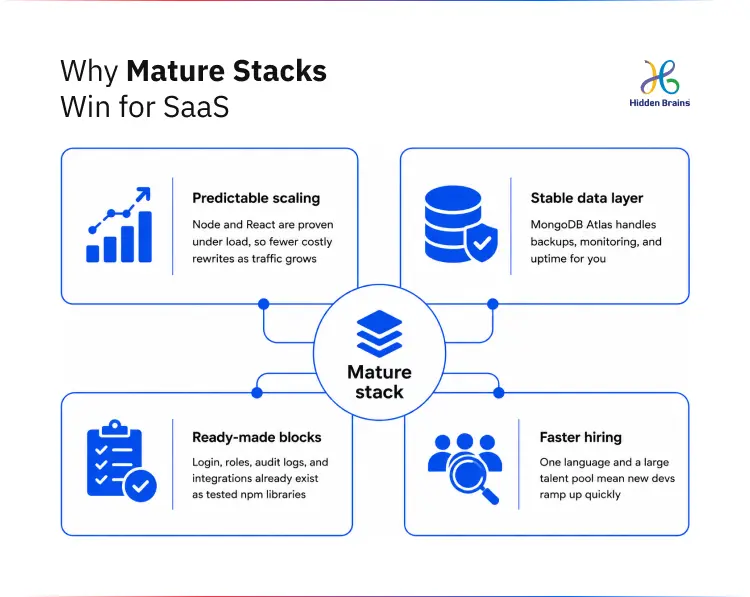
Why Mature Stacks Win for SaaS
Technology decisions are rarely about choosing the newest tool. For SaaS companies, the bigger consideration is reducing execution risk while maintaining the ability to move quickly. This is where mature stacks create a measurable advantage.
A mature technology stack gives product teams something newer technologies cannot immediately provide: proven patterns, predictable behavior, experienced developers, and established solutions for common engineering challenges.
MERN’s maturity creates four practical advantages:
1. Lower Architecture Risk
React and Node.js have powered production applications for more than a decade, meaning teams can rely on established architectural patterns instead of experimenting with unproven approaches.
2. Faster Feature Development
The MERN ecosystem includes thousands of production-tested libraries for authentication, payments, integrations, analytics, testing, and application infrastructure. Teams spend less time rebuilding common functionality and more time delivering product value.
3. Easier Hiring and Scaling
JavaScript remains one of the largest developer ecosystems globally. This gives SaaS companies access to a broader hiring market and reduces dependency on scarce specialist talent.
4. Operational Reliability
MongoDB Atlas provides managed database operations including backups, monitoring, security controls, and scalability features, allowing engineering teams to focus on product development instead of infrastructure management.MERN wins in the areas that determine whether a SaaS product ships on time and remains affordable to run: development speed, hiring, community, and control. For most SaaS roadmaps, those matter more than winning a benchmark.
Can MERN Handle AI-Powered SaaS Features?
Yes. MERN is increasingly being used by SaaS companies to add AI capabilities without rebuilding their existing technology stack. The reason is simple: most AI features are not replacing the core application, they are enhancing existing workflows, customer experiences, and business processes.
MongoDB Atlas Vector Search enables capabilities such as semantic search, AI knowledge assistants, recommendations, and retrieval-augmented generation (RAG) by bringing AI search capabilities closer to the application data layer. React and Node.js provide the flexibility to build AI-powered interfaces, integrate with leading AI models, and deliver features such as copilots, automation, and intelligent dashboards.
For SaaS companies, the strategic advantage is speed. Teams can introduce AI incrementally, starting with a single high-value use case such as customer support automation, intelligent search, or workflow assistance, and expand based on user adoption and business impact.
The key question is not whether MERN can support AI; it is whether the chosen architecture aligns with the complexity of the AI workload. For most business SaaS applications, MERN provides the flexibility, ecosystem, and development speed needed to move AI initiatives from experimentation to production.
| AI Capability | SaaS Use Case |
|---|---|
| AI Assistants | Customer support bots and internal copilots. |
| Semantic Search | Finding information based on meaning, not keywords. |
| RAG Applications | Chat with company documents and knowledge bases. |
| Recommendations | Personalized content, products, or workflows. |
| Automation | AI-powered reporting, classification, and task handling. |
Build In-House or Hire Remote MERN Developers?
There is no single right answer here. It depends on how fast you need to move and how much of a permanent team you want to own. The honest trade-offs look like this.
| Decision Factor | In-House | Remote Dedicated Team |
|---|---|---|
| Time to hire | Slower; weeks to months to source, vet, and onboard. | Faster; a vetted team can start in days. |
| Product velocity | Strong once the team is settled and knows the product. | Strong early; ramps quickly with an established team. |
| Cost | Higher; salaries, benefits, office, and overhead. | Lower; you pay for the team, not the overhead. |
| Flexibility | Harder to scale up or down quickly. | Easy to add or reduce developers as needs change. |
| Scaling | Limited by your local hiring market. | Access to a wider global talent pool. |
Many US SaaS companies use a mix. They keep a small core team in-house for product knowledge and direction, then hire dedicated MERN stack developers remotely to add speed and scale without the long hiring cycle or the full overhead of headcount.
If you go the remote route, a short checklist saves you pain later. Look for MERN stack developers for hire who can show real production SaaS work, not just demos. Check how they handle testing and code reviews. And confirm you keep full ownership of the code and repositories. Cost varies widely, so get a scoped quote against your actual requirements rather than a headline hourly rate.

From idea to launch, we help SaaS companies build and ship products faster.
Start Your JourneyWhy Hidden Brains Helps SaaS Companies Ship Faster
Hidden Brains builds and staffs MERN teams for SaaS products, backed by a CMMI Level 3 and ISO-certified delivery process, and has been in software engineering since 2003. What that certification means in practice is a defined process for code reviews, testing, and delivery, so fewer defects reach production, and your releases stay predictable.
Our model is designed to address these trade-offs. You get a dedicated MERN development team that works as an extension of your own, with the flexibility to scale up for major releases and scale back as priorities change. Best of all, you can choose a flexible engagement model that aligns with your project requirements, budget, and business goals, whether you need full-time developers, a dedicated team, or project-based support.
Whether you need to build a new SaaS product, from AI copilots and workflow automation tools to analytics dashboards, collaboration platforms, and customer portals, or hire a dedicated development team, the goal is the same: deliver high-quality software faster without the overhead of building an in-house team.
Frequently Asked Questions
How much does it cost to hire MERN stack developers for an enterprise SaaS build?
The cost of hiring MERN developers depends on your team size, required experience, and project scope. While pricing varies, our dedicated MERN developers are available starting at $25/hour. We offer flexible engagement models, and the final quote is tailored to your technical requirements, timeline, and business goals.
How quickly can we get a MERN team up and running?
A pre-vetted dedicated team can typically start within days, versus the weeks or months an in-house hire takes to source and onboard. Actual ramp time depends on how defined your product scope and requirements are at kickoff.
Can a MERN team scale up or down as our roadmap changes?
Yes. A dedicated team model lets you add developers for a major release and reduce the team afterward, without the fixed overhead of permanent headcount. This flexibility is one of the main reasons scaling SaaS companies use remote teams alongside a small in-house core.
Is MERN secure enough for enterprise SaaS with compliance requirements?
MERN can meet enterprise security needs when built correctly. MongoDB Atlas provides access control, encryption, and audit logging, and mature teams add API contracts, security scanning, and code reviews on top. Whether a specific standard is met depends on how the system is built and operated. [INSERT: specific compliance standards Hidden Brains supports, e.g. SOC 2, GDPR, ISO 27001.]
Do we own the code and intellectual property?
Yes. Under a standard dedicated-team engagement, you retain full ownership of the source code, repositories, and IP, and keep visibility into architecture and delivery decisions. Confirm this is written into the agreement before you start.
Can you migrate our existing app or legacy system to MERN?
Yes, and it is usually done in phases rather than all at once. A common approach is to modernize incrementally, wrapping an older system with a MERN front end and Node.js APIs, so you reduce risk and avoid a full rebuild while the product stays live.
What happens after launch? Do we get ongoing support?
Enterprise SaaS needs maintenance, monitoring, and feature work well after launch. A dedicated team can continue with post-launch support, performance tuning, and new feature development, so you are not left without engineering coverage once the product ships.
How do we vet MERN developers for a serious SaaS project?
Ask for real production SaaS work rather than demos, check how they handle testing and code reviews, confirm senior-level engineering rather than only junior capacity, and make sure code ownership and delivery process are clear up front.
Conclusion
Choosing a technology stack is ultimately a business decision, not just an engineering preference. The right choice is the one that helps your team validate ideas faster, control development costs, and continue evolving as customer needs change.
MERN remains relevant because it delivers that balance: a mature ecosystem, accessible talent pool, strong product velocity, and enough flexibility to support modern SaaS requirements, including AI-powered experiences.
If you are evaluating MERN for your next SaaS product, modernizing an existing platform, or looking to extend your engineering capacity, our team can help you define the right architecture, build the roadmap, and deliver a scalable product.
Talk to our experts today to discuss your requirements and explore the right engagement model for your business.
