

less manual effort (research + creation)
Faster Publish Ready Idea Generation
Better publishing consistency
Content-lifecycle visibility
Project Overview
For small businesses and startups, social media presence isn't a nice-to-have. It's how you compete. But content, the engine behind it all, is where most lean teams break down. Not because they lack ideas, but because the work of 7-8 hours of research, writing, and polishing could actually be cut down.
Our client saw the problem clearly. Manual research, inconsistent posting, multiple drafts, and approval were misaligned and leading to longer cycles. This is where he came up with the idea of cutting the process and building something smarter leveraging AI, and we came up with the execution.
Most platforms automate tasks. This one was designed to automate decisions, from topic selection to publish-readiness, while keeping the human in the driver's seat

The Challenge
Through stakeholder workshops and workflow analysis, we identified four recurring operational bottlenecks.
Manual Topic
Research
Writers and marketers spent significant time identifying content opportunities before drafting could even begin.
Irregular Publishing
Schedule
Content schedules depended heavily on contributors' availability, resulting in unpredictable publishing patterns.
No Centralized
System
Content assets were spread across documents, spreadsheets, internal communication tools, and scheduling platforms.
Lack of
Visibility
Teams had no reliable way to track approvals, revisions, publishing actions, or ownership across generated content.
Our Technical Approach
Content Engine AI is a unified content-operations platform built on an event-driven, agent-based architecture with a human approval gate at every decision point. Instead of adding another tool to a fragmented stack, we redesigned the workflow itself and delivered it as one system.
Agent-based orchestration
CrewAI agents handle topic discovery and draft generation; LiteLLM routes each task to the best-fit model across OpenAI, Claude, and Gemini — not a single hard-wired API.
Vector-backed relevance
PostgreSQL + pgvector power semantic retrieval, so topic suggestions map to real audience segments and goals.
Governed approval gates
Every asset follows strict human-in-the-loop validation before scheduling or publishing, ensuring zero unvetted posts go live.
Unified ops dashboard
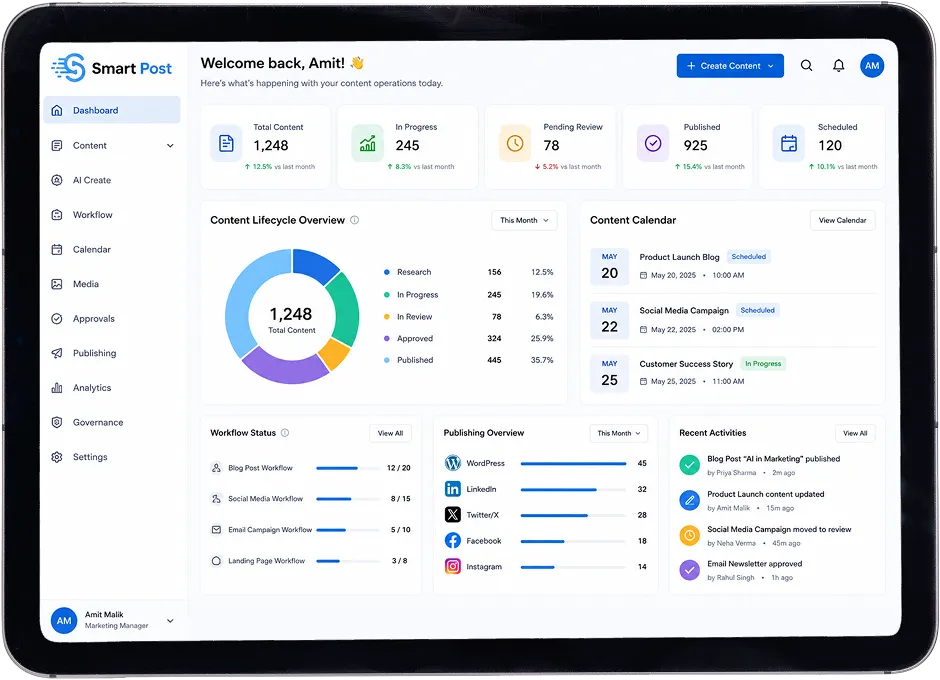
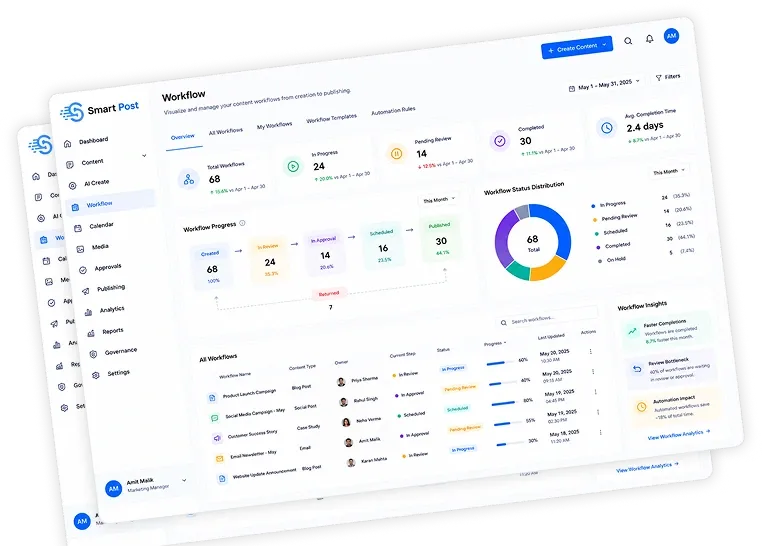
Centralized status tracking, revision logs, and multi-channel scheduling interface replacing five disconnected software tools.
Our Solution
Content Engine AI replaces five disconnected tools with one governed platform. AI surfaces topics and drafts them; the team approves; every asset moves through a single pipeline from idea to published post, no context-switching, no lost drafts, full visibility end to end.

AI topic
discovery engine
Continuously surfaces relevant content opportunities based on audience segments and goals. Teams approve, reject, or regenerate — keeping a live pipeline without any manual sourcing.

Agent-based
orchestration
Continuously surfaces relevant content opportunities based on audience segments and goals. Teams approve, reject, or regenerate — keeping a live pipeline without any manual sourcing.

Governed
content lifecycle
Every asset follows one path — created → reviewed → approved → scheduled → published — with accountability at each stage.

Centralised ops
dashboard
Search, filter, edit, duplicate, schedule, and track from one interface. Replaced five tools and removed 2–3 coordination touchpoints per post
Less Content Ops. More Output.
See How AI Can Help.
Technology Stack
We selected this stack for Content Engine's specific needs, mapping business goals, the existing ecosystem, operational requirements, and future roadmap to a stack that supports fast iteration and sustainable growth.


Delivery Approach
We ran a workflow-first delivery, mapping the operation before writing code, then building and validating AI-native flows with stakeholders in tight loops

Why We Built It This Way: AI-Native (Vibe) Development
Content Engine AI was built with an AI-native, “vibe coding” workflow, our engineers pairing with AI models to move from idea to working software in days, not sprint cycles. For a platform whose whole point is AI-assisted decisions, building it AI-native wasn’t a shortcut. It was the right method, and we shipped it production-grade.

Live In Weeks
You see a working product in weeks, not months, so you can react to something real early and steer the build before costs and decisions harden.

Prove Before Investing
You validate the idea with real users on a lean pilot budget first, committing to a full build only once there's evidence it works, protecting your spend.

Built To Last
You get production-grade software, not a fragile prototype, typed, tested, and monitored code that holds up under real users and keeps performing as you grow.

Yours To Own
You own a documented, maintainable system your team can run and extend without depending on us, full control, no lock-in, no black box handed over.
What We Bring to Every Project
We’re not a no-code tool vendor or an agency that hands off a slide deck. We build production-grade AI platforms end-to-end — and stay with you after launch.
Deep AI capability
We work across OpenAI, Claude, Gemini, and open-source models — selecting and routing intelligently via LLM, not just wrapping a single API.
Full platform builds
From system architecture to deployment on AWS, we build entire products, not integrations. One team owns the whole system.
Quick MVP development
We scope fast, build fast, and ship working software — from AI pilots to production.
Governed AI workflows
Human-in-the-loop approvals, audit trails, and strict role-based controls for enterprise confidence.
Ongoing partnership & scale
We maintain, optimize, and expand capabilities alongside your business growth post-launch.
Are you looking for 100% visibility
across your content lifecycle?
Looking Ahead
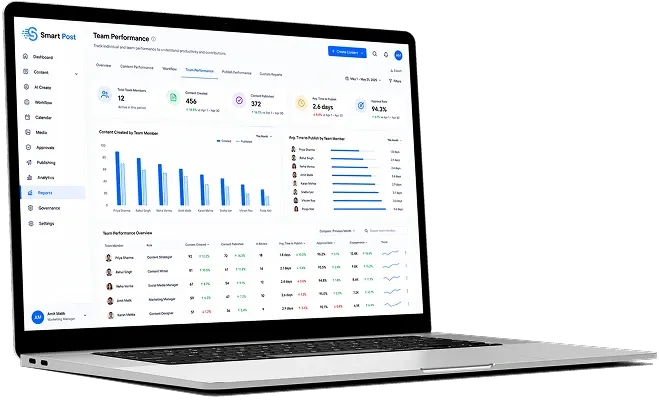
Phase 2 expands Content Engine AI beyond content creation into full campaign intelligence, giving teams the tools to plan, optimise, and measure across channels, not just produce:
- Multi-channel publishing automation

- Content performance analytics
- Campaign planning workflows
- AI-assisted content optimization
- Executive thought leadership programs
Related Capabilities
If Content Engine AI maps to a problem you’re facing, these are the Hidden Brains capabilities behind it — and where to go deeper:
Frequently Asked
Questions (FAQ)
Answers to the most common questions from businesses looking to bring automation, development, or integration to their operations- we've got you covered.
Yes. We design and build custom AI-native platforms tailored to your specific workflows, content operations, and business logic — not generic off-the-shelf wrappers.
Yes. We specialize in consolidating fragmented stacks into single, governed platforms that handle everything from topic research and agent drafting to review, scheduling, and publishing.
Absolutely. We offer phased delivery models starting with rapid MVP prototyping, proof-of-concepts, or pilot modules so you can validate value before scaling.
Initial functional pilots or core MVP releases typically take 4 to 8 weeks depending on integration complexity, followed by iterative feature expansion in ongoing agile sprints.
You retain 100% ownership of your IP, source code, and data. We implement enterprise-grade security protocols, role-based access control (RBAC), and compliance with SOC 2 & GDPR.
Yes. The architecture is cloud-native and horizontally scalable, engineered to process thousands of assets, agent workflows, and API calls seamlessly as operations grow.
No. We build intuitive, non-technical admin interfaces for your operations team, while offering optional ongoing managed maintenance and engineering support.
Got an Idea?
Get FREE Consultation
- 1 Drop your requirement and
our expert will analyze further - 2 Outlining it, we will build roadmap
and connect with you - 3 Further, finalize the approach
and begin implementation


