


Connected Payment Orchestration and Reconciliation for a Middle East Enterprise
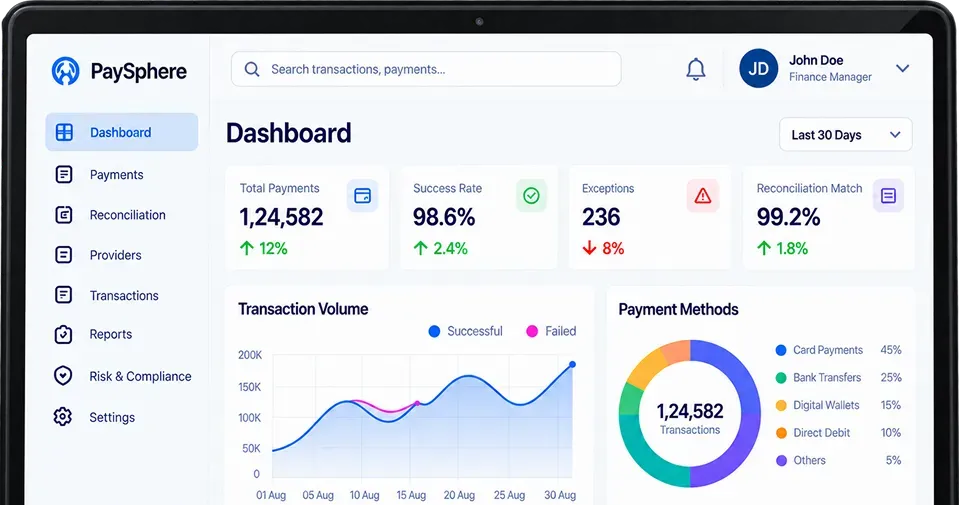
Faster
reconciliation cycles
Reduction in
manual effort
Higher
operational efficiency
Improved visibility and
regulatory compliance
About Project
The client was already processing payments at enterprise scale. The challenge was making the ecosystem easier to operate, reconcile, and modernize without disrupting live transactions.
Hidden Brains introduced a more controlled payment orchestration and reconciliation layer across existing applications, bank integrations, payment methods, and settlement workflows.
Payment Platform Engineering | Reconciliation Automation | Enterprise Integration | Legacy Modernization | Quality Engineering | AI Readiness
The Challenge
Payments moved across multiple banks, channels, settlement feeds, and legacy systems, each with different rules and statuses. Teams spent too much time manually reconciling transactions, investigating mismatches, and tracking exceptions across disconnected systems.

Modernize Payment Operations,
Reduce Reconciliation Effort
The Solution
Modernize around live payment operations, not at their expense. The team introduced new orchestration and reconciliation capabilities alongside existing services, allowing the platform to evolve without interrupting ongoing payment processing.
The Approach
Hidden Brains first mapped the existing payment flows, channels, bank integrations, settlement points, reconciliation rules, and exception-handling processes. From there, the team introduced a more controlled orchestration and reconciliation model without replacing the entire payment ecosystem.
A common orchestration layer was introduced to manage payment instructions more consistently.
-
 Validated incoming payment instructions
 - Applied routing and processing rules
- Connected the right banking or payment service
- Tracked transaction status across the lifecycle
- Standardized orchestration across payment flows
Normalized payment states across disparate core banking systems and settlement feeds.
- Standardized lifecycle events across bank APIs
- Real-time payment tracking for operational teams
- Unified error taxonomy for failed transactions
- Seamless visibility across cross-border settlement channels
Automated matching and reconciliation engine for high-volume transactions.
- Multi-way automated matching rules
- Drastic reduction in manual statement comparison
- Instant mismatch identification and tagging
- Automated daily ledger balance validation
Streamlined exception management for immediate resolution of payment anomalies.
- Categorized error queues based on severity
- Automated retry mechanisms for transient bank failures
- Role-based assignment and escalation protocols
- Comprehensive audit trail for operational overrides
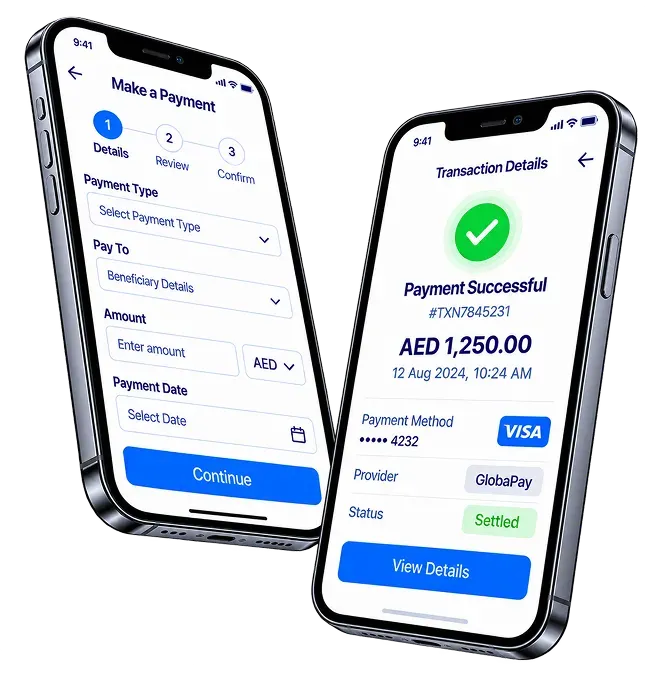
Centralized dashboard providing complete transparency into payment operations.
- Real-time financial status and settlement feeds
- Exportable compliance and regulatory reports
- Granular logs for complete transaction traceability
- Customizable operational metrics and analytics
Phased integration approach safeguarding uninterrupted live operations.
- Seamless coexistence with legacy banking core
- Modular deployment with zero system downtime
- Scalable architecture for future bank integrations
- Minimized operational risk during transition
Why Hidden Brains
The client needed an engineering partner that could work within its existing payment ecosystem, not force a full replacement. Hidden Brains combined architecture, development, integration, QA, automation, modernization, and delivery support through one managed team.

Existing Ecosystem First
Worked around connected applications and payment systems instead of replacing.

Managed Engineering Team
Brought solution architecture, development, QA, and coordination into one delivery model.

Enterprise Integration Expertise
Supported APIs, bank integrations, finance workflows, and legacy payment services.

Modernization Capability
Helped evolve older services progressively while live operations continued.

Quality & Automation Support
Combined manual QA, automation QA, integration testing, and release support.

AI Readiness Path
Explored controlled AI POCs without disrupting platform stabilization.
Payment Orchestration & Reconciliation Architecture
The platform was structured around connected layers so new capabilities could be introduced without replacing live payment systems all at once.
Channels & Payment Intake
Payment channels, enterprise applications, and payment instructions connect through APIs and integration services.
Payment Orchestration
Validation, routing, processing rules, transaction states, and service selection are managed centrally.
Settlement, Reconciliation & Exceptions
Bank and settlement feeds are matched against payment records, with exceptions routed into structured queues.
Operations & Governance
Dashboards, lifecycle visibility, reconciliation history, access controls, and audit traceability support oversight.

Controlled AI Path
AI POCs stay separate from live payment decisioning, with human review built in.
Security & Auditability
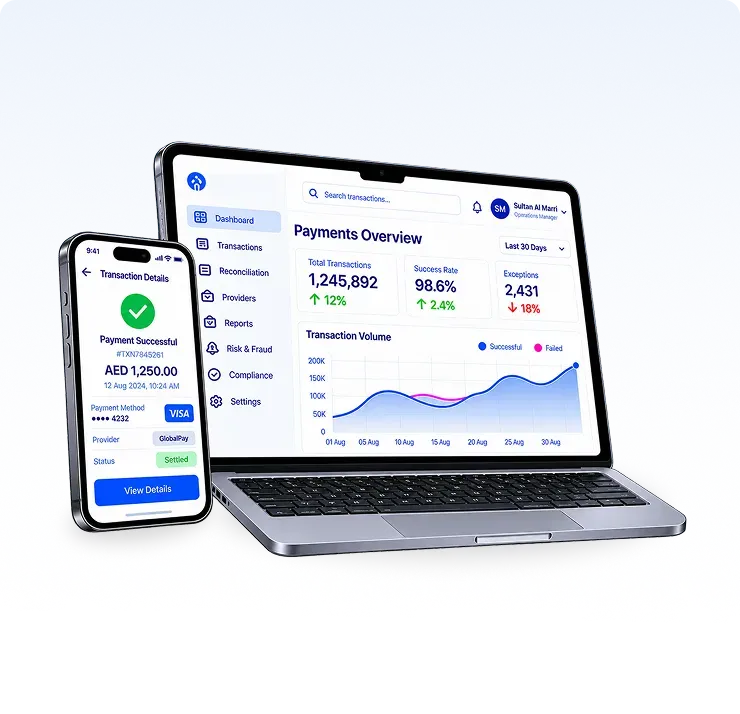
The payment platform had to connect multiple banking, payment, finance, CRM, and legacy systems while maintaining controlled access, traceability, and audit visibility across sensitive financial workflows.
Role-Based Access
Control payment and operational access by defined user roles.
Permission Controls
Restrict actions across connected workflows and systems.
Secure API Access
Protect banking, payment, and enterprise integrations.
Transaction Traceability
Track payment, settlement, and reconciliation activity.
Audit Visibility
Maintain clear records of operational actions and exceptions.
Governed AI Access
Keep AI-assisted workflows controlled and human-reviewed.
Building or Modernizing Payment
Systems for Banks in the Middle East?
Delivery Model
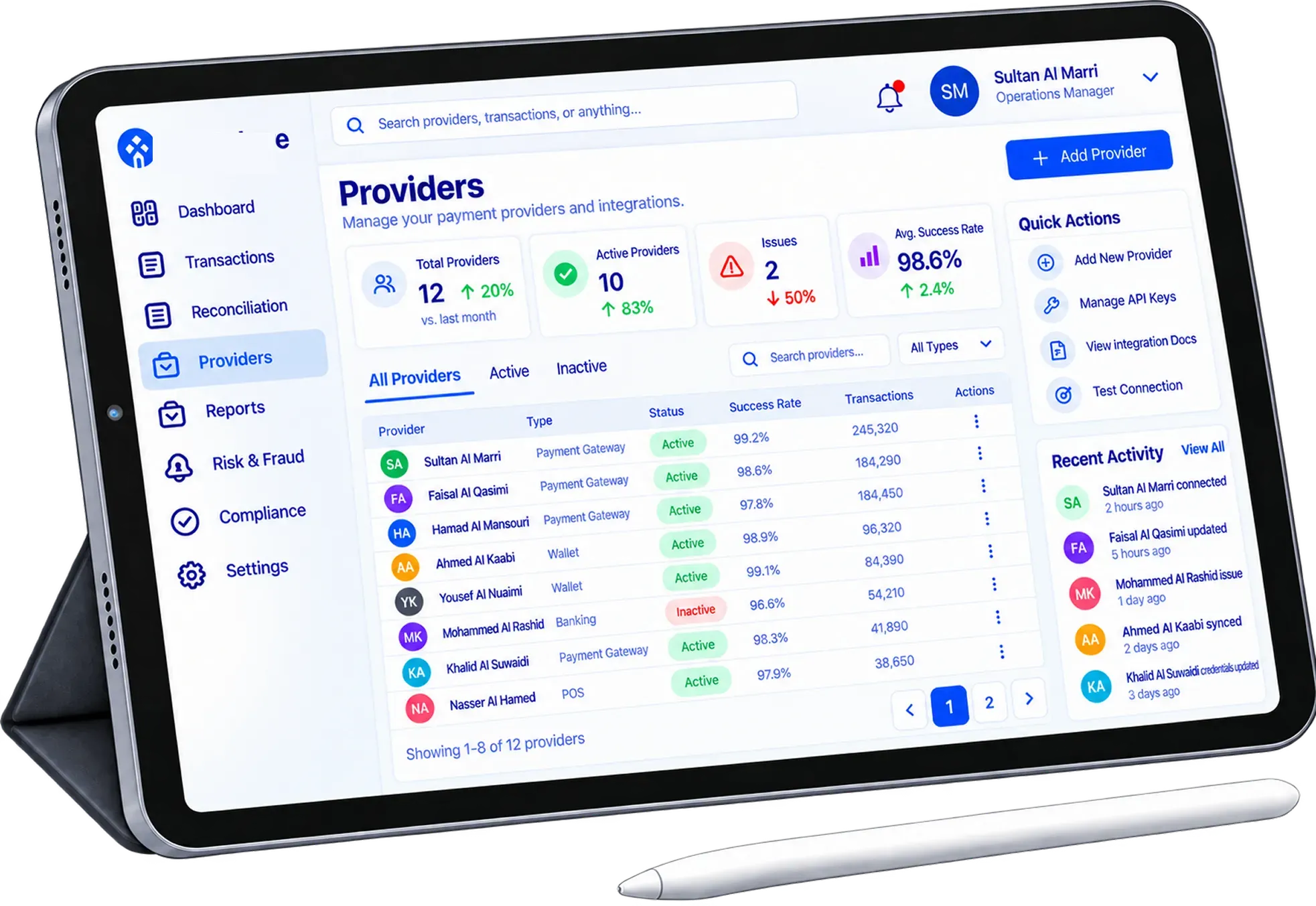
This was a 24+ month managed engineering engagement, not a one-time implementation. Hidden Brains worked alongside the client's internal teams across enhancement, integration, modernization, testing, production support, and ongoing platform evolution.

Client-Led Priorities
Product, payment, and finance priorities remained with the client.

Managed Technical Execution
Hidden Brains handled day-to-day engineering delivery.
Continuous Platform Evolution
Ongoing enhancements and updates delivered without system downtime.
Collaborative Agile Delivery
Joint sprint planning and regular milestone alignment across teams.
Technology Stack
The stack was chosen to work with the hospital's existing systems, not replace them. A microservices core in .NET Core, Node.js, & Spring Boot connected over secured APIs to the systems already running the hospital, with React, Angular, & React Native delivering one consistent experience across web and mobile. Generative & Agentic AI were included only as a controlled, human-reviewed track, kept well clear of core patient transactions.


What Changed for the Business
The engagement helped the client move toward a more controlled, connected payment ecosystem without disrupting live operations. Orchestration, reconciliation, exception handling, reporting, and modernization increasingly became part of one manageable payment lifecycle, while QA and automation supported safer ongoing change. The result was not simply a newer platform, but a stronger operating foundation.


Payment visibility
Transaction status scattered across multiple applications and services
Common lifecycle view across supported payment flows
Reconciliation
Significant manual comparison across payment, bank, and settlement records
Rules-based reconciliation with structured matching workflows
Exception handling
Failed and mismatched transactions investigated across disconnected systems
Centralized exception queues with clearer ownership and follow-up
Transaction states
Different systems interpreted payment status differently
Shared transaction states from initiation through settlement or exception
Operational reporting
Fragmented reporting with limited end-to-end visibility
Centralized payment, settlement, exception, and audit visibility
Engineering effort
Production issues and operational work continually disrupted planned development
More structured operations allowed engineering to focus on platform enhancement
Legacy modernization
Older services were difficult to evolve without operational risk
Progressive modernization through modular services and APIs
Quality assurance
Regression testing required significant repeated manual effort
Reusable test automation reduced regression testing effort by ~35%
What Made the Transformation Work
Payment modernization works best when systems are connected, rules stay configurable, repeatable work is automated, and change happens without disrupting live operations.
Connect and control existing systems before deciding what truly needs replacement.
Keep payment rules, routing logic, and integration configurations flexible as business requirements change.
Eliminate manual reconciliation, exception triage, and routine operational tasks using automated workflows.
Maintain unified payment states across all channels, core backend services, and third-party systems.
Upgrade components incrementally without disrupting live daily transactions or customer experience.
Frequently Asked Questions
By adopting a phased modernization strategy, isolating core transaction paths, and using modular microservices and APIs so legacy operations continue smoothly alongside new capabilities.
By establishing automated data pipelines that aggregate settlement feeds, bank statements, and payment records into centralized rules-based matching engines.
By building secured API layers, middleware connectors, and message queues that bridge legacy databases and mainframes with modern web and cloud services.
By routing mismatched transactions and exceptions into structured, centralized queues with automated status tracking, clear owner assignment, and audit trails.
By leveraging cloud-native microservices architecture, asynchronous event handling, and elastic database scaling designed to handle high peak transaction volumes.
By isolating Generative and Agentic AI into controlled, human-in-the-loop POC tracks kept separate from primary financial settlement and transaction processing.
By implementing end-to-end encryption, role-based access controls, immutable audit logging, and automated compliance checks across all payment channels.
Got an Idea?
Get FREE Consultation
- 1 Drop your requirement and
our expert will analyze further - 2 Outlining it, we will build roadmap
and connect with you - 3 Further, finalize the approach
and begin implementation


