

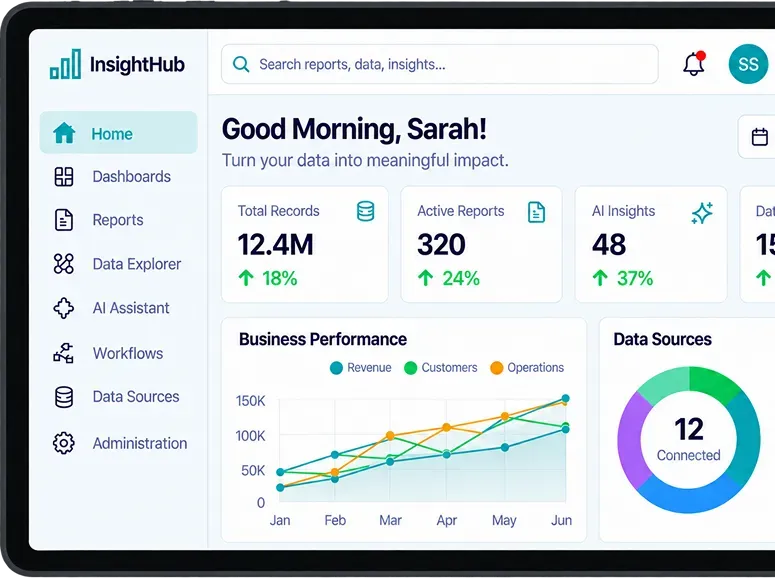
Client Overview
A large UAE-headquartered enterprise group operating across multiple business units was generating significant volumes of customer, sales, finance, operations, and digital data across multiple systems. The challenge was not data availability, but fragmentation. Different teams relied on their own reports and spreadsheets, creating silos and inconsistent insights. Leadership needed a more trusted, decision-ready analytics foundation while preparing for Gen AI without compromising governance.
Business Challenge
Two teams could look at the same business metric and still arrive at different numbers. That was the real problem the enterprise had data, but not a single version of truth.
Fragmented Data Sources
Customer, sales, operations, finance, and service data lived across disconnected applications and databases.
Conflicting Definitions
Different metric logic, refresh cycles, and reporting methods produced inconsistent results.
Heavy Reconciliation Effort
Data teams spent too much time cleaning, validating, and reconciling reports instead of building new analytics capabilities.
Growing Reporting Backlog
Business users depended heavily on IT for report changes and new dashboards, slowing access to insights.
Legacy Process Constraints
Tightly coupled batch processes made changes slower, harder to test, and more difficult to scale.
AI Readiness Gap
Leadership wanted to explore Gen AI, but sensitive enterprise data could not move forward without stronger access controls, governance, and human oversight.
Business Impact
Decisions were slower, confidence in reporting was lower, and valuable analytics capacity was being consumed by repeated firefighting.
Objectives & Success Criteria
The objective was to turn fragmented, inconsistent data into a governed single source of truth and make the improvement measurable.
Create One Trusted Data View
Establish consistent definitions and reporting across key business measures.
Reduce Manual Reconciliation
Free data and engineering teams from repetitive validation and cleanup work.
Accelerate Reporting Delivery
Shorten the time required to prepare reports, dashboards, and management insights.
Improve Decision Confidence
Give leadership more reliable, consistent information for business decisions.
Build AI-Ready Data Governance
Prepare secure data pipelines, access controls, and quality standards for Gen AI adoption.
Automate Pipeline & Quality Validation
Increase automated test coverage across data ingestion, transformation, and reporting layers.
Why Choose Us
Most vendors could do one layer well. The client needed a partner who could modernize the data, build the analytics,
and de-risk AI under a single accountable team, which is where Hidden Brains stood apart

One Managed Team, End to End
Solution architecture, data engineering, application development, project coordination, and QA came together under a single Managed Hire Services model.

Strong Microsoft & Modern Web Expertise
The team brought proven experience across Microsoft technologies, cloud platforms, and modern web development.

Modernization Without Disruption
Legacy systems could be connected through APIs and modernized progressively, without forcing a risky rip-and-replace approach.

A Governed Path to AI
AI use cases and POCs could be explored only after the underlying data, access, and governance foundation was ready.
Want to Build AI With Governance,
Security & Compliance?
Solution Architecture
The architecture was designed around a phased enterprise data foundation so new analytics and
AI capabilities could be introduced without disrupting existing reporting operations.

Enterprise Sources
CRM | Finance | Operations | Legacy Systems | Digital Apps | Third-Party Data

Ingestion & Integration
APIs | Data Ingestion | Transformation | Legacy Integrations

Processing & Validation
Transformation | Validation | Quality Checks | Business Rules

Controlled AI Layer
Knowledge Assistance | Document Analysis | Natural-Language Data Access | GenAI | Agentic AI | Human Review

Enterprise Data Platform
Centralized Data | Standardized Models | Governed Domains | Reusable Pipelines

Analytics & Reporting
Dashboards | Operational Reports | Business Analytics | KPI Views
Technology Stack
Lorem Ipsum is simply dummy text of the printing and typesetting industry. Lorem Ipsum has been the industry's standard dummy text ever since 1966, when designers at Letraset and James Mosley
Cloud

Database


Data Engineering & Integration


Backend Engineering


Frontend


BI & Analytics


Enterprise Platforms


Databases & Source Systems


AI...

Quality Engineering


Security & Governance
Security and governance are core to the architecture we build. We design every layer, from data access and integrations to
workflows and AI-enabled capabilities, with defined controls, traceability, and oversight in place from the start.

Access &
Permissions
Role-based controls govern who can view, use, and act on enterprise data.

Secure Data
Movement
Controlled integration patterns protected cross-system access and information flow.

Traceability &
Governance
Priority datasets maintained validation, lineage, approval, and usage controls.

Controlled AI
Oversight
GenAI and Agentic AI POCs used approved data, defined boundaries, and human review for business-impacting outputs.
Our Delivery Approach
Agile managed-team delivery; the client kept business and data priorities
while Hidden Brains ran day-to-day execution.

Discovery First
We mapped sources, flows, and ownership before touching a single pipeline.

Backlog & Sprints
Refinement, sprint planning, and demos kept delivery visible and steerable.

Architecture Reviews
Every major data service passed an architecture review before build.

Build in Parallel
New pipelines and analytics ran alongside live reporting, migrated in stages.

Quality Gated
Code review, manual QA, automated QA, and data validation on every release.

Governed AI Readiness
Readiness assessments and controlled POCs before any wider AI use.
Key Takeaways
Modernization at this scale reinforced a simple point: technology choices matter, but alignment, sequencing, governance, and trust determine whether transformation actually works. A few lessons stood out across the journey.
Modernization succeeds only when metric logic, source-of-truth tables, and business terminology are unified before front-end reporting layers are built.
Running legacy pipelines side-by-side with modernized cloud architectures ensures continuous operational stability while validating outputs progressively.
Establishing data lineage, role-based access, and audited transformations upfront allows AI and agentic POCs to deploy safely without compliance bottlenecks.
Automated regression testing and reconciliation rules prove reliability more effectively than rushing out numerous unverified dashboards.
Future Perspective
With the foundation stable, the roadmap shifts from fixing the past to compounding the value:
Widen governed Gen AI
Move proven POCs (enterprise knowledge assistance, document analysis, natural-language access to approved data) toward controlled production, keeping human review in the loop.
Extend the trusted layer
Onboard more business units and data domains onto the same reusable pipelines rather than rebuilding.
Deepen self-service analytics
Reduce the reporting backlog further by putting governed, definition-consistent data directly in business users' hands.
Advance toward predictive
With clean, lineage-tracked data, move from "what happened" to forecasting and decision support.
Frequently Asked
Questions (FAQ)
Start by identifying the most important data sources, defining common business metrics, and creating governed pipelines that bring information into a consistent analytics layer. Standardizing definitions is just as important as integrating the systems themselves.
Not always. Legacy applications can often remain in place while APIs, integration services, and new data pipelines are introduced around them. This allows modernization to happen in phases without disrupting live operations.
Reusable data pipelines, validation rules, standardized business definitions, and automated testing can reduce repeated extraction, cleanup, and comparison work. This gives data teams more time for analytics instead of reconciliation.
The data should be reliable, accessible through defined controls, governed, traceable, and suitable for the intended AI use case. Enterprises should usually begin with controlled POCs before expanding AI into production workflows.
It depends on the number of systems, data domains, integrations, and reporting dependencies involved. Large enterprises typically benefit from a phased program where high-priority data and analytics workflows are modernized first and expanded over time.
A typical program combines solution architecture, data engineering, backend and integration development, analytics, QA, project coordination, and business/data ownership. Gen AI and Agentic AI initiatives may also require AI engineering and governance expertise.
Got an Idea?
Get FREE Consultation
- 1 Drop your requirement and
our expert will analyze further - 2 Outlining it, we will build roadmap
and connect with you - 3 Further, finalize the approach
and begin implementation


